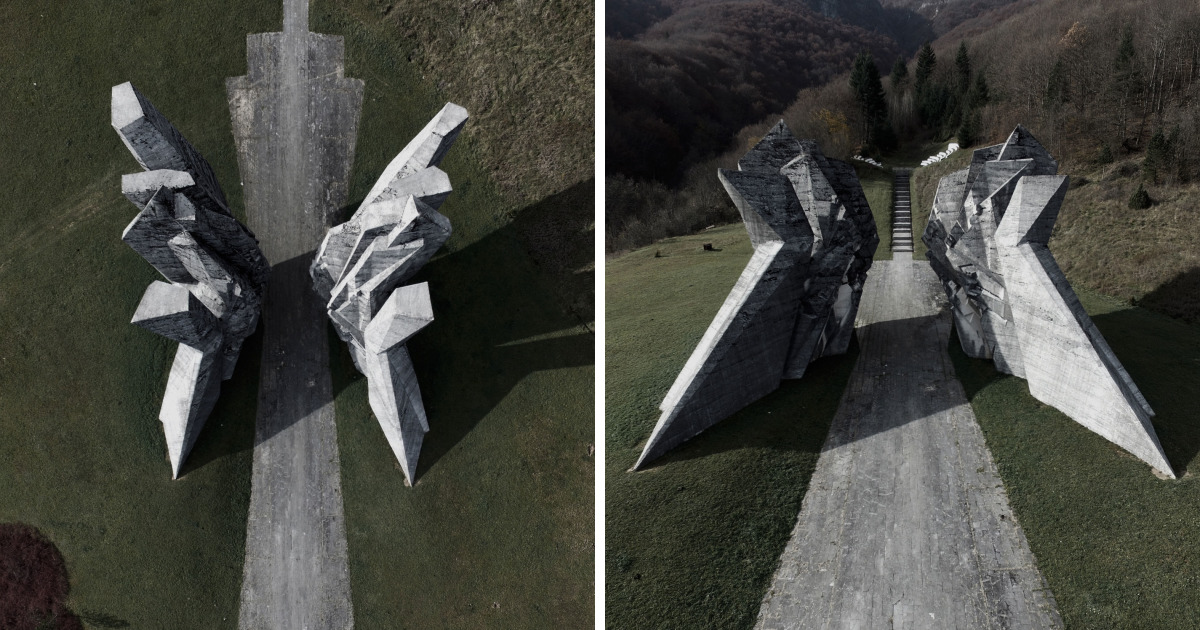
Some travel projects begin with a suitcase, a map, and a dangerously optimistic snack budget. Others begin with a drone, a strange concrete monument on a lonely hill, and the feeling that you have just found a sleeping giant. “The Guardians Of The Balcans” belongs firmly in the second category.
The project was inspired by a journey through the Balkan region, where travelers Lena and Alex, known through the Perito Burrito travel project, photographed and filmed abandoned World War II monuments from the air. These monuments, scattered across Bosnia and Herzegovina, Croatia, Serbia, Montenegro, and nearby post-Yugoslav landscapes, are often called spomeniks. The word simply means “monuments” in several South Slavic languages, but online it has become shorthand for some of the most dramatic, futuristic, and emotionally complicated memorial structures in Europe.
Calling them “guardians” feels almost too perfect. They stand on ridges, in forests, above villages, inside national parks, and beside roads where most tourists are too busy checking their GPS to notice history staring back at them. They look like spacecraft, flowers, wings, shields, bones, antennas, and occasionally something your printer might produce after reading philosophy at 3 a.m. But behind the unusual shapes are real stories: anti-fascist resistance, civilian suffering, collective memory, and a former country’s attempt to build unity out of trauma.
What Is “The Guardians Of The Balcans”?
“The Guardians Of The Balcans” is a digital storytelling project centered on abandoned and semi-forgotten Balkan World War II monuments. The creators used aerial photography and quadcopter footage to capture the monuments from perspectives that ordinary ground-level travel rarely provides. From above, these structures stop looking like isolated concrete oddities and start looking like symbols intentionally placed in conversation with mountains, valleys, villages, and battlefields.
The project was not a standard travel diary. It was closer to a visual memorial essay: part documentary, part digital exhibition, part emotional postcard from places many people have never heard of. The creators timed the project around May 8, a date associated with the end of World War II in Europe, giving the work a commemorative frame rather than treating the sites as mere “cool abandoned places.”
That distinction matters. The internet loves ruins. Give the web a crumbling structure and a foggy sky, and suddenly everyone becomes an architectural critic wearing imaginary hiking boots. But the best digital heritage projects do more than collect dramatic images. They ask what these places meant, what they mean now, and what happens when memory becomes beautiful, strange, inconvenient, and hard to maintain.
Why Balkan WWII Monuments Look So Unusual
To understand the power of this digital project, we need to understand the monuments themselves. Many of the most famous Yugoslav-era World War II memorials were built between the 1950s and the 1980s, especially during the socialist period of Yugoslavia. They honored Partisan fighters, civilian victims, major battles, resistance movements, and sites of mass suffering during the war.
Unlike traditional statues of generals on horses, many Yugoslav memorials used abstract modernist forms. Instead of showing one heroic figure, they often used geometry, scale, and landscape to create emotion. A visitor might walk through concrete wings, climb into a circular memorial space, or stand beneath sharp sculptural forms that seem to burst out of the earth. The message was rarely simple. It was grief, victory, warning, and national myth all poured into concrete.
These monuments also reflected Yugoslavia’s unusual position during the Cold War. The country was socialist but not part of the Soviet bloc in the same way as many Eastern European states. It developed its own architectural language, one that borrowed from modernism while trying to express a multiethnic idea of unity. The result was a memorial landscape that still feels startling today: futuristic, solemn, and sometimes almost impossible to categorize.
The Meaning Behind The “Guardians” Metaphor
The title “The Guardians Of The Balcans” works because these monuments really do feel like watchers. They are not just objects; they are presences. Some sit above empty fields. Some face forests. Some overlook villages that have changed governments, flags, and borders since the monuments were built. They have outlived the political system that created them, which makes their silence even louder.
In one sense, they guard memory. They remind visitors that World War II in the Balkans was not an abstract chapter in a textbook but a deeply local catastrophe shaped by occupation, resistance, civil conflict, and loss. In another sense, they guard questions. What should a society preserve when political meanings change? Can a monument built by a vanished state still belong to the people who live near it? Is abandonment always neglect, or can it also be a sign that a site has slipped into a more complicated emotional category?
A good digital project does not pretend to solve all of this before lunch. It opens the door, turns on the light, and lets people step inside.
Digital Storytelling Turns Remote Places Into Shared Memory
Many Balkan memorial sites are not easy to visit. Some are far from major tourist routes. Some require a car, patience, and the ability to remain calm when the road starts acting like it was designed by a goat with strong opinions. Digital storytelling makes these places visible to a global audience without requiring every viewer to become an expedition leader.
Aerial footage is especially powerful because many spomeniks were designed with landscape in mind. From ground level, a monument may seem like a massive object. From above, it becomes part of a pattern: a memorial axis, a hilltop marker, a sculptural response to terrain, or a concrete signal placed between earth and sky.
This is where “The Guardians Of The Balcans” succeeds as more than a travel photo set. It uses digital media to restore scale. Viewers can see the loneliness of the sites, the drama of their placement, and the contrast between monumental ambition and present-day quiet. The drone does not just make the shots prettier; it changes the argument. It says, “Look at how these monuments were meant to command space.”
Why These Monuments Became Internet Icons
Over the past decade, Balkan WWII monuments have gained enormous attention online. Their unusual shapes are tailor-made for digital culture. They photograph beautifully, they look mysterious, and they trigger the internet’s favorite question: “Wait, what am I looking at?”
But viral popularity has a downside. Images of spomeniks are often shared without context, reduced to “alien communist monuments” or “abandoned brutalist ruins.” Those descriptions are catchy, but they are also lazy. Calling every dramatic concrete memorial “alien” may get clicks, but it does not explain the people, artists, communities, and histories behind the sites. Besides, if aliens had built them, they probably would have left better parking.
The better approach is to balance visual wonder with historical care. Yes, these monuments look extraordinary. Yes, some are neglected. Yes, they are fantastic subjects for photography, architecture writing, and cultural tourism. But they are also memorials connected to painful histories. Digital projects should invite awe without turning remembrance into decoration.
The Role Of Preservation In Digital Heritage Projects
Digital documentation is not the same as physical preservation, but it can support it. When a project captures photographs, video, location data, written context, oral histories, and archival references, it creates a record that can help researchers, educators, travelers, and local communities. A monument may weather, crack, or be vandalized, but a careful digital record can preserve how it looked at a particular moment in time.
Cultural heritage organizations increasingly emphasize documentation as a foundation for conservation decisions. Recording a site helps people understand what exists, what condition it is in, and what kinds of intervention might be needed. In the case of remote Balkan memorials, even basic visibility can matter. A site that appears in a thoughtful digital project may gain new attention from historians, architects, tourism boards, or local advocates.
Still, digital preservation has limits. A website cannot repair concrete. A drone video cannot replace local stewardship. A beautiful photo cannot explain every historical layer. The strongest projects are honest about this. They do not claim that posting images online “saves” heritage. Instead, they help create public interest, provide accessible documentation, and encourage people to treat the real places with respect.
What Makes This Project SEO-Worthy And Human-Worthy
From an SEO perspective, “The Guardians Of The Balcans” naturally connects with several strong search themes: Balkan monuments, spomenik photography, Yugoslav architecture, digital heritage, WWII memorials, abandoned monuments, and cultural travel. But the real strength of the topic is not keyword volume. It is emotional curiosity.
People click because the monuments look strange. They stay because the story becomes deeper than expected. That is the sweet spot for high-quality web content: a visual hook, a meaningful topic, and enough context to make readers feel smarter without making them feel like they have accidentally enrolled in a graduate seminar.
The article also works well for search because it answers multiple user intents. A traveler may want to know where these monuments are. A design fan may want to understand the architecture. A history reader may want to know why they were built. A digital creator may want to learn how a heritage project can be presented online. By covering all these angles naturally, the content becomes useful for both Google and Bing without stuffing the page like a suitcase before a budget airline flight.
Examples Of Monument Sites That Fit The Project’s Spirit
While the project itself focused on a selection of Balkan monuments captured during travel, several well-known sites represent the same visual and historical world. The Sutjeska memorial complex at Tjentište in Bosnia and Herzegovina, designed by Miodrag Živković, is one of the most iconic examples. Its massive concrete forms rise like split cliffs, honoring the Battle of Sutjeska and the Partisan struggle.
The Monument to the Revolution of the People of Moslavina in Podgarić, Croatia, designed by Dušan Džamonja, is another frequently photographed structure. Its wing-like form seems to hover between machine and bird, which explains why it travels so well across the internet. Then there is the Petrova Gora memorial complex, whose weathered condition has become a symbol of both modernist ambition and post-Yugoslav neglect.
These examples show why drone-based digital storytelling is so effective. These are not small plaques politely asking for attention. They are landscape-scale works. To see them properly, the viewer needs distance, movement, and context. A digital project can provide all three.
The Ethical Side Of Photographing Abandoned Memorials
Photographing abandoned or neglected memorials requires care. It is easy to make ruins look romantic, especially when the sky cooperates and the grass grows at exactly the right level of poetic sadness. But memorials are not movie sets. They are connected to real communities and histories of loss.
Ethical heritage storytelling should avoid trespassing, damaging sites, removing objects, or presenting sacred or commemorative spaces as playgrounds. It should also avoid flattening local history into a single dramatic caption. The Balkans are culturally, politically, and historically complex. A responsible digital project should respect that complexity instead of turning the region into a backdrop for “mysterious ruins.”
“The Guardians Of The Balcans” works best when understood as an invitation: not the final word on these monuments, but a doorway into learning more. It reminds viewers that history is not always preserved in polished museums. Sometimes it stands on a windy hill, covered in moss, waiting for someone to ask the right question.
Lessons For Anyone Creating A Digital Heritage Project
1. Start With A Clear Story, Not Just Beautiful Footage
Stunning visuals attract attention, but story gives them meaning. A project about Balkan monuments should explain why the sites exist, what they commemorate, and why their current condition matters.
2. Use Technology As A Bridge
Drones, interactive maps, 3D models, virtual exhibitions, and digital archives are tools. They should help people understand heritage, not distract from it. The best technology disappears into the experience, like a good tour guide who knows when to stop talking and let the mountain do the dramatic work.
3. Respect Local Context
The same monument may mean different things to different communities. Some people see pride. Some see ideology. Some see family memory. Some see neglect. Digital storytelling should leave room for more than one emotional response.
4. Preserve Metadata
A digital archive is stronger when it includes dates, locations, creator information, historical notes, image rights, file formats, and preservation copies. Future researchers will thank you. They may not send flowers, but spiritually, flowers will be implied.
5. Make The Work Accessible
Good digital heritage should be easy to explore. Use clear headings, readable captions, searchable text, alt text for images, mobile-friendly layouts, and plain language. If visitors need a PhD and three browser extensions to understand the project, something has gone wrong.
Why “The Guardians Of The Balcans” Still Matters
The project matters because it captures a fragile cultural moment. Many Yugoslav-era memorials occupy an uncertain space. They are historically significant, visually powerful, and politically complicated. Some are maintained and visited. Others are damaged, forgotten, or misunderstood. A digital project cannot settle every debate, but it can keep the conversation alive.
It also shows how independent creators can contribute to cultural memory. You do not always need a giant institution to begin meaningful documentation. Sometimes two travelers, a drone, a strong idea, and a stubborn willingness to climb hills can produce work that sends thousands of people searching for the history behind a photograph.
That is the quiet magic of digital storytelling. It can turn an isolated monument into a shared encounter. It can transform “What is that weird concrete thing?” into “What happened here, who built this, and why did we forget to remember?”
Personal Experience: What It Feels Like To Build A Project Like This
Creating a digital project like “The Guardians Of The Balcans” feels less like making a normal travel feature and more like following a trail of stone breadcrumbs through history. At first, the monuments impress you because they are visually unreal. You arrive expecting architecture and get atmosphere. The wind is louder than expected. The scale is bigger than the photos promised. The concrete has stains, cracks, graffiti, and small signs of time doing what time does best: acting casual while eating everything.
Then the mood changes. You stop thinking only about composition, camera angles, and whether the drone battery is about to betray you. You begin wondering who came here when the memorial was new. School groups? Veterans? Families? Local officials giving speeches into microphones that probably squealed at the worst possible moment? You imagine crowds where there is now silence, ceremonies where there is now grass, and a shared national story where there are now several different countries with different memories.
The most challenging part is balance. If the images are too dramatic, the project can look like ruin tourism. If the writing is too academic, readers may flee as if chased by a footnote. The goal is to create a middle path: visually engaging, historically grounded, emotionally honest, and still readable by someone scrolling on a phone while pretending not to be at work.
Fieldwork also teaches practical humility. Remote monuments do not care about your production schedule. Weather changes. Roads become suspicious. Mobile signal disappears exactly when you need it. A site that looked easy on the map may require a hike, a local conversation, or a long pause in which everyone silently agrees that “just five more minutes” was a lie. But these obstacles become part of the story. They remind you that heritage is physical. It has distance, texture, temperature, and inconvenience.
Back at the editing stage, the emotional work continues. Choosing images is not just about beauty. It is about tone. A wide aerial shot may show loneliness. A close detail may show decay. A slow video movement may suggest reverence. Captions must be accurate without becoming stiff. The project title must invite curiosity without cheapening the subject. Even the order of the images matters, because viewers are not just looking; they are traveling through an argument.
The biggest lesson is that digital heritage projects are not really about the past alone. They are about the relationship between past and present. These monuments were built to remember World War II, but today they also tell us about Yugoslavia, modernism, political change, regional identity, tourism, neglect, and the strange afterlife of architecture on the internet. A project like “The Guardians Of The Balcans” gives those layers a new platform.
In the end, the experience is humbling. You leave with better photos, yes, but also with better questions. The monuments do not explain themselves easily. They stand there like patient guardians, refusing to become simple. And maybe that is exactly why they deserve digital attention: not because they are easy to understand, but because they are worth trying to understand.
Conclusion
“We Did A Digital Project Called ‘The Guardians Of The Balcans’” is more than a catchy title attached to spectacular drone footage. It is a reminder that the Balkans hold one of Europe’s most fascinating memorial landscapes, and that digital storytelling can help reconnect global audiences with places that are too often misunderstood, mislabeled, or ignored.
These monuments are not just abandoned concrete forms. They are historical witnesses, architectural experiments, political artifacts, and emotional landmarks. By presenting them through photography, aerial video, and thoughtful context, a digital project can help them speak againnot loudly, not simply, but powerfully enough for modern viewers to stop scrolling and start asking questions.