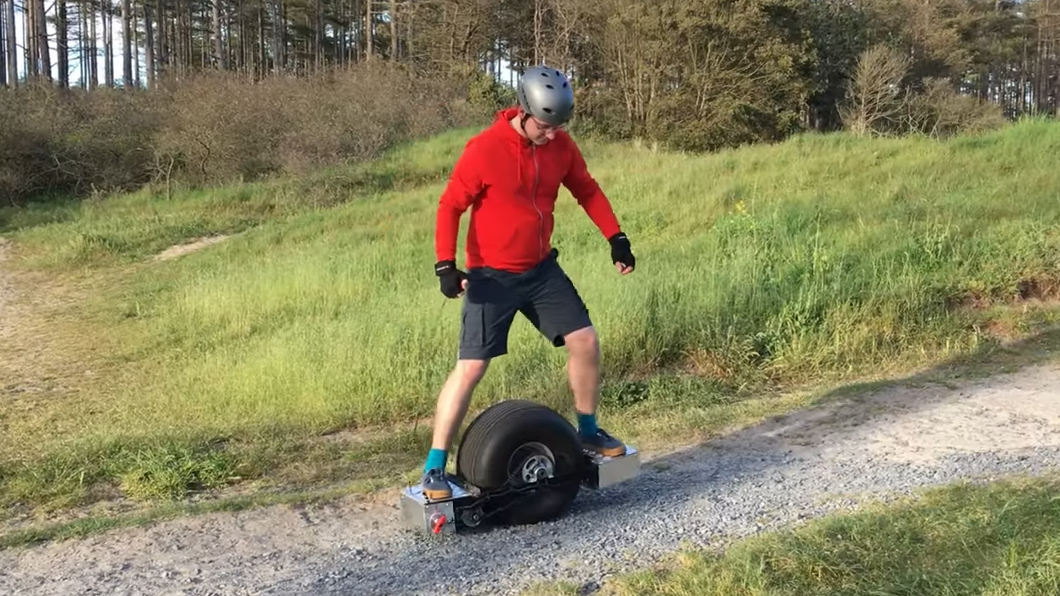
Some inventions whisper, “I am the future.” Others roll onto a beach on one gigantic tire and say, “Hold my battery pack.” The Mega-Wheelie belongs firmly in the second category. It is a huge, self-balancing, one-wheeled electric skateboard designed to test a wonderfully odd question: what happens when you take the basic idea of a single-wheel board and make the wheel much, much bigger?
The answer is part engineering experiment, part off-road toy, and part garage-built micromobility fever dream. Created by longtime electric-vehicle tinkerers John Dingley and Nick Thatcher, the Mega-Wheelie looks like a distant cousin of a Onewheel that spent a summer lifting weights and eating torque for breakfast. Instead of using four skateboard wheels, or even two scooter wheels, it places the rider on platforms around one massive pneumatic tire. Lean forward to move, lean back to slow, shift your weight to steer, and try not to grin like someone who just discovered gravity has a playful side.
But beneath the strange silhouette is a serious lesson about electric personal transportation. The Mega-Wheelie shows how batteries, microcontrollers, inertial sensors, and clever mechanical design have made it possible for hobbyists to build vehicles that once felt like science fiction. It also shows why big-wheel electric boards remain both exciting and intimidating: they promise smooth travel over rough ground, but they demand balance, respect, and a healthy awareness that pavement is not made of marshmallows.
What Is the Mega-Wheelie?
The Mega-Wheelie is a DIY, self-balancing, one-wheeled electric skateboard built as an experiment in riding across terrain that smaller wheels often dislike, especially uneven beaches, gravel, and dry sand. If a regular electric skateboard is a commuter in sneakers, the Mega-Wheelie is that same commuter wearing hiking boots and a helmet with questionable confidence.
The vehicle uses a large central wheel with standing platforms on either side. The rider stands sideways, similar to a skateboard or snowboard stance. Instead of steering with handlebars, the rider controls movement by shifting body weight. Leaning forward tells the board to accelerate. Leaning backward tells it to slow down. Side-to-side balance and subtle foot pressure help guide the direction.
The “magic” is not actually magic, although it certainly looks that way when the board stays upright under a human. The self-balancing behavior comes from a control system that constantly checks the board’s angle and adjusts the motor to keep the rider from tipping forward or backward. This is the same broad idea behind many balancing robots, electric unicycles, and single-wheel boards: sensors detect motion, software interprets it, and the motor responds quickly enough to make the machine feel almost alive.
The Hardware That Makes This Giant Wheel Behave
The Mega-Wheelie is especially interesting because its hardware list reads like a greatest-hits album for DIY electric vehicle builders. It includes a 24V LiFePO4 battery pack, a 450-watt gearmotor, a chain-and-sprocket drive, a SyRen motor controller, an Arduino microcontroller, and an inertial measurement unit, usually called an IMU. Each part plays a specific role in helping the machine move, balance, and respond to the rider.
The Battery: Power Without the Drama
The 24V LiFePO4 battery pack supplies the electrical energy. LiFePO4, short for lithium iron phosphate, is often appreciated in electric mobility projects because it is durable and generally regarded as a stable lithium battery chemistry. In a vehicle like the Mega-Wheelie, the battery has to deliver enough current to push a heavy wheel, rider, and drivetrain without turning the experience into a low-budget suspense film.
The Motor and Drive System: Torque Is the Star
A 450-watt gearmotor drives the wheel through a chain and sprocket. That choice matters because the Mega-Wheelie is not trying to win a drag race against a sports car. It needs usable torque, especially at low speeds and on challenging surfaces. Sand, dirt, and bumps ask more from a motor than smooth asphalt. The chain-and-sprocket setup helps translate motor output into the kind of slow, controlled push that a large wheel needs.
The Controller: The Board’s Electric Traffic Cop
The SyRen motor controller sits between the brain and the motor. It takes control signals and turns them into motor behavior. When the board needs to accelerate, brake, or correct its balance, the controller helps deliver the right response. For self-balancing vehicles, smooth and timely motor control is not a luxury; it is the difference between a futuristic ride and an awkward meeting with the ground.
The Arduino and IMU: Tiny Brain, Big Responsibility
The Arduino microcontroller and IMU are responsible for the balancing act. The IMU measures tilt and motion. The Arduino reads that data, runs the balancing logic, and sends commands to the motor controller. This relationship is what makes the Mega-Wheelie feel more like a responsive vehicle than a wheel with footrests.
In simple terms, the system is constantly asking: “Is the rider tipping forward? Is the board leaning too far back? How fast should the motor respond?” It asks those questions many times per second. The rider experiences the result as a board that tries to stay underneath them. That is impressive, slightly eerie, and exactly the kind of thing that makes engineers smile.
Why Use One Huge Wheel?
The giant wheel is not just there for comic-book energy. A larger pneumatic tire can roll over obstacles more easily than small skateboard wheels. Pebbles, cracks, packed dirt, and uneven sand are less dramatic when the wheel has more diameter and cushioning. This is one reason mountain bikes use large tires and why tiny suitcase wheels seem personally offended by every sidewalk crack.
For the Mega-Wheelie, the big wheel is the key to its off-road personality. Smaller electric skateboards can be fun and fast on pavement, but rough surfaces quickly expose their limits. A single large tire gives the board more ability to float over imperfections, which is especially useful on beaches where the ground changes from firm to soft without sending a polite warning email.
However, the large wheel also creates design problems. It takes up space that could otherwise be used for batteries or electronics. It raises questions about ground clearance and rider height. A platform that is too high can feel unstable, while one that is too low can scrape or limit terrain capability. The Mega-Wheelie has to balance those competing needs: big tire, low stance, enough clearance, and enough room for the hardware. Engineering is often less about finding a perfect answer and more about choosing the least annoying compromise.
Mega-Wheelie vs. Onewheel: Same Family, Different Personality
The easiest comparison is with Onewheel, the commercial self-balancing electric skateboard built around one central tire. Onewheel boards are polished consumer products with refined electronics, compact design, integrated batteries, mobile app features, and a strong rider community. They are designed for everyday riders who want a snowboard-like carving experience on pavement, trails, and neighborhood routes.
The Mega-Wheelie is different. It is a maker-built experiment, not a mass-market product. It looks more raw, more oversized, and more focused on testing what a bigger tire can do. Where a Onewheel aims for a finished product experience, the Mega-Wheelie feels like a working prototype that rolled straight out of a workshop and onto the beach.
That is not a criticism. In fact, it is the charm. DIY vehicles often reveal the thinking behind the machine. You can see the priorities: the large wheel for rough terrain, the chain drive for torque, the handheld dead man’s switch for safety, and the exposed experimental personality of the build. It is less “available in three colors” and more “please admire this glorious engineering beast from a respectful distance.”
Safety: The Part Nobody Should Skip
Self-balancing one-wheeled vehicles are thrilling, but they are not casual toys. They can accelerate quickly, stop abruptly, and respond differently depending on rider weight, terrain, battery condition, tire pressure, and software behavior. The Mega-Wheelie includes a handheld dead man’s switch, meaning the vehicle can shut off if the rider lets go. That is a sensible feature, especially for an experimental machine.
Still, any one-wheeled electric board deserves caution. Protective gear matters. Smooth practice areas matter. Speed discipline matters. It is also important to understand that balancing vehicles can fail in ways that feel sudden to the rider. A loss of traction, a hidden bump, an overconfident lean, or a power limitation can quickly turn a stylish glide into an unscheduled physics lesson.
That safety reality does not make the Mega-Wheelie less fascinating. It makes it more important to discuss honestly. The future of personal electric vehicles should not be judged only by how cool they look in videos. It should also be judged by how predictable, repairable, visible, and rider-friendly they can become.
Why the Mega-Wheelie Matters for Micromobility
Micromobility has grown far beyond simple kick scooters. Cities now see electric bikes, scooters, skateboards, unicycles, and compact personal transporters as part of the short-trip transportation puzzle. The Mega-Wheelie is not likely to replace buses, bikes, or walking shoes, but it belongs in the broader conversation because it explores a core micromobility challenge: how can small electric vehicles handle imperfect real-world surfaces?
Most urban trips are not made on laboratory pavement. Riders encounter broken sidewalks, curb cuts, gravel patches, puddles, street debris, and mystery bumps that seem to appear only when confidence is at its highest. A larger wheel can improve comfort and control on rougher ground. That does not automatically make a huge one-wheeled board practical for everyone, but it does highlight why tire size, suspension, software tuning, and safety systems matter so much.
The Mega-Wheelie also shows the value of hobbyist experimentation. Big companies often refine products after the basic concept has been proven. Makers, meanwhile, are willing to test strange ideas early. Sometimes those strange ideas stay strange. Sometimes they influence the next generation of practical designs. The Mega-Wheelie might not be parked outside every coffee shop next year, but its design questions are very relevant: Can one large wheel outperform several small ones off-road? How low should the rider stand? What level of motor power feels safe but capable? How should a balancing vehicle fail gracefully?
The Joy of Weird Engineering
One reason the Mega-Wheelie attracts attention is that it feels refreshingly physical. In a world full of invisible software and sealed gadgets, this machine is easy to understand at first glance. Big wheel. Foot platforms. Battery. Motor. Chain. Human balancing on top, trying to look brave. It has the honesty of a garage invention.
That visible engineering makes it fun to analyze. You can imagine the design meetings, even if those meetings happened beside a workbench with tools everywhere. “What if the wheel were bigger?” “What if we tried it on sand?” “What if steering were mostly body weight?” “What if the handheld controller only acted as a safety switch?” These are the kinds of questions that move personal electric vehicles forward.
It is also a reminder that innovation does not always arrive wearing a glossy product-launch outfit. Sometimes it arrives with exposed components, a test video, and a name like Mega-Wheelie. Frankly, more inventions should sound like they were named by someone having fun.
Design Lessons from the Mega-Wheelie
1. Bigger Wheels Can Unlock New Terrain
The most obvious lesson is that wheel size changes everything. A large pneumatic tire can smooth out rough surfaces, reduce the impact of small obstacles, and make off-road riding more realistic. That is why the Mega-Wheelie’s beach testing is so meaningful. Sand is difficult because it shifts, grabs, and varies constantly. If a one-wheeled board can behave reasonably there, it has passed a serious character test.
2. Low Center of Gravity Is Critical
A self-balancing board needs the rider to feel stable. The higher the platform, the more dramatic small side-to-side movements can feel. The Mega-Wheelie’s design challenge is to keep the rider low while still allowing enough wheel clearance. This is one of the most important trade-offs in big-wheel personal transport.
3. Control Systems Make or Break the Ride
The mechanical design matters, but software and sensing are equally important. The IMU, Arduino, and motor controller must work together smoothly. If the board reacts too slowly, the rider feels unsafe. If it reacts too aggressively, the ride can feel twitchy. Good self-balancing design is not just about power; it is about trust.
4. Safety Features Should Be Built In Early
The dead man’s switch is a smart reminder that experimental vehicles need safety thinking from the start. It is much easier to design safety into a machine than to bolt it on later like an apology. For any electric personal vehicle, designers should consider what happens when the rider falls, lets go, loses balance, or enters terrain the machine cannot handle.
Real-World Riding Experience: What a Huge One-Wheeled Board Feels Like
Imagine stepping onto a board that does not sit flat like a skateboard and does not offer handlebars like a scooter. Your feet are on either side of a large tire, your body is sideways, and the machine is quietly waiting for your weight shift. The first sensation would likely be hesitation. Your brain knows the board is supposed to balance itself, but your knees may still file a formal complaint.
Once moving, the feeling would probably be closer to carving than rolling. A one-wheeled electric skateboard does not turn like a bicycle or a regular skateboard. It asks the rider to communicate through lean, pressure, and patience. Small movements matter. Overdo it, and the machine reminds you that physics has excellent customer service and a strict return policy.
On pavement, a big wheel could feel stable and cushioned, though not as nimble as a smaller commercial board. On gravel, the tire would likely become the star, absorbing roughness that would rattle a normal skateboard. On packed sand, the Mega-Wheelie’s wide contact patch and torque would make the ride more plausible than a small-wheel design. On soft sand, however, even a big wheel has limits. There is a reason walking across dry beach sand makes calves question your life choices.
The experience would also be deeply sensory. You would hear the motor working, feel the tire compressing over uneven ground, and notice the board making constant micro-corrections beneath your feet. Unlike a car, which hides motion behind seats and suspension, a board like this lets the rider feel almost everything. That is part of the thrill and part of the challenge.
There is also a psychological experience to consider. Riding a one-wheeled vehicle requires trust. You trust the sensors to read correctly, the controller to respond instantly, the battery to deliver power, the motor to keep up, and the tire to grip. That trust builds slowly. The first few minutes are likely cautious. After a while, if the board behaves predictably, the rider starts to relax. That is when the fun appears: gentle carving, controlled acceleration, and the strange satisfaction of moving on one huge wheel like a low-altitude land UFO.
The Mega-Wheelie also teaches humility. It may look simple because there is only one wheel, but that simplicity is deceptive. A four-wheeled skateboard can coast even if the rider is not perfectly centered. A self-balancing one-wheeler is always negotiating. It is a conversation between rider and machine. The rider says, “Go.” The board says, “How much?” The terrain says, “Let’s make this interesting.”
For beginners, the most relatable comparison is probably learning to snowboard or surf. At first, the stance feels odd, the balance point is mysterious, and every correction seems late. Then the body begins to understand. The rider stops fighting the machine and starts flowing with it. That is the moment when a device like the Mega-Wheelie becomes more than a gadget. It becomes a movement experience.
From an everyday perspective, the Mega-Wheelie would not be the easiest commuter vehicle. It is large, experimental, and probably not something you casually carry into a grocery store unless you enjoy answering the same question 47 times. But as a test platform, it is fantastic. It explores how large tires, electric torque, and self-balancing control can work together. It is the kind of project that makes people rethink what a “skateboard” can be.
The best part is the personality. Many modern gadgets feel optimized until all the weirdness has been sanded away. The Mega-Wheelie keeps the weirdness proudly intact. It is bold, awkward, clever, and memorable. It reminds us that transportation innovation does not have to be boring. Sometimes progress looks like a giant tire with footpads, rolling across a beach while everyone nearby silently wonders who gets to try it next.
Conclusion: A Big Wheel With an Even Bigger Idea
The Mega-Wheelie is more than a huge one-wheeled electric skateboard. It is a rolling argument for experimentation. It proves that personal electric vehicles still have room for wild ideas, especially when makers are willing to challenge the usual shape of a skateboard, scooter, or unicycle.
Its oversized tire points toward better rough-terrain capability. Its self-balancing electronics show how accessible control systems have become. Its DIY construction highlights the creativity of builders who are not waiting for the future to arrive in a retail box. And its safety challenges remind us that exciting vehicles need careful design, cautious testing, and respect for the limits of both humans and hardware.
Will the Mega-Wheelie become the next mainstream commuter device? Probably not in its current form. But that is not the point. The point is that it expands the imagination. It asks what electric skateboards could become if designers think beyond small wheels and smooth pavement. It also gives us one of the most delightful images in modern DIY transportation: a rider balancing on a giant powered wheel, carving across rough ground like a snowboarder who accidentally wandered into a robotics lab.
Behold the Mega-Wheelie indeed. It is strange. It is smart. It is slightly ridiculous. And that is exactly why it is worth paying attention to.
Note: This article is written for informational and editorial purposes. One-wheeled electric vehicles can be hazardous, especially experimental builds, and should be approached with proper safety awareness, protective gear, and local rule compliance.