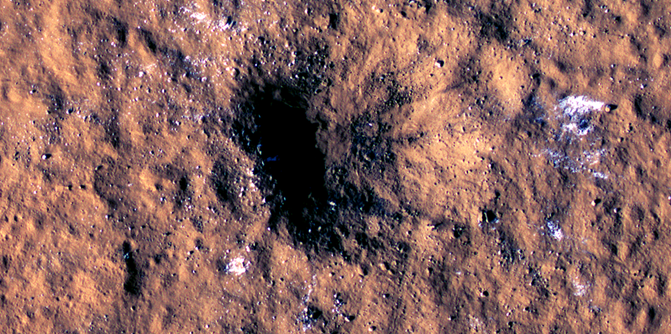
On Earth, a meteor screaming through the sky usually gets roasted by our atmosphere before it can ruin anyone’s picnic. Mars, however, runs a much looser security desk. Its atmosphere is thin, chilly, and not especially good at stopping incoming space rocks. That weakness produced one of the most exciting Martian discoveries of recent years: a meteor strike that shook the Red Planet, carved a fresh crater, and exposed hidden water ice near the Martian equator.
The event happened on December 24, 2021, in a broad volcanic plain called Amazonis Planitia. NASA’s InSight lander, stationed far away on the Martian surface, recorded the impact as a magnitude 4 marsquake. Later, NASA’s Mars Reconnaissance Orbiter spotted the brand-new crater from orbit. Around the crater’s rim, the High Resolution Imaging Science Experiment, better known as HiRISE, captured bright chunks of water ice tossed out by the impact. In simple terms, Mars got smacked, Mars shook, and Mars accidentally showed scientists where it had been hiding some of its frozen water.
That is why this discovery matters far beyond one dramatic crater. The exposed ice was found closer to the Martian equator than scientists had ever directly observed before. For future human missions, water ice is not just “nice to have.” It is drinking water, crop water, oxygen, and even rocket fuel waiting to happen. If Mars is a desert, then subsurface ice is the buried pantry. The 2021 meteor strike briefly opened the pantry door.
What Exactly Happened on Mars?
The impactor was not gigantic by Hollywood standards. NASA estimates it was roughly 16 to 39 feet wide, about the size of a large delivery truck or a small house with a terrible sense of direction. On Earth, an object that size would likely burn up or break apart in the atmosphere. Mars has only about 1 percent of Earth’s atmospheric density, so the meteoroid reached the ground with enough energy to blast open a crater approximately 492 feet across and about 70 feet deep.
The impact threw debris as far as 23 miles from the crater. That material, called ejecta, included chunks of bright ice that had been buried under the dusty surface. The crater was first identified in February 2022 through before-and-after images taken by cameras aboard the Mars Reconnaissance Orbiter. Scientists then matched the timing and location of the crater with the seismic signal recorded by InSight on Christmas Eve 2021.
A Rare Team-Up: A Lander Felt It, an Orbiter Saw It
The beauty of the discovery is that it required two kinds of detective work. InSight acted like a Martian stethoscope, listening to vibrations traveling through the planet’s crust. Meanwhile, the Mars Reconnaissance Orbiter served as the overhead investigator, scanning the surface for new marks in the dust.
InSight recorded the ground motion first. But at the time, a marsquake is only a signal: waves, timing, frequency, and direction. It does not come with a polite label reading, “Hello, I was caused by a space rock.” Scientists needed visual confirmation. MRO provided it when its cameras revealed a fresh dark blast zone and a newly formed crater in Amazonis Planitia. When the orbital images lined up with the seismic data, the case clicked into place.
This combination made the event scientifically powerful. Researchers could study the crater, measure the seismic waves, estimate the impact energy, and examine the newly exposed underground material. One impact became a multi-instrument lesson in Mars geology, impact science, and planetary resources.
Why the Exposed Ice Was Such a Big Deal
Mars is not completely dry. It has polar ice caps, buried ice at higher latitudes, hydrated minerals, and strong evidence that rivers, lakes, and possibly oceans existed billions of years ago. But accessible water is the prize. Ice locked at the poles is useful scientifically, but the poles are brutally cold and difficult places to land and operate. Future astronauts would prefer regions with better sunlight, milder temperatures, and safer landing conditions.
That is why near-equatorial ice is exciting. The equatorial and mid-latitude regions of Mars are more attractive for human exploration because they receive more sunlight and generally offer friendlier thermal conditions than the poles. The problem is that scientists did not expect stable shallow ice to be common near the equator because warmer conditions make exposed ice sublimate, meaning it can turn directly from solid to vapor.
The 2021 crater changed the conversation. It did not prove that astronauts can simply scoop ice everywhere near the equator. Mars is not handing out free snow cones. But it did show that buried ice can exist closer to the equator than previously confirmed by direct imaging. That makes Amazonis Planitia and similar regions more interesting targets for future resource mapping.
How Can Ice Survive Beneath the Martian Surface?
The Martian surface is cold, dry, and exposed to intense radiation. Liquid water cannot remain stable on the open surface for long under today’s low atmospheric pressure. Ice, however, can survive if it is buried under enough soil and dust. That protective layer acts like a freezer blanket, shielding the ice from sunlight and slowing its escape into the atmosphere.
Over long periods, Mars has gone through climate shifts caused by changes in its axial tilt. During certain eras, ice may have migrated from the poles toward lower latitudes. Dust and soil then covered some of those deposits, preserving them underground. A fresh impact works like a natural drill. It punches through the surface, excavates hidden layers, and throws buried material into view.
For scientists, this is both convenient and rude. Convenient, because nature does the digging. Rude, because it uses explosive violence rather than a tidy laboratory spoon. Still, impact craters have become valuable clues in the search for shallow subsurface water ice on Mars.
What InSight Revealed Beneath the Red Planet
NASA’s InSight mission was designed to study Mars from the inside out. Unlike rovers such as Curiosity or Perseverance, InSight did not drive around taking scenic road-trip photos. It stayed in one place and listened. Its seismometer detected marsquakes, meteorite impacts, and vibrations that helped scientists probe the planet’s crust, mantle, and core.
The 2021 impact was especially valuable because it generated surface waves, a type of seismic wave that travels along the outer crust. Those waves gave scientists a rare chance to study crustal structure far from the lander itself. By measuring how the waves moved, researchers could infer details about the properties of Martian rock and layering.
InSight’s work also continues to matter after the mission ended in 2022. Researchers have used its seismic data to explore the possibility of deeper water reservoirs within fractured rock in the Martian crust. Such deep liquid water, if confirmed and widespread, would be far too deep for easy human use, but it could help explain what happened to Mars’ ancient surface water and where habitable environments might still exist today.
Mars Water: Ancient Rivers, Buried Ice, and Deep Reservoirs
The meteor strike discovery fits into a much larger Mars water story. Billions of years ago, Mars was warmer and wetter. Rovers and orbiters have found dry river channels, delta deposits, lakebed sediments, clay minerals, and other signs that liquid water once shaped the landscape. Jezero Crater, where NASA’s Perseverance rover landed, was selected partly because it contains an ancient river delta. Gale Crater, explored by Curiosity, holds layered rocks that tell a long story of water-driven environmental change.
Today, Mars’ water is mostly hidden or frozen. Polar caps store ice. Mid-latitude regions contain buried ice deposits. Some hydrated minerals hold water chemically bound in their structures. Research using InSight data has also suggested that liquid water may exist many miles below the surface in fractured igneous rock. That deep water would not be a practical faucet for astronauts, but it matters for understanding the planet’s climate history and potential habitability.
The Amazonis Planitia impact is different because it revealed something more accessible: shallow ice. This kind of ice could, in principle, be reached by robotic drills, excavation systems, or future human crews if deposits are thick, clean, and widespread enough. The big unanswered question is not whether Mars has water. It is where the water is, how pure it is, how deep it lies, and whether humans or robots can use it without turning the mission into the most expensive digging project in history.
Why Water Ice Matters for Future Mars Missions
Water is heavy. Launching it from Earth is expensive. Every pound of water carried across interplanetary space competes with food, instruments, habitats, shielding, fuel, and all the other gear required to keep astronauts alive. This is why NASA and other space agencies care deeply about in-situ resource utilization, often shortened to ISRU. The idea is simple: use local resources instead of bringing everything from home.
On Mars, water ice could support several critical needs. It can be purified for drinking. It can help grow plants. It can be split into hydrogen and oxygen. Oxygen can support breathing, while hydrogen and oxygen can contribute to propellant production. Water can also help with radiation shielding when stored strategically around habitats.
In other words, Martian ice is not just a science target. It is infrastructure. It could reduce mission mass, extend surface stays, and make a research base more sustainable. The exposed ice around the 2021 crater therefore became a practical clue: it suggested that at least some useful ice may lie beneath areas more favorable for human exploration than the poles.
What the Meteor Strike Tells Us About Landing Sites
Choosing a human landing site on Mars is a cosmic real estate problem. Scientists and engineers need a place that is safe to land, rich in scientific value, warm enough for operations, sunny enough for power, flat enough for hardware, and close enough to resources. Easy, right? Just find the perfect neighborhood on another planet.
Water ice is one of the most important factors in that decision. NASA-supported mapping projects such as the Subsurface Water Ice Mapping project, or SWIM, combine data from multiple orbiters to estimate where shallow ice may exist. These maps use thermal measurements, radar evidence, neutron data, and observations of fresh impacts that expose ice. The meteor strike in Amazonis Planitia became one more valuable data point for testing and refining those maps.
Fresh impact craters act like truth checks. If a map predicts ice in a region and a new crater exposes ice there, confidence grows. If a region looks promising but craters reveal no ice, scientists may revise their models. This is how Mars exploration advances: not through one magic discovery, but through many observations that slowly sharpen the map.
How Scientists Know the Bright Material Was Water Ice
Bright material around fresh Martian craters is not automatically water ice. Scientists have to compare color, brightness, location, temperature behavior, and how quickly the material fades. Ice exposed on Mars is unstable at the surface, especially in warmer regions. It tends to disappear over time by sublimation, leaving behind dust and darker material.
HiRISE is powerful enough to capture detailed color images of the crater and ejecta. When scientists see bright deposits around a fresh impact, compare them with previous ice-exposing craters, and place them in the context of Mars’ thermal environment, water ice becomes the strongest explanation. The Amazonis Planitia crater was especially striking because the exposed chunks were large and clear enough to stand out in orbital images.
That does not mean the entire region is packed with clean ice like a glacier under a carpet. The ice could be patchy, mixed with soil, or limited to certain layers. Future missions would need ground truth: drills, radar, sampling tools, and chemical analysis. But as a signpost, the crater is hard to ignore.
A Scientific Accident With Big Implications
No mission planner ordered a meteoroid to hit Mars on Christmas Eve. Yet the timing was remarkable. InSight was still operating. MRO was still watching from orbit. HiRISE could image the aftermath in detail. The result was one of the best-documented fresh impact events ever observed on another planet.
The event also reminded scientists that Mars is active in ways people often overlook. It may not have plate tectonics like Earth, but its surface changes. Dust storms grow and fade. Dunes move. Slopes collapse. New craters appear. Meteor impacts are not ancient history; they are still happening. Each new crater is a tiny excavation experiment performed by the solar system itself.
For the public, the story is memorable because it connects drama with usefulness. A space rock slammed into Mars, made a crater wider than a football field is long, caused a marsquake, and exposed water ice that could help future astronauts. That is not just planetary science. That is planetary science wearing a leather jacket.
What Still Needs to Be Learned?
The discovery raised important questions. How widespread is shallow ice near Amazonis Planitia? How deep is it? Is it clean enough to process easily, or is it mixed with salts, dust, and rock? How stable has it been over time? Could similar deposits exist in other low-latitude areas? And can future missions safely land close enough to use such resources?
Answering those questions will require more orbital mapping, better radar studies, thermal modeling, and eventually landed missions designed to prospect for ice directly. Engineers also need to test excavation and processing systems that can work in Martian gravity, cold temperatures, abrasive dust, and low atmospheric pressure. Finding ice is step one. Turning it into reliable mission supplies is a much bigger job.
Still, the 2021 impact gave scientists a rare gift: direct evidence that near-equatorial buried ice can exist, at least locally. It helped connect seismic science, orbital imaging, climate history, and human exploration planning into one event. That is why a single crater became such a big story.
Experience-Based Reflections: What This Discovery Feels Like From a Human Exploration Perspective
Imagine planning a camping trip where every bottle of water, every breath of oxygen, every meal, every tool, and every return-ticket fuel tank has to be packed before leaving home. Now imagine the campsite is Mars, the drive takes months, and forgetting one “small thing” is not solved by a quick stop at a convenience store. This is why the meteor strike discovery feels so important from an exploration perspective. It changes the emotional texture of Mars from “distant desert” to “difficult place with hidden supplies.”
For mission designers, water ice is the difference between visiting Mars and learning how to stay there. A short mission can survive by bringing everything from Earth, although at enormous cost. A long-term research station needs a more local approach. The Amazonis Planitia impact did not hand us a ready-made Martian well, but it offered a natural field test. It showed that Mars may preserve useful ice under dusty ground in regions that are not impossibly polar. That matters because humans prefer not to build their first off-world base in the coldest, darkest, most punishing neighborhood available. We are adventurous, yes, but not completely ridiculous.
There is also a lesson here about patience in science. InSight was not sent to Mars specifically to discover a future water source. It was sent to study the planet’s interior. MRO was not launched only to support InSight; it has spent years mapping Mars, studying minerals, tracking climate, and supporting landing site decisions. The discovery happened because different missions, built for different purposes, overlapped in time. One listened. One looked. Together, they solved a mystery that neither could have solved as well alone.
That is a useful model for future exploration. Mars will not reveal its secrets through one heroic robot or one spectacular landing. It will take networks: orbiters, landers, rovers, drills, weather stations, seismic instruments, radar systems, sample labs, and eventually human crews. The meteor strike is a preview of that future. It shows how a sudden event can become meaningful when the right tools are already in place to notice it.
From a human point of view, the discovery is also oddly encouraging. Mars is still harsh. It is cold, dry, dusty, irradiated, and deeply uninterested in making life easy. But it is not blank. It has layers. It has memory. It has buried ice, ancient riverbeds, minerals shaped by water, and possibly deep reservoirs that preserve clues about a wetter past. The Red Planet is not simply dead rock; it is a world with a complicated history still written into its crust.
The practical experience takeaway is this: future Mars explorers will need to think like geologists, engineers, survivalists, and careful houseguests all at once. They will need to read landscapes for resources, protect scientifically valuable sites, avoid contaminating potential habitats, and build systems that can operate with minimal help from Earth. A crater exposing ice near the equator is not just a cool photo. It is a reminder that Mars exploration will be won by noticing details, connecting evidence, and respecting the planet’s limits.
In that sense, the 2021 meteor strike was more than an impact. It was a message delivered by a very fast rock: Mars still has surprises underground. Some of those surprises may help explain its ancient climate. Some may guide the search for life. And some may one day help astronauts drink, breathe, grow food, and launch home. Not bad for a cosmic accident.
Conclusion
The meteor strike on Mars revealed a potential water source by doing what no drill had done in that location: it punched through the surface and exposed buried ice near the equator. NASA’s InSight lander recorded the impact as a magnitude 4 marsquake, while the Mars Reconnaissance Orbiter confirmed the fresh crater and photographed the bright water ice scattered around it. The discovery matters because shallow subsurface ice could support future Mars missions with drinking water, oxygen, agriculture, and rocket propellant.
At the same time, the finding should be understood carefully. One crater does not prove that astronauts can land anywhere near the equator and start shoveling ice into buckets. It does, however, provide strong evidence that Mars has more accessible water resources than once assumed. For scientists, it sharpens models of Martian climate and subsurface ice. For engineers, it adds a promising clue to the search for future landing sites. For everyone else, it is a thrilling reminder that even a barren-looking world can hide treasure just beneath the dust.