Some watches whisper luxury. Some watches shout “I have notifications.” And then there is the DIY E-Ink Tank Watch: a tiny, wrist-mounted engineering flex that politely says, “Yes, I made my own display, thank you.” Inspired by the elegant rectangular shape of classic tank-style dress watches and powered by the quiet magic of electronic paper, this project sits at the wonderful intersection of horology, low-power electronics, and “maybe I should have used a bigger workbench.”
The idea is beautifully simple: build a slim, rectangular watch with an always-visible E-Ink display, long battery life, and a custom aesthetic that looks more like a museum gadget than a mass-market smartwatch. The execution, however, is where things become delightfully unhinged. Instead of buying a ready-made display and designing around it, the maker approach can involve cutting, delaminating, bonding, sealing, programming, measuring nanoamps, and developing a sincere relationship with tweezers.
That is what makes a DIY E-Ink tank watch so fascinating. It is not merely a watch. It is a lesson in display physics, battery discipline, printed circuit board design, firmware minimalism, and the eternal truth that anything described as “small and simple” will eventually require a microscope.
What Is a DIY E-Ink Tank Watch?
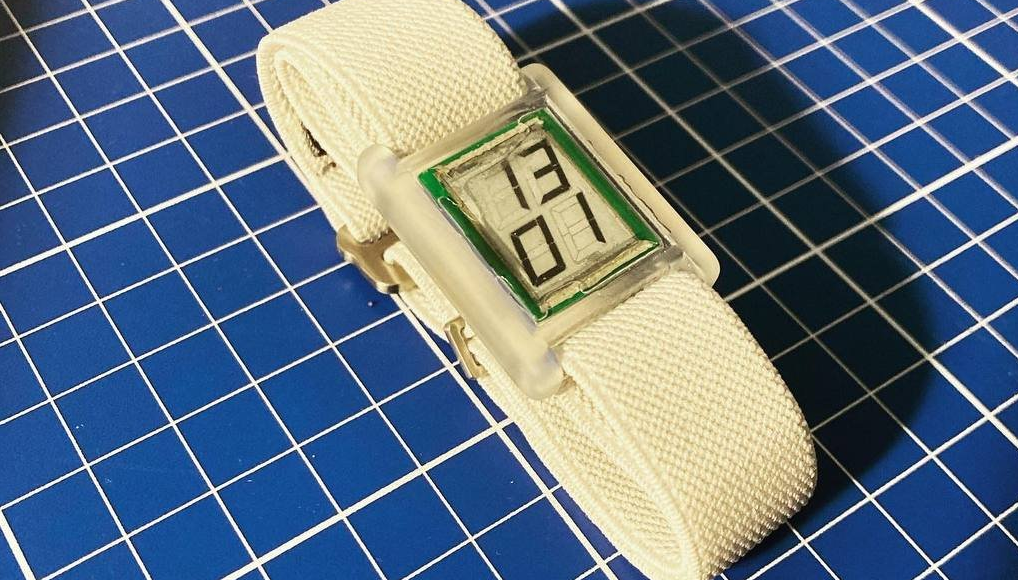
A DIY E-Ink tank watch is a homemade wristwatch that combines a tank-style rectangular case with an electronic paper display. The word “tank” refers to the shape, not military hardware, so please do not expect your wrist to invade a neighboring desk. The classic tank watch silhouette is slim, rectangular, and dressy, which makes it a fun contrast to the futuristic, technical look of E-Ink.
Unlike OLED or LCD screens, E-Ink displays are reflective. They do not glow by default. Instead, they use ambient light, much like printed paper. This makes them easy to read in bright sunlight and extremely efficient because they generally consume power mainly when the image changes. For a watch that only needs to update once per minute, that is a huge advantage.
The most interesting versions of this project use a custom segmented E-Ink display rather than a regular pixel matrix. In a segmented display, each digit or symbol is shaped as a dedicated electrode area. Think of it like a seven-segment calculator display, but cooler, stranger, and potentially shaped like something from a spacecraft control panel. In one well-known maker build, the digit style was inspired by the Apollo Guidance Computer’s DSKY interface, giving the watch a retro-space-age personality.
Why E-Ink Makes Sense on a Watch
Smartwatches usually trade battery life for features. Bright color displays, touchscreens, sensors, wireless radios, and animated widgets all need energy. That is fine if you enjoy charging another device every night, right next to your phone, earbuds, tablet, laptop, toothbrush, and emotional support power bank.
An E-Ink watch takes a different path. It asks: what if a watch were mostly a watch? What if the screen stayed readable without constant power? What if the microcontroller woke up, updated the display, and immediately went back to sleep like a responsible adult?
This is the heart of the DIY E-Ink tank watch. The display is not trying to be a tiny phone. It is a low-power timepiece with personality. The result can be thinner, calmer, and more durable in spirit, even if the prototype itself may look like it was assembled during a caffeine experiment.
The Core Components Behind the Build
1. The E-Ink Display
The display is the star of the project. A standard off-the-shelf E-Paper module is the easiest option for beginners, but it may not fit a narrow tank-style case. That is why advanced builders experiment with custom E-Ink segments. The process can involve taking a donor E-Ink screen, separating useful layers, cutting them to size, and bonding them onto a specially designed PCB.
This is not beginner-level “plug in three wires and upload code” territory. E-Ink screen layers include a protective surface, adhesive, a transparent common electrode, microcapsules, more adhesive, and a backplane. Separating these layers without destroying them requires heat, patience, and the emotional resilience of someone who has already ruined at least one display.
2. The PCB as the Watch’s Skeleton
In a watch this small, the printed circuit board is more than a place to solder parts. It is the skeleton, the display carrier, the electrical routing system, and sometimes part of the visual design. A tank-style watch has tight dimensions, so every millimeter matters.
A sophisticated design may use multiple thin PCBs connected by low-profile board-to-board connectors. The display board can hold the segmented electrodes, while the logic board carries the microcontroller, RTC, boost converter, switches, programming pads, and battery connection. Four-layer boards help route signals cleanly while keeping the surface tidy.
3. A Real-Time Clock for Accurate Timekeeping
A watch needs to keep time even when the main microcontroller is asleep. That is where the real-time clock, or RTC, comes in. A low-power RTC can run continuously while drawing only a tiny current. In a serious low-power design, the RTC is not just a supporting actor. It is the responsible friend who wakes the microcontroller when it is time to update the display.
The best approach is to let the RTC generate periodic interrupts, such as once per minute. The microcontroller wakes, reads the time, updates the E-Ink segments, shuts down unnecessary peripherals, and goes back to sleep. This simple rhythm is the secret behind multi-year battery ambitions.
4. A Microcontroller That Knows When to Stop Talking
Many DIY watches use an ESP32 because it is powerful, popular, and supported by huge communities. For an ultra-low-power tank watch, however, power is the main design constraint. A smaller microcontroller such as a PIC16 or another low-power MCU may be a better fit, especially if the watch only needs to display hours and minutes.
The ideal firmware is boring in the best way. It initializes, reads the clock, updates the display, disables UART, disables I2C, turns off peripheral clocks, and shuts down. No background drama. No unnecessary polling. No “just checking Wi-Fi real quick.” The watch survives because the microcontroller spends almost all of its life doing absolutely nothing.
5. The Battery and Power Supply
A tank-style case leaves little room for a battery. Coin cells such as CR1616 or CR1620 are attractive because they are thin, light, and widely available. They are also easy to abuse electrically. A small coin cell does not enjoy high current spikes, inefficient converters, or careless design choices. Treat it poorly and it will respond by dying early, as batteries do not attend customer service training.
Many E-Ink displays require a higher driving voltage than a single 3V coin cell can directly provide. A low-power boost converter can generate the needed voltage, often around 5V for better contrast and faster switching. The trick is to power that converter only when needed. Load switches, shutdown pins, and careful firmware sequencing are essential.
How the Custom Segmented E-Ink Display Works
The custom display is the most unusual part of this project. Instead of addressing thousands of pixels like a normal E-Paper screen, a segmented display energizes shaped areas. If the PCB has copper pads shaped like digits, those pads become the display’s segment electrodes. The top transparent electrode acts as the common electrode.
When voltage is applied between a segment pad and the common electrode, charged particles in the E-Ink microcapsule layer move. Depending on polarity, the segment appears dark or light. Because E-Ink is bistable, the image can remain visible after power is removed. That is the whole party trick.
For a watch, this is perfect. Hours and minutes do not require a full graphics screen. Dedicated digit segments can be efficient, legible, and visually distinctive. The downside is that the display is locked to those shapes. You cannot suddenly add a weather icon unless you designed a weather icon electrode. In other words, the watch has a strong personality and refuses to become a tiny smartphone.
Designing the Tank Case
The tank-style case gives the project its charm. A rectangular body feels elegant, vintage, and intentional. Clear resin or translucent printed resin can make the electronics visible, turning the watch into a wearable circuit sculpture. It is the opposite of hiding the PCB. It celebrates the PCB.
However, case design is not just about looks. The case must hold the board flat, protect the display, allow strap mounting, and ideally provide some access to the battery or programming pads. If the watch is permanently sealed in epoxy, it becomes visually stunning but less serviceable. That is a design tradeoff: museum object or maintainable daily driver?
A practical version may use a removable rear cover, small screws, a gasket, and exposed programming pads. A more experimental version may be potted in clear epoxy for strength and aesthetics. Both approaches are valid. One says “repairable prototype,” and the other says “tiny cyberpunk fossil.”
Firmware Strategy: Wake, Update, Vanish
The firmware for a DIY E-Ink tank watch should be ruthlessly minimal. A good sequence looks something like this:
- The RTC wakes the system once per minute.
- The microcontroller powers up and reads the current time.
- The display driver applies the correct waveforms to the E-Ink segments.
- Unused communication buses are disabled.
- The boost converter and display power are turned off.
- The microcontroller shuts itself down until the next wake event.
This approach makes the watch feel almost mechanical. It is not constantly calculating. It performs one tiny ritual every minute and then disappears. That is how ultra-low-power electronics become impressive: not by doing more, but by refusing to do anything unnecessary.
Common Challenges in Building an E-Ink Tank Watch
Fragile Display Layers
E-Ink films are delicate. Cutting, heating, peeling, or clamping them can destroy the display if handled carelessly. Newer screens may use stronger adhesives, making delamination harder. Older donor screens may be easier to separate, but they are not always consistent.
Moisture and Edge Sealing
Moisture is the enemy of many display assemblies. After bonding the E-Ink layer to the PCB, the edges need protection. UV-curable epoxy, CA glue, or another suitable sealant can help protect the fragile layers and improve mechanical strength.
Power Budget Surprises
Low-power projects are full of tiny traps. Pull-up resistors can waste current. A regulator with poor shutdown behavior can drain the battery. A floating pin can quietly sabotage runtime. Debug interfaces left enabled can ruin beautiful measurements. Nanoamp design is less like normal electronics and more like plumbing for invisible leaks.
Coin Cell Limitations
Coin cells are convenient but not magical. Their capacity depends on load, temperature, and discharge profile. Short current spikes can reduce effective runtime. A project may calculate a theoretical battery life of many years, but real-world performance will be lower because physics reads the fine print.
Why This Project Matters
The DIY E-Ink tank watch matters because it shows what wearable electronics can be when they are not designed by committee. It does not need a subscription. It does not need cloud synchronization. It does not need to count how many times you stood up during lunch. It simply tells time in a way that expresses curiosity, craftsmanship, and technical stubbornness.
It also teaches an important engineering lesson: constraints create character. The small case forces efficient layout. The coin cell forces low-power discipline. The segmented display forces careful visual design. The lack of space forces creativity. The result is not a generic gadget. It is a personal object.
Who Should Build One?
This project is best for experienced makers who are comfortable with PCB design, SMD soldering, firmware, power measurement, and delicate mechanical assembly. If you are new to E-Ink, start with a development board and a ready-made E-Paper module. Build a desk clock first. Then build a chunky wrist prototype. Then, once you have developed enough confidence and a mild addiction to tiny components, attempt the tank watch.
If your goal is a practical daily smartwatch, an open-source E-Paper watch platform may be a better starting point. If your goal is to learn, experiment, and build something nobody else at the coffee shop is wearing, the DIY E-Ink tank watch is wonderfully rewarding.
Experience Notes: Living With the Idea of a DIY E-Ink Tank Watch
The most memorable part of working around a project like a DIY E-Ink tank watch is how quickly it changes your definition of “simple.” At first, the concept sounds almost casual: a watch, a display, a battery, a case. Then the details arrive wearing steel-toed boots. The display needs the right voltage. The battery cannot handle careless current spikes. The PCB must be thin but still routable. The case must be elegant but not impossible to assemble. The firmware must be smart enough to do its job and humble enough to shut up afterward.
Handling E-Ink material is especially humbling. It looks like a flat piece of film, but it behaves like a tiny layered ecosystem. You begin to understand why commercial display manufacturing is not performed on a kitchen table between a coffee mug and a roll of tape. Delaminating a screen, cleaning contact areas, exposing the transparent electrode, and bonding the film to a PCB are all tasks where rushing is punished immediately. One bad scrape, one uneven clamp, one careless blob of adhesive, and your futuristic watch face becomes modern art.
Power measurement is another experience that changes your habits. In ordinary Arduino-style projects, a few milliamps here or there may not feel dramatic. In a coin-cell watch, every microamp becomes a suspect. You start checking pull-ups. You question indicator LEDs. You look at datasheets with the intensity of a detective in a raincoat. Suddenly, “sleep mode” is not enough. You want shutdown modes, leakage numbers, load switch behavior, startup current, and proof that no sneaky peripheral is sipping electrons while pretending to be off.
The mechanical side brings its own comedy. A tank watch shape looks clean because it is unforgiving. Round watches can hide small alignment sins. Rectangular watches expose them like a courtroom witness. If the display is crooked, everyone knows. If the strap lugs are slightly off, your wrist knows. If the case is too thick, the elegant dress-watch fantasy becomes a tiny sandwich strapped to your arm.
Yet that is exactly why the project is satisfying. A DIY E-Ink tank watch is not about convenience. It is about making choices. Do you want a sealed transparent case that looks amazing, or a serviceable back plate that lets you replace the battery? Do you want a minimalist display with only hours and minutes, or extra icons that complicate the electrode layout? Do you want maximum battery life, or a more active interface with buttons and animations?
The finished object, even as a prototype, feels different from a purchased gadget. It has evidence of decisions. It has fingerprints in the design. It may have a weird quirk: a slightly slow refresh, a display ghost under certain lighting, a case corner that could be smoother, or a programming jig that looks like it was built by a very focused raccoon. Those imperfections are not failures. They are proof that the watch was made, not merely bought.
Wearing something like this also changes the social experience of a watch. People may ask what it is. Some will admire the E-Ink display. Some will wonder why it does not have notifications. A few will ask whether it tracks fitness. The best answer is probably: “It tracks time, and my patience.” That is the charm. It is a calm, low-power, handmade object in a world full of devices trying to vibrate their way into your attention span.
Conclusion
A DIY E-Ink tank watch is fine work in the best maker tradition. It combines the classic visual language of a rectangular dress watch with the efficient, paper-like readability of E-Ink. It rewards careful PCB design, disciplined firmware, smart power management, and patient assembly. It also proves that a watch does not need to be overloaded with apps to be interesting. Sometimes the most compelling wearable is the one that does less, lasts longer, and looks like it escaped from a space-age design notebook.
For builders, the project is a challenge. For watch lovers, it is a fresh interpretation of a familiar shape. For electronics nerds, it is a playground of nanoamps, boost converters, RTC interrupts, and segmented display experiments. And for everyone else, it is a reminder that the best DIY projects are not always practical in the ordinary sense. They are practical in a deeper way: they teach you how things work, where the limits are, and how much joy can fit inside a rectangle smaller than a cookie.