Investing success is rarely about discovering a secret stock before your neighbor, your dentist, and three p things consistently for a very long time. That is the heart of Vanguard’s investing philosophy: set clear goals, build a balanced portfolio, keep costs low, and stay disciplined.
These principles may not sound as exciting as “The Next 10X Stock You Must Buy Before Tuesday.” That is exactly why they work. They are built for real people with real jobs, bills, changing priorities, market anxiety, and a tendency to check account balances after dramatic headlines. In other words, they are built for humans.
This guide explains Vanguard’s principles for investing success in practical American English, with examples that show how long-term investors can turn a simple plan into a more confident financial life.
The Four Vanguard Principles at a Glance
| Principle | What It Means | Why It Matters |
|---|---|---|
| Goals | Create clear and appropriate investment goals. | Your investments should serve your life, not become a confusing hobby with spreadsheets. |
| Balance | Use a diversified mix of investments. | Different assets behave differently, which can help manage risk over time. |
| Cost | Minimize fees, taxes, and unnecessary trading costs. | Every dollar not spent on avoidable costs has more opportunity to stay invested. |
| Discipline | Maintain a long-term perspective through market ups and downs. | Good plans can be damaged by panic, hype, and overconfident clicking. |
1. Start With Clear Investment Goals
Vanguard’s first principle is simple: know what your money is supposed to do. “Make more money” is technically a goal, but it is a little like saying your fitness plan is “become less potato-shaped.” It points in the right direction, but it does not tell you what to do next.
Give Each Dollar a Job
Strong investment goals have three parts: a purpose, a target amount, and a time frame. For example, a person might invest for retirement in 30 years, a child’s education in 15 years, or a home down payment in five years. These are all important goals, but they should not necessarily be invested the same way.
Money needed soon generally needs more stability and accessibility. Money intended for decades in the future may have more time to ride through normal market volatility. That does not mean every long-term goal should automatically be placed in stocks, but it does mean time horizon should shape the conversation.
Separate Short-Term Savings From Long-Term Investing
One of the most useful habits an investor can develop is keeping emergency money separate from long-term investments. An emergency fund is designed for surprise car repairs, medical bills, job interruptions, or the washing machine deciding to audition for a flood documentary.
When emergency expenses are covered by cash reserves, investors may be less likely to sell long-term investments during a bad market. That creates breathing room, and breathing room is underrated. It is hard to stay disciplined when a surprise expense is sprinting toward you with a receipt.
Use Goals to Choose the Right Account
For U.S. investors, goals can also guide account selection. Retirement goals may involve employer-sponsored plans, traditional IRAs, Roth IRAs, or taxable brokerage accounts. Education goals may involve a 529 plan. The correct choice depends on income, taxes, contribution limits, employer benefits, and personal circumstances.
The key lesson is not to chase the newest account type because a social-media influencer said it was “elite.” Instead, understand what the account is for, how it is taxed, and whether it fits the goal in front of you.
2. Build Balance Through Diversification
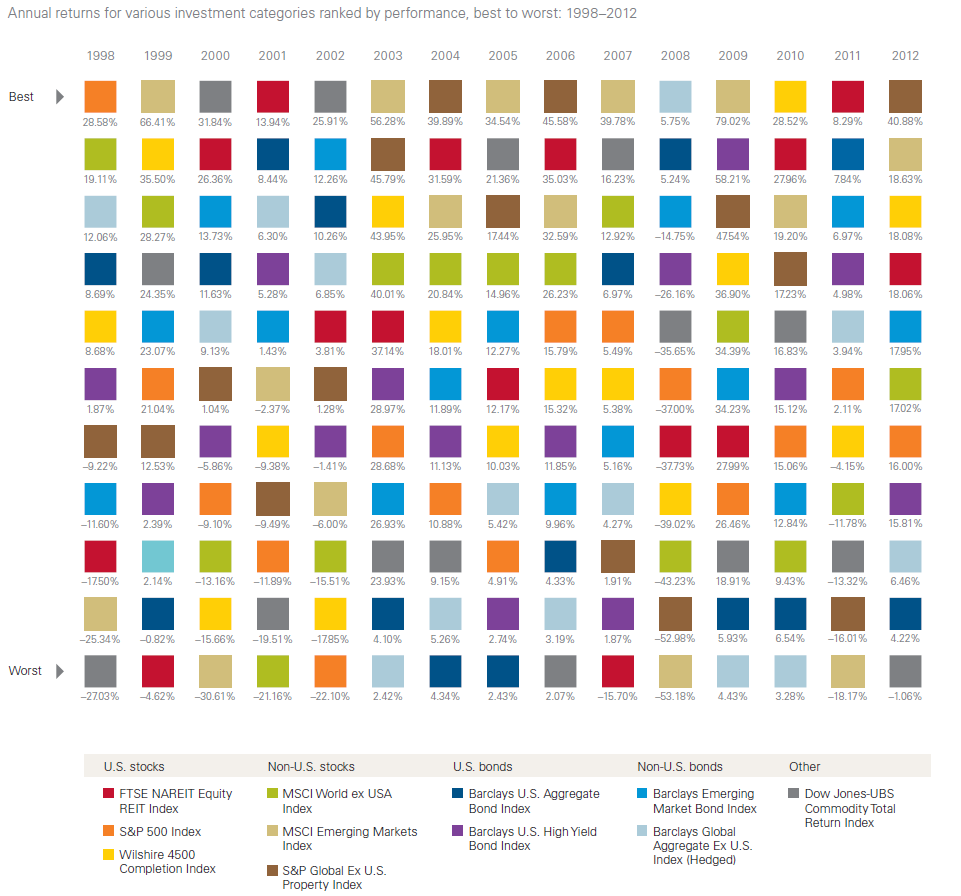
The second Vanguard principle is balance. A balanced portfolio does not mean every investment performs equally well every year. That would be convenient, but markets did not sign up to make life convenient. Balance means owning a mix of investments that can play different roles in your financial plan.
Stocks, Bonds, and Cash Have Different Jobs
Stocks can offer long-term growth potential, but they can also move sharply in both directions. Bonds may provide income and potentially reduce some portfolio volatility, though they carry their own risks. Cash and cash equivalents can offer liquidity and stability for near-term needs, although they may not keep pace with inflation over long periods.
A diversified portfolio may hold different asset classes, different industries, and investments from multiple regions. Rather than betting your future on one company, one country, or one trendy corner of the market, diversification spreads exposure across many opportunities.
Diversification Is Not a Magic Shield
Diversification can reduce concentration risk, but it cannot erase market risk. A diversified portfolio can still decline in value during a broad market downturn. The goal is not to eliminate every uncomfortable moment. The goal is to avoid having one bad investment decision become a financial disaster with its own documentary series.
For many investors, diversified mutual funds, index funds, exchange-traded funds, or target-date funds can offer a simpler path to broad exposure. The best choice depends on the investor’s goals, desired level of involvement, tax situation, and comfort with risk.
Rebalancing Keeps Risk From Wandering Off
Over time, market movements can change a portfolio’s original mix. Suppose someone begins with a portfolio designed to hold 70% stocks and 30% bonds. If stocks rise dramatically, the portfolio may become much more stock-heavy than intended. That may sound great while markets are rising, but it can also mean the portfolio has become riskier without the investor consciously choosing it.
Rebalancing means reviewing the portfolio and bringing it closer to the intended allocation. Some investors rebalance on a schedule, such as once a year. Others rebalance when allocations move beyond a chosen range. The goal is not constant tinkering. It is keeping the portfolio aligned with the plan.
3. Keep Investment Costs Low
Costs are one of the few parts of investing that can be observed before the future arrives. Nobody can guarantee next year’s market return, but investors can review expense ratios, advisory fees, trading commissions, sales loads, account charges, and tax consequences.
Why Small Fees Can Become Big Problems
A fee that looks tiny on a statement can become much more important over decades. Higher-cost investments must work harder just to deliver the same net return as lower-cost alternatives. This is why cost-conscious investing is not about being cheap in the “reuse one paper towel for six weeks” sense. It is about making sure your money is doing useful work instead of quietly leaking through avoidable expenses.
When comparing funds, investors should look beyond a catchy name or a recent performance chart. Useful questions include: What is the expense ratio? Is there a sales charge? Are there transaction costs? Does the investment create frequent taxable distributions in a taxable account? Is the strategy complex enough to justify its total cost?
Low Cost Does Not Mean Thoughtless
Keeping costs low does not mean buying the cheapest thing with a ticker symbol and hoping for the best. It means comparing similar investment choices and asking whether the potential benefit justifies the additional cost.
For example, a broadly diversified index fund may be a logical core holding for an investor seeking market exposure at a relatively low cost. An actively managed fund may still deserve consideration in certain situations, but the investor should understand what they are paying for and why.
Taxes Belong in the Cost Conversation
Taxes are not always avoidable, and tax rules are complicated enough to make a crossword puzzle look relaxing. Still, tax efficiency matters. Frequent buying and selling in a taxable account can create capital gains taxes, while certain retirement accounts may offer tax-deferred or tax-free growth depending on the account type and eligibility rules.
Investors do not need to become tax attorneys before buying a fund. They do need to understand that taxes, fees, and unnecessary trading can work together like a three-person committee whose only job is reducing returns.
4. Maintain Discipline and Long-Term Perspective
The fourth Vanguard principle may be the hardest: stay disciplined. Most investors already know that buying high and selling low is not ideal. Yet when markets drop, logic can leave the room quickly. Headlines become dramatic, commentators become louder, and suddenly every person with a Wi-Fi connection seems to have a strong opinion about the end of capitalism.
Market Volatility Is Normal
Markets rise and fall. Economic conditions change. Interest rates move. Companies disappoint. Companies surprise everyone. Political events create uncertainty. None of this is unusual. It is part of the environment investors accept when they pursue long-term returns.
A well-designed investment plan should account for the possibility of downturns before they happen. If a portfolio is so aggressive that an investor cannot sleep during normal volatility, the solution may be to reassess risk level, not to wait until the next market decline and make decisions while emotionally overheating.
Automate Good Behavior
Automatic contributions can make discipline easier. Investing a set amount on a regular schedule may help reduce the temptation to guess the perfect moment to enter the market. This approach, often called dollar-cost averaging, does not guarantee profits or prevent losses. It does, however, replace repeated emotional decisions with a routine.
That routine matters. Investors who contribute steadily are less dependent on motivation, excitement, market forecasts, or the mood of a random Tuesday afternoon.
Create Rules Before Emotions Arrive
One practical method is to write down a simple investment policy. It can include your major goals, target asset allocation, contribution schedule, rebalancing approach, and situations that would justify changing the plan. Life changes, such as retirement, a new child, a job change, or a major health event, may require adjustments. A scary headline alone usually does not.
Think of the policy as a seatbelt for your decision-making. You hope you never need it during a market panic, but you will be glad it exists if things get bumpy.
How to Apply Vanguard’s Investing Principles in Real Life
Imagine a 35-year-old investor named Jordan. Jordan wants to retire around age 65, has an emergency fund, contributes to a workplace retirement plan, and also invests through a taxable brokerage account. Jordan’s long-term goal is clear: build retirement wealth over 30 years.
Instead of trying to pick the next superstar stock, Jordan chooses a diversified mix of low-cost funds that reflects a reasonable level of risk. Jordan contributes automatically each month, checks the portfolio periodically rather than obsessively, and rebalances according to a written plan.
When the market falls, Jordan feels uncomfortable. That is normal. But Jordan does not sell everything and move to cash after a scary week. The portfolio was designed with volatility in mind. Jordan reviews the plan, confirms that the goal and time horizon remain intact, and continues investing.
That may not sound glamorous. There is no yacht montage, no dramatic bell-ringing ceremony, and no mystery stock tip whispered in an airport lounge. But it is a repeatable process. Repeatable processes tend to beat exciting mistakes.
Common Mistakes That Undermine Investing Success
- Investing without a specific goal: Money is placed in random investments with no clear purpose or time horizon.
- Taking more risk than you can handle: A portfolio may look great during a bull market but become unbearable during a decline.
- Ignoring fees: High costs can quietly reduce long-term results year after year.
- Owning too much of one investment: Concentration in a single stock, sector, or employer can create unnecessary risk.
- Trying to time the market: Investors may miss strong market days while waiting for a “perfect” entry point.
- Changing plans because of headlines: News is important, but a long-term investment strategy should not be rebuilt every time the market has a dramatic afternoon.
Real-World Experiences With Vanguard’s Principles for Investing Success
Many investors learn the value of Vanguard-style investing principles only after making the classic mistakes first. A person may begin by buying a stock because a friend made money on it. Another may jump into a hot sector after seeing it rise for months. Someone else may sell during a market drop, promise never to invest again, and then quietly return after prices have recovered. Investing has a way of turning confidence into humility, often with impressive speed.
One common experience is discovering that a simple portfolio can feel almost too boring. Investors are often conditioned to believe that successful investing requires constant action. They expect dashboards, alerts, technical charts, and perhaps at least one dramatic cup of coffee while staring at candlestick patterns. But after watching markets for several years, many people realize that frequent activity does not always equal progress.
A diversified, low-cost portfolio may not produce thrilling conversation at a dinner party. Nobody leans across the table and says, “Tell me more about your sensible asset allocation.” Yet that same portfolio can be easier to understand, easier to maintain, and less vulnerable to one bad prediction.
Another important experience is learning that risk tolerance is emotional as well as mathematical. On paper, an investor may say they can handle a 30% decline. In real life, watching an account value fall can feel very different. The lesson is not that investors should avoid all risk. It is that they should build a portfolio they can realistically hold through difficult periods.
Investors also learn that regular contributions can become more powerful than perfect timing. Someone who invests a manageable amount every month may feel unimpressive compared with a person making a large one-time investment. Over many years, however, consistency can build momentum. Regular investing creates a habit, and habits are often more reliable than bursts of inspiration.
Cost awareness becomes more meaningful with experience, too. A new investor may see an expense ratio difference of a fraction of a percent and shrug. Later, after understanding compounding, they may recognize that small annual costs can affect long-term results. The same lesson applies to excessive trading, account charges, and tax inefficiency. None of these may seem dramatic in isolation, but they can create a steady drag over time.
Perhaps the biggest lesson is that discipline does not mean ignoring life. A good investor changes course when goals, income, family responsibilities, health, or retirement needs change. Discipline means changing the plan for meaningful reasons, not because a news headline created panic at breakfast.
In the end, successful investors are not always the people with the most predictions. They are often the people who understand their goals, control what they can, avoid unnecessary costs, stay diversified, and keep going. That may be less exciting than chasing the next market miracle, but boring can be beautiful when it is helping fund a future you actually want.
Conclusion: Investing Success Is Built, Not Guessed
Vanguard’s principles for investing success offer a practical framework for long-term investors: set clear goals, maintain a balanced portfolio, minimize costs, and stay disciplined. None of these principles can guarantee returns, and every investment carries risk. Still, they focus attention on the decisions investors can control instead of the market movements they cannot.
The best investing plan is usually not the one that looks smartest in a headline. It is the one you understand, can afford, can maintain, and can stick with when the market gets noisy. Build your plan carefully, review it when life changes, and let patience do some of the heavy lifting.
Note: This article is for educational purposes only and is not personalized financial, tax, legal, or investment advice. Investing involves risk, including possible loss of principal.