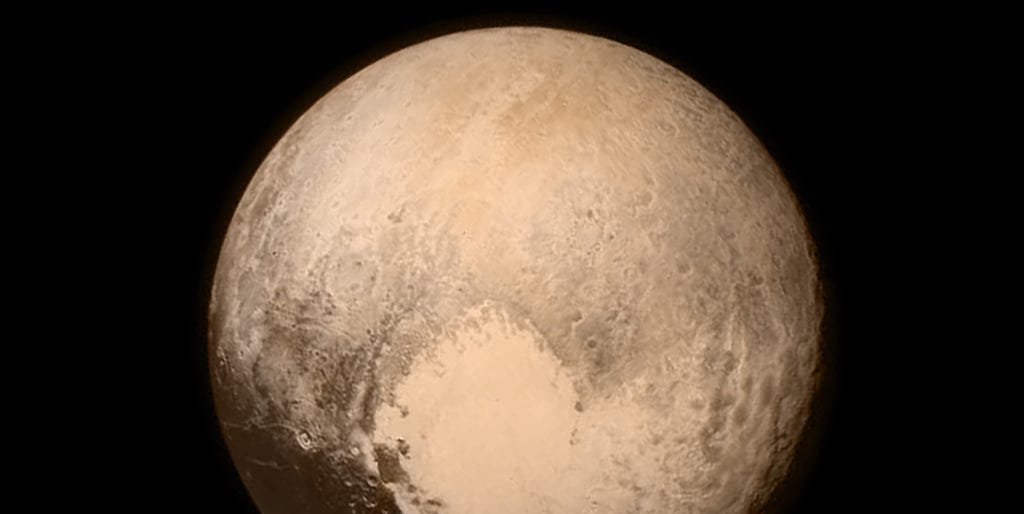
Pluto may be small, frozen, and parked billions of miles from the Sun, but it has never been short on drama. When NASA’s New Horizons spacecraft photographed the dwarf planet up close in 2015, one feature instantly stole the show: a vast, bright region shaped remarkably like a heart. It looked almost too perfect, as though the solar system had stamped Pluto with a cosmic Valentine.
Scientists, naturally, saw something less romantic and much more complicated. Pluto’s “heart,” officially called Tombaugh Regio, contains glaciers, moving nitrogen ice, deep basins, towering mountains, and clues to events that occurred billions of years ago. Its western half, Sputnik Planitia, has been especially difficult to explain because it is enormous, unusually deep, oddly shaped, and positioned in a place where an ordinary impact basin should not remain.
A study published in Nature Astronomy proposed an intriguing solution: Sputnik Planitia may have formed when a large planetary body struck Pluto slowly and at a shallow angle. Instead of completely exploding or sinking into Pluto, part of the impactor may have remained buried beneath the basin like the rocky filling in a very cold cosmic sandwich.
First, What Exactly Is Pluto’s Heart?
The name “Pluto’s heart” is commonly used for the entire bright formation visible in New Horizons images. Its official name, Tombaugh Regio, honors Clyde Tombaugh, the American astronomer who discovered Pluto in 1930.
However, the heart is not one uniform feature. Its western lobe is Sputnik Planitia, a huge, pear-shaped basin filled mainly with frozen nitrogen. The eastern lobe is brighter than much of Pluto’s surrounding terrain but has a thinner coating of volatile ice and a different geological structure.
Sputnik Planitia is approximately 1,200 by 2,000 kilometers, or about 750 by 1,240 miles, across. Its central plains sit roughly three to four kilometers below the surrounding surface. That low elevation creates a natural cold trap where nitrogen, methane, and carbon monoxide can collect and freeze.
The result is a brilliant white plain that looks smooth from a distance but contains polygonal cells, pits, flowing glaciers, and floating blocks of water ice. Calling it a “frozen plain” is accurate, but it can also be misleading. Sputnik Planitia is not sitting quietly. It is more like a giant nitrogen-ice conveyor belt operating at the speed of geology.
A Giant Collision May Have Created Sputnik Planitia
For years, planetary scientists suspected that an ancient collision created the basin. The challenge was reproducing its peculiar elongated, pear-like shape. Most large impacts create formations that are broadly circular, even when later geological activity modifies them.
The newer research used three-dimensional hydrodynamic simulations to test collisions involving different impactor sizes, speeds, compositions, and approach angles. The scenario that most closely reproduced Sputnik Planitia involved an object approximately 700 to 730 kilometers wide. That is about 435 to 450 miles across and slightly larger than the asteroid Vesta.
The simulated body was not merely a loose snowball. It was differentiated, meaning it likely possessed a dense rocky center surrounded by a layer rich in ice. It approached Pluto at a relatively low speed and struck at an angle of about 30 degrees rather than crashing straight down.
A Slow-Motion Catastrophe
“Low speed” is a relative term in planetary science. The impact would still have released extraordinary energy and devastated a large portion of Pluto’s surface. It was slow only compared with the much faster collisions that occur closer to the Sun.
Objects in the distant Kuiper Belt often move around the Sun in broadly similar directions and at lower orbital speeds than bodies in the inner solar system. As a result, some collisions there can be slower and more glancing. That matters because a slower, oblique impact does not behave like a high-speed, head-on blast.
In the successful simulations, the impactor spread across Pluto’s interior and surface in what researchers informally described as a “splat.” The outer icy layers were heavily disrupted, but the denser rocky core remained comparatively intact.
The Rocky Remnant Beneath the Ice
The impactor’s surviving core may have come to rest near Pluto’s core-mantle boundary beneath Sputnik Planitia. This buried concentration of dense material is known as a mass concentration, or “mascon.” Similar gravity anomalies have been identified beneath some large impact basins on the Moon.
In simpler terms, Pluto may still be carrying a chunk of the object that struck it. The visible basin is the scar, while the impactor’s rocky center could remain hidden below, quietly affecting the dwarf planet’s balance billions of years later.
This possibility helps explain one of the most stubborn mysteries surrounding Pluto’s heart: why Sputnik Planitia is located close to the equator and aligned near the axis connecting Pluto with its largest moon, Charon.
Why Sputnik Planitia’s Location Is So Strange
A large impact basin removes material from one region of a rotating world. That usually produces a negative mass anomalya place with less mass than the surrounding terrain. Over long periods, a rotating planet or moon tends to shift such a lightweight region toward one of its poles.
Sputnik Planitia did not follow that expected script. It sits near Pluto’s equator and nearly opposite Charon. This suggests that the basin behaves more like an area of excess mass than a giant missing chunk.
Previous studies proposed that thick deposits of nitrogen ice and a denser layer of liquid water beneath Pluto’s crust created enough extra mass to pull Sputnik Planitia toward its present location. That process, known as true polar wander, may have reoriented much of Pluto’s crust.
The new impact model offers another possibility. A dense rocky remnant beneath the basin could supply the needed extra mass even if Pluto does not contain a large, present-day ocean. Instead of an underground sea anchoring Pluto’s heart, the anchor could be the compact remains of the ancient impactor.
Does the New Theory Mean Pluto Has No Ocean?
Not necessarily. The study provides an alternative to the subsurface-ocean explanation, but it does not conclusively drain Pluto’s hypothetical ocean.
Evidence supporting an ocean has come from several sources, including Pluto’s surface fractures, signs of long-term expansion, its geologically active terrain, and the apparent mass anomaly beneath Sputnik Planitia. Some models suggest that radioactive decay inside Pluto could maintain a layer of liquid or partially melted water beneath a thick shell of ice.
Other researchers argue that keeping such an ocean liquid for billions of years on a world with a surface temperature near minus 387 degrees Fahrenheit would require particular interior conditions, insulating materials, or antifreeze compounds such as ammonia. Pluto is not exactly known for its beach weather.
The rocky-mascon model shows that scientists may not need a global ocean to explain Sputnik Planitia’s location. Pluto could possess a very thin ocean, a partially frozen layer, isolated pockets of liquid, or no remaining ocean at all. Distinguishing among those possibilities will probably require better gravity measurements than a single fast flyby could provide.
How Nitrogen Ice Turned an Impact Scar Into a Heart
The ancient impact may have created the basin, but it did not necessarily create the bright heart shape that people recognize today. That appearance developed as volatile ices moved across Pluto’s surface.
Because Sputnik Planitia is several kilometers lower than nearby terrain, it acts as a vast freezer drawer. Nitrogen gas in Pluto’s thin atmosphere condenses in the basin, where it accumulates as ice. Over time, the deposit may have grown several kilometers thick.
Nitrogen ice is much softer than the water ice forming Pluto’s bedrock and mountains. At Pluto’s temperatures, water ice behaves more like rock, while nitrogen ice can slowly flow, overturn, and convect. Heat rising from below creates enormous polygonal cells as warmer ice rises and cooler ice sinks. These movements continually refresh the surface and help erase impact craters.
Sunlight also causes nitrogen ice to sublimate directly into gas. As temperatures fall, some of that gas freezes again. This daily and seasonal exchange drives atmospheric circulation and has inspired scientists to describe Sputnik Planitia as Pluto’s “beating heart.” The heartbeat is slow, frigid, and entirely nitrogen-powered, but it still has more personality than many office meetings.
Why the Pear Shape Matters
Sputnik Planitia’s outline is not simply a cosmetic curiosity. Its shape records information about the direction, speed, and angle of the original collision.
A head-on impact would probably have produced a more circular basin. A highly energetic collision might have vaporized or thoroughly mixed the impactor and Pluto’s interior. The modeled shallow-angle collision stretched the damaged region across the surface and allowed more of the impactor’s dense core to survive.
The researchers found that a roughly 30-degree impact produced a basin that most closely resembled Sputnik Planitia. The collision created an elongated depression, displaced large amounts of icy material, and left the impactor’s rocky component concentrated beneath the region.
This is important beyond Pluto. It suggests that low-velocity impacts among icy objects can create landforms that differ significantly from familiar craters on rocky planets. Planetary scientists may need to reconsider how they interpret unusual basins on moons, dwarf planets, and other Kuiper Belt objects.
Pluto Is Far More Active Than Scientists Expected
Before New Horizons arrived, many researchers expected Pluto to be an ancient, heavily cratered ball of ice with little recent activity. The spacecraft instead found glaciers, dunes, possible cryovolcanoes, fractured plains, haze layers, avalanches, and landscapes of dramatically different ages.
Sputnik Planitia contains no easily identifiable impact craters, indicating that its visible surface is geologically young. The basin itself may be ancient, but its nitrogen covering is continually renewed. Nearby regions contain rugged mountains made of water ice, some rising several kilometers high.
Southwest of the heart, scientists have also identified enormous mounds that may have formed through cryovolcanismthe eruption of water-rich material rather than molten rock. Some of these structures rival major terrestrial volcanoes in size, although their eruptions would have looked more like freezing slush than glowing lava.
These discoveries show that a small world can retain heat, move volatile ice, and reshape its surface long after its formation. Pluto may be cold, but geologically speaking, it has refused to retire.
What Scientists Still Do Not Know
The impact hypothesis fits several important observations, but it is not the final word. Scientists still need to determine the precise thickness of Sputnik Planitia’s nitrogen ice, the structure of Pluto’s deep interior, and whether a liquid layer survives beneath its crust.
They also do not know exactly when the collision occurred. The basin is ancient, but its younger ice covering continually erases craters that could otherwise help researchers estimate its age. It is like trying to determine when a floor was installed while someone repeatedly replaces the carpet.
Another open question concerns the eastern half of Tombaugh Regio. It contains a thinner and more diffuse coating of nitrogen-rich ice, but scientists do not yet fully understand how that material was deposited or how closely its formation was connected to Sputnik Planitia.
A Pluto orbiter could provide detailed gravity mapping, radar measurements, long-term atmospheric observations, and higher-resolution images of regions New Horizons could not study closely. Such data could reveal whether the suspected rocky mascon is present and whether an ocean remains hidden below the surface.
The Experience of Watching Pluto’s Heart Mystery Unfold
Following the investigation of Pluto’s heart offers a rare experience in modern science: watching a familiar dot transform into a real world. For most of the twentieth century, Pluto appeared in textbooks as a tiny circle accompanied by a handful of numbers. Artists filled in the missing details with gray craters, vague frost, and generous amounts of imagination.
Then New Horizons arrived. As the spacecraft approached in July 2015, each new image sharpened the view. A pale patch became a heart. The heart became two distinct lobes. The western lobe became a glacier-filled basin bordered by mountains. What first looked like a charming symbol gradually revealed itself as an archive of collisions, climate cycles, atmospheric motion, and internal heat.
That progression changes how a person experiences planetary science. A press release announcing “a pear-shaped nitrogen basin” may sound technical, but the images make the concept tangible. You can look at Sputnik Planitia and imagine ice moving through valleys, nitrogen vapor rising into a hazy sky, and blocks of water ice floating like gigantic bergs in a denser frozen sea.
The computer simulations add another layer to the experience. Researchers cannot travel backward several billion years and watch the collision, so they build virtual Plutos. They vary the impactor’s size, angle, speed, temperature, and composition. Most simulated crashes fail to produce the observed landscape. A few begin to resemble it. Gradually, the range of plausible histories narrows.
This process is less like receiving a perfect answer and more like solving a crime with incomplete evidence. The basin is the impact scar. The nitrogen deposit is the altered scene. Pluto’s orientation is a gravitational clue. The suspected rocky mascon is the object that may still be hiding under the floorboards.
It is also an experience in scientific humility. In 2016, the subsurface-ocean explanation seemed especially persuasive because it could account for the basin’s extra mass and unusual location. The newer impact model does not make the earlier work foolish or useless. Instead, it demonstrates how science advances: one explanation succeeds until another model reproduces the evidence with fewer assumptions or opens a new path for testing.
For readers, that uncertainty is part of the fun. Pluto’s heart is not mysterious because scientists have no ideas. It is mysterious because several ideas can explain parts of the evidence, and researchers must find observations capable of separating them.
The story also makes the solar system feel less finished. Pluto is not merely a leftover world waiting to be cataloged. It is a place with weather, seasons, geology, and a violent personal history. Its most photogenic feature may be the result of a collision, yet that catastrophe created a basin that later became the center of Pluto’s active climate system.
That is perhaps the most memorable experience offered by Pluto’s heart: realizing that beauty in the solar system often emerges from destruction. A planetary body crashes into another, excavates a vast depression, leaves its rocky core behind, and changes the world’s orientation. Billions of years later, nitrogen ice settles into the scar and turns it into something that, from Earth, looks uncannily like a symbol of affection.
Conclusion: Pluto’s Heart May Be an Ancient Cosmic Splat
The leading new explanation for Pluto’s mysterious heart begins with an enormous but relatively slow collision. A differentiated object roughly 700 kilometers wide may have struck Pluto at a shallow angle, carving out Sputnik Planitia and leaving part of its rocky core buried beneath the basin.
That hidden remnant could explain both the basin’s distinctive shape and its surprising position near Pluto’s equator. Nitrogen ice later collected in the depression, producing the bright, smooth, constantly renewed plain seen by New Horizons.
The hypothesis does not completely eliminate the possibility of a subsurface ocean, and many details remain unresolved. However, it provides a realistic mechanism that connects Pluto’s surface geology, interior structure, impact history, and orientation.
Pluto’s heart may look romantic from five billion kilometers away, but its origin story is pure planetary chaos: one giant collision, a buried rocky core, a glacier several kilometers thick, and billions of years of frozen weather. Apparently, even dwarf planets know that the most interesting hearts come with complicated histories.
Editorial note: This article synthesizes peer-reviewed findings and reporting from Nature Astronomy, NASA, Johns Hopkins University Applied Physics Laboratory, Southwest Research Institute, NASA Jet Propulsion Laboratory, Science News, Science News Explores, Scientific American, Smithsonian Magazine, The Planetary Society, Space.com, Live Science, Astronomy Magazine, and the University of Bern. The proposed oblique-impact model is a scientific hypothesis supported by simulations, not a conclusively proven reconstruction of Pluto’s history.