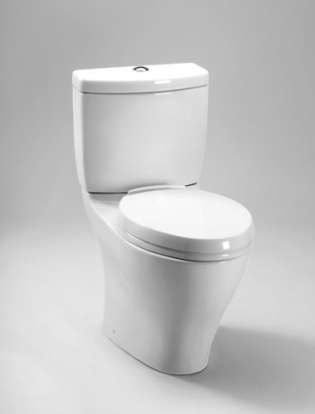
The Toto Aquia II Close Coupled Elongated Dual-Flush Toilet proves that even the most practical fixture in the house can have architectural ambitions. Sold under model number CST416M, this two-piece toilet combines a smooth skirted bowl, an elongated seat area, and two flush volumes designed to reduce unnecessary water use.
It is also a legacy model, so shoppers may encounter it as remaining dealer inventory, an open-box bargain, a replacement fixture, or an existing toilet inherited with a home. That makes a careful review especially important. The Aquia II has several genuinely appealing qualities, but it also brings installation requirements and everyday quirks that are easy to overlook when admiring its clean profile.
Editorial note: This guide covers the original Aquia II CST416M with 0.9- and 1.6-gallon flush settings. Specifications should not be confused with newer Aquia IV toilets, which use different flushing technology and water-consumption ratings.
Toto Aquia II Specifications at a Glance
| Model | CST416M |
|---|---|
| Configuration | Two-piece, close-coupled toilet |
| Bowl shape | Elongated |
| Flush system | TOTO Dual-Max gravity flushing |
| Flush volumes | 0.9 GPF reduced flush and 1.6 GPF full flush |
| Rough-in | 12 inches |
| Approximate dimensions | 27.5 inches deep, 15.25 inches wide, and 30.25 inches high |
| Trapway | 2-1/8-inch fully glazed, concealed trapway |
| Material | Vitreous china |
| Minimum water pressure | 8 psi static pressure |
| Seat | Typically sold separately |
| Original warranty | One-year limited warranty |
What “Close Coupled” Actually Means
A close-coupled toilet has a separate tank attached directly to the bowl. It is still a two-piece toilet, but the finished fixture looks visually compact because there is no exposed pipe connecting the tank and bowl.
The Aquia II takes that tidy appearance one step further with a concealed trapway. Instead of displaying the winding outline of the toilet’s internal drain channel, its exterior forms a smooth skirt around the base. The result is more modern than the average two-piece toilet and far easier to wipe down around the sides.
This is not merely a cosmetic detail. Conventional exposed trapways create curves, crevices, and bolt areas that collect dust with almost supernatural enthusiasm. The Aquia II replaces much of that obstacle course with broad ceramic surfaces. Cleaning behind the toilet is still nobody’s idea of a thrilling Saturday, but at least the fixture does not actively fight back.
How the Dual-Max Flush System Works
The Aquia II uses TOTO’s gravity-fed Dual-Max system. Two buttons on top of the tank allow the user to select the amount of water appropriate for the job.
The 0.9-Gallon Reduced Flush
The reduced setting is intended primarily for liquid waste. At 0.9 gallons per flush, it uses considerably less water than a conventional 1.6-gallon toilet. In a household where people consistently choose the correct button, these small savings accumulate over hundreds or thousands of flushes.
The 1.6-Gallon Full Flush
The full setting releases 1.6 gallons for solid waste and other situations requiring greater bowl evacuation. The larger flush is not unusually high by traditional federal standards, but it is higher than the 1.28-gallon maximum used by many newer high-efficiency toilets.
Real Water Savings Depend on User Behavior
Under the historical WaterSense calculation for dual-flush toilets, two reduced flushes and one full flush produce an effective average of approximately 1.13 gallons per use. That is roughly 29 percent less water than using 1.6 gallons every time.
The important phrase is “using the correct button.” If everyone presses the full-flush control out of habit, the toilet cannot perform water-saving magic through positive thinking. Clear household instructions help, especially when guests encounter the buttons for the first time.
Buyers should also understand that WaterSense requirements have evolved. A legacy Aquia II may have qualified under earlier effective-flush-volume rules, while newer standards and local rebate programs can apply different criteria. Verify current eligibility before counting on a utility rebate.
Comfort and Everyday Usability
The elongated bowl gives the Aquia II a roomier seating area than a round-front toilet. Many adults prefer this shape for comfort, although it projects farther into the room. Its roughly 27.5-inch overall depth is reasonable for an elongated model, but every inch matters in a small powder room.
The original Aquia II is generally considered a regular- or standard-height toilet rather than a universal-height or ADA-style fixture. That can feel perfectly natural to average-height users, but taller adults and people with limited knee or hip mobility may prefer a higher bowl.
The seat was normally sold separately. That provides freedom to choose a basic seat, a TOTO SoftClose model, or a compatible bidet seat, but it also means the advertised fixture price may not represent the complete installed cost. A dedicated adapter hose kit may be needed for certain TOTO Washlet installations.
Flushing Performance: Strong but Not Flawless
The 2-1/8-inch glazed trapway provides a capable waste path, and the full 1.6-gallon flush offers more volume than many current high-efficiency models. The flush is quick and purposeful rather than theatrical. There is no pressure-assist roar, no electrical system, and no secret turbine preparing for takeoff.
Independent performance references and many owner reports describe reliable waste removal when the toilet is properly installed and adjusted. The full flush is the setting to use for solids; expecting the reduced flush to perform every task is a reliable recipe for unnecessary repeat flushing.
One potential drawback is the relatively compact water surface. A smaller water spot supports water conservation, but it can allow more bowl streaking than some users expect. Occasional brush use may therefore be part of ownership, especially when compared with newer TOTO bowls using advanced rimless washing patterns and specialized ceramic glazes.
A second flush should not be routine. When it becomes common, the first things to examine are button adjustment, tank water level, flush-valve operation, drain condition, and whether the appropriate flush mode is being selected.
Cleaning and Maintenance
The skirted exterior is among the Aquia II’s best features. The concealed trapway removes much of the sculpted plumbing geometry found on ordinary toilets, leaving fewer edges where hair and dust can settle. The side mounting points are also covered after installation.
Inside the bowl, regular cleaning remains necessary. Use a nonabrasive bathroom cleaner and a soft toilet brush or pad. Harsh scouring products can dull the ceramic surface, turning a quick cleaning problem into a long-term finish problem.
Common Serviceable Components
TOTO documentation identifies replaceable parts including the fill valve, dual-flush valve, push-button assembly, tank-to-bowl gasket, flush-valve seals, mounting hardware, and plastic rough-in socket. Replacement components have remained available through TOTO parts sellers and plumbing-supply specialists, which is encouraging for owners maintaining an older fixture.
Always confirm the complete model number and color code before ordering. A part that looks almost correct in an online photo can become an expensive little sculpture when it does not fit the tank.
Installation Is More Involved Than It Looks
The Aquia II fits a nominal 12-inch rough-in, measured from the finished wallnot the baseboardto the center of the closet flange. Accurate measurement is essential because the tank needs adequate clearance from the wall.
Unlike many standard toilets that drop directly onto closet bolts, the Aquia II uses a plastic socket rough-in and separate floor-mounted blocks. The installer positions a supplied template over the flange, marks drilling locations, mounts the socket with a wax seal, secures the mounting blocks, and lowers the bowl over the assembly. Side screws then fasten the skirted bowl to those blocks.
This system creates the attractive concealed base, but it adds several opportunities for error. The template must be aligned correctly, the wax seal must seat properly, and holes may need to be drilled into tile, concrete, or wood. The bowl must also slide completely into the socket to prevent movement, odor leakage, or water leakage.
A confident DIYer with the correct drill bits can complete the installation. A homeowner who regards drilling porcelain tile as an invitation to financial tragedy should hire a plumber.
Installation Checklist
- Confirm a true 12-inch rough-in from the finished wall.
- Check the water-supply location against the skirted bowl.
- Verify that the socket, template, mounting blocks, and hardware are included.
- Use a new wax seal and avoid moving the socket after it is set.
- Do not overtighten ceramic, plastic, or tank hardware.
- Test both flush buttons and inspect all connections for leaks.
- Add the cost of a seat, supply line, and professional labor to the budget.
Advantages of the Toto Aquia II
- Two flush choices: The reduced setting can save substantial water when used consistently.
- Clean modern profile: The concealed trapway suits contemporary bathrooms.
- Easier exterior cleaning: Smooth sides eliminate many dust-catching curves.
- Comfortable elongated bowl: The shape offers more seating space than a round-front bowl.
- Capable full flush: The 1.6-gallon setting provides solid gravity-flush performance.
- Serviceable design: Many internal seals, valves, and mounting components can be replaced.
- Bidet-seat potential: The elongated bowl can accommodate compatible TOTO seats and Washlets.
Possible Drawbacks
- Legacy product status: New inventory, matching colors, and complete hardware kits may be difficult to find.
- Seat not included: A separate seat increases the final cost.
- Standard seating height: It may feel low to tall users or people with mobility limitations.
- More complicated installation: The socket and mounting-block system requires careful drilling and alignment.
- Small water surface: Some households may notice more frequent bowl streaking.
- Full flush uses 1.6 gallons: Newer toilets may achieve strong performance with 1.28 gallons or less.
- Short original warranty: A one-year limited warranty is modest compared with some newer fixtures.
Should You Buy an Aquia II Today?
The Aquia II can still be a sensible purchase when the unit is complete, undamaged, reasonably priced, and appropriate for the room. It is particularly attractive for replacing an existing CST416M because the rough-in socket and floor holes may already be present.
Exercise more caution with secondhand and open-box toilets. Confirm that the tank, bowl, tank lid, push-button assembly, socket rough-in, template, mounting blocks, side screws, gaskets, and caps are present. Missing proprietary installation components can erase the savings of a bargain surprisingly quickly.
For a completely new bathroom, compare the Aquia II with current Aquia IV models and other modern TOTO toilets. Newer choices may offer a lower full-flush volume, universal-height seating, improved bowl-cleaning technology, enhanced glazing, and easier access to warranties and matching parts.
Realistic Ownership Experience: What Living With the Aquia II Feels Like
The first impression is usually visual. Once installed, the Aquia II looks more expensive than a typical exposed-trapway toilet. The broad skirted base reduces clutter around the floor, and the high-profile tank gives the fixture a crisp, almost furniture-like outline. In a modern bathroom, it tends to blend quietly into the design rather than standing there like a white ceramic accordion.
The dual buttons introduce a brief learning period. Residents generally adapt quickly, but visitors may pause to solve what appears to be a tiny plumbing quiz. A simple rule works: use the smaller control for liquid waste and the larger control for solid waste. When everyone follows that routine, the reduced flush handles ordinary light use efficiently and the household notices fewer full-tank refills.
The full flush feels fast and direct. It does not rely on a long swirling performance, and the bowl empties with the compact urgency expected from a gravity-fed dual-flush system. When adjusted correctly, it should clear normal loads without drama. Heavy paper use, an incorrectly adjusted button, or choosing the reduced setting for solids can lead to an avoidable second flush.
Cleaning the outside is pleasantly uneventful. A cloth moves over the skirt without repeatedly stopping at trapway curves and bolt recesses. This advantage becomes more noticeable in homes with pets, where bathroom dust is apparently made from equal parts lint, hair, and mysterious ambition.
The inside of the bowl may require more attention. Owners accustomed to a large water surface sometimes notice marks above the waterline. Keeping a brush nearby solves the problem, but buyers seeking the lowest possible cleaning effort may prefer a newer bowl with a more aggressive washing pattern and advanced glaze.
Comfort depends strongly on the user. The elongated shape is spacious, but the regular bowl height may feel lower than contemporary comfort-height toilets. Children and shorter adults may appreciate that position, while taller users may immediately understand why universal-height fixtures became popular.
Maintenance is generally straightforward once the correct part numbers are identified. Fill valves, flush-valve seals, button assemblies, and tank gaskets can wear over time like those in any toilet. The difference is that an older Aquia may require more careful model matching than a generic builder-grade fixture. Saving the model number, parts diagram, and installation manual is a practical favor to your future self.
Installation quality has an outsized influence on the experience. A properly mounted Aquia II feels stable, flushes cleanly, and leaves an elegant base with hidden hardware. A poorly aligned socket or loose mounting block can create rocking, leaks, or unpleasant odors. This is one fixture where precision during installation pays rent every day afterward.
Overall, the Aquia II ownership experience is best described as stylish, water-conscious, and slightly particular. It rewards correct flush-button use, accurate installation, and occasional bowl brushing. In exchange, it delivers an uncluttered appearance and a practical dual-flush system that still feels thoughtful years after the model’s introduction.
Final Verdict
The Toto Aquia II Close Coupled Elongated Dual-Flush Toilet was an influential combination of water efficiency and minimalist bathroom design. Its 0.9-gallon reduced flush, capable 1.6-gallon full flush, elongated bowl, concealed trapway, and serviceable components remain useful qualities.
Its weaknesses are equally clear. It is a legacy model with standard-height seating, a separately purchased seat, a compact water surface, and an installation system that demands more precision than an ordinary toilet. Newer Aquia models also provide updated efficiency and cleaning features.
For an existing Aquia II owner, proper maintenance can keep the toilet operating for years. For a shopper considering old inventory, the decision depends on completeness, price, parts access, and installation costs. When those details line up, the Aquia II remains a handsome and functional fixturenot bad for an appliance whose main job is rarely mentioned at dinner.