Some stories begin with a flash in the sky. This one begins underground, hidden beneath sediment, farms, roads, river country, and a quiet town in southern New South Wales. Scientists have proposed that the Deniliquin structure in southeastern Australia may be the buried remains of the world’s largest asteroid impact structure ever identified. If confirmed, it would be a cosmic scar so large that calling it a “crater” feels almost impolitelike calling the Grand Canyon a pothole.
The possible Deniliquin impact structure is estimated to span up to about 520 kilometers, or roughly 323 miles, in diameter. That would make it far larger than the Chicxulub crater in Mexico, the impact site famously linked to the extinction of non-avian dinosaurs, and larger than the Vredefort structure in South Africa, widely regarded as Earth’s largest confirmed impact structure. But the most important word in this discovery is not “largest.” It is “possibly.” The claim is exciting, but science does not hand out world records just because a geological feature looks dramatic on a map.
At the center of the story is a serious scientific question: Is the Deniliquin structure truly the deep, eroded root of an ancient asteroid impact, or is it the result of another massive geological process? Researchers have found magnetic and gravity patterns, radial faults, and a deep structure that may fit the profile of a large impact basin. Yet direct physical evidence of shocksuch as shocked quartz, shatter cones, impact melt, or other unmistakable impact mineralshas not yet been recovered from deep drilling. In other words, the case is strong enough to be fascinating, but not yet strong enough to put the trophy on the mantle.
What Is the Deniliquin Structure?
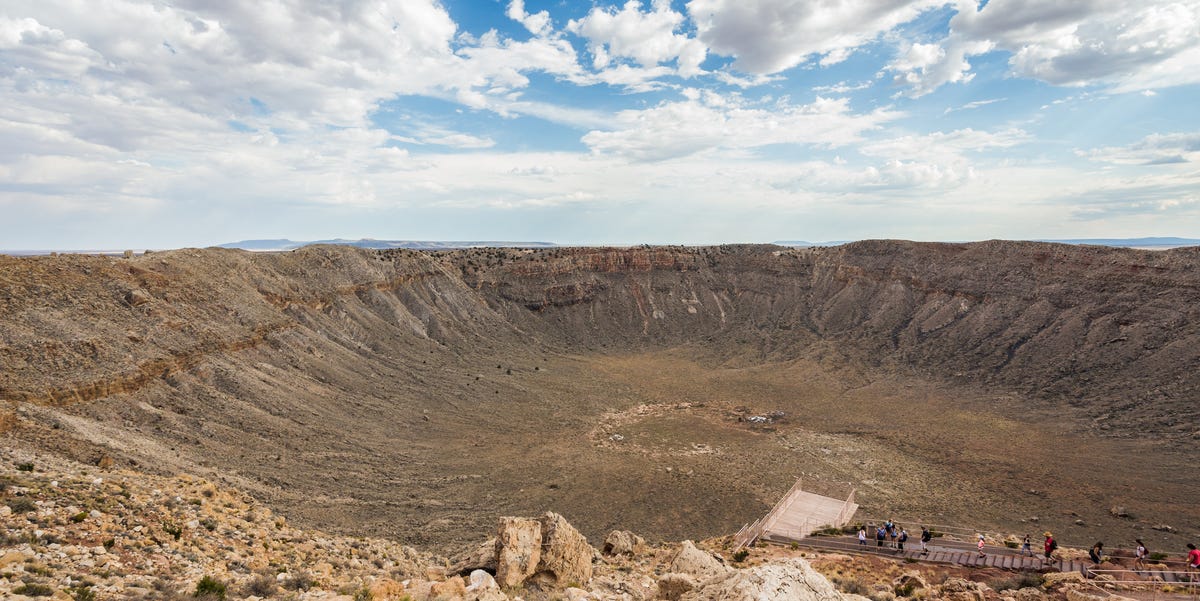
The Deniliquin structure lies beneath the Murray Basin near the town of Deniliquin in New South Wales, Australia. Unlike Arizona’s Meteor Crater, which is visible as a dramatic bowl in the desert, Deniliquin is buried deep below the surface. You cannot stand at the rim, snap a selfie, and caption it “casual asteroid damage.” The feature must be studied through geophysics: magnetic surveys, gravity data, seismic reflection profiles, drill samples, and regional geological mapping.
Researchers Andrew Glikson and Tony Yeates have argued that the Deniliquin multiple-ring feature may represent the deeply eroded root zone of a giant impact structure. A multiple-ring impact basin forms when an enormous collision deforms the crust on a scale far beyond a simple bowl-shaped crater. Instead of one neat rim, the crust can rebound, collapse, fracture, and reorganize into rings, central uplifts, radial faults, and deep anomalies. It is geology’s version of dropping a bowling ball into pudding, except the pudding is Earth’s crust and the bowling ball arrives from space at terrifying speed.
The proposed Deniliquin structure includes a broad circular pattern in total magnetic intensity data, a central magnetically quiet zone, circular gravity patterns, radial faults, and a shallower Moho beneath the region. The Moho, short for Mohorovičić discontinuity, marks the boundary between Earth’s crust and mantle. A shallower mantle dome can be interpreted as evidence that the crust rebounded after an enormous impact. That kind of rebound is expected in giant impact structures, where the crust behaves less like solid stone and more like very unhappy taffy under extreme stress.
Why This Possible Asteroid Impact Matters
If Deniliquin is confirmed as an asteroid impact structure, it could reshape the ranking of Earth’s largest known impact sites. Vredefort in South Africa is currently the heavyweight champion among confirmed terrestrial impact structures, with estimates commonly ranging from about 180 to 300 kilometers across. Chicxulub, buried partly under Mexico’s Yucatán Peninsula and the Gulf of Mexico, is roughly 180 kilometers wide and is linked to the mass extinction that ended the age of the dinosaurs around 66 million years ago.
Deniliquin, at a proposed diameter of up to 520 kilometers, would be in a different league. It would not merely beat the record; it would kick open the door, eat the record’s lunch, and leave a crater-shaped calling card. But the significance goes beyond size. Giant asteroid impacts are not just local disasters. They can change climates, alter oceans, trigger fires, launch dust and vaporized rock into the atmosphere, and disrupt ecosystems across the planet.
One hypothesis links the Deniliquin impact to the Hirnantian glaciation during the Late Ordovician Period, around 445 million years ago. This interval is associated with one of the major mass extinctions in Earth history. Marine life was hit especially hard, with many species disappearing as climate and sea levels changed. If a giant impact contributed to that crisis, Deniliquin could become a crucial clue in understanding how sudden extraterrestrial events interact with long-term climate and biological change.
The Evidence: What Scientists Have Found So Far
Magnetic and Gravity Patterns
Much of the Deniliquin argument comes from geophysical evidence. Magnetic surveys show broad circular and semi-circular patterns beneath the basin. Gravity data also reveal structures that researchers interpret as compatible with a deeply buried, multiple-ring impact basin. These patterns do not prove an asteroid impact by themselves, but they are important clues. In planetary geology, giant impacts often leave circular fingerprints in crustal structure long after surface features have been erased.
Radial Faults and a Central Quiet Zone
The Deniliquin feature appears to include radial faults extending away from a central region. In large impact structures, radial fractures can form as the crust is violently compressed, uplifted, and pulled apart during the impact and rebound process. The central magnetically quiet zone may represent deep deformation associated with an uplifted core. These features make the impact interpretation plausible, especially when combined with the overall circular geometry.
A Possible Mantle Dome
Another intriguing detail is the suggested mantle dome beneath the structure. In very large impacts, the crust can rebound upward after the initial excavation, producing a central uplift or deeper structural anomaly. Over hundreds of millions of years, erosion can remove the upper crater and leave only the deep root zone. That is one reason Deniliquin is so difficult to evaluate: scientists may not be looking at the original crater at all, but at the basement-level remains of something once much larger and more obvious.
Why Confirmation Is So Difficult
Earth is terrible at preserving evidence. That may sound rude, but it is true. Wind, water, sedimentation, volcanism, plate tectonics, erosion, metamorphism, and burial all work together like a cleanup crew with no interest in helping future geologists. On the Moon, craters can remain visible for billions of years. On Earth, the surface is constantly recycled, resurfaced, folded, buried, and weathered.
For a structure as old as Deniliquin may be, the original crater rim, central uplift, melt sheets, and ejecta deposits could be deeply buried or completely eroded. The region has also experienced a long and complicated tectonic history. That means circular patterns might have more than one possible explanation. Some scientists have suggested that the feature could relate to continental collision or other large-scale tectonic processes rather than an asteroid impact.
This is why direct evidence matters. The gold standard for confirming an impact includes shock metamorphic features: minerals and rocks altered by pressures far beyond ordinary volcanic or tectonic processes. Shocked quartz, shatter cones, impact melt rocks, breccias, tektites, and certain geochemical signatures can provide the hard proof that a space rock struck Earth. Without these, Deniliquin remains a compelling hypothesis rather than a confirmed champion.
How Deniliquin Compares With Chicxulub and Vredefort
Chicxulub is the celebrity crater. It has name recognition, a dramatic extinction story, and the kind of global consequence that makes documentary narrators lower their voices. The impactor that formed Chicxulub struck Earth around 66 million years ago and helped trigger the extinction of non-avian dinosaurs, along with many marine and terrestrial species. The crater is buried, but it has been studied through drilling, seismic data, gravity anomalies, ejecta layers, and global geochemical evidence.
Vredefort is older and larger among confirmed impact structures. Located in South Africa, it formed more than two billion years ago. The original crater has been deeply eroded, but the remaining dome and deformed rocks preserve evidence of extreme impact conditions. Vredefort is a reminder that huge impacts can survive in the geological record even when their original surface expression is mostly gone.
Deniliquin would be even bigger if confirmed. But comparing these structures also highlights the difference between “known,” “confirmed,” and “proposed.” Chicxulub and Vredefort have direct impact evidence. Deniliquin has impressive geophysical clues, but it still needs the kind of physical proof that can withstand decades of scientific scrutiny. In science, “maybe” is not a weakness. It is a holding area where exciting ideas wait for better evidence.
Could the Impact Have Triggered a Mass Extinction?
The most dramatic possibility is that Deniliquin may be connected to the Late Ordovician mass extinction, one of the largest extinction events in Earth’s history. During the Hirnantian stage, global cooling, glaciation, sea-level changes, and habitat loss devastated marine ecosystems. Because most complex life at the time lived in the oceans, a disruption to shallow seas had enormous consequences.
A giant asteroid impact could theoretically contribute to such a crisis by injecting dust, aerosols, and vaporized material into the atmosphere, reducing sunlight, cooling the planet, and disturbing ocean chemistry. However, linking a specific impact structure to a specific extinction event is difficult. Scientists must align dates, identify impact ejecta, locate global signatures, and rule out competing explanations. The Chicxulub impact is unusually well supported because its timing, global iridium layer, shocked minerals, crater structure, and extinction boundary line up so well.
For Deniliquin, the timeline is still under discussion. Some estimates place the feature between about 514 million and 417 million years old, while the Hirnantian extinction occurred around 445 million years ago. That overlap makes the hypothesis possible, but not settled. More precise dating and physical evidence will be essential before scientists can say whether Deniliquin was a planetary disaster-maker or simply an enormous geological mystery with excellent dramatic timing.
What Would Scientists Need to Prove It?
The next major step would be deep drilling into carefully selected parts of the structure. Surface data can suggest where to look, but drill cores can reveal what actually happened to the rocks. Researchers would search for shocked quartz, planar deformation features, impact melt, breccias, high-pressure minerals, and geochemical traces of extraterrestrial material. They would also try to date the affected rocks with enough precision to connect the structure to a specific event in Earth history.
That work would not be simple. Drilling deep into a buried structure is expensive, technically demanding, and slow. It requires funding, logistics, permissions, careful site selection, and teams capable of analyzing microscopic mineral evidence. Science may be thrilling, but it also has paperwork. A lot of paperwork. Somewhere, even the asteroid is probably waiting for an environmental assessment form.
If drilling reveals unmistakable shock evidence, Deniliquin could move from “possible” to “confirmed.” If it does not, the impact hypothesis may weaken, or scientists may conclude that the critical evidence was eroded away. Either result would be valuable. Even a negative result would improve understanding of southeastern Australia’s deep crustal history.
Why Australia Is a Hotspot for Impact Mysteries
Australia is an excellent place to study ancient geology because large areas preserve very old rocks and buried structures. The continent includes confirmed impact sites such as Gosses Bluff, Wolfe Creek, Acraman, and Yarrabubba. Some are visible at the surface; others are subtle or heavily eroded. The combination of ancient crust, sparse vegetation in many regions, mining exploration data, and advanced geophysical mapping makes Australia a natural laboratory for finding impact structures.
That does not mean every circular feature is a crater. Earth produces circles in many ways. Volcanoes, salt domes, tectonic arcs, collapsed basins, intrusions, and erosion patterns can all create suspiciously crater-like shapes. This is why impact scientists are cautious. A circle on a map is an invitation to investigate, not a final answer.
Deniliquin is especially interesting because it is not a neat surface crater. It is a buried, large-scale geophysical structure interpreted from patterns deep beneath the surface. That makes it harder to explain casually and harder to confirm quickly. It also makes the story more fascinating. The largest asteroid impact structure on Earth may not be a dramatic hole you can see from space. It may be a ghost of an impact, preserved as a deep structural memory in the crust.
What This Discovery Means for Planetary Defense
Ancient impact structures are not just geological curiosities. They are reminders that Earth is part of a busy solar system. Asteroids are rocky remnants from the early formation of the solar system, and many orbit the Sun between Mars and Jupiter. Some are nudged into near-Earth paths by gravitational interactions. Most pose no threat, but large impacts have happened before, and smaller impacts happen more often.
Modern planetary defense focuses on detecting near-Earth objects, tracking their orbits, assessing risk, and developing ways to prevent or reduce damage. NASA’s DART mission, which changed the orbit of the asteroid moonlet Dimorphos, showed that humans can alter the motion of a small celestial body under the right conditions. That is a remarkable achievement. It is also much more comforting than hoping the universe checks with us before throwing rocks.
Studying ancient impact structures helps scientists understand what impacts can do to climate, crust, oceans, and life. Deniliquin, if confirmed, would offer a rare chance to study the deep remains of a truly enormous collision. It could help answer questions about how mega-impacts affect Earth systems over short and long timescales.
Experience Notes: What the Deniliquin Story Teaches Us
Thinking about the possible Deniliquin asteroid impact is a strange experience because it changes how ordinary landscapes feel. A flat plain stops being just a flat plain. A quiet rural town becomes part of a planetary detective story. The ground beneath your feet no longer feels boring; it feels like a locked archive. Somewhere below layers of sediment may be evidence of a collision so enormous that it could have changed the course of life on Earth.
One useful way to experience this topic is to imagine traveling across southeastern Australia with a geologist’s mindset. At first glance, you might see farms, roads, rivers, open sky, and small communities. Nothing screams “ancient asteroid impact.” There are no flaming rocks, no movie-trailer shockwaves, no dinosaurs looking worried. But geology often hides its biggest stories in patterns too large for the human eye. You cannot understand Deniliquin by standing in one spot. You need maps, instruments, data, patience, and the humility to admit that Earth has been doing complicated things for longer than humans have been misplacing their car keys.
For writers, educators, and science communicators, the Deniliquin story is a perfect example of how to discuss uncertainty without draining the excitement from a discovery. It is tempting to write, “Scientists found the world’s largest asteroid crater,” because that sounds clean and clickable. But the more accurate version is better: “Scientists may have found it, and the evidence is intriguing, but confirmation requires deep drilling and shock evidence.” That sentence has suspense, honesty, and scientific integrity. It tells readers that discovery is not a single lightning bolt moment. It is a process of testing, arguing, revising, and occasionally saying, “Well, that was weirdlet’s drill a hole in it.”
For students, Deniliquin offers a memorable lesson in how science works. Scientists do not simply look at a circular pattern and declare victory. They compare magnetic anomalies, gravity signatures, regional geology, seismic data, drill cores, mineral textures, and alternative explanations. They ask whether the evidence fits an impact better than tectonics or other geological processes. This kind of reasoning is valuable far beyond geology. It teaches critical thinking: extraordinary claims can be exciting, but they need extraordinary support.
For travelers and curious readers, the story adds wonder to Australia’s landscape. The country is already famous for ancient rocks, deserts, reefs, fossils, and wildlife that seems designed by a committee with a sense of humor. Add possible mega-impact structures to the list, and Australia becomes even more extraordinary. You do not need to see a visible crater to appreciate the idea. Sometimes the most powerful landscapes are the ones whose biggest secrets are hidden underground.
The Deniliquin hypothesis also gives us perspective. Human history feels long until you compare it with 445 million years. Our cities, technologies, arguments, trends, and Wi-Fi passwords occupy only the thinnest surface layer of time. Beneath that layer are stories of vanished oceans, moving continents, mass extinctions, and possible asteroid impacts large enough to reshape the planet. That does not make human life small in a depressing way. It makes curiosity feel bigger. We live on a planet with a memory, and science is one of the best tools we have for reading it.
Finally, the experience of following this discovery is a reminder that the best science stories are not always settled. Some are open cases. Deniliquin may become the largest confirmed impact structure on Earth, or it may become a fascinating example of how non-impact geology can mimic cosmic violence. Either outcome is worth knowing. The real thrill is not just the possibility of a record-breaking crater. It is watching scientists carefully separate evidence from excitement, one buried clue at a time.
Conclusion
The possible Deniliquin asteroid impact structure in Australia is one of the most fascinating geological claims of recent years. If confirmed, it could become the largest known asteroid impact structure on Earth, potentially dwarfing Vredefort and Chicxulub. The evidence so far includes large-scale magnetic and gravity patterns, radial faults, a central quiet magnetic zone, and a possible mantle dome. These clues are consistent with a giant impact interpretation, but they are not yet the final proof.
The key to confirmation lies underground. Scientists need direct shock evidence from deep drilling before Deniliquin can officially claim the title of world’s largest asteroid impact structure. Until then, it remains a thrilling possibilitya buried giant, a geological mystery, and a reminder that Earth’s calm surface often hides a wild past. The story is not finished, and that is exactly what makes it so compelling.