Television loves a good cliffhanger, but sometimes the biggest drama happens after the credits roll. A joke lands badly. A plot line suddenly echoes a real-world tragedy. A children’s cartoon gets a little too adult for the juice-box crowd. Before long, an episode disappears from reruns, streaming platforms, DVD sets, or in the rarest cases, from television entirely.
These controversial TV episodes were not all “banned” in the same way. Some were temporarily pulled after public complaints. Some were edited and quietly returned. Others remain hard to find because networks, creators, or streaming services decided the baggage outweighed the entertainment value. Together, they show how TV history is not just written by writers’ rooms, but also by parents, advocacy groups, advertisers, executives, censors, and viewers with very active phone lines.
Why Do TV Episodes Get Pulled?
Episodes are usually removed for one of five reasons: offensive stereotypes, sexual content, graphic violence, safety concerns, or unfortunate timing. A story about school violence might be acceptable in February and impossible to air in April after a national tragedy. A comedy sketch that once passed standards may look very different decades later. And occasionally, a cartoon tells kids that spiders are harmless in a country where spiders are absolutely not here to make friends.
Below are 27 famous TV episodes that were pulled from airwaves, delayed, banned from reruns, removed from streaming, or never aired as originally planned.
27 Controversial TV Episodes That Disappeared
-
1. “The Puerto Rican Day” Seinfeld
This late-season Seinfeld episode sparked backlash over its depiction of Puerto Rican paradegoers and a scene involving a Puerto Rican flag. NBC apologized, and the episode was left out of early syndication packages before eventually returning. It remains a classic example of a sitcom joke turning into a cultural fire drill.
-
2. “Home” The X-Files
Fox aired “Home” once in 1996 and then kept it out of regular reruns for years. The episode’s grotesque story of incest, violence, and a hidden family secret was too much even for a series built on nightmares. Ironically, fans later embraced it as one of The X-Files’ boldest hours.
-
3. “Stark Raving Dad” The Simpsons
The 1991 episode featuring Michael Jackson as the voice of Leon Kompowsky was pulled from circulation after renewed allegations against Jackson surfaced in the documentary Leaving Neverland. Producers decided the episode should no longer be distributed, making it one of the most famous missing chapters in Simpsons history.
-
4. “The City of New York vs. Homer Simpson” The Simpsons
This episode originally aired in 1997 and featured Homer trying to retrieve his car near the World Trade Center. After the September 11 attacks, the episode was removed from rotation for years because the setting felt too painful. It later returned, but its absence showed how real-world tragedy can instantly change the meaning of a joke.
-
5. “200” South Park
South Park built its 200th episode around celebrity mockery and the forbidden depiction of Muhammad. The controversy was immediate, and the episode became difficult to access through official channels. For a show designed to offend almost everyone equally, “200” still managed to hit a censorship wall.
-
6. “201” South Park
The follow-up episode was even more controversial. Comedy Central heavily censored references to Muhammad and bleeped major portions of the episode’s closing speech. It was not widely rerun and remains one of the most discussed examples of network censorship, safety concerns, and satire colliding at full speed.
-
7. “Super Best Friends” South Park
This earlier episode included Muhammad among a team of religious figures. It aired before the later South Park Muhammad controversy exploded, but after “200” and “201,” it was pulled from official streaming availability. Sometimes an episode becomes controversial years after it first seemed survivable.
-
8. “Partial Terms of Endearment” Family Guy
Fox declined to air this abortion-themed Family Guy episode in the United States. The story follows Lois as a surrogate facing a difficult decision after the biological parents die. It later appeared on DVD and aired in some international markets, proving that “too controversial for broadcast” does not always mean “gone forever.”
-
9. “Œuf” Hannibal
NBC skipped this episode of Hannibal in the United States because its plot involved children being manipulated into murdering their families. Creator Bryan Fuller supported withholding it out of sensitivity to the national mood following real-world violence. The full episode later became available through digital and home releases.
-
10. “Please, Baby, Please” black-ish
ABC shelved this politically charged episode in 2018, reportedly over creative differences. The story addressed anxiety in America after the 2016 election, including discussions of protest, racism, and national division. It was finally released on Hulu in 2020, where viewers could decide for themselves what the network had been so nervous about.
-
11. “Earshot” Buffy the Vampire Slayer
This episode, involving a student with a gun, was delayed after the Columbine High School shooting in 1999. The story’s actual message was more complicated than early descriptions suggested, but the timing made it impossible for The WB to air as scheduled. It eventually aired months later.
-
12. “Graduation Day, Part Two” Buffy the Vampire Slayer
The Buffy season three finale was also delayed after Columbine because it featured students banding together in a violent school-set climax. The episode is now considered essential viewing, but at the time, the network chose caution over continuity.
-
13. “I’ll See You in Court” Married… with Children
Fox pulled this episode before it aired in the United States because of its sexual content. The plot involved the Bundys and the Rhoades discovering they had been secretly recorded at a motel. It became known as a “lost episode” until FX aired a version years later.
-
14. Episode 847 Sesame Street
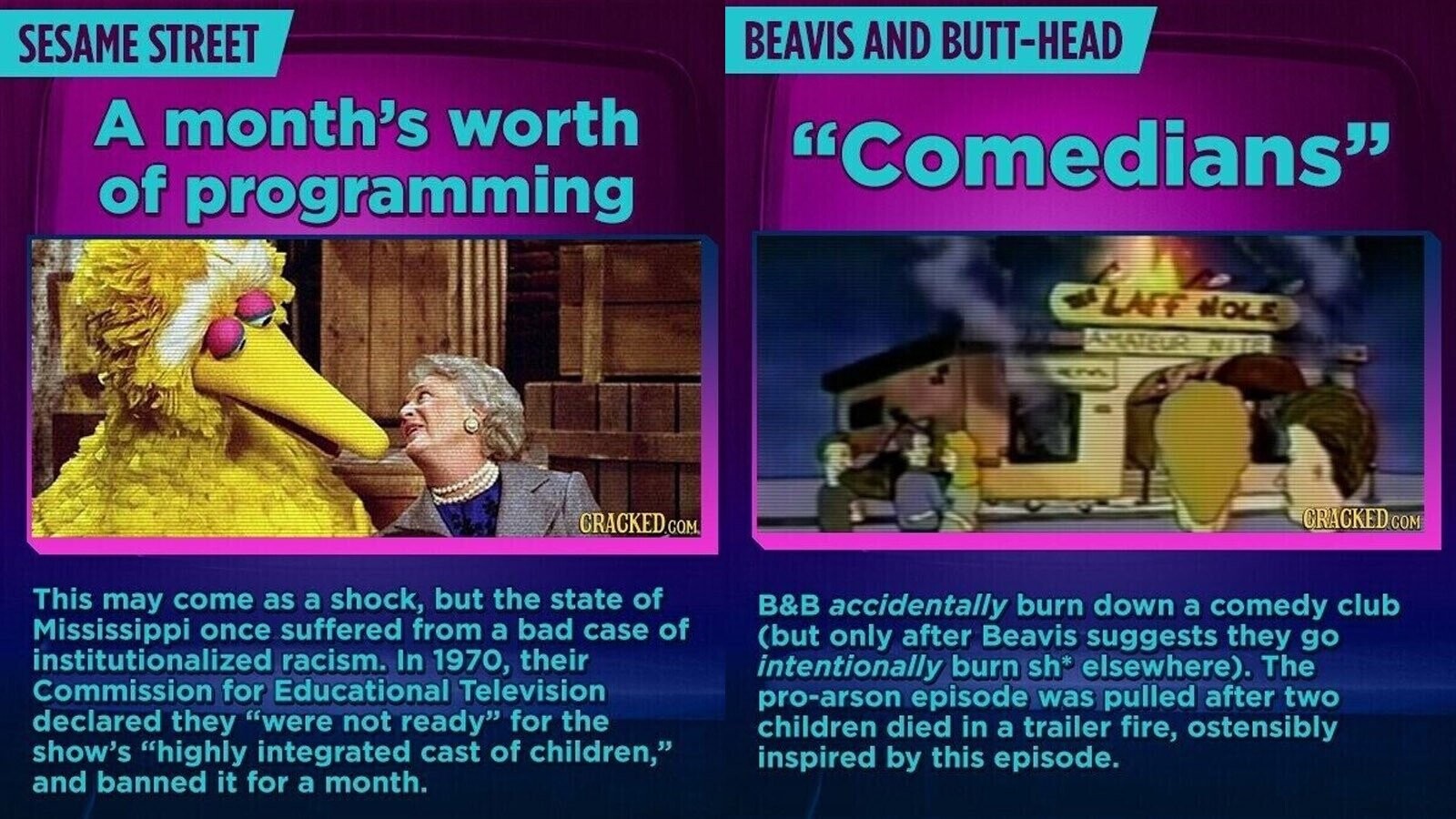
In 1976, Margaret Hamilton reprised her role as the Wicked Witch of the West on Sesame Street. The educational goal was to help children process fear, but many young viewers were reportedly terrified. After complaints from parents, the episode was pulled and never aired on television again.
-
15. “Electric Soldier Porygon” Pokémon
This infamous 1997 episode aired once in Japan and triggered seizure-like symptoms in hundreds of viewers because of rapidly flashing red and blue lights. The Pokémon anime went on hiatus, the episode was permanently removed, and it never aired internationally. Pikachu caused the flash, but poor Porygon took the public-relations thunderbolt.
-
16. “Beauty and the Beach” Pokémon
This episode was skipped during the original American run because of scenes involving James wearing a bikini with inflatable breasts. A heavily edited version later aired as a “lost episode,” with the most controversial footage removed. It remains one of the earliest examples of localization changing what American children saw.
-
17. “The Legend of Dratini” Pokémon
This Pokémon episode never aired in the United States largely because it featured frequent gun use, including characters being threatened at gunpoint. The omission created continuity confusion because Ash caught several Tauros in the episode, and thensurprise!they simply existed later.
-
18. “Mid-Life Crustacean” SpongeBob SquarePants
Nickelodeon removed this episode from rotation after a standards review found some story elements inappropriate for children. The main issue was a “panty raid” sequence involving SpongeBob, Patrick, and Mr. Krabs. For a show about a sponge living in a pineapple, this was apparently where the line had to be drawn.
-
19. “Kwarantined Krab” SpongeBob SquarePants
This episode was delayed because its plot involved a disease outbreak at the Krusty Krab. During the COVID-19 pandemic, a quarantine comedy aimed at kids was not exactly the escapism families were ordering. It eventually aired later, after the real-world context had cooled down.
-
20. “Advanced Dungeons & Dragons” Community
This beloved Community episode was removed from Netflix and Hulu because Chang appears in dark makeup while role-playing as a “dark elf.” Many fans argued the context was different from traditional blackface, but streamers still pulled the episode during the broader 2020 reckoning over racist imagery in comedy.
-
21. “Believe in the Stars” 30 Rock
Tina Fey and NBCUniversal asked distributors to remove several 30 Rock episodes involving race-changing makeup. “Believe in the Stars” includes Jenna darkening her skin during a misguided identity-swap storyline. The removal showed how even self-aware satire can age into something creators no longer want circulating.
-
22. “My Jiggly Ball” Scrubs
Scrubs also removed episodes from Hulu over blackface scenes, including “My Jiggly Ball.” Creator Bill Lawrence supported the decision and later apologized for the show’s handling of those jokes. Medical comedy is one thing; old racial makeup gags are another, and no prescription fixes that cleanly.
-
23. “The Gang Makes Lethal Weapon 6” It’s Always Sunny in Philadelphia
Several It’s Always Sunny episodes disappeared from streaming because of blackface and brownface in the gang’s homemade action-movie parodies. The show later addressed the controversy through meta-commentary, but the removed episodes remain a reminder that “the characters are terrible people” is not always enough protection.
-
24. “Mixed Blessings” The Golden Girls
Hulu removed this episode in 2020 over a scene where Blanche and Rose appear wearing mud masks while meeting a Black family. Many viewers criticized the decision, arguing that the context was not blackface. The controversy became a debate about whether platforms were making thoughtful choices or panic-clicking the delete button.
-
25. “Boston” Aqua Teen Hunger Force
This unaired episode was created after the 2007 Boston Mooninite panic, when a guerrilla marketing campaign for the Aqua Teen Hunger Force movie was mistaken for a bomb threat. Adult Swim pulled the episode to avoid pouring gasoline on a public-relations bonfire. An unfinished version later leaked online.
-
26. “See Me, Feel Me, Gnomey” The Powerpuff Girls
This rock-opera-style episode was reportedly held back in the United States over concerns about religious imagery and cult-like themes. It later became available, but its strange path made it a favorite among fans of “wait, Cartoon Network banned what?” trivia.
-
27. “Rude Removal” Dexter’s Laboratory
This episode was produced but never aired on Cartoon Network because it centered on rude clones of Dexter and Dee Dee who curse constantly. The profanity was bleeped, but the concept was still too spicy for a children’s cartoon. Years later, Adult Swim released it online, turning a forbidden cartoon into a cult artifact.
What These Pulled TV Episodes Tell Us About Pop Culture
The most interesting thing about controversial TV episodes is that they rarely disappear for only one reason. Usually, the problem is a messy cocktail: timing, tone, audience expectations, advertiser anxiety, and the changing moral temperature of the culture. A joke that squeaks by in 1998 may look radioactive in 2026. A frightening scene that adults find clever may send preschoolers sprinting behind the sofa. A political episode that feels urgent to a writer may feel financially dangerous to a network executive who can already hear the angry emails arriving in formation.
These episodes also prove that “pulled” does not always mean “bad.” Some removed episodes are genuinely clumsy, offensive, or irresponsible. Others are thoughtful stories caught in awful timing. “Earshot” is not pro-school violence; it is actually concerned with pain, isolation, and misunderstanding. “Œuf” was not necessarily more graphic than the rest of Hannibal; it simply touched a nerve at the wrong moment. Meanwhile, episodes like “Electric Soldier Porygon” were not controversial because of theme or ideology, but because they exposed a serious safety problem in broadcast animation.
Streaming has made the issue even stranger. In the old days, an episode could vanish from reruns and become a rumor passed around by fans. Today, viewers notice immediately when season three jumps from episode two to episode four. Missing episodes become screenshots, Reddit threads, TikTok explainers, and “Why can’t I watch this?” articles. The attempt to erase controversy often creates a brighter spotlight. The internet is basically a raccoon with Wi-Fi: if you hide something shiny, it will find it.
For publishers, writers, and entertainment fans, these stories are useful because they show how media ages in public. TV is not frozen at the moment it airs. It keeps meeting new audiences, new politics, new tragedies, and new standards. Sometimes that means a warning label would be better than deletion. Sometimes removal is understandable. Sometimes the decision is so cautious that it becomes its own controversy, as with “Mixed Blessings.” The best approach depends on context, but the conversation itself matters.
Personal Viewing Experience: Why Missing Episodes Fascinate Fans
There is a special kind of curiosity that comes with a missing TV episode. Tell viewers an episode is “not available,” and suddenly it becomes the most interesting episode in the entire series. It could be a masterpiece, a disaster, or eleven minutes of confused cartoon characters yelling at a potato, but the mystery adds flavor. That forbidden label turns ordinary television into pop-culture archaeology.
Many fans first encounter these episodes through gaps. You watch a streaming service and notice an episode number is missing. You buy a DVD set and find a disclaimer. You read a fan forum where someone casually mentions, “Oh, that one was banned,” and suddenly your relaxed evening has become a research project with snacks. The experience feels like discovering a secret room in a house you thought you knew.
What makes the topic so compelling is the clash between memory and access. Older viewers may remember seeing an episode once on television, only to discover it is no longer available. Younger viewers may know a show only through streaming and never realize they are watching a curated version. That missing piece changes how we understand a series. In comedy especially, removed episodes can reveal where a show’s writers were pushing boundaries, where they misjudged the room, and where society later moved the boundary line.
There is also a difference between watching a pulled episode for shock value and watching it critically. The best viewing experience is not “How offensive is this?” but “Why did this cause a reaction, and what does that reaction reveal?” For example, “Home” from The X-Files remains disturbing because it was designed to be disturbing. “Advanced Dungeons & Dragons” raises a harder question about context, intent, and platform responsibility. “Electric Soldier Porygon” is less a moral scandal than a landmark in safety standards. Each case teaches something different.
As a viewer, the most valuable lesson is that television is never just entertainment. It is a time capsule. Every pulled episode carries the assumptions of the people who made it, the network that approved it, the audience that reacted to it, and the culture that later re-examined it. Some episodes deserve to stay unavailable for practical or ethical reasons. Others deserve preservation with context, because pretending awkward history never happened is not the same as learning from it. Either way, controversial TV episodes remind us that the remote control has always been connected to something bigger than the screen.
Conclusion
Controversial TV episodes live in the strange space between entertainment, history, and public debate. Some were pulled because they were offensive. Some were delayed because the world changed overnight. Some never aired because executives decided the risk was too high. And some became more famous in disappearance than they ever would have been in regular rotation.
The larger lesson is not simply that television used to be edgier or that modern platforms are more cautious. It is that every generation renegotiates what it wants from media. We want comedy, but not cruelty. We want honesty, but not carelessness. We want archives, but not harm without context. That is a tricky balance, and TV has been wobbling on that tightrope for decades.
Note: Availability for pulled TV episodes can change by region, platform, licensing agreement, and standards review. This article summarizes widely documented cases and focuses on why each episode became controversial.