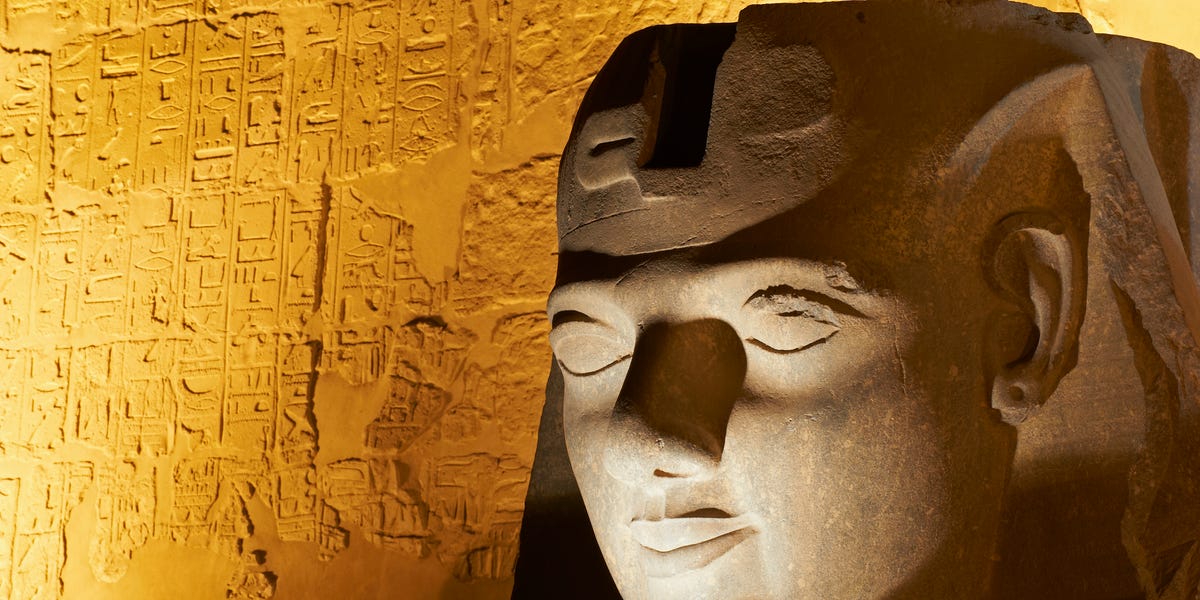
The phrase “Ramses II’s lost sarcophagus found” sounds like the opening line of a blockbuster movie: wind, sand, dramatic music, and someone yelling, “Don’t touch the glowing hieroglyph!” The real story is quieter, smarter, and in many ways more exciting. Archaeologists did not stumble into a secret golden chamber. Instead, a long-overlooked granite fragment, discovered years earlier in Abydos, has now been identified as part of the long-lost outer sarcophagus of Ramses II, one of ancient Egypt’s most famous pharaohs.
This major archaeological discovery matters because it solves a funerary mystery that has followed Ramses II for more than a century. His mummy was known. His wooden coffin was known. His tomb in the Valley of the Kings was known. But the large stone sarcophagus that once helped protect the king’s burial had vanished into the fog of looting, reuse, and history’s favorite hobby: making life difficult for modern researchers.
The newly identified piece is not just another carved stone. It is a 1.7-meter-long granite panel that once formed a major section of Ramses II’s outer sarcophagus. Its inscriptions, royal cartouche, and decoration helped Egyptologist Frédéric Payraudeau connect the object to the great pharaoh. In archaeology, that is the scholarly equivalent of finding a name tag on a 3,000-year-old mystery.
Who Was Ramses II?
Ramses II, also spelled Ramesses II, ruled Egypt during the 19th Dynasty, from about 1279 to 1213 BCE. Known as Ramses the Great, he reigned for roughly 66 years, making him one of the longest-ruling monarchs in ancient Egyptian history. If ancient Egypt had a “most likely to put his name on everything” award, Ramses II would not only win ithe would commission a colossal statue of himself holding the trophy.
His reign was marked by military campaigns, monumental building projects, and a carefully managed royal image. He is closely associated with the Battle of Kadesh against the Hittites, one of the most famous chariot battles of the ancient world. He also helped shape a peace agreement with the Hittites, often described as one of the earliest known international peace treaties.
But Ramses II’s biggest legacy may be architectural. He built or expanded temples across Egypt and Nubia, including Abu Simbel and the Ramesseum. His name appears on countless monuments, sometimes because he built them, and sometimes because he “borrowed” older monuments by adding his own royal signature. Ancient branding, it seems, did not begin with coffee cups.
What Exactly Was Found?
The discovery centers on a granite sarcophagus fragment found in 2009 beneath the floor of a Coptic building in the Abydos region of Egypt. At first, researchers knew the object was important. Its scale, material, and decoration suggested that it belonged to a very high-ranking person from the Egyptian New Kingdom. However, its original owner remained uncertain.
The fragment had also been reused. That is a crucial part of the story. The sarcophagus was later adapted for Menkheperre, a High Priest of Amun from the 21st Dynasty, around 1000 BCE. Because of this reuse, later inscriptions partially obscured earlier ones. Imagine trying to read a royal business card after someone wrote a grocery list over itexcept the grocery list is also ancient and historically significant.
Frédéric Payraudeau reexamined the hieroglyphic evidence and noticed that a cartouche previously linked to the later owner actually belonged to the earlier inscription layer. That cartouche contained the coronation name of Ramses II. Combined with the decorative program, especially imagery connected to the Book of Gates, the evidence pointed strongly to a royal sarcophagus from the Ramsesside period.
Why the Sarcophagus Was “Lost”
Ramses II was originally buried in tomb KV7 in the Valley of the Kings. Like many royal tombs, it was looted in antiquity. His burial equipment was damaged, stripped, moved, or reused. The inner alabaster sarcophagus associated with his tomb had been found smashed into fragments, while his mummy was eventually transferred into a wooden coffin and placed in the Deir el-Bahari Royal Cache, known as TT320.
For years, scholars knew pieces of the burial story, but the outer granite sarcophagus remained missing. The newly identified panel changes that. It shows that Ramses II’s burial arrangement was more elaborate than the surviving evidence alone suggested: a lost gold coffin, an inner alabaster sarcophagus, and a larger outer granite sarcophagus.
This is why the discovery is so important. It does not simply add one object to the museum checklist. It reconstructs part of the royal burial system of one of Egypt’s greatest pharaohs. It also shows how ancient tombs were not frozen in time. They were entered, robbed, rearranged, recycled, and sometimes “officially” repurposed by later authorities.
The Mystery of Reuse in Ancient Egypt
Modern readers may hear “reused sarcophagus” and picture grave robbers dragging priceless objects away under moonlight. That happened, but the bigger picture is more complicated. During the 21st Dynasty, Egypt faced political, economic, and social pressures. Valuable materials such as gold, fine wood, and carved stone were limited. Royal funerary equipment from earlier dynasties became a tempting resource.
Some reuse may have been framed as protection. Priests and officials moved royal mummies from vulnerable tombs into caches, likely to guard them from looters. At the same time, many objects were stripped, modified, or reassigned. The line between preservation and appropriation could be thinner than a linen mummy wrapping.
The Ramses II sarcophagus fragment offers a rare window into this process. The same stone object carried the identity of a legendary pharaoh and later a powerful priest. The surface itself became a historical palimpsest, with one layer of authority carved over another.
How Researchers Identified Ramses II’s Sarcophagus
1. The Royal Cartouche
In ancient Egyptian writing, a cartouche is an oval frame surrounding a royal name. It works a little like a flashing neon sign that says, “Important person here.” Payraudeau’s close reading showed that the earlier inscription layer contained the coronation name of Ramses II. This was the key evidence linking the fragment to the pharaoh.
2. The Book of Gates Decoration
The fragment also included decoration associated with the Book of Gates, a funerary text used in royal contexts during the Ramsesside period. This strengthened the case that the original owner was not merely a prince or noble, but a king.
3. The Quality and Scale of the Stone
The granite panel is large, heavy, and finely decorated. Such craftsmanship suggests elite, royal-level use. A sarcophagus of this kind was not the ancient Egyptian equivalent of a budget storage box. It was built for someone at the very top of society.
4. The Pattern of Later Reuse
The second use by Menkheperre matches what researchers know about 21st Dynasty funerary reuse. Ramses II’s successor, Merneptah, also had funerary equipment reused by later rulers. The newly identified fragment fits this broader historical pattern.
Why This Discovery Matters for Archaeology
The identification of Ramses II’s lost sarcophagus is a reminder that archaeology is not always about digging deeper. Sometimes it is about looking again. The object was found in 2009, but its full significance emerged through careful reanalysis years later. In other words, archaeology occasionally says, “Hold my brushI need to reread that inscription.”
This matters because museums, storerooms, excavation archives, and previously published finds may still contain major discoveries waiting to be recognized. New technology helps, but so does old-fashioned expertise: knowing scripts, understanding styles, comparing inscriptions, and asking whether a previous interpretation truly fits the evidence.
The discovery also helps scholars better understand the fate of royal burials in the Valley of the Kings. Ramses II was not just buried and left in peace. His mummy and burial equipment had an afterlife of their own, shaped by looting, priestly intervention, and the practical needs of later generations.
Common Misunderstandings About the Discovery
Was Ramses II’s Mummy Newly Found?
No. Ramses II’s mummy was discovered in the Royal Cache at Deir el-Bahari in 1881. The recent discovery concerns the identification of a granite sarcophagus fragment, not the discovery of the mummy itself.
Was a Complete Sarcophagus Found?
No. The object is a large fragment, likely nearly one side of the outer sarcophagus. Its curved edges were probably broken off in antiquity, possibly so the flat slab could be reused as paving or building material.
Was It Found in Ramses II’s Tomb?
No. The fragment was found in Abydos, beneath the floor of a Coptic building. This is part of what makes the story so fascinating: the sarcophagus traveled, was reused, and ended up far from its original royal burial setting.
Ramses II, Memory, and the Power of Names
Ramses II understood the power of being remembered. His monuments were enormous, his inscriptions were everywhere, and his royal image was carefully polished. The rediscovery of his sarcophagus fragment proves that names can survive even when gold is stolen, tombs are plundered, and stone is reused.
There is something poetic about that. The pharaoh who spent a lifetime carving his identity into Egypt’s landscape was identified through a partially obscured inscription on a damaged slab. Three thousand years later, the name still did its job.
What Happens Next?
The fragment is currently stored in Abydos. Its future display will depend on Egyptian authorities and collaborating researchers. If it is eventually exhibited, it could become a major attraction because it connects directly to Ramses II’s burial, the Valley of the Kings, Abydos, and the broader story of how ancient Egypt handled royal death and memory.
For the public, the find offers a more realistic view of archaeology. Discoveries are not always shiny, complete, or instantly understood. Sometimes the biggest breakthrough is a damaged stone panel with overwritten hieroglyphs. Glamorous? Maybe not at first glance. Historically powerful? Absolutely.
Experiences Related to the Discovery: How to Appreciate Ramses II’s Lost Sarcophagus Like an Insider
To truly appreciate the discovery of Ramses II’s lost sarcophagus, it helps to imagine archaeology as a slow conversation with the past rather than a treasure hunt. The best experience begins with patience. Look at the object not as a broken slab, but as a survivor. It passed through royal burial rituals, ancient looting, reuse by a later priest, relocation to Abydos, burial beneath a Coptic structure, excavation, publication, and finally reidentification. That is not just an artifact; that is a biography carved in granite.
If you are planning a museum visit or writing about ancient Egypt, start by comparing three layers of Ramses II’s afterlife: his monuments, his mummy, and now his sarcophagus fragment. His monuments show how he wanted to be seen in life: powerful, divine, victorious, and larger than everyone elsesometimes literally. His mummy reminds us that even the greatest ruler became a human body requiring care, protection, and relocation. The sarcophagus fragment adds the missing middle layer: the protective royal container that once helped frame his journey into eternity.
A useful experience is to study images of cartouches before reading about the find. Once you understand that a cartouche encloses a royal name, the discovery becomes easier to follow. You begin to see why one small inscription can change an entire interpretation. Archaeology often turns on details that casual viewers might miss: a name, a symbol, a reused line, a decorative scene. The drama is real, but it is written in tiny clues rather than movie explosions.
Another way to connect with the discovery is to think about reuse. In modern life, we recycle furniture, renovate old buildings, and repurpose materials when resources are scarce. Ancient Egyptians did the same, though on a far grander and more sacred scale. A royal sarcophagus could become the burial container of a later high priest. A coffin could be stripped and reworked. A tomb could be emptied, resealed, or turned into a cache. This does not make ancient people careless. It makes them practical, political, religious, and human.
For travelers, the discovery creates a meaningful triangle: Luxor, Abydos, and Cairo. Luxor holds the Valley of the Kings, where Ramses II was first buried. Abydos is where the granite fragment was found. Cairo preserves major royal mummies and coffins connected to Egypt’s dynastic past. Even if you never board a plane, you can recreate that route through books, museum collections, documentaries, and digital exhibitions.
The most rewarding experience is to let the discovery correct the usual myth of archaeology. The past is not always “found” in one dramatic moment. Sometimes it is found, labeled, studied, doubted, reexamined, and finally understood. Ramses II’s lost sarcophagus teaches that history can hide in plain sight, waiting for the right question. And yes, sometimes the right question is basically: “Are we sure that ancient name was read correctly?”
Conclusion
The identification of Ramses II’s lost sarcophagus is a major archaeological discovery because it restores a missing piece of one of ancient Egypt’s most famous royal burials. A granite fragment found in Abydos has revealed that Ramses II was once placed inside a large outer sarcophagus, later reused by Menkheperre during the 21st Dynasty. The evidence comes from a royal cartouche, layered inscriptions, and decoration linked to the Book of Gates.
More than a headline, this discovery deepens our understanding of royal burial, tomb looting, funerary reuse, and the long afterlife of Egyptian kings. Ramses II spent his reign building monuments to preserve his name. Ironically, one of the most important pieces of his burial story survived not because it remained untouched, but because it was reused, buried, forgotten, and finally read again.