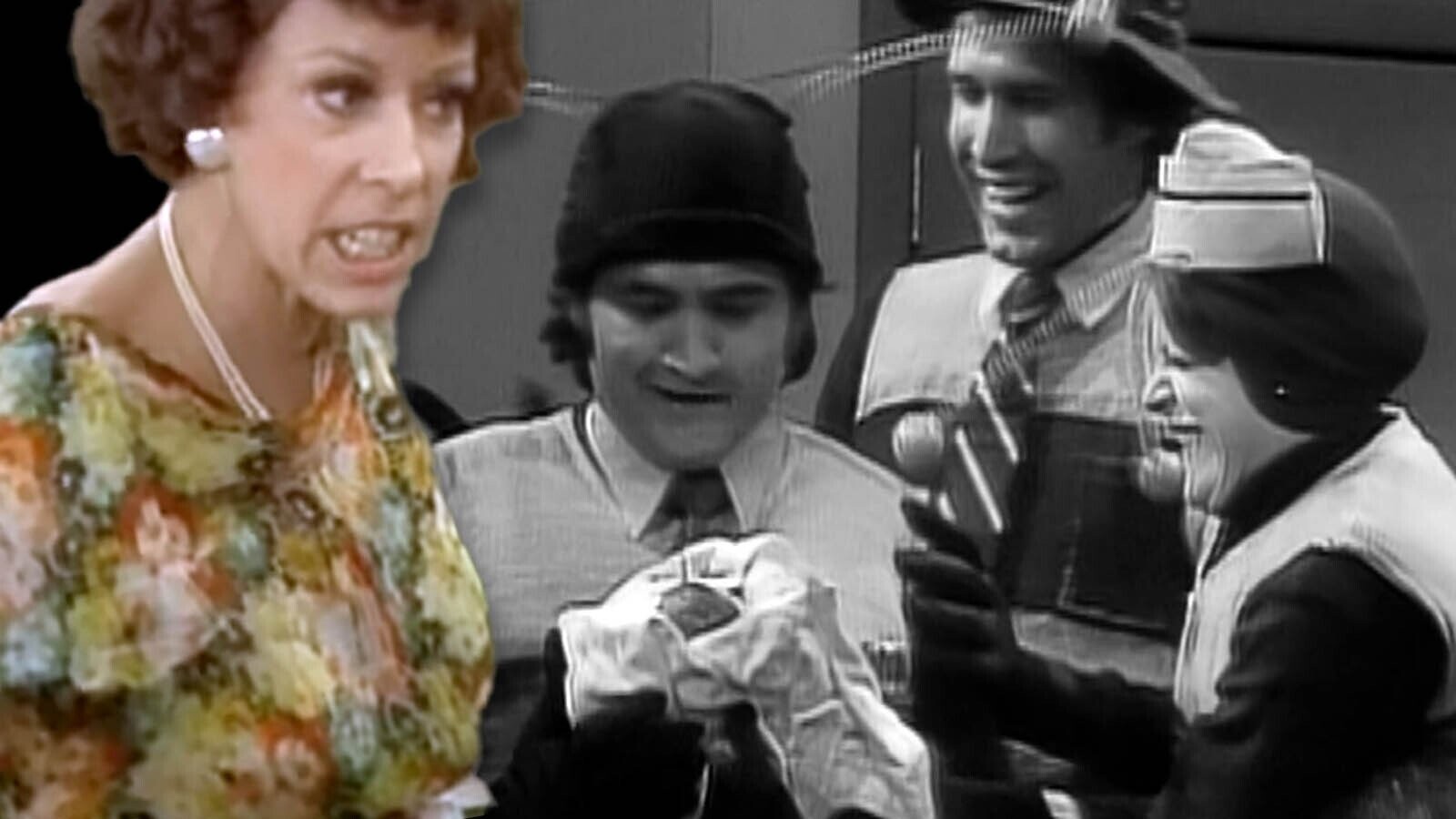
In the early days of Saturday Night Live, few insults could sting a writer’s ego quite like being told a sketch was “too Carol Burnett.” Today, that sounds almost absurd. Calling something “too Carol Burnett” now feels like saying a cake is “too delicious” or a puppy is “too emotionally available.” Carol Burnett is widely beloved, a comedy legend whose influence stretches across sketch comedy, variety television, sitcoms, drag, musical parody, and basically every performer who has ever made a funny face on purpose.
But in the mid-1970s, inside the young, restless, smoke-filled, sleep-deprived world of early Saturday Night Live, “Carol Burnett” meant something very specific. It meant broad. It meant polished. It meant old-fashioned. It meant television your parents understood. And for Lorne Michaels and his original team, that was exactly what they were trying not to be.
The phrase was not really about Carol Burnett the person. It was about what her show represented to a group of young comedians desperate to invent a new language for late-night television. The irony, of course, is delicious: SNL eventually became the very kind of American comedy institution it once rebelled against. That is not a failure. That is what happens when the cool kids live long enough to become the faculty.
The Comedy World Before SNL: Carol Burnett Was the Gold Standard
Before Saturday Night Live premiered in 1975, The Carol Burnett Show was one of the most successful and recognizable sketch-variety programs on American television. Airing on CBS from 1967 to 1978, the show combined comedy sketches, musical numbers, celebrity guests, movie parodies, recurring characters, and vaudeville-style performance. It was elegant, silly, theatrical, and tightly produced.
Burnett worked with a gifted ensemble that included Harvey Korman, Vicki Lawrence, Lyle Waggoner, and Tim Conway. Together, they delivered sketches that could be smart, sentimental, ridiculous, and occasionally so funny that the cast members visibly fought to keep their faces from collapsing into laughter. Viewers loved that. The crack-ups became part of the pleasure. Watching Korman lose it because Conway had pushed a bit into comic madness felt like being allowed backstage without leaving the couch.
The show also had a warm relationship with its audience. Burnett’s famous opening question-and-answer segments made her feel approachable, almost like America’s funniest aunt had invited the country into her living room. Her ear tug at the end of each episode became a personal signature. The whole operation had polish, heart, and a sense of theatrical generosity.
That warmth was exactly what early SNL distrusted.
What “Too Carol Burnett” Meant Inside Early Saturday Night Live
To understand why “too Carol Burnett” was a diss, you have to step into the mind-set of early Saturday Night Live. The original show, first titled NBC’s Saturday Night, premiered on October 11, 1975. It was created by Lorne Michaels and built for a late-night audience that television executives were still learning how to reach. This was not prime-time family entertainment. It was live, young, strange, urban, and occasionally rude enough to make a network executive’s tie tighten by itself.
Michaels wanted the show to feel different from the familiar variety format. He did not want a gleaming parade of safe jokes and big musical entrances. He wanted something closer to counterculture: comedy that felt handmade, unpredictable, skeptical, and connected to the world younger viewers actually inhabited.
In that environment, calling a sketch “too Carol Burnett” meant it felt too conventional. It suggested the joke was too neat, the ending too tidy, the performance too theatrical, or the premise too rooted in older variety-show instincts. Even the word “skit” became suspect. Early SNL preferred “sketch,” a word that sounded sharper, more writerly, and less like something performed at a church talent night between a bake sale announcement and a recorder solo.
The insult carried several meanings at once:
1. Too Broad
Burnett’s comedy often embraced physical exaggeration, big characters, loud reactions, and theatrical setups. That was part of its charm. But early SNL wanted a cooler, more ironic tone. It wanted the audience to feel like they were catching something slightly dangerous, not applauding a beautifully delivered punch line with a bow on it.
2. Too Polished
The Carol Burnett Show was a professional machine. Costumes, music, staging, choreography, and guest-star integration were handled with old-school show-business skill. Early SNL, by contrast, cultivated a rougher energy. Its unfinished edges became part of the brand. A sketch could feel like it had been written at 4 a.m. because, frankly, it probably had been.
3. Too Comfortable
Burnett’s audience knew it was in good hands. Early SNL wanted viewers to wonder whether anyone was in charge at all. That tension was part of the electricity. The show felt like it might fail in real time, which made the laughs sharper when it succeeded.
4. Too Willing to Break
One major divide involved performers laughing during sketches. On The Carol Burnett Show, breaking character could become a beloved moment. On early SNL, Michaels reportedly viewed breaking as disrespectful to the writing. The idea was simple: the sketch itself should be funny, not the actor’s inability to survive it.
Carol Burnett Was Not the ProblemShe Was the Target Because She Was the Standard
The funniest thing about the insult is that it only worked because Carol Burnett mattered so much. Nobody builds a rebellion against something irrelevant. Early SNL positioned itself against Burnett’s style because her show was the dominant model of sketch-variety television. She was the mountain in the distance. Michaels did not want to climb it. He wanted to build a nightclub underneath it and invite George Carlin.
Burnett represented an older comedy lineage: vaudeville, Broadway, musical revue, Hollywood parody, and CBS prime-time polish. SNL represented late-night irreverence, National Lampoon energy, post-Watergate cynicism, New York anxiety, and jokes that looked like they had not asked permission from anyone’s parents.
That difference was generational as much as artistic. Burnett’s comedy often worked from shared cultural references and exaggerated human behavior. SNL wanted to sound like the inside of a younger, more suspicious American brain. It leaned into topical humor, fake news, anti-establishment attitudes, and sketches that sometimes seemed to end not with a punch line but with a shrug, a scream, or Chevy Chase falling down.
The First SNL Era Wanted Comedy With “Integrity”
The early SNL writers and performers were not simply rejecting laughs. They were rejecting a certain kind of laugh. A traditional variety sketch might build toward a clean comic payoff. Early SNL often preferred discomfort, irony, oddness, or a joke that seemed to evaporate before the audience could decide whether it had landed.
That attitude could produce brilliance. It gave American television sketches that felt fresh, nervy, and impossible to imagine on prime-time CBS. The first generation of SNL included John Belushi, Gilda Radner, Dan Aykroyd, Jane Curtin, Laraine Newman, Garrett Morris, and Chevy Chase. Their work helped shape a new comedy vocabulary: more topical, more deadpan, more self-aware, and more openly suspicious of show-business gloss.
But that attitude also came with a little snobbery. Actually, let’s be honest: it came with enough snobbery to qualify for its own parking spot at 30 Rock. Early SNL sometimes treated traditional joke construction as corny. Going for a big laugh could be viewed as selling out. That is a risky belief for a comedy show, because audiences generally enjoy laughing. They can be old-fashioned that way.
Why the Diss Feels So Ironic Now
History has a wicked sense of humor. Over the decades, Saturday Night Live became a polished television institution with celebrity hosts, musical guests, recurring characters, anniversary specials, viral clips, and a national audience that includes multiple generations. In other words, it became exactly the sort of major American comedy machine that young rebels usually claim they will never become.
The show also softened its once-strict attitude toward breaking. Some of modern SNL’s most beloved moments involve cast members trying not to laugh. Think of sketches where performers crack under pressure, where the audience laughs partly because the actors are laughing too. That pleasure is not so far from the joy of watching Tim Conway destroy Harvey Korman’s composure.
So the grand joke is this: the thing early SNL mocked as “too Carol Burnett” turned out to be a durable part of television comedy. Audiences like warmth. They like chaos. They like performers who seem human. They like seeing the machinery wobble. The Burnett style was not a fossil. It was a reminder that comedy is communal. Sometimes the laugh is in the writing. Sometimes it is in the performance. Sometimes it is in watching a trained professional lose a battle with their own face.
The “Went with the Wind!” Factor
No discussion of Carol Burnett’s comedy legacy is complete without “Went with the Wind!,” her legendary parody of Gone with the Wind. In the sketch, Burnett appears in a curtain dress designed by Bob Mackie, complete with the curtain rod still attached across her shoulders. The visual gag is so perfect that it barely needs a line. It is comedy engineering: one glance and the joke has already moved into your house, opened the fridge, and started eating leftovers.
That sketch shows why Burnett’s comedy endured. It was broad, yes, but broad does not mean lazy. The costume joke worked because it was specific, theatrical, and instantly readable. It trusted the audience to understand the movie reference while also giving them a physical image so silly that no advanced degree in satire was required.
Early SNL may have wanted to run in the opposite direction, but Burnett’s best work had something any sketch show needs: clarity. A great sketch needs a premise the audience can grasp quickly. It needs escalation. It needs performers who commit. Whether the tone is Broadway, rock and roll, punk, absurdist, or aggressively dressed in beige, the fundamentals still matter.
Was the “Too Carol Burnett” Diss Sexist?
This question has become more complicated with time. Carol Burnett herself has wondered publicly why she was never invited to host SNL, especially given how many SNL alumni admire her. Some observers see the old “too Carol Burnett” attitude as part of a broader pattern in which women’s comedy, especially warm or domestic comedy, was treated as less serious than male-coded counterculture humor.
There is a fair argument there. Early SNL had its own gender problems, and several women connected to the show have spoken over the years about the challenges of getting material respected. When comedy about suburban life, relationships, family, divorce, or emotional messiness gets dismissed as “middle-aged stuff,” it is worth asking whose experiences are being treated as artistically valuable.
At the same time, the phrase was also stylistic. Michaels seemed to be drawing a line between Broadway-influenced variety comedy and the rock-and-roll identity he wanted for SNL. The problem is that style and gender are not always easy to separate. In American entertainment, what gets called “edgy” and what gets called “corny” often says as much about cultural power as it does about craft.
The fairest conclusion is that “too Carol Burnett” was both an aesthetic judgment and a revealing cultural reflex. It showed how badly early SNL wanted to be new. It also showed how easily “new” can define itself by sneering at what women had already built.
Carol Burnett’s Influence on SNL Alumni
The strange twist is that many performers associated with SNL adore Burnett. Tina Fey, Amy Poehler, Maya Rudolph, Julia Louis-Dreyfus, Kristen Wiig, and many others have either cited Burnett directly or worked in comedy traditions that clearly owe something to her. Character work, physical boldness, musical parody, ensemble timing, and the ability to look ridiculous without apology are all part of the Burnett inheritance.
That influence is especially visible in performers who combine elegance with absurdity. Kristen Wiig can play a character who seems socially normal for three seconds and then reveal an entire haunted furniture store inside her personality. Amy Poehler’s bright comic intelligence often carries a Burnett-like openness. Maya Rudolph’s musicality and character transformations feel connected to the variety-show tradition, updated for a modern audience.
In that sense, SNL did not defeat Carol Burnett’s style. It absorbed parts of it, resisted others, and eventually proved that American sketch comedy is healthiest when it has room for both cool irony and giant curtain rods.
Why the Diss Still Matters in Comedy History
The phrase “too Carol Burnett” matters because it captures a key moment in American television: the shift from prime-time variety warmth to late-night counterculture attitude. It shows how comedy evolves not only by inventing new forms but by rejecting old ones, sometimes unfairly.
Every new comedy generation does this. Young creators look at the reigning style and declare it dead, stale, safe, or embarrassing. Then they borrow half its tools, change the lighting, add sharper language, and call it a revolution. This is not hypocrisy. It is tradition wearing sunglasses.
Early SNL needed Carol Burnett as a negative example. The writers needed a phrase that could protect the show’s identity. “Too Carol Burnett” was a creative border wall: no broad endings, no sentimental applause, no obvious joke buttons, no cozy prime-time rhythm. It helped define what SNL was by naming what it refused to be.
But time has been kind to Burnett. The qualities once mocked as too broad or too theatrical now look like strengths. Her show understood something that never goes out of style: people enjoy watching gifted performers play together. They enjoy jokes with shape. They enjoy a little humanity with their satire. And sometimes, yes, they enjoy a comedian breaking because the moment has become too funny to survive.
Experience Section: What Modern Creators Can Learn From the “Too Carol Burnett” Debate
The “too Carol Burnett” story offers a surprisingly useful lesson for anyone who writes, performs, produces, edits, or even watches comedy with more seriousness than their group chat recommends. The lesson is not simply “respect your elders,” although that is a good start, especially if the elder in question can turn a curtain rod into comedy history. The deeper lesson is that every creative identity needs boundaries, but boundaries can become blind spots.
Imagine being a young writer in the first years of SNL. You are working inside a brand-new format. The hours are terrible. The pressure is ridiculous. The network does not fully understand what you are making. The audience may or may not follow you into the weird corner you have chosen. In that environment, having a phrase like “too Carol Burnett” is useful. It gives the room a shared language. It says, “That is not us.” Creative teams need that. Without taste boundaries, every project becomes soup.
But the danger is that a useful shorthand can turn into lazy thinking. Once “too Carol Burnett” becomes an automatic rejection, writers may stop asking whether the idea is actually bad. Maybe the sketch is not corny. Maybe it is clear. Maybe the big laugh is not cheap. Maybe the audience wants the release of a strong punch line after three minutes of weirdness. Maybe the old form has something to teach the new one.
This applies far beyond sketch comedy. Bloggers, YouTubers, filmmakers, podcasters, newsletter writers, and social media creators all define themselves against something. “We are not like old media.” “We are not like corporate brands.” “We are not like boring educational channels.” “We are not like those polished influencers who alphabetize their spice racks and pretend it happened naturally.” That rejection can be energizing. It can also become a trap.
The smartest creators learn to separate style from substance. Early SNL was right to chase a new tone. It needed to be late-night, young, topical, and strange. But Burnett’s show still had lessons worth stealing: ensemble trust, physical commitment, memorable characters, visual jokes, audience connection, and disciplined rehearsal. A creative rebellion works best when it rejects the stale parts of the past while quietly pocketing the useful parts like hotel shampoo.
For comedy writers, the practical takeaway is simple: do not be afraid of a big laugh. A joke can be obvious and still be excellent if it arrives with timing, surprise, and character. Do not confuse subtlety with quality. Some of the funniest moments in television history are subtle. Others enter wearing drapes. Both can be art.
For performers, Burnett’s legacy is a masterclass in commitment. She never seemed embarrassed by looking silly. That is harder than it sounds. Many performers want to be funny while still looking cool. Burnett understood that comedy often asks you to sacrifice coolness on the altar of the laugh. You cannot pratfall halfway. You cannot play vanity while secretly protecting your own. The audience can smell hesitation, and it smells like an unbuttered airport bagel.
For producers and editors, the debate is a reminder that tone is everything. Lorne Michaels protected the early tone of SNL fiercely because he knew the show could not become just another variety program. That discipline helped create a television landmark. But long-running shows also need flexibility. What feels forbidden in year one may become essential in year twenty. If an audience loves a performer breaking, maybe the rule needs rethinking. Rules are useful until they start guarding an empty room.
For viewers, the experience is even more fun. Knowing the history makes both shows richer. You can watch The Carol Burnett Show and see not just old-fashioned variety, but a highly skilled ensemble building laughter with precision and warmth. You can watch early SNL and see not just youthful arrogance, but a real attempt to change television’s rhythm. The friction between them is the story of American comedy growing up, getting a leather jacket, becoming famous, buying nicer shoes, and eventually realizing Mom had some great jokes all along.
In the end, “too Carol Burnett” was the ultimate diss on early Saturday Night Live because it named the one thing the show feared becoming: safe, broad, mainstream, and beloved by everyone. The punch line is that becoming beloved by everyone is not the worst fate for a comedy show. Carol Burnett proved that. SNL proved it too, though it took the scenic route through irony, fake news, Coneheads, cowbells, political cold opens, and many performers trying desperately not to laugh on live television.
Conclusion
“Too Carol Burnett” was more than a throwaway insult. It was a mission statement disguised as a put-down. Early Saturday Night Live wanted to be everything Burnett’s prime-time variety show was not: younger, stranger, rougher, more topical, more ironic, and less willing to chase the obvious laugh. That creative rebellion helped shape one of the most important comedy programs in television history.
But the phrase also reveals the limits of rebellion. Carol Burnett’s comedy was not merely broad or old-fashioned. It was expertly performed, emotionally generous, visually inventive, and deeply influential. The very qualities SNL once mocked eventually found their way back into mainstream sketch comedy, including SNL itself.
The ultimate lesson is that comedy history is not a clean handoff from old to new. It is a family argument at Thanksgiving where everyone denies sounding like their parents, then uses the same serving spoon. Early SNL needed to reject Carol Burnett to become itself. Later comedy needed to rediscover her to remember what great sketch performance can do.