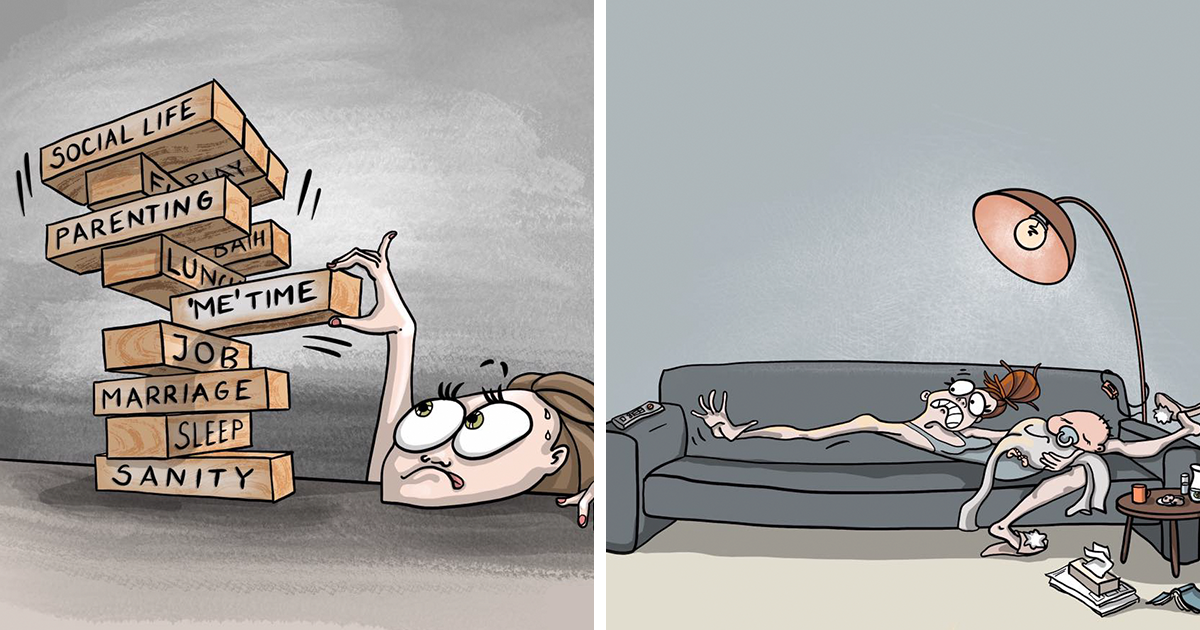
Parenthood is a magical journey, assuming your definition of “magical” includes stepping on a wooden block at 6:12 a.m., negotiatina toddler household is never peacefulit is evidence.
That is the messy little universe behind “Toddlerama”, a collection of funny parenting comics about the beautiful, sticky, confusing, snack-covered experience of raising a small child. These comics were born from the everyday frustrations of parenthood: the interrupted coffee, the dramatic bedtime monologues, the suspiciously wet socks, and the emotional plot twists that arrive before breakfast.
But “Toddlerama” is not about complaining for the sake of complaining. It is about laughing at the chaos before the chaos turns you into a person who whispers “please nap” into the void. Parenthood can feel isolating, especially when social media makes it look like every other family is eating organic rainbow lunches in linen outfits while your toddler is licking a shopping cart. Humor becomes a way to say, “Yes, this is ridiculousand yes, I love them more than anything.”
What Is “Toddlerama” Really About?
“Toddlerama” is a comic-style love letter to the uncensored side of parenthood. It focuses on the stage when children are old enough to have opinions but not quite old enough to understand why crayons do not belong in electrical outlets. The result is a world where every ordinary moment can turn into a tiny domestic epic.
The comics capture scenes many parents know by heart: the toddler who refuses dinner and then demands crackers five minutes later, the parent who tries to work while being used as climbing equipment, the bedtime routine that somehow requires three books, two songs, one missing stuffed animal, and a legal closing argument.
These parenting comics work because they are specific. They do not simply say, “Kids are hard.” They show the small absurd details: the cup that is unacceptable because it is blue, not the other blue; the toy that has been ignored for six months but becomes sacred the instant another child touches it; the parent who finally sits down and immediately hears, “Mom? Dad? I need something.”
Why Parenthood Feels So Funny After It Stops Feeling Impossible
There is a strange delay in parenting humor. In the moment, a toddler meltdown in the cereal aisle can feel like a full public relations crisis. Later, once everyone is safe, fed, and no longer screaming about the wrong banana, it becomes a story. Then, with enough distance and caffeine, it becomes a comic.
Toddlerhood is naturally dramatic because young children are still learning how to handle big emotions, communicate clearly, and manage disappointment. A toddler is not trying to ruin your day because the toast was cut into squares instead of triangles. They are experiencing betrayal at a Shakespearean level with a vocabulary of about 200 words and zero chill.
That is why humor matters. It gives parents a pressure valve. It turns the messy parts of raising kids into something shareable. When a parent sees a comic about sleep deprivation, snack negotiations, or the mysterious disappearance of every matching sock, they do not just laugh. They feel seen.
The 18 Comic Moments Every Parent Recognizes
The “Toddlerama” concept can stretch across dozens of parenting situations, but these 18 classic comic ideas represent the heart of the series. Each one takes a familiar frustration and exaggerates it just enough to reveal the truth hiding underneath.
1. The Snack Negotiator
A toddler asks for a banana. You peel the banana. The toddler cries because the banana is now “open.” This comic belongs in a museum, preferably next to other great works of human suffering.
2. The Bedtime Escape Artist
Bedtime begins as a routine and ends as a hostage negotiation. One more story becomes one more sip of water, one more hug, one more question about dinosaurs, and one sudden need to discuss the moon.
3. The Public Meltdown
Nothing tests inner peace like a toddler becoming horizontal on a store floor. The comic version is funny because every parent has performed the same awkward dance: calm voice, fake smile, emergency exit strategy.
4. The Toy Ownership Crisis
A toy may sit untouched for months. But if another child picks it up, it becomes the most important object in civilization. The toddler’s legal argument is simple: “Mine.” Case closed.
5. The Parent Who Just Wants Coffee
In the comic, a parent reaches for a warm mug. A toddler appears like a tiny supervisor and immediately needs help with something urgent, sticky, and probably imaginary.
6. The Laundry Mountain
Before kids, laundry is a chore. After kids, laundry becomes a weather system. One comic panel shows a parent folding clothes; the next shows a toddler jumping into the pile like a raccoon in a fabric store.
7. The Bathroom Audience
Privacy becomes a myth parents tell child-free friends. A “Toddlerama” bathroom comic practically writes itself: one parent, one closed door, one tiny voice asking, “What are you doing?”
8. The Dinner Rejection
You prepare a balanced meal. Your toddler rejects it with the confidence of a restaurant critic. Ten minutes later, they eat a floor Cheerio with deep spiritual commitment.
9. The Car Seat Acrobat
Getting a toddler into a car seat can look like trying to buckle a small octopus into a rocket ship. The parent is sweating. The toddler is boneless. The clock is laughing.
10. The Sudden Independence Speech
“I do it myself!” is a powerful sentence. It can mean putting on shoes, pouring milk, brushing teeth, or attempting a task that will add 24 minutes and three towels to your day.
11. The Tiny Fashion Director
The toddler refuses pants, demands rain boots, adds a superhero cape, and declares the outfit complete. Honestly, the confidence is inspiring.
12. The Mystery Silence
A quiet toddler is not relaxing. It is a suspense movie. The comic panel shows a parent enjoying ten seconds of peace, followed by the discovery of marker art on the wall.
13. The Emotional Support Rock
Children attach meaning to objects adults do not understand: a leaf, a spoon, a broken sticker, a rock named Kevin. Losing it may trigger a family-wide search mission.
14. The Nap Refusal
The toddler is exhausted. The parent is exhausted. The stuffed animals are exhausted. Everyone agrees sleep would help, except the one person who needs it most.
15. The “Why?” Spiral
One question becomes 47. “Why is the sky blue?” turns into “Why do clouds exist?” then “Why are we people?” Somewhere in the background, a parent quietly forgets every science class they ever took.
16. The Sticker Disaster
Stickers are joy until they appear on furniture, pets, appliances, and one sleeping adult’s forehead. “Toddlerama” understands that stickers multiply when unsupervised.
17. The Goodbye That Takes Forever
Leaving the house requires shoes, snacks, water, wipes, a toy, another toy, emotional closure, and a toddler who suddenly needs to inspect a pebble.
18. The Heart-Melting Finale
After a day of chaos, the toddler gives one tiny hug or says one sweet sentence, and suddenly the whole circus feels worth it. Parenting is unfair that way. It exhausts you, then ambushes you with love.
Why Funny Parenting Comics Are So Relatable
Parenting comics succeed because they compress emotional truth into a simple visual punchline. A single panel can show what a thousand-word parenting essay might struggle to explain: the contradiction of being completely overwhelmed and completely in love at the same time.
The humor also works across families because toddler behavior is surprisingly universal. Different homes have different rules, cultures, routines, and parenting styles, but most parents eventually meet the same tiny chaos goblin wearing pajamas at noon. Children want autonomy before they have judgment. They want control before they understand consequences. They want the purple cup, except when they want the green cup, and may the odds be ever in your favor.
Comics are especially good at showing the parent’s inner monologue. On the outside, a parent may calmly say, “I see you’re upset.” On the inside, they may be thinking, “We are both crying over a waffle.” That gap between what parents feel and what they try to model is where the comedy lives.
The Hidden Seriousness Behind the Jokes
Even the funniest parenthood comics are built on real pressure. Modern parents are often juggling work, money worries, childcare costs, health concerns, social comparison, and the constant feeling that they should be doing more. Add toddlerhood to the mix, and the emotional volume gets turned up.
That is why a series like “Toddlerama” matters. It takes private frustration and makes it public in a gentle, funny way. It says that losing patience sometimes does not make someone a bad parent. It makes them human. It says that feeling tired does not cancel out love. It says the perfect-parent fantasy is not only unrealistic; it is boring. Nobody wants a comic about a parent calmly packing a nutritionally balanced lunch while birds fold the laundry.
Honest parenting humor can also help reduce shame. When parents see others joking about the same struggles, they may feel less alone. That shared laughter can become a small form of support, especially for new parents who are still adjusting to the shock of having their time, body, home, and identity rearranged by someone who cannot pronounce “spaghetti.”
What “Toddlerama” Says About Modern Parenthood
The best part of “Toddlerama” is that it does not pretend parenthood is one thing. It is not all joy. It is not all sacrifice. It is not all messy buns, inspirational quotes, and glowing sunsets at the playground. It is a rotating combination of comedy, exhaustion, tenderness, confusion, and snack crumbs.
Modern parenthood is full of contradictions. Parents are told to be patient but also productive, gentle but firm, present but employed, relaxed but informed, fun but structured, and somehow well-rested while living with a person who wakes up because their blanket “looked at them.”
Comics cut through that noise. They do not lecture. They point at the absurdity and let parents laugh. A good parenting comic does not need to solve the problem. It only needs to say, “I know. Me too.”
Why Sharing Frustration Can Be Healthy
There is a difference between mocking children and laughing at the impossible situations parenthood creates. “Toddlerama” lands on the caring side of that line. The jokes are not cruel. They are affectionate. The toddler is not a villain; the toddler is a tiny person learning how to be a person. The parent is not a failure; the parent is a tired adult doing their best inside a house where someone has hidden a cheese stick in a shoe.
Sharing frustration through art can help parents process everyday stress. Drawing a comic turns a difficult moment into a story with shape, timing, and meaning. The parent gets to step back and say, “That was hard, but also incredibly funny.” That shift does not erase the challenge, but it makes it easier to carry.
It also invites community. A comic about toddler tantrums may make one parent laugh, another parent comment, and a third parent send it to a friend with the sacred message: “This is us.” In that moment, humor becomes connection.
How Parents Can Find Their Own “Toddlerama” Moments
Not every parent draws comics, but every parent collects stories. The trick is noticing them before they disappear into the blur of daily survival. A “Toddlerama” moment might be the time your child insisted on wearing mittens in July. It might be the day they named every raisin before eating it. It might be the morning you said, “Please don’t put yogurt in the toy truck,” and realized this sentence had never existed before you became a parent.
Parents can turn frustration into humor by looking for the twist. What made the moment absurd? What did the toddler think was happening? What was the parent trying to accomplish? What tiny disaster interrupted it? The comedy is usually hiding in the mismatch between adult logic and toddler logic.
For example, an adult sees bath time as hygiene. A toddler sees it as a water-based performance art festival. An adult sees bedtime as rest. A toddler sees it as a final opportunity to ask about mortality, dinosaurs, and whether socks have feelings. An adult sees a grocery trip as errands. A toddler sees it as a snack parade with fluorescent lighting.
Lessons Hidden in the Chaos
Behind every funny parenting comic is a little lesson, though usually one wearing mismatched socks. “Toddlerama” reminds parents that control is often an illusion. You can prepare the bag, plan the route, pack the snacks, and still end up carrying a crying child under one arm while holding a single shoe.
It also reminds us that children are not inconvenient adults. They are beginners. Their brains are still building the systems that help with patience, language, impulse control, and emotional regulation. That does not make tantrums pleasant, but it does make them more understandable.
Most of all, the comics show that love does not always look calm. Sometimes love looks like cleaning applesauce off the wall. Sometimes it looks like reading the same book nine times. Sometimes it looks like apologizing after snapping, trying again, and making pancakes shaped like a creature that was supposed to be a bear but looks legally questionable.
Personal Experiences: Living Inside the Toddlerama Zone
The longer you spend around toddlers, the more you understand that parenthood is less like managing a household and more like hosting a tiny, emotional game show where the rules change every seven minutes. One morning can begin with cuddles and end with someone sobbing because their shadow is “following them.” You learn to expect the unexpected, and then the unexpected spills juice on your clean shirt.
One of the most relatable experiences behind “Toddlerama” is the loss of ordinary adult confidence. Before parenthood, many people believe they are patient, organized, and reasonably intelligent. Then a toddler asks why water is wet, refuses the sandwich they specifically requested, and hides your keys in a toy oven. Suddenly, you are not a competent adult. You are a detective wearing yesterday’s sweatshirt.
Another familiar experience is the emotional whiplash. A toddler can push every button you have, including buttons you did not know were installed. They can scream because you prevented them from eating a receipt, then climb into your lap five minutes later and pat your face with sticky hands. The frustration is real, but so is the tenderness. That combination is what makes parenting humor so rich. It is not just “kids are wild.” It is “kids are wild, and somehow I would fight a bear for this person who just poured cereal into my shoe.”
There is also the strange loneliness of parenting, even when you are never physically alone. You may spend all day with a child touching your arm, calling your name, asking for help, and narrating the emotional life of a plastic dinosaur. Yet adult conversation can feel rare. That is where funny comics can become surprisingly comforting. They create a little window. Through that window, another parent waves and says, “Yes, the dinosaur also lives at my house.”
The experience of making or reading parenthood comics can also soften the memory of hard days. A tantrum, while it is happening, can feel endless. But when turned into a comic, it becomes a scene with a beginning, middle, and punchline. The parent is no longer trapped inside the frustration; they are observing it, shaping it, and maybe even laughing at it. That does not mean every difficult moment is funny immediately. Some moments need time, sleep, and maybe a snack. But humor often arrives later like a friend who knows the back door code.
“Toddlerama” also reflects the way parents become fluent in a private family language. You learn which cup is “the good cup.” You learn that “I’m not tired” means sleep is approaching with the force of a freight train. You learn that a toddler saying “uh-oh” from another room deserves immediate investigation. These details may seem small, but they are the raw material of family life. They become the stories people tell years later, when the toys are packed away and the walls are finally free of crayon.
Perhaps the biggest experience connected to “Toddlerama” is learning to lower the bar without lowering the love. Some days, success is not a clean house, a perfect routine, or a calm educational activity involving wooden toys and natural light. Some days, success is everyone being fed, safe, and only mildly sticky. Some days, the victory is choosing not to argue with a toddler dressed as a frog at the supermarket. Parenthood teaches humility with impressive efficiency.
In the end, the “Toddlerama” experience is about survival with affection. It is about turning frustration into art, exhaustion into jokes, and chaos into connection. It celebrates the parents who are doing their best, the toddlers who are doing their loudest, and the strange little moments that become funny once the floor is clean and the tiny person is asleep.
Conclusion
“Toddlerama” works because it tells the truth in a way parents can laugh at. It captures the daily absurdity of raising toddlers without losing sight of the love underneath. The comics are funny because they are familiar: the tantrums, the snack demands, the bedtime delays, the fierce independence, the mysterious messes, and the sudden sweetness that makes the whole exhausting adventure feel worth it.
Parenthood is not polished. It is not always graceful. Sometimes it is loud, sticky, and held together by coffee, patience, and the hope that the missing toy is not in the toilet. But when parents share those moments honestly, they create something better than perfection. They create recognition. They create laughter. And sometimes, that is exactly what another tired parent needs.
Note: This article is written as an original, web-ready SEO feature inspired by real parenting challenges, toddler development patterns, and the relatable humor tradition of parenthood comics.