Before kids had phones, streaming apps, and the ability to accidentally terrify themselves with an algorithm at 2 a.m., they had the Scholastic Book Fair. And sitting there on the table, glowing like cursed treasure under fluorescent school lights, were the thin paperbacks that taught a generation a valuable lesson: reading is fun, basements are suspicious, dummies are never “just toys,” and any town with a name like Dark Falls should be removed from Zillow immediately.
R.L. Stine’s Goosebumps series launched in 1992 with Welcome to Dead House, and what started as a monthly children’s horror experiment quickly became one of the biggest middle-grade publishing phenomena in American pop culture. Scholastic pushed the books into schools, libraries, bedrooms, backpacks, and lunch-table debates. Stine brought the secret sauce: fast pacing, cliffhanger chapters, creepy ideas, jokes that cut the tension, and endings that sometimes felt like the book itself had just shoved you into a locker.
This is a Cracked-style walk through the history of Goosebumpsnot a dusty museum tour where everyone whispers politely, but the kind where the exhibits might blink. Out of the original series, spin-offs, TV adaptations, and decades of nostalgic screaming, six books stand out as the ones that did it best. They did not simply scare readers; they defined the formula, expanded the franchise, and proved that children’s horror could be smart, funny, weird, and emotionally sticky.
Why Goosebumps Worked So Well
The genius of Goosebumps was never that it was the most terrifying horror series ever written. It was that it understood exactly how scary a story could be for kids while still feeling like a carnival ride. You got the haunted house, the monster, the evil mask, the living dummy, or the suspicious summer campbut you also got jokes, siblings arguing, parents being hilariously useless, and chapter endings designed like tiny trapdoors.
Stine’s books were short, punchy, and built for momentum. Many chapters ended with a gasp-worthy twist, only for the next page to reveal that the “monster” was a dog, a sibling, or some other innocent fake-out. Then, five pages later, the real monster arrived because Stine was not here to let anyone relax. That rhythm made reluctant readers keep turning pages. The books felt dangerous enough to be exciting but safe enough to read under a blanket with a flashlight and a juice box.
Another reason the series worked: the horror was usually rooted in everyday childhood fears. Moving to a new house. Being ignored by parents. Feeling embarrassed at school. Wanting to be braver, cooler, stronger, or more popular. The supernatural element simply took those feelings and put fake vampire teeth on them.
The 6 Goosebumps Books That Did It Best
1. Welcome to Dead House: The One That Opened the Coffin
If Goosebumps had begun with a softer book, the series might have become a cute spooky novelty. Instead, Stine opened with Welcome to Dead House, a surprisingly grim story about Amanda and Josh Benson moving into an old house in Dark Falls. The town is too quiet, the neighbors are too strange, and the family’s new home has the welcoming energy of a refrigerator in a horror movie basement.
What makes this book so important is its atmosphere. Later Goosebumps titles often leaned harder into comedy, gimmicks, and monster-of-the-month fun, but Welcome to Dead House feels genuinely eerie. The dread builds slowly. The town itself feels wrong. The mystery is simple but effective: why does everyone in Dark Falls act like they know something the Bensons do not?
It also established the classic Goosebumps structure: ordinary kids, clueless adults, a strange setting, escalating weirdness, and a finale that says, “Congratulations, reader, you survived. Unfortunately, here is one last terrible thing.” As a first book, it did exactly what it needed to do. It told kids this was not just a silly scary series. It had teeth.
2. Monster Blood: The Green Goo That Refused to Mind Its Business
Monster Blood is one of the great examples of Stine turning an absurd object into a full-scale disaster. The setup is beautifully simple: Evan buys a can of weird green slime from a toy store. It grows. Then it keeps growing. Then it becomes clear that this is not regular slime, which is already gross enough when it gets stuck in carpet.
The reason Monster Blood works is that it taps into childhood fascination with forbidden objects. Every kid understands the thrill of buying something strange, sticky, and possibly banned by parents. The horror comes from escalation. The goo is funny at first, then inconvenient, then threatening, then completely out of control.
It also became one of the series’ most recognizable recurring concepts. Monster Blood returned in sequels because it had the ideal Goosebumps DNA: a memorable title, a visual hook, a weird texture you can almost feel, and a plot that can be explained in one sentence to a friend at recess. “It’s about slime that grows and causes chaos.” Sold. Take my book fair money.
3. Night of the Living Dummy: Slappy Enters, Everyone Regrets It
No Goosebumps history is complete without Slappy, the ventriloquist dummy with the personality of a haunted tax audit. Night of the Living Dummy introduced one of the franchise’s most famous villains and gave the series a mascot who could stand beside other kid-horror icons.
What makes Slappy so effective is not just that dolls and dummies are creepy. It is that ventriloquist dummies already look like they know your secrets and are disappointed in your posture. Stine took that built-in discomfort and turned it into a character: rude, manipulative, theatrical, and impossible to keep in a box. Slappy is not a silent monster lurking in the dark. He talks. He insults. He schemes. He performs.
The book also plays with a fear many kids recognize: being blamed for something you did not do. When strange events happen around the dummy, the human characters struggle to prove they are not responsible. That emotional hook makes the supernatural chaos more frustrating and more fun. Slappy is not just dangerous; he is annoying in the most villainous way. He is the kid-horror equivalent of someone eating chips loudly during a math test.
4. The Haunted Mask: The Scariest Halloween Costume Ever Purchased
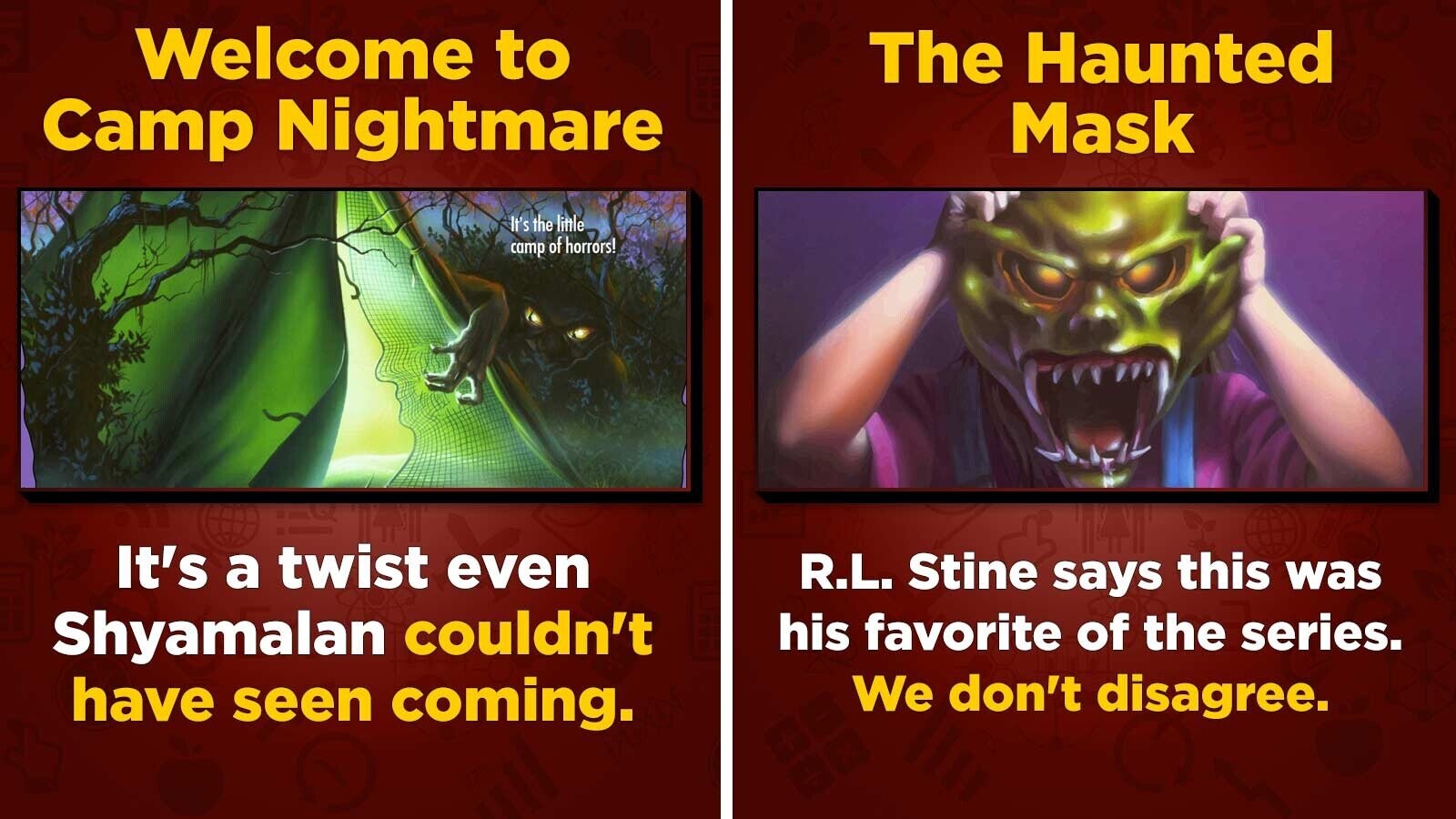
The Haunted Mask may be the most emotionally complete book in the original Goosebumps run. Carly Beth is tired of being scared and teased, so she buys a terrifying mask to frighten everyone else for once. Unfortunately, the mask attaches to her face and begins changing her personality. This is what happens when Halloween shopping goes from “seasonal fun” to “dermatological emergency.”
The brilliance of The Haunted Mask is that the horror comes from identity. Carly Beth does not simply wear something frightening; she becomes someone frightening. The story understands how powerful masks are for kids. A costume can make you feel brave, funny, monstrous, or invisible. Stine takes that feeling and asks, “What if you could not take it off?”
This book also became one of the most memorable Goosebumps TV adaptations, partly because the image of the green mask is instantly recognizable. But even on the page, it works because it has a strong emotional engine. Carly Beth wants control. She wants confidence. She wants revenge on the kids who mock her. The mask gives her those things in the worst possible way, like a cursed motivational speaker.
5. One Day at HorrorLand: Theme Parks, But With More Liability Issues
One Day at HorrorLand is peak Goosebumps because it weaponizes one of childhood’s happiest places: the theme park. The Morris family gets lost and ends up at HorrorLand, an amusement park full of monsters, dangerous attractions, and employees who would absolutely fail a customer-service training video.
The book succeeds because amusement parks already contain controlled fear. Roller coasters, haunted houses, drop towers, and suspiciously expensive snacks all depend on the idea that you are scared but safe. One Day at HorrorLand removes the “safe” part and keeps the screaming. Suddenly, every attraction feels like a trap, every mascot feels like a threat, and every cheerful sign looks like it was painted by someone who owns too many fog machines.
It also shows how good Stine was at turning a setting into a character. HorrorLand is not just a backdrop; it has rules, jokes, branding, and menace. It feels like a place that could support many more stories, which is exactly why the concept later expanded into other Goosebumps projects. The book is funny, chaotic, and endlessly marketablein other words, the most dangerous kind of theme park.
6. The Werewolf of Fever Swamp: Fur, Fog, and Florida-Level Bad Decisions
The Werewolf of Fever Swamp is one of the strongest atmosphere-driven books in the series. Grady and his family move near a swamp, where strange howls, suspicious neighbors, and a new dog create a mystery that keeps pointing toward one furry conclusion. The setting does half the work: the swamp is humid, dark, noisy, and impossible to trust. Basically, nature has joined the horror genre.
Werewolf stories work because they combine fear of the monster with fear of transformation. In this book, the tension comes from not knowing whoor whatis responsible for the attacks. Stine keeps the mystery moving with enough suspects and misdirection to make young readers feel like detectives with mosquito bites.
What makes it one of the best is its balance. It has a classic monster, a strong location, a pet-centered emotional hook, and a final twist that leaves readers with that familiar Goosebumps feeling: delighted, alarmed, and mildly suspicious of every dog in the neighborhood.
How These Books Shaped the Goosebumps Formula
These six books show the range of the series. Welcome to Dead House brought the dread. Monster Blood brought the gross-out object. Night of the Living Dummy brought the recurring villain. The Haunted Mask brought emotional body horror. One Day at HorrorLand brought the big, marketable nightmare location. The Werewolf of Fever Swamp brought classic monster mystery.
Together, they explain why Goosebumps became more than a row of paperbacks. The series offered kids a horror sampler platter. Not every reader was afraid of the same thing, so Stine gave them options: haunted houses, cursed objects, creepy toys, monsters, ghosts, cameras, masks, plants, blobs, camps, and at least one sponge-like thing from under the sink that made everyone reconsider home maintenance.
The books also understood the importance of covers. Tim Jacobus’s original artwork became inseparable from the reading experience. Before a kid read a single page, the cover had already done its job. It promised danger, color, weirdness, and a story that felt slightly forbidden. A good Goosebumps cover looked like it had escaped from a nightmare and landed directly in a school library.
The TV Shows and Movies Kept the Monsters Alive
The 1990s Goosebumps TV series helped turn the books into a multimedia memory machine. Episodes adapted popular stories like The Haunted Mask, Night of the Living Dummy, and The Werewolf of Fever Swamp, giving young viewers moving versions of images they had already imagined while reading. Were the effects always convincing? Not exactly. But that was part of the charm. A rubbery monster can be terrifying when you are eight and watching television too close to bedtime.
The later films starring Jack Black took a different approach by turning Stine himself into a character and letting multiple monsters escape into one big horror-comedy adventure. The newer streaming adaptations updated the franchise for audiences raised in a world where teenagers have phones, trauma, and better lighting. Yet the core idea stayed the same: ordinary kids stumble into extraordinary horror, and adults are usually several chapters behind.
Why Goosebumps Still Matters
Many children’s books are remembered fondly. Goosebumps is remembered physically. Readers remember the paper texture, the cover art, the smell of book fairs, the numbered spines, the thrill of finding the next title, and the tiny betrayal of a fake cliffhanger. The series trained kids to read for pleasure by making books feel like contraband fun.
It also gave young readers permission to enjoy fear. Horror for kids is not about traumatizing them; it is about letting them practice bravery in a controlled space. You can close a book. You can turn on the light. You can laugh at the monster. Then you can open the book again, because apparently humans are weird and we like doing this to ourselves.
That is the lasting magic of Goosebumps. The books were scary, but never hopeless. Twisted, but rarely cruel. Funny, but not empty. They invited kids into horror through the side door, handed them a flashlight, and said, “Go ahead. Look in the basement.”
Extra Experience: Reading Goosebumps Then and Now
Reading Goosebumps as a kid felt like joining a secret club where the password was “Do not tell Mom this book has a haunted ventriloquist dummy.” The experience was social before social media made everything social in the loudest possible way. Kids traded copies, argued over which one was scariest, and treated the school library shelf like a treasure map. If the copy of The Haunted Mask was missing, someone had it, and that someone was living your dream.
The best part was how personal the fear felt. A reader who had just moved houses might find Welcome to Dead House especially unsettling. A kid with a messy closet full of toys might side-eye Night of the Living Dummy. Someone who loved amusement parks might read One Day at HorrorLand and suddenly wonder whether every cheerful mascot was hiding a second, worse face. The books met children where they livedsuburbs, bedrooms, schools, summer vacationsand quietly added monsters.
As an adult, revisiting these books is a different experience but still rewarding. The chapters move fast. The scares are cleaner. The twists can be outrageous. You notice the machinery: the cliffhangers, the misdirection, the repeated parental disbelief, the final-page stinger. But instead of ruining the magic, that structure makes the books more impressive. Stine was writing at speed, for a specific audience, with a sharp sense of what would make a kid say, “Just one more chapter.” That is not easy. Many writers try to be simple and become boring. Stine was simple, but rarely dull.
There is also a warm nostalgia in realizing how much the books respected young readers. They did not lecture. They did not pause for long moral speeches. They delivered story. Even when the premise was ridiculousand let us be honest, many premises were gloriously ridiculousthe books trusted kids to follow the emotional logic. Fear of embarrassment, fear of being ignored, fear of losing control, fear of being trapped, fear of becoming something you do not recognize: those are real feelings, even when delivered through slime, masks, and werewolves.
That is why the six books above still stand out. They represent different doors into the same haunted house. Some readers wanted the moody dread of Dark Falls. Some wanted the monster-movie fun of Fever Swamp. Some wanted Slappy causing chaos like a wooden influencer with no brand manager. Some wanted Halloween terror, gross green goo, or a theme park that made regular amusement-park safety signs look wildly optimistic.
The experience of Goosebumps is ultimately the experience of discovering that books can be fast, funny, scary, collectible, and completely addictive. For many readers, it was the first time reading felt less like homework and more like sneaking into a forbidden attraction. And honestly, that may be the greatest twist ending of all: the monsters got kids to read.
Conclusion
Goosebumps became a cultural monster because it understood childhood better than most horror ever has. It knew that kids want to be scared, but not abandoned in the dark. They want jokes with their ghosts, twists with their monsters, and heroes who are just ordinary enough to feel like classmates. Welcome to Dead House, Monster Blood, Night of the Living Dummy, The Haunted Mask, One Day at HorrorLand, and The Werewolf of Fever Swamp did the job best because each one perfected a different part of the formula.
They are creepy, clever, nostalgic, and still readable decades later. More importantly, they remind us that children’s horror does not have to be watered down. It just has to know when to slam the door, when to crack a joke, and when to leave one last impossible thing breathing in the corner.
Note: This article is written as original, publish-ready commentary based on real public information about R.L. Stine, Scholastic’s Goosebumps franchise, major adaptations, and widely recognized books from the original series.