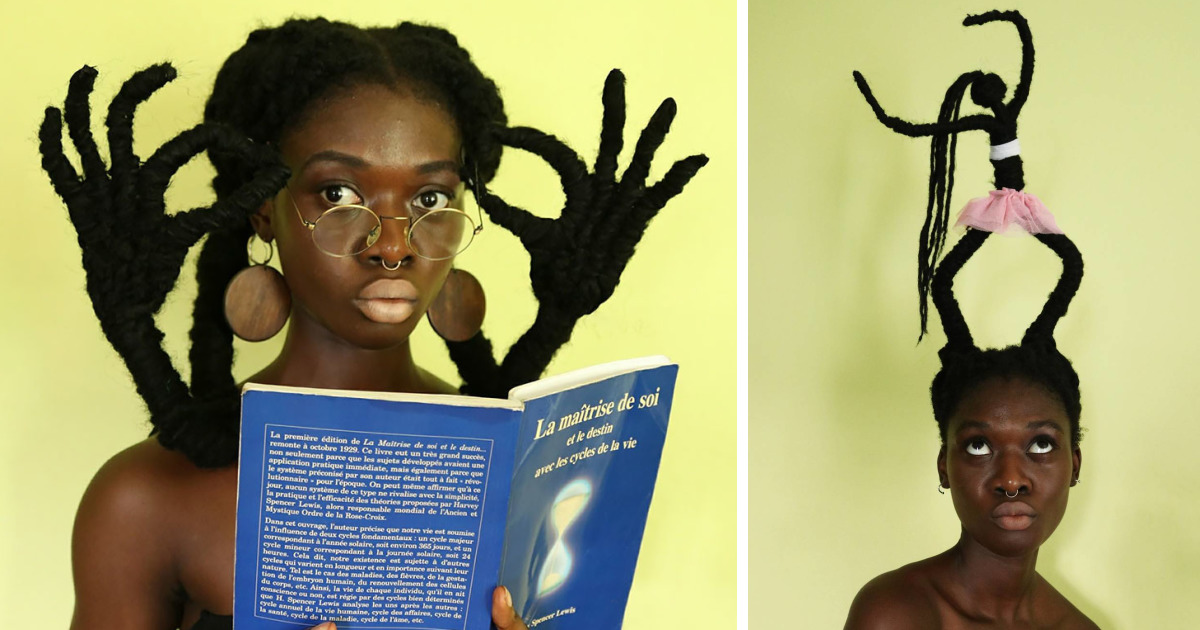
Some artists need clay. Some need marble. Some need a warehouse, a welding mask, and a grant application thick enough to stop a door. Laetitia Ky needs something far more personal: her hair, a little wire, thread, extensions, patience, and a sense of imagination that seems to have misplaced its “off” switch.
The Ivorian artist, born in Abidjan, Côte d’Ivoire, has become internationally known for turning her natural hair into sculptural works of art. Her creations have formed hands, animals, musical instruments, maps, dancers, symbols of protest, and scenes that speak about womanhood, beauty standards, African identity, body autonomy, and social justice. In other words, her hair does not merely sit politely on her head. It has opinions. It has choreography. It occasionally looks ready to file a dissertation.
But what makes Laetitia Ky’s hair sculptures so captivating is not only their visual surprise. Yes, the first reaction is usually, “Wait, that is hair?” The deeper response comes a moment later, when the viewer realizes that these playful, gravity-defying shapes are also cultural statements. Ky uses hair as a canvas, a microphone, and a memory archive. She transforms a feature that has often been policed, judged, straightened, hidden, or misunderstood into something bold, architectural, and impossible to ignore.
Who Is Laetitia Ky?
Laetitia Ky is an Ivorian artist, activist, fashion designer, author, and photographer whose signature medium is her own hair. She grew up in Abidjan and studied business before choosing a creative path. Her early interest in fashion, African aesthetics, and self-expression gradually evolved into a completely original art practice: sculpting hair into three-dimensional images and photographing the final results.
Her rise began on social media, where viewers were stunned by the technical skill and wit of her images. One sculpture might show two hands playing a guitar. Another might create the outline of Africa. Another might show a figure tugging at a woman’s skirt, turning a hairstyle into a powerful statement about sexual harassment and the #MeToo movement. She has also made works about bullying, racism, reproductive rights, female genital mutilation, breast flattening, colonial beauty standards, and the pressure placed on women’s bodies.
Her work has been discussed by major art, fashion, beauty, and culture publications, and she has presented her art in international contexts, including the Venice Biennale’s Côte d’Ivoire Pavilion and KYOTOGRAPHIE in Japan. Her book, Love and Justice, combines memoir, photography, and activism, showing how her hair sculptures developed from playful experimentation into a visual language of empowerment.
How She Turns Hair Into Sculpture
Laetitia Ky’s sculptural hairstyles may look like magic, but they are built with planning, structure, and a very practical understanding of materials. She typically uses her natural hair along with extensions, wire, thread, wool, fabric, pins, and sometimes glue or other support materials. The wire provides the skeleton. The hair becomes the surface. The final sculpture sits above or around her head like a living drawing in space.
Depending on the design, a piece may take less than an hour or several hours to create. Some works are relatively simple silhouettes, while others become elaborate scenes with figures, props, or symbolic shapes. Ky often photographs the finished sculpture herself, which means she is not only the sculptor but also the model, stylist, director, and visual storyteller. That is a lot of jobs for one head. Most of us are proud when we find a matching hair tie.
Her Materials Are Simple, but the Ideas Are Big
The beauty of Ky’s work lies in the contrast between ordinary materials and extraordinary outcomes. Wire, thread, and extensions are not rare museum objects. They are accessible tools. Yet in her hands, they become a visual vocabulary. A braid can become an arm. A curve of hair can become a question mark. A raised fist can become a protest sign without using paper, ink, or a megaphone.
This is why the phrase “hair sculpture” does not fully capture the depth of her practice. Her work is also performance, portraiture, fashion, photography, cultural research, and activism. Each image asks viewers to reconsider what hair can do. Hair can decorate, yes. But it can also speak, accuse, celebrate, remember, and heal.
The African Hair Traditions Behind Her Art
Ky has often connected her work to the history of African hairstyles, especially pre-colonial traditions in which hair carried social, spiritual, and cultural meaning. Across many African communities, hairstyles have historically communicated identity, age, status, family background, religion, beauty, grief, celebration, and belonging. Hair was not just personal grooming; it was language.
That history matters because colonialism and Western beauty standards often taught Black women to distrust or dislike their natural hair. Straight hair was presented as polished, professional, or beautiful, while tightly coiled and kinky textures were treated as difficult, improper, or undesirable. Ky’s art pushes back against that inherited hierarchy. She turns natural hair into something monumental, witty, elegant, and public.
Her sculptures do not ask for permission to be beautiful. They simply arrive, stand tall, and make the room adjust.
From Natural Hair to Self-Love
One of the most powerful themes in Laetitia Ky’s work is self-acceptance. She has spoken about growing up surrounded by beauty ideals that did not celebrate features like hers. Like many Black girls, she encountered pressure to relax, alter, or hide her natural texture. Her art became part of a personal journey toward loving her hair, her skin, her body, and her African identity.
This is why her hair sculptures resonate far beyond the art world. They connect with people who have had to unlearn shame. They speak to anyone who has been told that some part of them was “too much,” “too different,” or “not professional enough.” Ky takes what society has often tried to shrink and makes it physically larger. That is not subtle, and thank goodness. Subtlety is sometimes overrated.
Hair as Feminist Protest
Laetitia Ky’s work is often playful, but it is not lightweight. Many of her most memorable images address violence against women, sexism, reproductive rights, and bodily autonomy. Her #MeToo hair sculpture, for example, used hair to depict a man violating a woman’s boundaries. The image was uncomfortable, direct, and impossible to scroll past without absorbing its message.
That is one reason her work is so effective online. Social media moves quickly. People glance, swipe, and forget. Ky’s sculptures interrupt that rhythm. They are visually strange enough to stop the thumb, then emotionally clear enough to start a conversation.
Her feminist art does not rely on long academic explanations. It works because the image lands first. The viewer sees a body, a gesture, a threat, a protest, or a celebration. Then the meaning unfolds. Her hair becomes a headline, a poster, and a sculpture all at once.
Why Her Work Went Viral
The internet loves novelty, and Laetitia Ky’s hair sculptures certainly qualify. But viral attention alone does not explain her staying power. Many things go viral for thirty-six hours and then disappear into the digital attic next to forgotten dance challenges and suspiciously confident life hacks. Ky’s work endured because it combines visual surprise with emotional substance.
Her Art Is Instantly Recognizable
In a crowded visual culture, originality is gold. A Laetitia Ky image is immediately identifiable. The clean portrait setup, the sculptural hair, the bold silhouette, the confident gaze, and the blend of humor and seriousness all create a distinct visual signature. You do not need to read a caption to know you are seeing something unusual.
It Works Across Art, Beauty, Fashion, and Activism
Her audience is not limited to one niche. Beauty lovers admire the hair technique. Artists admire the sculptural thinking. Fashion audiences notice the styling and body as canvas. Activists respond to the social messages. Historians and cultural critics see her engagement with African identity. That cross-category appeal makes her work especially powerful for Google, Bing, social media, and visual discovery platforms.
Specific Examples of Her Hair Sculptures
Ky has created a wide range of sculptural hairstyles, from charming and humorous to deeply political. Some of her earlier works showed hands, a guitar, a dancer, sunglasses, flowers, animal ears, and geographic shapes. These pieces demonstrated the technical possibilities of hair as a sculptural medium.
Later, her art increasingly addressed social issues. She has made pieces dealing with sexual harassment, abortion rights, racism, beauty standards, and violence against women. In some works, her hair forms figures in conflict. In others, it becomes a symbol of strength, protection, grief, or resistance. Her art often contains a striking balance: it can be visually delightful while carrying a message that is anything but decorative.
One of the reasons these examples matter is that they challenge the old separation between beauty and seriousness. A hairstyle is often dismissed as superficial, especially when associated with women’s appearance. Ky flips that assumption upside down. In her work, beauty becomes a delivery system for truth.
Laetitia Ky and the Natural Hair Movement
Laetitia Ky is often discussed in connection with the natural hair movement, a broad cultural shift encouraging Black women to embrace natural textures rather than conforming to Eurocentric beauty standards. Her work supports that movement not through instruction but through imagination.
She does not simply say natural hair is beautiful. She proves it by making natural hair do something spectacular. Her sculptures tell viewers that Black hair is strong, flexible, expressive, and worthy of being centered. The message is not “natural hair is acceptable.” It is bigger than that: natural hair is art, architecture, history, humor, rebellion, and power.
For many viewers, that message feels personal. A child seeing Ky’s work may understand that hair like hers can be celebrated. An adult who spent years fighting their texture may see a path back to pride. A viewer outside the Black community may gain a deeper appreciation for the cultural and political weight carried by hair.
The Role of Photography in Her Practice
Although the hair sculptures are the most obvious feature, photography is essential to Ky’s art. The sculptures are temporary. They are built, worn, posed, photographed, and then eventually taken down. Without the photograph, the work would live only as a private performance or a fleeting moment.
Through photography, Ky controls the frame. She decides the angle, expression, background, clothing, and mood. Her direct gaze often gives the images extra force. She does not look like a passive model wearing an eccentric hairstyle. She looks like the author of the image, which she is.
This matters because her body is part of the artwork, but not as an object for someone else’s control. She uses self-portraiture to claim authorship. She is the maker and the message.
Why Her Art Feels So Modern
Laetitia Ky’s work feels contemporary because it understands how images travel today. Her sculptures are physical, but they are built for a visual world shaped by screens. They are bold enough to read clearly on a phone. They are layered enough to reward deeper viewing. They are personal enough to feel intimate and public enough to spark debate.
That combination makes her one of the most compelling artists working at the intersection of hair, identity, and digital culture. She uses an ancient form of expression, hair styling, and updates it for the age of Instagram, global feminism, and online visual activism.
Lessons Creatives Can Learn From Laetitia Ky
Ky’s career offers useful lessons for artists, writers, designers, beauty professionals, and anyone trying to build a creative voice.
Use What Is Closest to You
Her medium is literally attached to her. That is a reminder that originality does not always begin with expensive tools. Sometimes it begins with looking again at what is already part of your life.
Let Play Become Purpose
Ky’s hair sculptures began with curiosity and fun, but they grew into a serious artistic and activist practice. Creative play can become powerful when it is given room to evolve.
Make Your Message Visual
Her work communicates quickly because the idea is built into the image. In an age of short attention spans, visual clarity is not a bonus. It is survival gear.
Experiences Related to This Ivorian Artist Who Can Sculpt Her Hair Into Anything
Experiencing Laetitia Ky’s work, even through a screen, can feel like attending a tiny art exhibition inside your own phone. At first, you may approach the image casually, expecting another creative hairstyle. Then your brain catches up. The line above her head is not an accessory; it is a hand. The hand is not decorative; it is making a gesture. The gesture is not random; it is telling a story. Suddenly, what looked playful becomes layered. That shift is part of the magic.
For people who grew up with natural hair, her work can feel especially personal. Many know the long Saturday routines, the combs, the oils, the protective styles, the aunties with strong opinions, and the emotional politics of hair. Hair can be tender ground. It can carry family memories, school rules, workplace judgments, compliments, insults, pride, and frustration. Seeing Ky transform hair into sculpture can feel like watching that entire history stand up and take a bow.
There is also a practical awe in looking at her pieces. Anyone who has struggled to make a bun stay in place during humid weather may view Ky’s sculptures with a mix of admiration and comic disbelief. How does a braid become a full figure? How does a silhouette keep its balance? How does the idea survive gravity, the oldest hater in the universe? Her work reminds us that behind every “effortless” image is effort: sketching, testing, bending wire, wrapping hair, adjusting weight, posing carefully, photographing, and probably fixing something that refused to cooperate.
Artists and content creators can learn a great deal from that process. Ky’s success did not come from copying a trend. It came from developing a visual language that was unmistakably hers. In a digital world where many images start to look alike, she created something that could not be confused with anyone else’s work. That is the dream for any creator: not merely to be seen, but to be recognized.
Her art also invites viewers to rethink the body. We often treat the body as something to correct, manage, compare, or sell products to. Ky treats the body as a site of imagination. Her hair is not a problem to solve. It is a tool to build with. Her skin is not a backdrop to be altered. It is part of the composition. Her gaze is not apologetic. It is steady, sometimes stern, sometimes playful, but always in control.
That experience can be freeing. It suggests that self-expression does not need to wait for outside approval. It can begin with a mirror, a memory, a frustration, a joke, or a political conviction. It can begin with what others dismissed. It can begin with hair.
For young Black girls, especially, Ky’s work offers an image of possibility. Natural hair is not shown as something to tame before entering the world. It is shown as a world-making force. It can become a dancer, a fist, a flower, an animal, a protest, or a crown that does not need jewels because it brought its own architecture.
For everyone else, her work is an invitation to look more carefully. Hair is never just hair. Fashion is never just fashion. Beauty is never just beauty. In the hands of an artist like Laetitia Ky, a hairstyle can become a cultural essay, a sculpture garden, and a punchline with perfect timing. It can make us laugh, then make us think, then make us ask why we ever believed the materials of everyday life were ordinary.
Conclusion: More Than Hair, More Than Sculpture
Laetitia Ky can sculpt her hair into almost anything, but the real achievement is not only technical. Her art reshapes how people see Black hair, African heritage, women’s bodies, and creative activism. She turns a deeply personal material into public art and uses beauty as a form of resistance.
Her work is funny, serious, strange, elegant, and fearless. It belongs in conversations about contemporary African art, feminist art, natural hair, fashion photography, and digital storytelling. Most importantly, it reminds us that creativity does not always require permission, polish, or traditional materials. Sometimes it begins with the courage to look at yourself and say, “This is enough to build something powerful.”
Laetitia Ky’s hair sculptures prove that identity can be shaped, reclaimed, and raised high for the world to see. And yes, they also prove that the rest of us may need to apologize to our ponytails for underachieving.
Note: This article was written in original American English and synthesized from real reporting, artist profiles, interviews, book information, exhibition materials, and reputable arts, fashion, beauty, and culture sources.