Every fall, many of us look up, see birds streaming across the sky, and mentally file the scene under “nature doing its thing.” Geese honk south. Warblers vanish before the frost. Raptors ride invisible highways of rising air. It all feels orderly, like a feathered version of holiday traffic, minus the gas-station coffee and passive-aggressive GPS voice.
But sometimes birds do something that makes scientists blink twice: they fly the “wrong” way. Not a tiny detour. Not a quick scenic loop over a lake. We are talking about birds that migrate in the opposite direction from what people expect, show up thousands of miles outside their usual range, or follow seasonal patterns that look backward compared with the classic north-south migration story.
The mystery is not just adorable bird chaos. Wrong-way bird migration can reveal how animals navigate, how climate change is reshaping habitats, how storms and city lights disrupt flight paths, and how much we still do not understand about the internal compass tucked inside a creature that weighs less than a sandwich.
What Does “Migrating in the Wrong Direction” Actually Mean?
When birders say a bird is flying the wrong way, they usually mean one of three things. First, the bird may be a vagrant, meaning it appears far outside its normal range. Second, it may show reverse migration, traveling at a roughly 180-degree angle from the expected direction. Third, it may follow a migration schedule or route that is unusual for its species or population.
In other words, “wrong” does not always mean the bird made a mistake. Sometimes the bird is using a strategy humans simply did not recognize yet. Nature loves a plot twist.
A classic example is a young songbird that should fly southwest in autumn but instead heads northeast. Another is a seabird carried inland by a hurricane, landing in a parking lot and looking as confused as everyone else. And then there are Arizona Bald Eagles, whose movements are so counterintuitive that they have become a fascinating case study in avian migration patterns.
The Arizona Bald Eagle Puzzle: North When Everyone Expects South
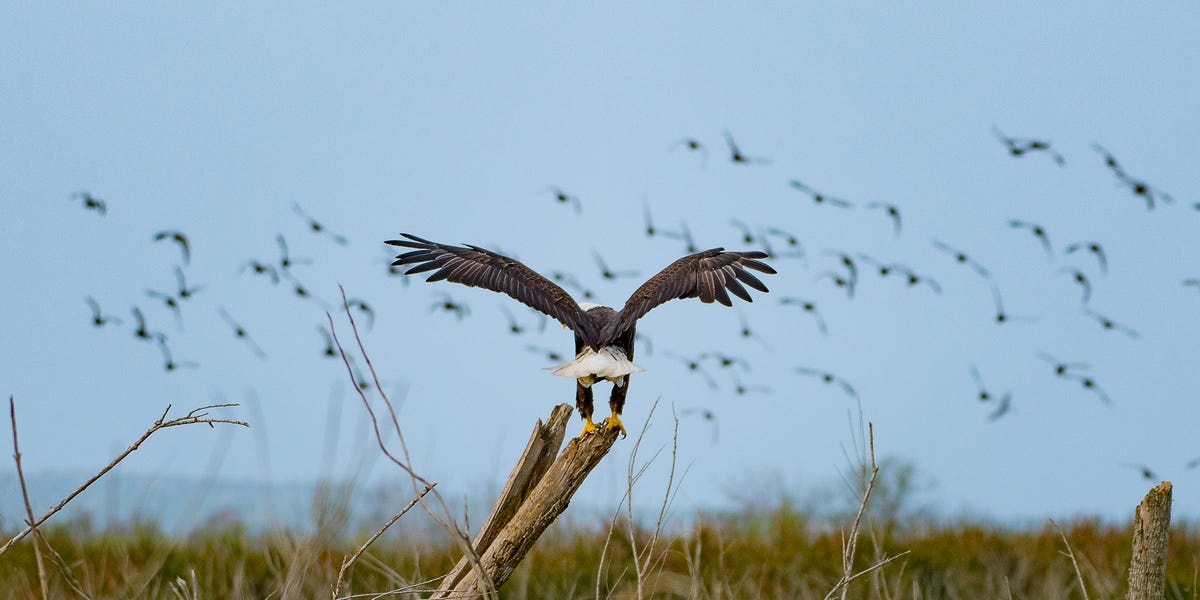
Bald Eagles are not usually the first birds people imagine when they think of mysterious migration. They look less like fragile travelers and more like national-symbol managers who would like to speak with the fish department. Yet recent tracking of nonbreeding Bald Eagles from Arizona shows that some of these birds move north after the breeding period and return south before the next breeding season.
That seems backward if your mental model is “birds go south for winter and north for spring.” But Arizona changes the rules. For these eagles, the breeding season happens earlier than it does for many northern populations. When the hot season arrives, young and nonbreeding birds may travel north toward rivers, reservoirs, lakes, and cooler foraging areas across the Intermountain West and even into parts of Canada. Later, they return south toward Arizona ahead of the local breeding season.
Researchers used satellite GPS transmitters to follow newly fledged eagles and a small number of nonbreeding adults. Their tracks showed fast, directed travel out of Arizona, slower wandering around northern stopover and summering areas, and then direct return movements back south. That pattern suggests this is not random wandering. It is a real migration strategy, just one with a calendar that looks upside down to anyone expecting a simple textbook route.
Why Would Eagles Do This?
The likely answer is practical: food, weather, age, and breeding status. Nonbreeding birds do not need to defend a nest or feed chicks. That gives them freedom to roam. Young Bald Eagles are also still learning where the good feeding sites are, which is basically the avian version of figuring out which grocery store has the best rotisserie chicken.
Water matters, too. Bald Eagles rely heavily on aquatic habitats because fish and waterbirds are major food sources. Historic stopover sites, reservoirs, rivers, and lakes can act like refueling stations. If those places remain reliable across generations, young eagles may keep using them even as landscapes around them change.
Reverse Migration: When the Compass Seems Flipped
Reverse migration is one of the most intriguing explanations for birds migrating in the wrong direction. In this phenomenon, a bird travels nearly opposite its normal route. A species that should go southeast may head northwest. A bird that belongs in Asia may turn up in western Europe. A tiny warbler may appear on the wrong coast, causing birders to grab binoculars, field guides, and possibly snacks for a very long stakeout.
Scientists think reverse migration can happen when inherited orientation programs misfire. Many young birds migrate without being guided by parents. Their first journey depends heavily on internal instructions: fly this direction, for this long, under these environmental cues. If that directional program is reversed or altered, the bird may continue flying with determination, confidence, and absolutely terrible travel results.
That explains why first-year birds are often overrepresented among vagrants. They are not “bad at being birds.” They are inexperienced travelers using a built-in navigation system that is powerful but not perfect.
How Birds Normally Navigate Without a Phone Plan
Bird migration is not controlled by one simple tool. Birds use a layered navigation system involving the sun, stars, polarized light, landmarks, smell, wind patterns, and Earth’s magnetic field. It is less like Google Maps and more like a tiny biological command center with feathers.
The Sun, Stars, and Polarized Light
Daytime migrants can use the sun as a compass, adjusting for time of day through an internal clock. Nocturnal migrants often use star patterns, especially around the celestial pole. Birds can also detect polarized light at sunrise and sunset, which helps them set an initial bearing before night migration begins.
The Magnetic Compass
Many migratory birds can sense Earth’s magnetic field. Scientists are still studying exactly how this works, but one leading idea involves light-sensitive molecules in the eye that may help birds perceive magnetic direction. Another possibility involves magnetic particles in the body that provide positional information. Either way, birds appear to carry a compass humans would very much like to understand better, preferably before our car GPS sends us into another cornfield.
Landmarks and Experience
Older birds often improve with practice. Once they have survived a route, they may remember coastlines, mountain ranges, rivers, wetlands, and feeding sites. This is one reason adult migrants can be more precise than juveniles. Experience turns a risky first trip into a repeatable route.
What Throws Birds Off Course?
Wrong-way migration can have several causes, and they often overlap. A bird may start with a small navigational error, then get pushed by wind, drawn toward city lights, or forced to land in poor habitat. Migration is already hard. Add human-made obstacles and weird weather, and the route becomes a flying obstacle course.
1. Storms and Wind
Storms can displace birds dramatically. Hurricanes may trap seabirds in their circulation and deposit them far inland. Strong winds can push migrating songbirds across oceans or into regions where they would rarely appear. Some birds correct course after the weather clears. Others become vagrants, showing up in places that make local birders whisper, “Wait, is that what I think it is?”
2. Geomagnetic Disturbances
Because many birds use magnetic cues, disturbances in Earth’s magnetic field may contribute to vagrancy. Solar activity and geomagnetic storms can affect the magnetic environment birds are trying to interpret. Research suggests the relationship is complicated, not a simple “space weather happens, bird gets lost” equation. Still, magnetic disruption remains a serious piece of the wrong-way migration puzzle.
3. Artificial Light at Night
Artificial light is one of the clearest human-related threats to migrating birds. Many species migrate at night. Bright city lights can attract and disorient them, pulling them toward buildings, towers, and glass. Once birds circle in illuminated areas, they may waste energy, collide with structures, or land in dangerous urban environments.
This is why “Lights Out” campaigns matter. Turning off unnecessary lights during peak migration seasons is not just symbolic. It can reduce confusion and collisions for birds traveling through major flyways.
4. Climate Change and Shifting Habitats
Climate change affects migration by changing the timing of spring, insect emergence, plant growth, drought, storms, and suitable habitat ranges. Some birds are migrating earlier. Some are wintering farther north. Some are being pushed toward new areas as familiar habitats become less reliable.
This does not mean every wrong-way bird is a climate-change refugee. But climate pressure can make unusual movements more common, more visible, or more consequential. When food, temperature, water, and breeding timing shift, birds must adjust quickly or pay the price.
Vagrant Birds: Accidents, Pioneers, or Both?
For a long time, vagrant birds were often treated as lost individuals. Many are exactly that: birds that made a navigational mistake and may not survive. But scientists now recognize that vagrancy can also be part of how species explore new possibilities.
A bird that ends up in a new region might find suitable habitat. If enough individuals arrive and survive, what begins as a mistake could eventually become range expansion. Today’s “lost bird” might be tomorrow’s pioneer, though the bird itself is probably more interested in lunch than evolutionary headlines.
This matters in a warming world. As habitats shift northward or upslope, birds capable of exploring new places may have a better chance of adapting. However, exploration only helps if safe habitat exists along the way. A vagrant landing in a glass-and-asphalt maze does not get much opportunity to become a pioneer.
Why Birders Notice Wrong-Way Migration Faster Than Ever
Another reason we hear more about mysterious bird migration is that people are watching more carefully. Citizen-science platforms, birding apps, radar tools, satellite transmitters, and local bird alerts have transformed how rare sightings are documented.
In the past, a misplaced bird might have passed through unnoticed. Today, someone may photograph it, log it, share it, and trigger a polite stampede of birders wearing sensible hats. This flood of observations helps researchers identify patterns that were previously invisible.
Radar systems such as migration forecasting tools also allow scientists to estimate the number, timing, and direction of birds moving at night. Combined with GPS tracking, banding records, and field observations, these tools show migration as a living network rather than a few arrows printed in a nature book.
Why This Mystery Matters for Conservation
Understanding wrong-way migration is not just a fun detective story. It can help conservationists protect birds at the moments they are most vulnerable. Migrating birds need stopover sites where they can rest and feed. They need dark skies, safer buildings, clean water, reduced poisoning risks, and habitats connected across huge distances.
For Arizona Bald Eagles, knowing the routes and stopover areas used by young and nonbreeding birds can guide protection beyond nesting territories. For songbirds, reducing artificial light and treating windows can prevent deaths during migration. For shorebirds and waterbirds, protecting wetlands is essential because migration without stopover habitat is like a road trip with no gas stations, no restaurants, and no bathrooms. Even birds have limits.
What You Can Do to Help Migrating Birds
You do not need a satellite transmitter or a PhD in ornithology to help. Start by turning off unnecessary outdoor lights during spring and fall migration. Close curtains or blinds at night when interior lights are bright. Use motion sensors, shields, timers, and warm downward-facing lighting outdoors.
Make windows safer with external screens, decals, tape patterns, or bird-safe film. The key is spacing: birds need visible markers close enough that they do not try to fly through the glass. Keep cats indoors, avoid rodenticides when possible, plant native species, and support local habitat conservation.
You can also contribute observations to bird-monitoring projects. A single backyard checklist may seem small, but millions of observations can reveal major migration changes. Science loves data, and birds love people who keep the porch light off.
Experiences and Field Reflections: Watching “Wrong-Way” Migration in Real Life
Seeing an unexpected bird in the wrong place has a strange emotional effect. At first, it feels like a mistake. A flash of color crosses a winter shrub, or a raptor circles where it “shouldn’t” be, and your brain opens three tabs at once: identification, disbelief, and “where did I put the binoculars?” This is one reason wrong-way migration has such a strong hold on birdwatchers. It turns an ordinary walk into a mystery with wings.
Imagine standing near a reservoir in the American Southwest in late summer. The heat is still radiating from the rocks, the cattails look tired, and the waterline has dropped enough to expose muddy edges. Then a young Bald Eagle appears overhead, not as a patriotic postcard but as a working animal scanning for food. It may not be breeding. It may not be staying. It may be one of those wandering young birds using rivers and lakes as stepping stones before heading north. To a casual observer, it is simply an eagle. To a migration biologist, it is a moving data point in a route that may connect desert nesting areas with mountain valleys, northern lakes, and distant seasonal food sources.
The same feeling happens with smaller birds. A rare warbler in the wrong state can draw visitors from hours away. People gather quietly, compare field marks, whisper directions, and try not to scare the bird. There is humor in the scene: a creature weighing less than an ounce accidentally becomes a celebrity, while grown adults stand in wet grass debating wing bars with courtroom seriousness. But beneath the comedy is respect. That tiny bird has crossed weather systems, cities, rivers, and possibly an ocean of bad luck.
Wrong-way migration also teaches patience. Sometimes the bird is not lost in the dramatic sense. It may be testing habitat, following food, avoiding storms, or moving according to a population-specific strategy we have not studied enough. Human expectations are tidy. Bird lives are not. A map can show the usual route, but the sky contains exceptions.
For anyone who wants to experience this topic personally, autumn and spring are the best seasons to pay attention. Watch local weather fronts. Notice nights with heavy migration forecasts. Visit wetlands, lakes, wooded parks, and coastal points after storms, but do so responsibly. Keep distance, avoid playback for stressed rarities, and remember that a vagrant bird is not a collectible item. It is a living traveler that may already be running on fumes.
One of the most memorable lessons from observing migration is how invisible it can be. A quiet night sky may hold thousands of birds passing overhead. You hear a thin call, then another, and suddenly darkness feels crowded with purpose. Some birds are exactly on course. Some are adjusting. A few may be heading into the unknown. That uncertainty is part of the wonder. Migration is not a machine. It is a risky, flexible, ancient behavior carried out by animals responding to a changing planet in real time.
Conclusion: The “Wrong” Direction May Be a Clue
Birds migrating in the wrong direction are not just oddities for rare-bird alerts. They are clues. They reveal how navigation works, where migration routes depend on fragile stopover sites, how artificial light and storms create danger, and how climate change may rewrite the seasonal rules birds have followed for generations.
The Arizona Bald Eagles flying north after breeding remind us that “normal” depends on location, age, food, and timing. Reverse-migrating songbirds remind us that even an inherited compass can glitch. Vagrant birds remind us that mistakes can sometimes become discoveries.
So the next time you see birds overhead, resist the urge to assume they are simply going “south” or “north.” They may be following a route older than memory, correcting for wind, dodging city light, chasing food, or surprising scientists with a strategy no one had fully mapped yet. In bird migration, the wrong direction may be nature’s way of saying, “Look closer.”