Most before-and-after photographs cover a haircut, a home renovation, or six heroic weeks without dessert. Photographer Jan Langer’s Faces of Century project takes a considerably longer view: roughly eight decades.
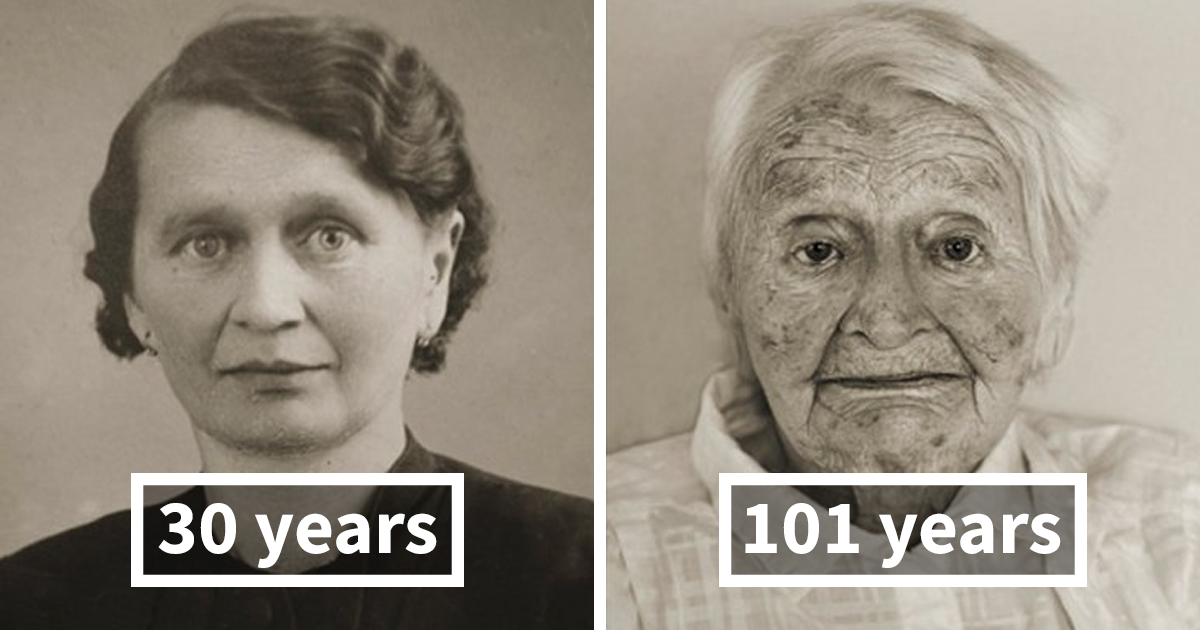
In the series, portraits of Czech centenarians are placed beside photographs taken when those same people were young adults. A 22-year-old engineer reappears at 101. A 26-year-old woman meets her 103-year-old self. A construction worker photographed at 30 returns at 105. The clothing, skin, posture, and photographic technology change dramatically, yet something recognizable remains.
That “something” is what makes the images difficult to scroll past. The project is not merely about wrinkles or longevity. It is about identity, memory, survival, and the strange realization that every older face once belonged to a young person making plans for a future that had not happened yet.
The Story Behind the Faces of Century Project
Czech photographer Jan Langer created Faces of Century to explore what changesand what may remain rootedwhen a human life stretches beyond 100 years. He photographed more than a dozen centenarians and paired each modern portrait with an image from the subject’s youth.
The comparison was carefully constructed. Whenever possible, the older subject adopted a pose or expression resembling the original photograph. This visual echo makes the transformation easier to study. Viewers can compare the shape of the eyes, the set of the mouth, the angle of the head, and even hints of the same attitude.
Langer did not stop at appearance. Short biographies accompanying the portraits described the subjects’ former occupations, strongest memories, present interests, family circumstances, and personal wishes. That decision turned the series from an aging experiment into a collection of individual lives.
Why Matching the Poses Matters
Without a similar pose, viewers might focus only on obvious differences. A formal studio portrait from the 1930s and a casual snapshot taken decades later can feel like images of two unrelated worlds. Matching the head position and expression creates a visual bridge between them.
Suddenly, the younger and older versions do not appear to be strangers. The jaw may soften and the cheeks may narrow, but the gaze often feels surprisingly familiar. It is as though the young adult has not disappeared but has moved deeper into the photograph.
This is where the project quietly defeats the usual “before versus after” formula. Neither image is presented as the correct or superior version. The young person is not an unfinished draft, and the centenarian is not a faded copy. Both portraits show the same life at different points in its development.
The People Behind the Portraits
The names and stories matter because centenarians are often discussed as statistics, scientific puzzles, or inspirational mascots. Langer’s subjects are not generic examples of “successful aging.” They are specific people who worked, loved, lost relatives, developed habits, and carried private memories across extraordinary spans of time.
Prokop Vejdělek: From 22 to 101
Prokop Vejdělek was photographed as a 22-year-old and again at 101. He had worked as a metallurgical engineer, yet one of the memories associated with his portrait was wonderfully ordinary: the taste of warm, fresh goat’s milk.
That detail is more revealing than a list of historic events. A person can live through wars, political upheaval, industrial transformation, and the arrival of computers, yet a simple taste from early life may remain vivid. Apparently, the human memory sometimes ignores the history textbook and keeps the breakfast menu.
Bedřiška Köhlerová: From 26 to 103
Bedřiška Köhlerová appeared at 26 and 103. Her biography included a wish to visit Italy again. The detail disrupts the assumption that very old people live only in the past. At 103, she could still imagine another journey and another experience worth anticipating.
Antonín Kovář: From 25 to 102
Antonín Kovář was shown at 25 and 102. His wish was to play the clarinet again. The instrument becomes more than a hobby in this context; it represents ability, pleasure, and a connection with the person he had been.
Anna Vašinová: From 22 to 102
Anna Vašinová’s story carries a much heavier memory. Photographed at 22 and 102, she remembered her husband being taken away by the Nazis. Her paired portraits therefore contain more than physical aging. Between them lies a personal tragedy shaped by one of Europe’s darkest historical periods.
A Human Face Can Hold an Entire Century
Someone who reached 100 in the early twenty-first century may have been born when household radios were still a novelty and commercial aviation was in its infancy. Such a person could witness world wars, changing borders, the Cold War, space exploration, television, personal computers, and smartphones.
But Langer’s photographs avoid reducing a life to a timeline of famous inventions. History appears indirectly, through clothing, photographic styles, expressions, occupations, and memories. The century is present, but the individual remains in the foreground.
This distinction is important. When people look at a centenarian, they may immediately wonder, “What is the secret?” The question is understandable, but it can transform a person into a walking longevity recipe. Was it oatmeal? Gardening? Good genes? Refusing to argue before lunch?
Research suggests that extreme longevity is more complicated than any single habit. Genetics, physical health, environment, social circumstances, personality, resilience, and plain chance can interact across a lifetime. Even among centenarians, health and cognitive ability vary considerably.
What Changes in a Face After Eight Decades?
Aging affects skin thickness, elasticity, facial fat, muscle tone, bone structure, and posture. Those physical changes are easy to see in paired portraits. Foreheads acquire lines, cheeks lose volume, ears appear more prominent, and expressions may settle differently on the face.
However, viewers rarely study these images as a medical diagram. Instead, they search for continuity. We look at the eyes first. We notice the curve of a lip, the position of the eyebrows, or the slight tilt of the head. We try to identify the younger person inside the older face.
This instinct reveals something about how humans understand identity. We know that a person cannot remain physically unchanged, but we still expect an inner thread to connect every stage of life. The photographs make that invisible thread feel visible.
The Persistence of Expression
Some subjects seem to preserve a recognizable emotional style. A serious young adult may retain the same concentrated gaze. A faintly amused expression may survive even when the face around it has changed.
That does not prove that personality is permanently fixed. People adapt, mature, and sometimes change profoundly. Langer’s project instead suggests that certain expressive habits may remain familiar. The face learns favorite ways of responding to the world, much as a hand develops familiar handwriting.
Research into personality and aging similarly presents a nuanced picture. Personality can evolve, but traits and patterns established earlier in life may continue to influence well-being and behavior many decades later. A century-old face is therefore neither completely new nor frozen in time.
Why Old Photographs Trigger Such Strong Emotions
A photograph performs two jobs at once. It records what someone looked like, and it reminds us that the photographed moment is gone. The longer the gap between the image and the present, the more powerful that tension becomes.
With a standard family portrait, viewers must imagine what happened next. Langer’s project supplies another chapter. We see the young adult and then jump forward 70, 80, or even 88 years. Everything between the images is absent, yet the absence feels crowded with weddings, jobs, illnesses, jokes, arguments, meals, funerals, and ordinary Tuesdays.
Personal photographs can also serve as strong prompts for autobiographical memory. Studies of reminiscence and photo-based memory work suggest that familiar images may support storytelling, identity, well-being, and social connection among older adults. Photographs do not merely prove that something happened; they can help reopen the emotional doorway to the event.
The Reminiscence Bump
Older adults often recall a disproportionately large number of memories from adolescence and early adulthood, a pattern researchers call the “reminiscence bump.” These are years when people commonly form identities, begin careers, fall in love, leave home, and make other life-shaping decisions.
That helps explain why youthful portraits can carry so much emotional force. They come from a period packed with firsts. When a centenarian looks at an image taken at 20 or 25, the photograph may connect not only to a face but also to an entire network of defining experiences.
Centenarians Are Becoming More Visible
Reaching 100 remains uncommon, but centenarians are no longer quite as rare as they once were. According to the U.S. Census Bureau, America’s centenarian population grew by approximately 50% between the 2010 and 2020 censuses. The 2020 count still represented only about two centenarians for every 10,000 residents, but the direction is clear: more families will know someone who enters a second century of life.
This demographic shift makes respectful portrayals of advanced age increasingly important. Popular culture often reduces older people to a handful of roles: fragile patient, wise grandparent, grumpy neighbor, or miraculous fitness enthusiast who can somehow do more push-ups than everyone at the office.
Real aging is broader and messier. A person can be resilient and vulnerable at the same time. Someone may need physical assistance while remaining intellectually curious. Another may have excellent mobility but struggle with memory. Chronological age alone does not describe the whole person.
What the Project Teaches Us About Ageism
Ageism becomes easier when older adults are viewed as a separate category rather than as people continuing the same lives they began decades earlier. Paired portraits interrupt that separation.
Look at the young photograph first, and it is difficult to dismiss the older subject as merely “old.” That person once worried about work, romance, money, appearance, and whether a photograph would turn out well. In other words, the centenarian was once young, busy, and probably late for something.
Now reverse the exercise. Look at the centenarian first and remember that the young subject is not protected from time. Youth is temporary rather than opposite. Every young adult is already participating in the aging process, even when the evidence is limited to one mysterious knee sound after standing up.
The project encourages viewers to replace pity with curiosity. Instead of asking only what an older person can no longer do, we might ask what that person remembers, values, notices, regrets, or still hopes to experience.
How to Create a Respectful Then-and-Now Portrait
Families and community organizations can create their own intergenerational portrait projects, but the process should begin with consent and conversation rather than a camera.
Start With the Story
Ask the participant to choose a meaningful photograph from early adulthood. Do not automatically select the most glamorous image. A work portrait, military photograph, wedding snapshot, or ordinary picture taken outside a family home may carry a richer story.
Recreate, But Do Not Force
Try to match the pose, camera angle, lighting direction, and expression without demanding uncomfortable physical positions. Similarity is useful, but dignity matters more than perfect alignment.
Record the Details
Write down the person’s name, age in each image, occupation, location, memories, and hopes. The Library of Congress recommends labeling family photographs with names, dates, and places when known because those details can spark conversations and make future historical research far easier.
Avoid Turning Aging Into a Spectacle
The goal should not be to make viewers gasp at how much someone has “deteriorated.” Aging is not a failed beauty treatment. Present both images with care, and let the participant influence how the story is told.
A 500-Word Experience: Looking Through a Family Album With New Eyes
One of the most meaningful experiences related to then-and-now photography begins without professional equipment. It starts with a box, drawer, or aging photo album that has quietly collected dust while everyone promised to organize it “one weekend.” That weekend has finally arrived.
Sit beside an older relative and let that person choose the first photograph. Resist the temptation to run the conversation like an interview with a strict list of questions. Begin with something simple: “What was happening here?” Then listen.
The first answer may be brief. It was taken after work. That was a neighbor’s car. The dress belonged to a sister. The photographer had only one piece of film left. Small details begin attaching themselves to the image, and the silent people in the photograph acquire voices, habits, and relationships.
Next, ask what happened shortly before or after the picture. This often produces the better story. A serious studio portrait may have been followed by a disastrous lunch. A polished wedding photograph may conceal the fact that the groom forgot the rings. Family history is rarely as formal as the surviving pictures suggest.
When recreating the portrait, do not chase perfection. The same chair may no longer exist, the clothing may be impossible to reproduce, and the participant may be unable to hold the original pose. Use what is available. Match the direction of the face, the position of the hands, or the mood of the expression.
The most surprising moment often comes when the two pictures are placed together. At first, everyone notices the years. Then someone points to the eyes. Another person recognizes the smile. A grandchild sees a familiar expression and realizes it appears on several younger members of the family. The comparison becomes less about age and more about connection.
The experience may also uncover difficult memories. A photograph can bring back grief, displacement, war, discrimination, estrangement, or relationships the participant would rather not discuss. Do not push for a complete explanation. Respecting silence is part of preserving a story responsibly.
Include positive memories, but do not force the project into an inspirational slogan. A long life does not need to be presented as a nonstop triumph. It can contain luck, resilience, frustration, humor, compromise, and loss. The honest mixture is what makes the portrait human.
Finally, label the images and save the accompanying story in more than one format. Print a copy, store a digital version, and give it to relatives who will value it. A photograph without a name may eventually become a mystery. A photograph with a story becomes an inheritance.
The deeper lesson is simple: do not wait until someone reaches 100. Photograph parents, grandparents, friends, and yourself now. Ask questions while answers are still available. Someday, an ordinary picture taken this afternoon may become the treasured “then” half of a remarkable pair.
Conclusion: The Years Change a Face, Not Its Human Value
Faces of Century succeeds because it allows viewers to see time without letting time erase individuality. The photographs document wrinkles, changing posture, and physical vulnerability, but they also reveal continuity. A familiar gaze survives. A personal wish remains. A memory from early adulthood can still feel close after eight decades.
The series also reminds us that old age is not a separate species of human existence. Every centenarian began as a child, became a young adult, made mistakes, loved people, endured losses, and moved through history one ordinary day at a time.
When we place the two portraits side by side, the question is no longer simply, “How did this person change?” A better question emerges: “What did this person carry forward?” That is where the real portrait begins.
Note: This article synthesizes documented information about Jan Langer’s photography project with demographic, psychological, memory, and healthy-aging research from established arts publications, U.S. government resources, and peer-reviewed studies.