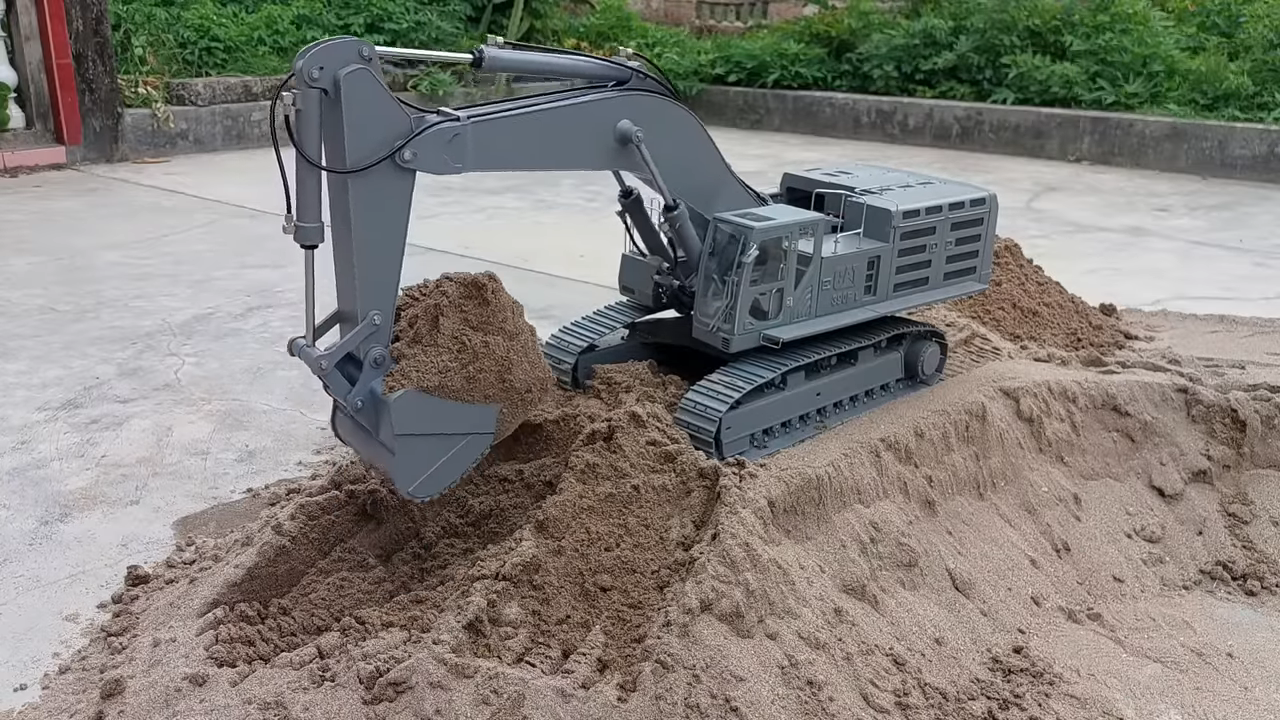
Some model builds are cute. Some are clever. And then there are the builds that make you stare at your screen, quietly question your life choices, and whisper, “Well, I guess I’m never calling my glue-gun project advanced again.” A scratch-built RC excavator made largely from PVC pipe belongs firmly in that final category.
The project, inspired by the Caterpillar 390F tracked excavator, is not simply a remote-control toy with a bucket bolted on the front. It is a miniature machine with tracks, hydraulic cylinders, servo-operated control valves, a detailed body, and the kind of hand-fabricated parts that turn ordinary plastic into something that looks ready to report for duty at a tiny construction site. The phrase “model making tour de force” is not decorative here; it is accurate.
What makes this scratch-built RC excavator so fascinating is not just that it works. Plenty of RC construction models work. The real magic is how it was made: common materials, patient craftsmanship, mechanical problem-solving, and a builder’s refusal to accept that “you should probably buy that part” is a final answer.
Why This Scratch-Built RC Excavator Grabs Attention
At first glance, the build looks like a premium commercial RC excavator. It has the recognizable silhouette of a large tracked machine: wide undercarriage, heavy boom, dipper arm, bucket linkage, cab, counterweight, and layered body panels. The details are not random decoration. They follow the design language of real hydraulic excavators, where every curve and hinge has a job to do.
Look closer, though, and the real achievement appears. Much of the model is made from plain gray PVC pipe. The pipe is cut, flattened into sheets, sliced into small pieces, heated, bent, shaped, drilled, glued, and assembled into parts that mimic stamped metal, cast brackets, track shoes, access panels, and hydraulic hardware. In other words, the builder turned plumbing material into miniature heavy equipment. Somewhere, a hardware-store employee is still wondering why someone bought that much pipe and zero fittings.
The result is a fully functional RC excavator that feels less like a weekend kit and more like a masterclass in scale engineering. It moves. It digs. Its boom, stick, and bucket operate through hydraulic cylinders. Its tracks give it the proper crawler-excavator stance. And its bodywork sells the illusion so well that the brain briefly forgets the machine started life as PVC.
The Engineering Behind the Miniature Machine
A Real Excavator, Shrunk Down With Patience
Full-size excavators rely on a coordinated system of engine power, hydraulic pumps, valves, hoses, cylinders, tracks, and operator controls. The same basic logic applies to an advanced RC excavator model. The machine needs power for travel, power for slewing or positioning, and controlled force for the boom, arm, and bucket. A convincing model must also move in a way that feels heavy, deliberate, and proportional.
That is the difference between a display model and a working scale machine. A static model can get away with beautiful paint and accurate proportions. A functional RC excavator has to survive motion. The boom cannot sag. The bucket linkage cannot bind. The tracks must stay aligned. The hydraulic system must push without leaking. The electronics must fit inside the body. The whole model has to look like a tiny excavator while behaving like a tiny excavator. That is a very demanding little beast.
Hydraulics Make the Build Feel Authentic
Hydraulic systems are ideal for excavators because pressurized fluid can produce smooth, powerful linear motion. On a real machine, a pump drives fluid through hoses and valves into cylinders, converting hydraulic pressure into mechanical force. That is how operators lift booms, curl buckets, run attachments, and perform precise digging movements.
On a scale model, hydraulics are both exciting and unforgiving. A builder has to think about pump output, fluid flow, pressure, seals, valve timing, cylinder stroke, and hose routing. Even a tiny leak can turn a clean model into an oily crime scene. But when it works, hydraulics deliver the right visual language. The boom rises with authority, the bucket curls like it has real bite, and the machine stops looking like a toy.
This scratch-built RC excavator uses working hydraulic cylinders for the boom, dipper, and bucket. Even more impressive, the control valves are servo-operated. That means the radio-control system does not merely switch motors on and off; it commands servos that manipulate hydraulic flow, giving the builder a miniature version of the control logic used in larger machines.
PVC: The Unlikely Hero Material
PVC pipe is affordable, widely available, and easy to overlook. Most people see it as plumbing material. Model makers see potential. Once cut and flattened, PVC becomes a workable plastic sheet. It can be shaped with heat, trimmed with basic tools, drilled, filed, and bonded into layered components. For a builder with patience, PVC can impersonate sheet metal surprisingly well.
In this RC excavator, PVC is used not as a shortcut but as a craft medium. The builder turns it into track parts, body panels, brackets, covers, and small mechanical details. The process is labor-heavy. Pieces must be measured, cut, matched, and repeated. Tracks alone require many nearly identical components. One slightly crooked hole may not matter on its own, but dozens of slightly crooked holes can become a rolling disaster. Precision is not optional.
This is where the project becomes more than a model. It becomes a study in repeatability. Every good scratch-built model teaches the same quiet lesson: the glamorous part is the final reveal, but the real work is making the fiftieth tiny part as carefully as the first. That is not romantic. That is discipline wearing safety glasses.
RC Electronics: Small Signals, Big Movements
Remote-control construction equipment depends on a chain of commands. The operator moves a stick on the transmitter. The receiver interprets that signal. Servos, electronic speed controllers, or motor controllers respond. Mechanical parts move. In a simple RC car, that might mean steering and throttle. In an RC excavator, the challenge multiplies quickly.
A convincing excavator may need independent track control, boom lift, stick movement, bucket curl, turret rotation, hydraulic pump control, lights, and sometimes sound. Each function consumes space, power, wiring, and mental energy. If the builder wants proportional control, the setup becomes even more complex. Servos need clean power. Motors need controllers that can handle current. Radio channels must be assigned logically so the machine can be operated without feeling like a piano recital performed during an earthquake.
That is why servo-operated hydraulic valves are such a clever feature. Servos are compact, widely used in RC and robotics, and capable of repeatable movement when properly powered and controlled. In this build, they act as the fingers of the hydraulic system, translating radio commands into fluid control.
Scale Detail Is More Than Decoration
The best scale models succeed because they capture function as well as form. A tiny latch matters because a real machine has service panels. Hydraulic hoses matter because real excavators are forests of hoses and fittings. Track pads matter because crawlers distribute weight and create traction. Even the cab shape matters because the operator’s space defines the personality of the machine.
This scratch-built RC excavator understands that realism is cumulative. One detail may be easy to miss. Fifty details create believability. The layered panels, moving joints, formed curves, visible hydraulics, track construction, and accurate proportions work together. The model says, “I am small,” but it does not say, “I am simple.”
That is the secret behind many great model engineering projects. They do not rely on a single trick. They succeed because hundreds of small decisions agree with each other. The boom geometry looks right. The bucket linkage behaves right. The tracks sit right. The body mass appears balanced. The viewer may not consciously identify every detail, but the eye knows when a machine feels convincing.
Why Scratch Building Still Matters in the Age of 3D Printing
Modern model makers have amazing tools. CAD software can turn an idea into a precise digital model. 3D printers can produce prototypes in hours. Laser cutters, desktop CNC machines, resin printers, and online parts suppliers have changed what hobbyists can build at home. These tools are fantastic, and any serious maker should respect them.
But this RC excavator shows why scratch building remains powerful. A scratch builder develops an intimate understanding of material behavior. PVC bends differently when heated too much. Thin parts flex. Glue joints need surface area. Holes drift if the bit wanders. Linkages bind if geometry is guessed instead of tested. Those lessons do not arrive as pop-up notifications. They arrive through mistakes, repairs, and the occasional dramatic sigh.
In many ways, the ideal modern workflow combines both worlds. CAD can help plan complex geometry. 3D printing can create test parts, jigs, brackets, and molds. Hand fabrication can handle custom shapes, fast changes, and material experiments. The impressive thing about this excavator is that it proves high-level results do not always require expensive machinery. Skill still matters. Patience still matters. A sharp blade, a steady hand, and a good eye can still embarrass a poorly calibrated printer.
What Makers Can Learn From This Build
Start With the Movement, Not the Paint
The first lesson is simple: function comes before finish. A model excavator can look beautiful on the bench and fail immediately in the dirt if the joints are weak or the hydraulics are underpowered. Builders should define the required movements early. How far should the boom lift? How deep should the bucket curl? How much clearance do the tracks need? What parts carry load?
Once the movement is understood, decoration becomes easier. Panels can be shaped around working parts. Hoses can be routed where they will not pinch. The body can hide electronics without trapping heat or making repairs impossible.
Repeatability Is a Superpower
Tracks are a perfect example. A crawler excavator needs many repeated pieces. If each track shoe is slightly different, the undercarriage may bind, wobble, or shed parts. Successful scratch building often depends on making simple jigs, templates, and drilling guides. They may not look glamorous, but they save hours and protect accuracy.
Build for Maintenance
Working models break. That is not pessimism; that is gravity and friction having a meeting. A good RC excavator should allow access to batteries, pumps, hoses, receivers, servos, and track components. Removable panels, working latches, and modular assemblies are not just realistic details. They are practical survival tools.
The Joy of Watching a Handmade Machine Come Alive
There is something uniquely satisfying about a scratch-built machine that actually moves. A store-bought RC excavator can be impressive, especially the high-end hydraulic models with metal parts and precise controls. But a scratch-built machine carries a different kind of energy. Every movement is proof of a solved problem. The bucket curls because the linkage geometry worked. The boom rises because the hydraulic cylinder sealed properly. The tracks crawl because dozens of hand-made pieces agreed to cooperate for once.
That emotional payoff is why projects like this spread across maker communities. Viewers admire the finished model, but they also admire the courage to begin. A build of this scale is intimidating. It contains many chances to quit. The material can crack. A valve can leak. A servo can jitter. A track can derail. The body can look wrong. Yet the final machine rolls forward, digs, lifts, and proves that persistence is a valid fabrication method.
Experience Notes: Lessons From the Bench
Anyone who has spent time building RC models, robots, or mechanical prototypes will recognize the rhythm behind a project like this. It rarely begins with a perfect plan. It usually begins with curiosity, a few sketches, some optimistic measurements, and a workbench that is already too small. A scratch-built RC excavator adds another layer because it is not one project; it is several projects wearing one yellow jacket. It is a tracked vehicle, a hydraulic machine, a scale model, an electronics package, and a durability test.
The first real experience lesson is that materials have personalities. PVC is forgiving in some ways and stubborn in others. It cuts easily, but thin sections can flex. It can be heat-formed, but overheating can distort the surface or weaken the piece. It glues well when properly prepared, but a joint under load needs design support, not blind faith. A builder quickly learns to test small samples before committing to a major part. That little scrap on the bench is not trash; it is research with dust on it.
The second lesson is that motion reveals truth. A boom assembly may look aligned until the cylinder extends. A bucket linkage may seem strong until it bites into compacted soil. A track may roll smoothly in the air and then complain loudly on the ground. This is why experienced builders test early and often. They assemble rough mechanisms, move them by hand, listen for rubbing, watch for twist, and adjust before paint ever enters the conversation. Paint is not a solution. Paint is a celebration after the solution behaves.
The third lesson is to respect wiring and hoses. In compact RC machinery, the inside of the model can become a tiny jungle. Wires want to snag. Hydraulic lines want to kink. Batteries want to occupy the same space as everything else. Good layout is not an afterthought; it is part of the engineering. Leave service loops. Label channels. Secure moving lines. Make panels removable. Future-you will be grateful, especially when a servo needs replacement ten minutes before showing the model to friends.
The fourth lesson is patience with repetition. Tracks, hinges, brackets, and small panels demand consistency. Making one nice part is satisfying. Making forty matching parts is character development. The secret is to create templates and stop trusting eyeballs when a guide would do better. A simple drilling jig can turn frustration into rhythm.
Finally, projects like this teach humility in the best way. The builder learns that craftsmanship is not magic. It is careful work repeated long enough to look impossible from the outside. That is the real charm of the scratch-built RC excavator: it reminds makers that extraordinary results can come from ordinary material, provided the person holding the tool refuses to rush.
Conclusion: A Tiny Excavator With a Huge Lesson
The scratch-built RC excavator is more than a miniature construction vehicle. It is a celebration of model engineering, resourcefulness, and stubborn creativity. By transforming PVC pipe into tracks, panels, hydraulic parts, and realistic structure, the builder demonstrates what happens when practical skill meets imagination. The machine is impressive because it looks right, moves right, and teaches the viewer something about how real excavators work.
For RC hobbyists, it is inspiration. For model makers, it is a benchmark. For engineers, it is a reminder that elegant solutions do not always come from expensive materials. And for everyone else, it is a delightful warning: never underestimate a person with PVC pipe, a sharp blade, and enough patience to make a bucket curl like the real thing.