Every now and then, the internet produces a piece of writing so strangely specific, so deeply unserious, and so unexpectedly educational that it deserves to be studied like a rare bird itself. That is exactly the case with the viral idea behind “A Non-Comprehensive List Of Birds That Piss Me Off”, a wonderfully ridiculous concept that turns ordinary bird appreciation into dramatic courtroom testimony.
At first glance, it sounds like someone simply woke up, saw a bird, and chose chaos. But that is part of the charm. Birds are already funny without trying. They have suspicious little feet, intense side-eyes, dramatic mating dances, ancient dinosaur energy, and an impressive ability to look offended by the weather. So when a person decides to rank, roast, or complain about birds for reasons that are mostly emotional and only occasionally scientific, the result is pure internet gold.
This kind of humor works because it takes something familiarbirds in trees, birds at feeders, birds staring into your soul from a parking lotand treats it with the seriousness of a federal investigation. It is not really about hating birds. It is about noticing how bizarre they are. And once you start noticing, you may never look at a pigeon, crow, mockingbird, potoo, shoebill, or vulture the same way again.
Why Bird Humor Hits So Hard Online
Birds occupy a perfect little branch in the comedy tree. They are beautiful, yes, but they are also deeply weird. A cardinal looks like it has an urgent appointment with a tiny royal court. A blue jay behaves like it owns the neighborhood and has paperwork to prove it. A shoebill looks like it remembers the fall of an empire. A great potoo looks like a tree stump that has seen your search history.
That contrast is what makes bird memes and funny bird lists so effective. Birds are associated with elegance, freedom, nature, and peaceful morning songs. Then you observe them for more than twelve seconds and realize they are also petty, loud, territorial, theatrical, and occasionally shaped like an unfinished sketch from a fantasy movie.
The phrase “non-comprehensive list” also adds to the joke. It suggests that the author has not even begun to explore the full depth of avian annoyance. There are more birds to be judged. More feathers to cross-examine. More beaks to accuse of emotional misconduct. It is absurd, but it feels oddly reasonable.
The Secret Ingredient: Birds Already Act Like Tiny Drama Machines
What makes the joke even better is that real bird behavior can be genuinely dramatic. At backyard feeders, birds often compete through quick postures, lunges, bluffing, and social ranking. To humans, it may look like a fluffy snack bar argument. To the birds, it is politics, economics, and probably a little performance art.
Some species appear naturally bossier than others. Hummingbirds, for example, may look like flying jewelry, but many defend nectar sources with astonishing intensity. They are basically glittering helicopters with anger management issues. Northern mockingbirds are another excellent example. They are famous for singing, copying sounds, and defending nests with the confidence of a bird that has never once questioned its own authority.
During nesting season, many birds become especially protective. If a bird swoops, calls loudly, or acts unusually bold, it may not be “being rude” so much as saying, “Please step away from my extremely important twig-based real estate.” Of course, that does not make it less funny when a tiny feathered creature behaves like a nightclub bouncer outside a shrub.
The Funniest Part Is the Fake Outrage
The list’s humor depends on exaggerated personal offense. The writer is not calmly explaining bird biology. They are emotionally inconvenienced by the existence of specific birds. This creates a delightful mismatch between subject and tone. A bird might be criticized for looking too much like a villain, for having suspicious legs, for appearing to be designed by committee, or for simply “knowing what it did.”
That style is classic internet nonsense: deeply committed, highly specific, and proudly unhelpful. It is the same energy as rating types of pasta by how suspicious they seem, ranking clouds by attitude, or accusing a household appliance of “standing there weird.” The joke is not that the complaints are fair. The joke is that they are delivered with total confidence.
Birds That Deserve a Dramatic Side-Eye
To understand why a list like this works, it helps to look at a few birds that naturally invite dramatic commentary. These are not “bad” birds. They are ecological marvels, evolutionary success stories, and important parts of their habitats. They are also, from a purely comedic perspective, a little much.
The Shoebill: The Bird That Looks Like It Knows Ancient Secrets
The shoebill is one of the most internet-ready birds on Earth. Tall, gray, intense, and equipped with an enormous shoe-shaped bill, it looks less like a bird and more like a retired wizard who got tired of answering questions. Its stare is legendary. Its posture is intimidating. Its whole presence says, “I was here before your civilization and I will be here after your group chat collapses.”
In reality, the shoebill is a fascinating wetland bird native to parts of central and eastern Africa. Its massive bill helps it catch prey in swampy habitats. But online, facts often come second to vibes, and the shoebill’s vibe is “prehistoric librarian with a grudge.” No wonder it shows up in funny bird discussions. It is impossible to look at one and not feel like you are being silently evaluated.
The Great Potoo: The Tree Stump With Eyeballs
The great potoo is a masterpiece of camouflage and accidental comedy. During the day, it sits extremely still, blending into branches and tree trunks. This is brilliant survival behavior. It is also the behavior of an animal that appears to be pretending it does not owe you money.
With huge eyes, a wide mouth, and a habit of looking both shocked and absent from the meeting, the great potoo has become a favorite in internet bird humor. It is not traditionally cute in the polished greeting-card sense. It is cute in the “why does this creature look like it just heard gossip about itself” sense. That is arguably better.
The King Vulture: Royalty, But Make It Extremely Weird
The king vulture has one of the most unforgettable faces in the bird world. Its body is mostly pale with darker wing and tail feathers, while its head and neck can display bright colors. It looks like nature opened the art supplies drawer and said, “Yes.”
As a scavenger, the king vulture plays a valuable ecological role. It helps clean up carrion and contributes to the balance of tropical ecosystems. But visually, it is difficult not to understand why someone might place it on a “birds that annoy me” list. Not because it has done anything wrong, but because it looks like it arrived at a formal event wearing a mask made by a very talented goblin.
The Jacana: Too Much Foot, Not Enough Explanation
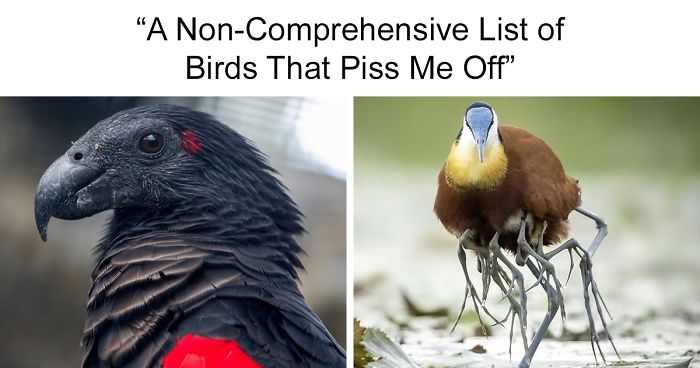
Jacanas are sometimes called “lily-trotters” because their extraordinarily long toes allow them to walk across floating vegetation. Scientifically, this is a beautiful adaptation that spreads the bird’s weight over a wider surface area. Comedically, it looks like a bird borrowed someone else’s hands and attached them to its legs.
This is exactly the kind of bird that belongs in a ridiculous list. The jacana did not ask to become a meme. It simply evolved excellent wetland footwear. Unfortunately for the jacana, the internet has eyes, and those toes are impossible to ignore.
The Dracula Parrot: Goth Energy in Feather Form
Pesquet’s parrot, often nicknamed the Dracula parrot, is another bird that seems invented for dramatic reactions. With dark plumage, striking red accents, and a vulture-like profile, it looks like it should live in a castle and give cryptic warnings during thunderstorms.
The funny twist is that despite its intense appearance, this bird is not a bloodthirsty nightmare. It is largely associated with fruit, especially figs. That makes the Dracula parrot one of nature’s finest bait-and-switch designs: looks like a vampire, eats like someone at a farmers market.
Why “Nonsensical” Lists Are Actually Smart Content
On the surface, a funny bird complaint list is just entertainment. But from a content perspective, it is surprisingly clever. It combines curiosity, humor, shareability, and visual imagination. Readers click because the title is strange. They keep reading because the tone is funny. They remember it because birds are memorable. They share it because everyone knows at least one person who would enjoy a passionate argument against a weird-looking animal.
This is also why animal humor performs so well on social media. It invites participation. People do not just read; they respond. They defend their favorite birds. They nominate new birds. They argue that geese should be included. They accuse pigeons of suspicious sidewalk behavior. Before long, a simple joke becomes a communal bird court.
The best part is that the humor does not require actual cruelty or misinformation. The funniest version of this content comes from affectionate exaggeration. It is not “birds are bad.” It is “birds are magnificent little weirdos, and I need to file a report.” That distinction matters. Comedy lands best when it celebrates the subject while pretending to be mildly betrayed by it.
The Science Behind Birds Acting “Annoying”
Many behaviors that humans label as annoying are perfectly logical from a bird’s perspective. Loud calls may warn others, attract mates, defend territory, or keep flock members connected. Swooping may protect a nest. Chasing at feeders may help secure food. Standing motionless for hours may be camouflage. Looking judgmental is probably not intentional, though in some cases it is emotionally convincing.
Birds have evolved to survive in environments full of competition, predators, seasonal changes, and limited resources. Their actions are not random, even when they look unhinged. A bird yelling at dawn is not personally attacking your sleep schedule. It may be claiming territory or communicating fitness. A jay grabbing food and leaving like a feathered shoplifter is not being rude. It is using intelligence and opportunity. A hummingbird dive-bombing another hummingbird is not starting drama for fun. It is defending a valuable energy source.
Still, understanding the science does not erase the comedy. If anything, it improves it. Once you know a bird has a serious biological reason for behaving like a tiny chaos engine, the whole thing becomes even funnier. Nature is not just beautiful. Nature is also deeply extra.
How the Title Turns Curiosity Into Clicks
The title “Person Compiles ‘A Non-Comprehensive List Of Birds That Piss Me Off’, And It’s A Hilariously Nonsensical Read” is long, specific, and emotionally charged. That is exactly why it works. It creates a question in the reader’s mind: Which birds? Why are they offensive? How can a list be both non-comprehensive and intense? What did the birds do?
For SEO and reader engagement, this title has multiple hooks. It includes the core topic, “birds,” while also signaling humor, internet culture, and list-based entertainment. It promises a low-stakes read with high amusement value. In an online world crowded with serious news, productivity advice, and recipes that require seventeen bowls, a ridiculous bird list feels like a vacation for the brain.
It also carries a relatable tone. Everyone has irrational opinions. Maybe you distrust pelicans because their mouths look like luggage. Maybe geese remind you of parking-lot security guards. Maybe you respect crows but suspect they are forming committees. The title gives readers permission to enjoy a silly opinion without needing it to be correct.
What Writers Can Learn From This Kind of Viral Humor
For bloggers, humor writers, and social media creators, the success of this concept offers a useful lesson: specificity is powerful. “Funny birds” is broad. “A non-comprehensive list of birds that annoy me for reasons I cannot fully defend” is instantly more interesting.
Good internet humor often sounds like a private thought accidentally delivered on a public stage. It has personality. It has rhythm. It sounds like a real person with a real, silly grievance. That authenticity is hard to fake, which is why the best versions of this style feel spontaneous even when they are carefully written.
Another lesson is that educational content does not have to wear a lab coat at all times. A reader may arrive for jokes about spooky birds and leave knowing that jacanas use long toes to move across floating vegetation, or that potoos rely on camouflage, or that birds can become more defensive during nesting season. Humor lowers the door. Curiosity walks through it.
Why We Secretly Love the Birds That “Piss Us Off”
The truth is, birds that inspire fake outrage are often the most interesting ones. Nobody writes passionate complaints about a bird that leaves no impression. The “annoying” bird is memorable. It has presence. It looks strange, acts boldly, or makes us feel like the natural world is winking at us through a beak.
That is why the list feels affectionate rather than mean. It is a roast, not a rejection. The writer is not asking for fewer birds. They are asking for answers. Why does this bird look like that? Why is it standing there with such confidence? Why does it scream like a haunted door? Why are its toes long enough to sign documents?
Birds invite these questions because they are both common and alien. They live beside us, above us, around our houses, in our parks, and across our cities, but they still feel like tiny ambassadors from another timeline. They are dinosaurs with modern schedules. They are neighborhood residents with wings. They are beautiful, ridiculous, and occasionally shaped like a punchline.
Extra Experiences: Living With Birds, Laughing at Birds, and Occasionally Being Judged by Birds
Spend enough time around birds and you begin collecting small stories that sound fake but are not. Almost everyone has had at least one bird encounter that felt personal. Maybe a gull stole fries at the beach with the precision of a trained criminal. Maybe a goose blocked a sidewalk and forced several adults to reconsider their life choices. Maybe a pigeon made direct eye contact while walking directly through a situation it had no business entering.
One of the funniest everyday bird experiences is watching feeder politics unfold. At first, a backyard feeder seems peaceful. You imagine soft chirping, gentle fluttering, and a wholesome nature-documentary mood. Then the birds arrive, and suddenly the feeder becomes a miniature cafeteria during a seating dispute. One bird hops in confidently. Another bird lunges. A third waits nearby, pretending not to care, then dives in the moment there is an opening. It is strategy. It is theater. It is lunch.
Mockingbirds provide another memorable kind of bird experience. They can be wonderful singers, filling neighborhoods with bright, varied sound. But during nesting season, they may also behave as if the entire block has signed a lease under their name. Walk too close to a nest and you might receive a sharp reminder that you are not the main character in that shrub. The bird is. Please update your records.
Then there are crows, the philosophers of the parking lot. Crows often appear to be thinking several steps ahead, and that alone makes people suspicious. A crow standing near a trash can does not look like a random animal. It looks like a manager waiting for a shipment. Whether it is solving a problem, watching people, or simply existing with dramatic intelligence, a crow can make an ordinary afternoon feel like the opening scene of a clever heist movie.
Even small birds can deliver big comedy. Hummingbirds, for example, are so tiny and dazzling that they should seem delicate. Instead, they often behave like competitive athletes in a sugar-fueled aerial league. Watching one defend a feeder is like watching a gemstone develop a personal vendetta. It is hard not to respect the commitment.
Birdwatching also teaches patience, although sometimes against your will. You may spend twenty minutes trying to spot a bird you can hear but cannot see, only to discover it has been sitting directly in front of you the entire time, perfectly blended into the branches. The great potoo takes that concept to an extreme. Its whole survival strategy seems to be: “What if I became a stick, but emotionally?” That is not just camouflage. That is performance.
Experiences like these are why funny bird lists resonate. They exaggerate something real: birds are unpredictable neighbors. They interrupt mornings, decorate sidewalks, patrol parks, steal snacks, sing beautifully, scream horribly, and occasionally look like fantasy creatures who missed their casting call. The more you notice them, the more entertaining the world becomes.
So yes, a “non-comprehensive list of birds that piss me off” is nonsensical. That is the whole point. But it is also a love letter disguised as a complaint. It reminds readers that nature does not have to be distant or solemn to be appreciated. Sometimes appreciation begins with laughter. Sometimes it begins with confusion. And sometimes it begins when a bird looks at you from a fence like it knows exactly what you did, even though you did absolutely nothing.
Conclusion
The viral appeal of “A Non-Comprehensive List Of Birds That Piss Me Off” comes from the perfect blend of absurd humor, real animal weirdness, and internet-ready personality. Birds are already dramatic enough to carry the joke: they swoop, scream, strut, stare, camouflage, compete, and occasionally resemble creatures designed during a thunderstorm. The list simply gives readers permission to laugh at that strangeness while secretly learning a little about the natural world.
In the end, the funniest bird content is not really about being annoyed. It is about noticing. It is about looking at a jacana’s toes, a shoebill’s stare, a potoo’s disguise, or a mockingbird’s territorial confidence and saying, “I have questions.” And honestly, the birds probably have questions about us too.