Everyone has at least one suspiciously specific piece of knowledge rattling around in their brain. Perhaps you know how long an octopus can survive outside water, what sugar does to wet concrete, or why an intoxicated person can technically break the law by remaining inside an Alaskan bar. None of this information appears during an ordinary grocery run. Yet there it is, waiting for the perfect conversational ambush.
That was the idea behind an online question asking people to reveal their best “why the hell do you know that?” fact. The answers ranged from delightful animal trivia to historical oddities, medical claims, engineering curiosities, and statements that sounded as though they had been collected during an unusually chaotic police interview.
There was one complication: random facts shared online are not automatically true. Some were accurate, some needed context, and others had been stretched until they squeaked. The following collection preserves the fun while separating fascinating trivia from confidently delivered nonsense.
30 Random Facts That Sound Made Up but Mostly Are Not
1. Hens Really Do Announce Their Eggs
Many hens produce a distinctive post-laying cackle consisting of short calls followed by a longer vocalization. Other chickens may join the noise, creating what backyard keepers call the “egg song.” It sounds less like a gentle lullaby and more like a tiny feathered press conference.
2. Fidel Castro Had a Celebrity Supercow
Ubre Blanca, a Holstein-zebu cross raised in Cuba, became famous for producing an extraordinary amount of milk. In 1982, she reportedly yielded approximately 109.5 liters in one day. Castro frequently celebrated her as evidence of Cuba’s agricultural ambitions. Most cows receive hay. Ubre Blanca received political symbolism and eventually a monument.
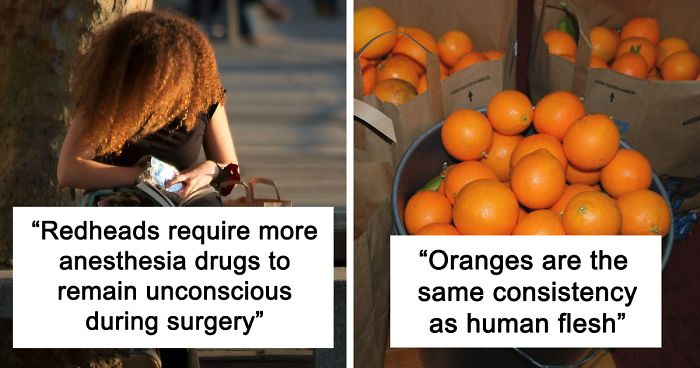
3. Red Hair May Affect Responses to Some Anesthetics
A small controlled study found that naturally red-haired women required more of one inhaled anesthetic than dark-haired participants. Other research, however, has not found a clinically meaningful reason to change anesthesia automatically based on hair color. The sensible conclusion is not “redheads are immune to anesthesia,” but that genetics may influence pain and drug responses in complicated ways.
4. Being Drunk Inside an Alaskan Bar Can Be Illegal
Alaska law states that a drunken person may not knowingly enter or remain on licensed premises. Bars are also prohibited from serving or allowing visibly intoxicated people to remain. That means the place commonly associated with becoming drunk is legally required to stop accommodating you once you have achieved the apparent objective.
5. An Actor Was Accused of Being Jack the Ripper Because He Acted Too Well
Richard Mansfield terrified audiences with his stage transformation between Dr. Jekyll and Mr. Hyde. During the 1888 Whitechapel murders, someone wrote to police suggesting that Mansfield might be Jack the Ripper. There was no credible case against him, but it may be history’s harshest theater review: “Excellent performance; possibly an actual murderer.”
6. “Widdershins” Means Counterclockwise
Long before people casually said “turn counterclockwise,” English speakers used words such as widdershins for movement opposite the sun’s apparent path. Deasil or sunwise described the other direction. The viral claim that these terms existed strictly “before clocks” is too neat, but the words themselves are real and deserve a comeback.
7. Orcas Have Occasionally Preyed on Swimming Moose
Moose are powerful swimmers and may cross coastal channels or move between islands. In rare areas where their routes overlap with mammal-eating orcas, swimming moose have reportedly become prey. Orcas are not a primary moose predator, but nature apparently permitted this bizarre crossover episode.
8. Some Moths Perform Wild Evasive Maneuvers When They Detect Ultrasound
Many moths have evolved defenses against echolocating bats. Depending on the species and situation, they may dive, loop, stop flying, or produce ultrasonic sounds of their own. The popular claim that jingling keys will always make a moth backflip is unreliable, but the underlying bat-avoidance acrobatics are real.
9. Sugar Can Seriously Disrupt Concrete
Sugar can interfere with cement hydration and delay setting. Tiny, carefully measured quantities may function as a retarder, while larger amounts can drastically reduce strength or prevent proper hardening. The viral “one pound per thousand pounds” formula is not universal because results depend on the cement, mixture, temperature, and dosage.
10. People With Shellfish Allergies Should Be Cautious About Eating Cicadas
Cicadas and crustaceans contain related proteins, including tropomyosin, which can trigger allergic reactions. A shrimp allergy does not guarantee a cicada allergy, but health authorities have advised susceptible people not to experiment without consulting an allergist. Yes, this warning exists because enough people looked at a swarm and thought, “Lunch.”
11. A Flight Attendant Survived a Fall of More Than 33,000 Feet
Vesna Vulović survived the 1972 destruction of JAT Flight 367 and holds the official record for the highest fall survived without a parachute: 33,333 feet. She was trapped inside part of the aircraft rather than falling freely through the sky, and she suffered devastating injuries. The record is accurate, although “survived” should never be confused with “walked away comfortably.”
12. Sea Cucumbers Can Expel Internal Organs as a Defense
When threatened, some sea cucumbers eject parts of their digestive or respiratory systems. Others release sticky, sometimes toxic tubules that entangle predators. They can later regenerate the lost structures. The internet version often claims the organs always kill the attacker, but distraction and entanglement are more common outcomes.
13. The Last Known Aurochs Died in Poland in 1627
Aurochs were enormous wild cattle and ancestors of many domestic breeds. The last known individual died in Poland’s Jaktorów Forest in 1627. Viral retellings sometimes call her the last “wild cow” and relocate her to Kraków, but the broader point remains: a species once spread across Europe disappeared surprisingly recently.
14. Eating 140 Bananas Is Not a Scientifically Established Lethal Dose
Bananas contain potassium, but healthy kidneys regulate potassium efficiently, and no credible medical rule says exactly 140 bananas will kill a person. Eating that many at once would be nearly impossible anyway. The more immediate emergency would probably involve volume, choking, vomiting, and a lifelong inability to look at a smoothie.
15. An Octopus Has Three Hearts
Two hearts pump blood through the gills, while a third circulates oxygenated blood through the rest of the body. Octopus blood is blue because it uses copper-rich hemocyanin rather than the iron-rich hemoglobin that makes human blood red. Evolution could have stopped after “three hearts,” but apparently it wanted matching designer blood.
16. Calling an Octopus a Nine-Brained Animal Is an Oversimplification
An octopus has a central brain plus large neural clusters in each arm. Those arms can process sensory information and coordinate many movements with considerable independence. Saying it has nine brains is catchy but anatomically loose. It is more accurate to describe a highly distributed nervous systemessentially nature’s strangest group project.
17. A Blue Whale’s Heart Can Weigh About 400 Pounds
The blue whale is the largest known animal, so subtle internal organs were never part of the plan. Its heart may weigh approximately as much as a studio piano and must circulate blood through a body that can stretch close to the length of a basketball court.
18. A Blue Whale’s Tongue Can Weigh as Much as an Elephant
Blue whales filter enormous quantities of seawater to collect tiny krill. Their tongues can weigh several tons, often compared with the weight of an elephant. That makes the animal’s tongue larger than many entire land mammals, which feels excessive until one remembers that the whale itself may weigh more than 300,000 pounds.
19. Giant Squid Have Eyes Roughly the Size of Volleyballs
Giant squid possess the largest known eyes in the animal kingdom. Their enormous visual organs help detect faint changes in light deep underwater, including disturbances caused by approaching predators such as sperm whales. Somewhere in the darkness, a squid is staring with equipment that looks borrowed from a sporting-goods store.
20. Sea Sponges Are Animals Without Brains, Hearts, or Stomachs
Sponges have no nervous, circulatory, or conventional digestive system. Water moving through their bodies supplies oxygen and food while carrying away waste. They are animals, but they have rejected nearly every feature people normally expect an animal to possess.
21. Sea Cucumbers Breathe Through Structures Near Their Digestive Tracts
Many sea cucumbers pump seawater through branching structures called respiratory trees. These structures sit inside the body near the digestive system and exchange gases with the surrounding water. In plain English, the animal breathes through internal plumbing connected to its rear opening. Biology was apparently unsupervised that day.
22. Both Eyes of a Flatfish End Up on One Side of Its Head
Young flatfish begin life looking more conventionally symmetrical. During development, one eye migrates across the skull, allowing the adult fish to lie flat on the seafloor while keeping both eyes pointed upward. Depending on the species, the eyes settle on either the right or left side.
23. Venus Is Hotter Than Mercury
Mercury is closer to the Sun, but Venus has an extremely dense, carbon-dioxide-rich atmosphere that traps heat through a powerful greenhouse effect. Its surface is hot enough to melt lead. Proximity matters, but an atmosphere capable of functioning as a planetary pressure cooker matters more.
24. Our Solar System Takes About 230 Million Years to Orbit the Milky Way
The Sun and its planets travel around the center of the Milky Way at extraordinary speed, yet one complete galactic orbit still takes roughly 230 million years. The last time our solar system occupied approximately this position, dinosaurs were only beginning to diversify.
25. The Moon Is Shrinking and Experiencing Quakes
As the Moon’s interior gradually cools, it contracts. That contraction wrinkles the crust and contributes to faults and moonquakes. Earth’s companion may look calm from a backyard telescope, but geologically it is a slowly shrinking world with occasional structural complaints.
26. Astronaut Footprints Can Remain on the Moon for an Extremely Long Time
The Moon has no wind or flowing water to erase tracks in its powdery surface material. Apollo footprints therefore remain, although micrometeorite impacts and other space-weathering processes will eventually disturb them. “Forever” is an exaggeration, but “far longer than any shoe warranty” is safe.
27. Antarctica Is a Desert
Deserts are defined by low precipitation, not temperature. Much of Antarctica receives so little snow that it qualifies as the world’s largest desert. It is therefore possible to freeze in a landscape that is technically drier than many places filled with sand and cacti.
28. Chickens Do Not Produce Sound With Vocal Cords
Birds use an organ called the syrinx, located near the lower end of the trachea. Airflow and muscular control create their calls, cackles, and crows. A rooster announcing dawn is therefore performing with equipment fundamentally different from a human singer’s larynx.
29. Whales Cannot Completely Switch Off While Sleeping
Whales must consciously surface to breathe, so they cannot sleep exactly as humans do. Many rest in a partly alert state, sometimes floating at the surface like logs or resting vertically. Their sleep system effectively keeps someone on respiratory duty at all times.
30. A Female Brown Shrimp Can Release Up to a Million Eggs
Female brown shrimp may release approximately 500,000 to one million eggs near the seafloor. Most offspring will not survive to adulthood, which explains the staggering number. Nature’s reproductive strategy is sometimes less “carefully raise a family” and more “launch an enormous biological email campaign.”
Why Random Facts Are So Addictive
Useful information usually arrives with responsibilities. You learn tax rules because forms are waiting. You learn first aid because somebody may need help. Random facts are different. They offer the pleasure of discovery without assigning homework afterward.
They also violate expectations. A familiar animal suddenly has three hearts. A frozen continent turns out to be a desert. A word that sounds like a magical spell turns out to mean “counterclockwise.” The brain enjoys these sharp changes in perspective because they make ordinary subjects feel new again.
However, surprise makes people less skeptical. A strange claim feels shareable precisely because it is strange, and the desire to repeat it can outrun the desire to verify it. That is how “sugar delays cement setting” becomes a universal sabotage formula, or “some redheads responded differently in a study” becomes “redheads cannot be anesthetized.”
The best weird facts survive a quick reality check. They remain interesting after qualifications are addedand often become more interesting because the real explanation is richer than the meme.
Experiences From Becoming the Person Who Knows Too Many Odd Facts
Learning random trivia changes social situations in predictable ways. At first, people are entertained. Someone mentions a chicken, and you explain the post-laying cackle. Someone complains about turning a screw the wrong way, and you introduce the word widdershins. For a brief, glorious moment, you are a charming conversational wizard.
Then you become overconfident.
A discussion about seafood reminds you that people with shellfish allergies may react to edible insects. You casually mention cicadas. Everyone stops eating. You attempt to clarify that the risk concerns related proteins and that nobody at the table is currently consuming cicadas. This does not help. You have already become “the bug allergy person.”
Trivia nights are where unusual knowledge finally earns its rent. Most teams prepare for presidents, geography, sports, and pop music. The random-fact collector waits patiently for a question about Ubre Blanca, Antarctic precipitation, or obsolete directional vocabulary. When the moment arrives, the correct answer is delivered with such confidence that teammates become suspicious rather than impressed.
“Why do you know that?” they ask.
There is rarely a satisfying answer. Perhaps you watched a documentary years ago. Perhaps you read the back of a cereal box. Perhaps the fact entered your brain through an article opened at 2:13 a.m. while you were supposed to be checking tomorrow’s weather. Memory does not organize itself according to usefulness. It may forget a password created yesterday while preserving the estimated weight of a whale’s tongue indefinitely.
Sharing strange facts also teaches an important lesson about context. The most memorable version is not always the most accurate one. “Moths backflip when they hear keys” sounds better than “some moth species perform evasive flight responses after detecting ultrasound within particular frequencies.” The first version wins attention; the second version deserves trust.
Medical and safety-related trivia requires even more care. A study involving anesthesia should not be treated as personalized medical advice. An engineering curiosity should not become instructions for damaging property. A dramatic survival record should not encourage anyone to test gravity’s willingness to negotiate. Interesting information remains interesting without turning it into a challenge.
The healthiest approach is to treat random facts as invitations. Ask where the claim came from. Look for the original research, law, museum record, or scientific agency. Check whether the wording changed as it traveled across social media. Sometimes the fact collapses immediately. Sometimes it survives with a few corrections. Occasionally, the verified explanation is stranger than the rumor.
That process is part of the entertainment. Knowing that sea cucumbers expel internal structures is memorable. Learning that different species release different organs, that some use adhesive tubules, and that they can regenerate the missing tissue turns a gross party fact into an extraordinary lesson in evolution.
Eventually, people may stop asking why you know these things. They simply begin sending you screenshots at midnight with messages such as, “This sounds fake. Please investigate.” At that point, the transformation is complete. You are no longer the person who knows one suspicious fact. You are the volunteer curator of everyone else’s suspicious facts.
Conclusion: Curiosity Is Useful Even When the Facts Are Not
The internet’s best random facts make the world feel delightfully unorganized. Chickens hold noisy egg celebrations, sea cucumbers weaponize their anatomy, and an old word for turning left sounds like something whispered over a cauldron.
Not every viral claim deserves belief, but every surprising claim deserves a question. Verify it, correct it, and then save it for the next awkward silence. One day, someone will ask why the hell you know thatand you will finally have your moment.