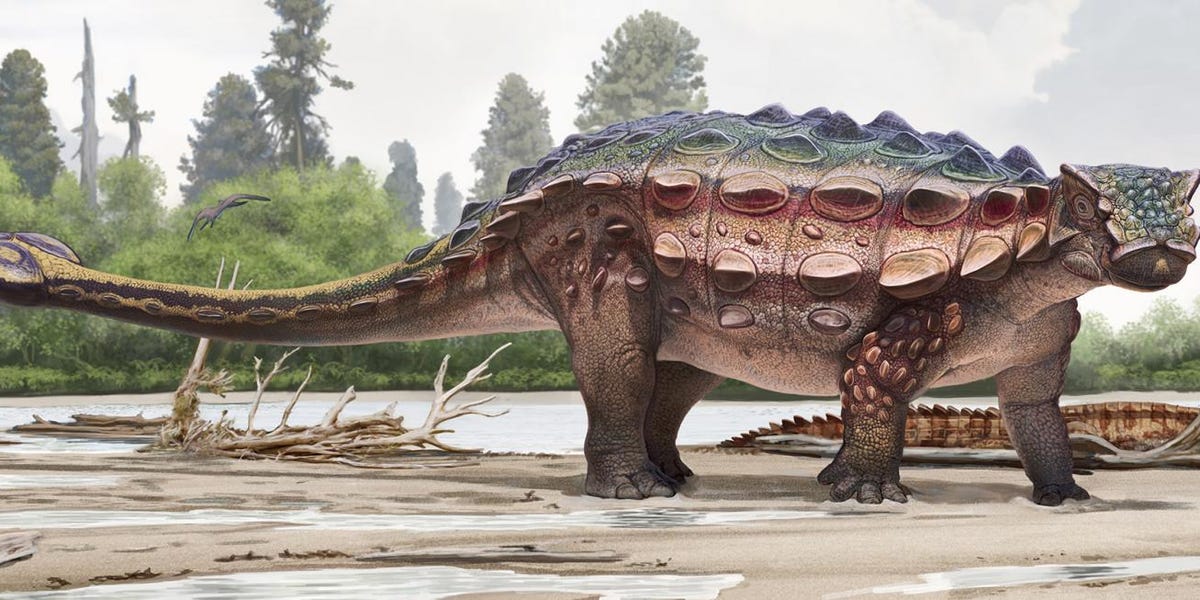
Every so often, paleontologists uncover a dinosaur that makes you stop mid-scroll and say, “Okay, that thing absolutely knew how to make an entrance.” This Utah discovery is one of those fossils. Meet Akainacephalus johnsoni, an armored dinosaur so heavily equipped with spikes, plates, and a tail club that calling it a “tank” feels less like a metaphor and more like a public service announcement.
Discovered in southern Utah and formally described in 2018, this ankylosaurid was a low-slung, plant-eating fortress that lived roughly 76 million years ago during the Late Cretaceous. It had a broad body, thick armor, a clubbed tail, and a skull covered in dramatic cone- and pyramid-shaped bony knobs. In other words, if most herbivores were trying to avoid trouble, Akainacephalus looked like trouble showed up, took one look, and quietly backed away.
What makes this dinosaur especially exciting is not just the “wow, that head looks like medieval weaponry” factor. Its anatomy is helping researchers understand how armored dinosaurs evolved, how they moved between Asia and North America, and why southern Utah keeps turning into a jackpot for Late Cretaceous fossils. So yes, this dinosaur looked like a prehistoric tank. But scientifically, it was also a rolling clue.
What Exactly Was Discovered?
Akainacephalus johnsoni is a newly identified species of ankylosaurid, a group of heavily armored, four-legged herbivorous dinosaurs famous for turning defense into an art form. The fossil was found in the Kaiparowits Formation of southern Utah, inside Grand Staircase-Escalante National Monument, a region that has produced a remarkable number of dinosaur discoveries over the last couple of decades.
The name is wonderfully on-brand. “Akaina” comes from a Greek word for thorn or spine, while “cephalus” means head. So the genus name essentially means “thorn head.” The species name, johnsoni, honors Randy Johnson, the museum volunteer who prepared the skull and lower jaws. That is, frankly, one of the coolest career plot twists ever: retired chemist helps prep fossil, gets immortalized in dinosaur history.
Researchers did not just find a random bone and decide to get dramatic. This specimen is important because it is unusually complete. The remains include a complete skull, parts of the vertebral column, limb bones, armor plates, neck rings, and a near-complete tail with its signature club. For paleontologists, that is the difference between trying to solve a mystery with one blurry photo and getting a whole album.
Why This Dinosaur Looked Like a Tank
The skull was basically a spiked helmet with opinions
The most striking feature of Akainacephalus is its head. Many people picture ankylosaurs as broad, squat dinosaurs with armor like built-in paving stones, and that is not wrong. But this one added extra flair. Its skull and snout were covered in tightly packed bony knobs and spikes shaped like small cones and pyramids. Instead of a smoother armored dome, it had a face that looked like it had been designed by someone who thought subtlety was overrated.
That spiky skull is a big deal because it separates Akainacephalus from several better-known North American ankylosaurs. Rather than having flatter head armor like some of its North American relatives, it had a pattern more similar to certain Asian ankylosaurids. That detail may sound niche, but in paleontology, weird skull ornamentation is the good stuff. It can reveal relationships, migration patterns, and whole branches of the dinosaur family tree.
The tail club completed the full armored package
No respectable tank dinosaur would show up without backup equipment, and Akainacephalus had a classic ankylosaurid tail club. Built from fused bone and supported by stiffened tail vertebrae, the club may have served as a defensive weapon against predators. Imagine being a large carnivore, thinking you found a slow-moving salad bar, and then getting introduced to the business end of a prehistoric sledgehammer.
Its body armor also included osteoderms, the bony plates embedded in the skin that made ankylosaurs look like mobile fortresses. Add short, sturdy legs and a broad torso, and you get an animal that was not built for speed but was built to make attacking it a terrible life choice.
Where It Lived and What Utah Was Like Back Then
Today, southern Utah is known for dramatic desert scenery, cliffs, and wide-open country. But during the Late Cretaceous, the world of Akainacephalus looked very different. Around 76 million years ago, this region was part of Laramidia, the western landmass of North America, separated from the eastern side by a vast inland sea.
The environment was warm, humid, and cut through by rivers and streams. Instead of dusty red rock and road-trip playlists, think lush floodplains, conifers, swamps, and a subtropical landscape packed with animals. This dinosaur shared its world with crocodilian relatives, turtles, duck-billed dinosaurs, and large predators. It was not wandering through a barren wasteland. It was navigating a busy, living ecosystem where armor made excellent sense.
That setting is one reason the Kaiparowits Formation matters so much. It preserves an unusually rich snapshot of Late Cretaceous life in southern Laramidia. Fossils from this region have shown that dinosaur communities could differ significantly from one part of western North America to another, even during the same general time period.
Why This Fossil Matters to Science
It helps explain dinosaur migration
One of the biggest scientific takeaways from Akainacephalus is that its skull features resemble those of some Asian ankylosaurids more than the flatter-headed forms better known from North America. That resemblance supports the idea that armored dinosaurs did not just evolve in one place and stay put. Instead, researchers think ankylosaurids likely dispersed from Asia into North America multiple times during the Late Cretaceous, probably when lower sea levels exposed the Bering land bridge.
That is a big deal because it suggests North American ankylosaurs were not one simple, tidy group. There were likely multiple lineages arriving and then evolving in different directions. Akainacephalus and the New Mexico ankylosaur Nodocephalosaurus appear to represent a spikier, more Asian-linked branch. Meanwhile, famous dinosaurs like Ankylosaurus and Euoplocephalus belong to a flatter-skulled tradition. Prehistoric family reunions were clearly complicated.
It strengthens the case for regional dinosaur diversity
The fossil also matters because it supports the idea that southern Laramidia had dinosaur communities distinct from those farther north. Scientists sometimes describe this as provincialism, which is a formal way of saying that ancient ecosystems were not uniform from top to bottom. Geography, climate, sea level, and landscape barriers may have helped isolate populations, allowing different species to evolve in different regions.
That means Akainacephalus is not just an isolated oddball. It is part of a broader story showing that Late Cretaceous western North America was a patchwork of dinosaur neighborhoods, each with its own cast of characters. Southern Utah was not merely “dinosaur country.” It was a very specific kind of dinosaur country.
How the Fossil Was Found and Prepared
The fossil was first discovered in 2008 during fieldwork in Grand Staircase-Escalante National Monument. Excavation in a remote, rugged place like this is not glamorous in the movie sense. It is a lot of hard work, careful mapping, precise digging, plaster jackets, weather battles, and the constant fear of stepping on the wrong thing and becoming the villain in your own paleontology documentary.
Once the specimen reached the lab, the real marathon began. Preparing the bones, especially the skull, took years. Rock had to be removed grain by grain so the anatomy could be studied without damaging the fossil. That slow, meticulous work is one reason the final description of a new dinosaur often comes long after the first bones are found. Discovery day is exciting; prep day is where patience becomes a scientific superpower.
And in this case, that patience paid off. The completeness of the specimen gave researchers enough information to recognize it as a new genus and species, compare it to other ankylosaurs, and place it into a larger evolutionary picture. It also made for an excellent museum display, because let us be honest, a skull covered in spikes is not exactly low-impact exhibit material.
What This Dinosaur Probably Ate and How It Lived
Despite looking like it could win an argument by standing there, Akainacephalus was a plant eater. Like other ankylosaurs, it likely used a beak to crop vegetation and small teeth to process softer plant material. It was probably feeding low to the ground, browsing on ferns, shrubs, and other available plants in its river-rich environment.
Its body plan suggests a life strategy built around defense rather than speed. Short, sturdy limbs supported a heavily armored frame. The low center of gravity would have made it stable. The armor discouraged attacks. The tail club may have added an extra line of protection. It was not the kind of dinosaur that needed to sprint across the landscape. It was the kind that made predators reconsider their entire evening.
That combination of bulk, armor, and weaponry helps explain why ankylosaurs remain fan favorites. They look like fantasy creatures but were completely real, walking around ancient ecosystems with built-in shields and clubs like evolution had binge-watched too many battle scenes.
Why People Cannot Get Enough of “Tank Dinosaurs”
There is something instantly satisfying about armored dinosaurs. Predators get a lot of press because teeth are flashy, but ankylosaurs offer a different kind of charisma. They are the underdog fantasy in fossil form: not the fastest, not the tallest, not the most dramatic hunters, yet astonishingly well-equipped to survive. They are basically proof that “I brought armor” can be a successful life strategy.
Akainacephalus takes that appeal and dials it up because its head armor is so unusual. It is one thing to hear “new dinosaur species discovered.” It is another to see a skull covered in thorny ornamentation and realize nature once produced a creature that looked like a medieval battering ram crossed with a landscaping hazard.
That visual punch matters. Great dinosaur discoveries do not just add names to a list. They help the public imagine ancient life as vivid, strange, and deeply specific. This was not a generic armored dinosaur. This was Akainacephalus, a thorn-headed tank from ancient Utah with a story stretching all the way back to migrations between continents.
Experiences Related to the Discovery: Why This Story Hits So Hard
Part of what makes the story of Akainacephalus so memorable is the experience wrapped around it. Not just the science, but the human feeling of discovery. A fossil like this does not arrive all at once with a label attached. It begins as a hint in the ground, a set of bones weathering out of rock, a puzzle nobody can yet see clearly. There is a special kind of suspense in that. Every field season brings heat, dust, long hikes, careful digging, and the quiet hope that the next few inches of rock might reveal something extraordinary.
Then there is the preparation process, which is its own experience entirely. Most people imagine paleontology as dramatic excavation scenes, but some of the most important work happens later in a lab, where technicians and volunteers spend months or years removing rock from bone. That is part science, part craftsmanship, part stubborn refusal to blink. The fact that Randy Johnson helped prepare the skull and then had the species named in his honor adds a deeply human layer to the discovery. It reminds people that fossil science is not only about famous professors and published papers. It is also about volunteers, preparators, museum workers, and patient hands doing incredibly skilled work behind the scenes.
There is also the museum experience. Seeing an armored dinosaur on display is different from reading about it in an article. In a museum gallery, the scale clicks. The armor feels more real. The skull looks less like an illustration and more like a warning label from another world. Visitors do not just learn facts; they feel the strange physical presence of an animal that lived millions of years before humans existed. That feeling is hard to fake. It is part awe, part curiosity, part “how did this thing actually happen?”
For kids, discoveries like this can be a gateway into science. For adults, they often revive the same fascination people had when they were seven and thought every dinosaur fact was the greatest thing ever spoken aloud. A story like this connects fieldwork, geology, evolution, anatomy, museum education, and public imagination all at once. It gives people an entry point into real science without draining the wonder out of it.
And maybe that is why Akainacephalus sticks with people. It is not just because it looked like a tank, though that certainly helps. It is because the discovery captures the full experience of paleontology: the remote field site, the slow preparation, the scientific detective work, the evolutionary surprise, and finally the moment when the public gets to meet a dinosaur that is both bizarre and real. In a world full of forgettable headlines, “spiky-headed armored dinosaur from Utah” has the decency to sound like an event. More importantly, it earns that sound with real science.
Conclusion
Akainacephalus johnsoni is one of those discoveries that manages to be fun, weird, and scientifically important all at the same time. On the surface, it is easy to love because it looked like a tank with a thorny helmet and a tail club. But underneath that instantly memorable appearance is a fossil that helps researchers track dinosaur migration, understand regional diversity in ancient North America, and appreciate just how distinctive southern Utah’s Late Cretaceous fauna really was.
So yes, the headline works. This new spiky-headed armored dinosaur from Utah really was basically a tank. Just a tank that ate plants, wore built-in body armor, and carried 76-million-year-old evolutionary secrets in the bones of its skull. Honestly, that might be even cooler.