Imagine getting a phone alert that says, “Incoming solar storm. You have 30 minutes. Please secure your satellites, reroute your flights, and maybe don’t trust your tractor’s GPS for a bit.” It sounds like the opening scene of a sci-fi thriller, except this story is not fiction. NASA-supported researchers have developed an artificial intelligence model designed to forecast dangerous space weather before it affects Earth’s magnetic environment.
The model is called DAGGER, short for Deep Learning Geomagnetic Perturbation. Thankfully, it sounds cooler than “Computer That Watches the Sun So Your Power Grid Doesn’t Have a Bad Tuesday.” DAGGER combines AI with spacecraft measurements of the solar wind and observations from ground-based magnetic stations. Its mission is practical: predict where geomagnetic disturbances may hit around the world with about 30 minutes of warning.
That half hour may not seem like much if you are trying to finish laundry, answer email, and find your car keys. But for satellite operators, power-grid managers, aviation planners, emergency coordinators, and telecommunications teams, 30 minutes can be the difference between reacting blindly and taking targeted protective action.
What Are Solar Storms, Really?
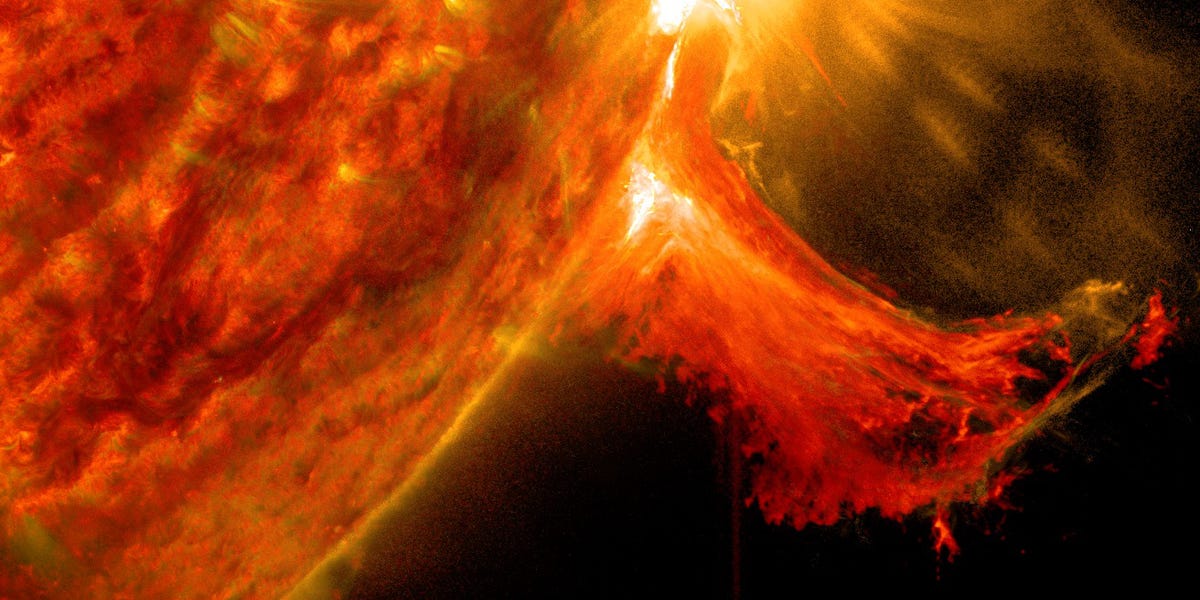
A solar storm begins with the Sun doing what the Sun does best: being dramatic. Our star constantly releases a stream of charged particles called the solar wind. Most of the time, Earth’s magnetic field handles this flow like a cosmic umbrella. But when the Sun launches a stronger eruption, especially a coronal mass ejection, or CME, the situation can become more serious.
A CME is a massive cloud of magnetized solar material blasted into space. These clouds can travel at extraordinary speeds and, if aimed toward Earth, may collide with our planet’s magnetosphere. When the magnetic fields line up in just the wrong way, energy pours into Earth’s near-space environment and creates a geomagnetic storm.
The pretty side of this interaction is the aurora. Charged particles excite gases in the upper atmosphere, painting the sky green, red, purple, and pink. The less charming side includes GPS errors, radio blackouts, satellite drag, spacecraft charging, transformer stress, and power-grid disturbances. In other words, the same storm that gives photographers a bucket-list sky can give infrastructure teams a bucket of problems.
Why NASA’s DAGGER Model Matters
Space weather forecasting has existed for decades, but it is extremely difficult. The Sun is not a light bulb with a predictable dimmer switch. It is a boiling, magnetically tangled plasma sphere that sometimes throws billions of tons of material into space. Forecasting the timing, strength, direction, and ground-level effects of that material is a scientific challenge with real economic consequences.
DAGGER matters because it focuses on fast, global forecasts of geomagnetic perturbations. Instead of merely saying, “A solar storm may arrive,” the goal is to estimate where Earth’s magnetic field may be disturbed and how those disturbances could affect systems on the ground. That is a more useful warning for people who have to make operational decisions quickly.
The model uses deep learning, a branch of AI that can identify patterns in large datasets. Researchers trained it to connect solar wind measurements from heliophysics missions with magnetic disturbances measured at stations around the planet. Once trained, the model can generate forecasts quickly, making it suitable for near-real-time warning systems.
How the 30-Minute Solar Storm Warning Works
The 30-minute warning is tied to where many solar wind monitors sit in space. Spacecraft positioned upstream from Earth can sample incoming solar wind before it reaches our planet. Think of them as weather buoys floating in the ocean between the Sun and Earth. They cannot stop the storm, but they can tell us what is about to arrive.
DAGGER analyzes those measurements and forecasts how the approaching solar wind may disturb Earth’s magnetic field. It then produces global predictions that can be refreshed frequently. That frequent updating is important because space weather changes fast. A storm’s magnetic orientation, density, and speed can shift, and those changes influence how strongly Earth responds.
What DAGGER Is Predicting
Strictly speaking, DAGGER is not predicting the birth of a solar eruption at the Sun. It is predicting geomagnetic disturbances near Earth after solar wind data becomes available. That distinction matters. A headline may say “NASA’s AI predicts solar storms,” but the more accurate version is: NASA-enabled AI can forecast the near-term ground magnetic impacts of incoming space weather.
This is still a big deal. Grid operators do not only need to know that the Sun erupted two days ago. They need to know whether the storm is likely to produce dangerous ground-level magnetic changes in their region. A global, frequently updated AI forecast makes that information more actionable.
What Can Be Done in 30 Minutes?
Thirty minutes will not let anyone build a backup power plant, launch a replacement satellite, or politely ask the Sun to calm down. But it can support rapid, realistic protective steps.
Power Grid Operators Can Reduce Risk
Geomagnetic storms can induce currents in long conductors, including power transmission lines. These geomagnetically induced currents can stress transformers, trigger voltage instability, or interfere with protective systems. With a timely warning, grid operators may adjust loads, monitor vulnerable equipment, delay maintenance, or prepare crews for irregular behavior.
Satellite Teams Can Protect Spacecraft
Satellites face multiple space-weather hazards. Charged particles can interfere with electronics, solar panels, sensors, and communication systems. Geomagnetic storms can also heat Earth’s upper atmosphere, causing it to expand. For satellites in low Earth orbit, that expansion increases drag and can change orbital paths. A short warning can help operators postpone delicate maneuvers, safe-mode sensitive instruments, or update tracking estimates.
Aviation and Radio Users Can Reroute or Adapt
High-frequency radio communication and polar aviation routes are especially sensitive to solar radiation storms and geomagnetic activity. Airlines may adjust routes to avoid regions where communication, navigation, or radiation exposure could become more troublesome. Mariners, emergency responders, and radio operators may also shift to backup communication plans.
GPS Users Can Expect Trouble Before It Arrives
Modern life leans heavily on satellite navigation. GPS supports farming, construction, surveying, shipping, aviation, emergency response, banking time synchronization, and smartphone maps. During severe space weather, ionospheric disturbances can bend or scatter GPS signals, increasing positioning errors. For precision users, a 30-minute warning can prevent expensive mistakes.
Why Solar Storm Forecasting Is Becoming More Urgent
Human civilization has become wonderfully advanced and hilariously dependent on invisible signals. We use satellites to navigate streets, time financial transactions, monitor crops, forecast weather, guide aircraft, and stream cat videos with suspiciously good confidence. A major solar storm does not need to destroy everything to cause serious disruption. It only has to interrupt enough systems at once.
History offers reminders. The 1859 Carrington Event disrupted telegraph systems and even caused fires in some telegraph offices. The March 1989 geomagnetic storm contributed to the collapse of Hydro-Québec’s power grid, leaving millions without electricity. More recently, the May 2024 Gannon storm produced widespread auroras and real-world technology impacts, including GPS problems for some U.S. farmers and rerouted flights across the Atlantic.
These events show that space weather is not just an astronomy topic. It is a resilience topic. It affects energy, transportation, communications, agriculture, defense, finance, and public safety. The more connected the world becomes, the more valuable early warning becomes.
AI Is Not Replacing Space Weather Scientists
DAGGER is powerful, but it is not a magic crystal ball wearing a NASA badge. AI models need good data, careful testing, expert interpretation, and operational discipline. Space weather forecasters still matter because they understand the physical context behind the numbers. AI can help them process complex data faster, but human expertise remains essential for judging uncertainty, issuing alerts, and coordinating response.
The best future is not “AI versus scientists.” It is AI plus scientists, with satellites, ground stations, physics-based models, and operational agencies working together. In that future, machine learning may handle rapid pattern recognition while humans focus on decisions, risk communication, and infrastructure coordination.
Potential Limitations of DAGGER
Every forecast model has limits. DAGGER’s 30-minute lead time is useful, but many large solar storms are monitored days in advance as CMEs travel from the Sun toward Earth. The challenge is that some of the most important storm details are not fully known until the solar wind is measured closer to Earth. In particular, the direction of the interplanetary magnetic field can strongly influence whether a storm becomes mild, moderate, or severe.
Another limitation is that historical training data may not contain enough examples of truly extreme events. Rare, high-impact storms are exactly the events society worries about most, but rarity makes them difficult for AI models to learn perfectly. That is why model validation, uncertainty estimates, and continued testing are essential.
Finally, warnings only help if organizations know what to do with them. A brilliant alert that lands in an inbox nobody checks is just a fancy digital paperweight. For DAGGER-like systems to matter, utilities, satellite operators, aviation planners, and emergency managers need response plans built around fast warnings.
What This Means for Everyday People
Most people do not need to panic about solar storms. The Sun is not secretly plotting against your weekend barbecue. For typical individuals, the most likely visible effect of a geomagnetic storm is a chance to see auroras farther from the poles than usual. That is the fun part.
However, everyday people still benefit from better forecasting because modern services depend on systems that are sensitive to space weather. If GPS timing stumbles, navigation apps, banking systems, logistics networks, and precision farming can feel the effects. If satellites experience drag or communication issues, weather forecasting, broadband, and Earth observation services can be affected. If power systems are stressed, local utilities need time to stabilize operations.
In that sense, NASA’s AI model is not just for scientists. It is part of a larger effort to make invisible risks visible before they become expensive surprises.
Experience Section: What a 30-Minute Solar Storm Warning Could Feel Like in Real Life
To understand the practical value of a 30-minute solar storm warning, picture a normal workday inside several different control rooms. In one room, a satellite operations team is preparing a delicate maneuver. Screens show orbital paths, battery status, antenna alignment, and instrument temperatures. Everything is calm until a space weather alert flashes: elevated geomagnetic disturbance expected within 30 minutes. The team pauses the nonessential maneuver, confirms spacecraft health, checks attitude-control settings, and prepares for possible tracking errors. Nobody runs around yelling like a movie extra. They follow a checklist. That is the beauty of warning time: it turns panic into procedure.
Now shift to a utility control center. Grid managers are already balancing demand, maintenance, generation, and weather-driven load changes. A geomagnetic warning gives them a chance to heighten monitoring on vulnerable transformers and long transmission lines. They may delay switching operations, communicate with neighboring grid operators, or prepare for voltage irregularities. Thirty minutes is not a vacation, but it is enough to move from “What is happening?” to “We know the risk and we are watching the right assets.”
On a farm in the Midwest, the warning has a different flavor. Precision agriculture depends on highly accurate GPS. A farmer using automated guidance may decide not to begin a pass that requires centimeter-level accuracy if severe ionospheric disturbance is expected. That choice can save fuel, seed, time, and frustration. Anyone who has watched expensive machinery wander off line knows that “just a GPS issue” can become a very costly afternoon.
In aviation, the experience is more procedural but equally important. Flights near polar routes depend on reliable communication and navigation, and crews must consider radiation exposure during certain events. A short warning can help dispatchers evaluate alternate routes, coordinate with air traffic control, and brief pilots. It does not mean every plane turns around. It means decisions are made with better information.
For the public, the experience may be quieter. A geomagnetic storm alert might appear in a news feed beside aurora forecasts. Sky watchers may grab cameras and head away from city lights. Amateur radio operators may check bands. Emergency managers may review communication backups. Most people will continue their day, but behind the scenes, dozens of industries may be adjusting operations because a machine-learning model noticed the solar wind was about to get spicy.
The deeper lesson is that resilience often looks boring from the outside. No explosions. No heroic soundtrack. Just trained people receiving timely information and making small decisions before small problems become big ones. That is exactly why NASA’s AI-powered solar storm forecasting matters. It gives modern society a few precious minutes to behave less like a surprised tourist and more like a prepared pilot.
Conclusion
NASA’s AI model DAGGER is an important step toward faster, smarter space weather forecasting. By combining deep learning with satellite and ground-based observations, it can help predict geomagnetic disturbances around the globe about 30 minutes before they occur. That warning may sound brief, but for power-grid operators, satellite controllers, aviation planners, GPS-dependent industries, and emergency teams, it is valuable time.
The Sun will keep erupting. Earth will keep moving through space. Technology will keep getting more connected. The smart move is not to fear solar storms, but to forecast them better, communicate risk clearly, and build systems that can respond quickly. DAGGER points toward that future: a world where solar storm warnings are as normal, useful, and practical as severe weather alerts on Earth.