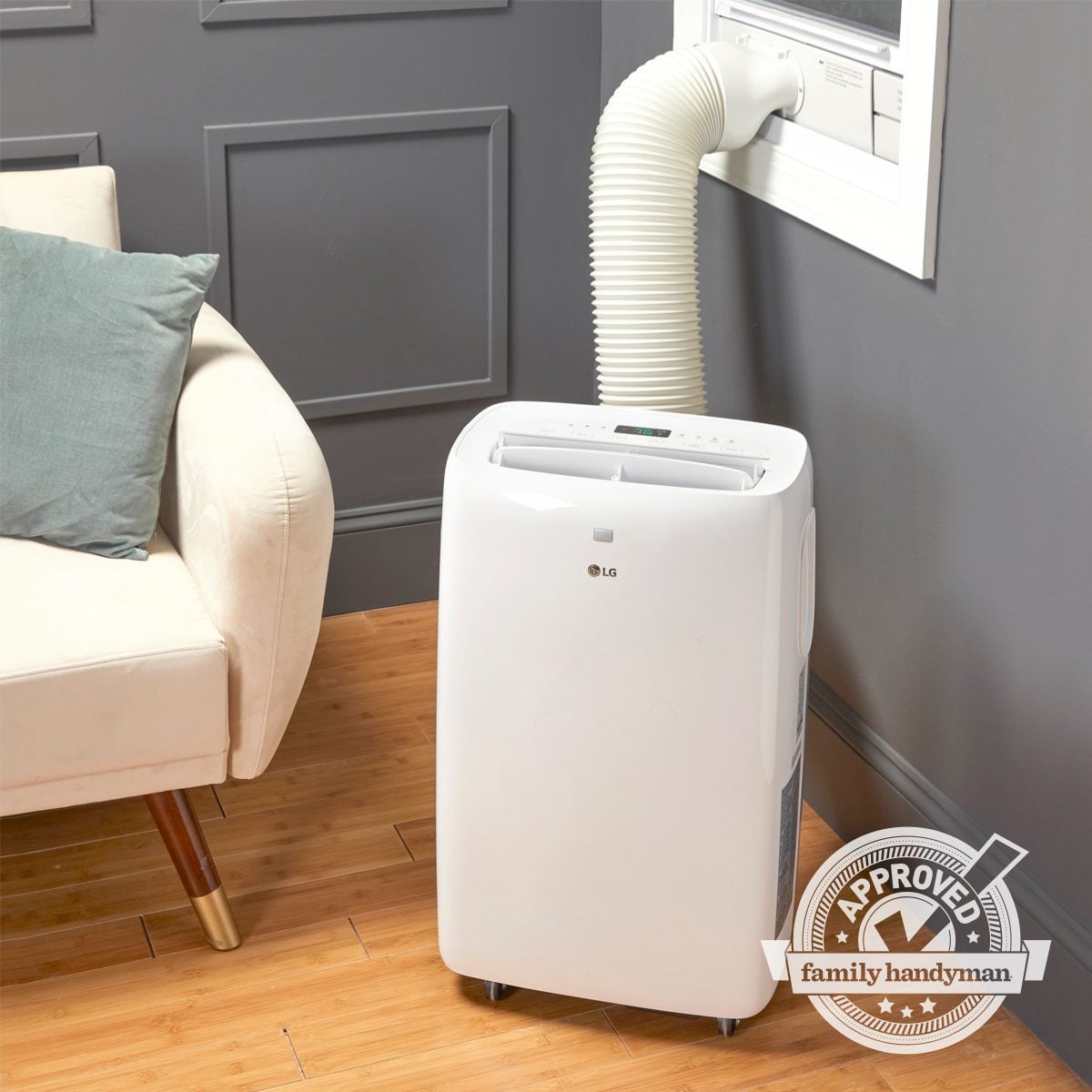
Editor’s note: This review focuses on the LG LP1419IVSM Dual Inverter Smart Wi-Fi Portable Air Conditioner, the company’s 10,000-BTU SACC model designed for rooms up to 500 square feet. Findings are synthesized from manufacturer documentation, independent laboratory testing, long-term evaluations, retailer feedback, and U.S. energy-efficiency guidance.
Portable air conditioners are appliances of compromise. They are easier to install than window units, less permanent than mini-splits, and considerably more effective than pointing three fans at yourself and hoping for a weather miracle. Unfortunately, many are also loud, inefficient, and about as “portable” as a packed suitcase full of bricks.
The LG LP1419IVSM tries to improve that formula with a variable-speed Dual Inverter compressor, app controls, a 10,000-BTU seasonally adjusted cooling capacity, and operation rated as low as 44 decibels. It is positioned as a premium portable air conditioner for bedrooms, apartments, offices, and living spaces where a window AC is impractical.
Testing evidence shows that the LG can cool effectively, maintain a stable temperature, and run more smoothly than conventional single-speed machines. However, its premium compressor is attached to a less-than-premium single-hose system. That design weakness makes the buying decision more complicated than LG’s cheerful “Life’s Good” slogan might suggest.
LG LP1419IVSM Specifications at a Glance
| Specification | LG LP1419IVSM |
|---|---|
| Cooling capacity | 10,000 BTU SACC / 14,000 BTU ASHRAE |
| Recommended coverage | Up to 500 square feet |
| Compressor | Dual Inverter rotary compressor |
| Noise rating | As low as 44 dBA |
| Power input | 1,370 watts maximum rated input |
| Voltage | 115 volts |
| Dimensions | 19.41 inches wide by 30.43 inches high by 18.11 inches deep |
| Weight | Approximately 71 pounds |
| Dehumidification | Up to 6.8 pints per hour |
| Smart features | LG ThinQ, Amazon Alexa, and Google Assistant |
| Warranty | One year for parts and labor |
Cooling Performance: Powerful, but Room Conditions Matter
The number that matters most is 10,000 BTU SACC, not the larger 14,000-BTU figure printed prominently in some listings. The ASHRAE rating measures cooling under controlled conditions, while the Department of Energy’s SACC rating better accounts for heat produced by the appliance, exhaust losses, and seasonal operation. In plain English, 10,000 BTU is the more realistic shopping number.
Independent testing has produced different results because room size, outdoor heat, insulation, and methodology vary. In one long-term evaluation, the LG reduced the temperature in a 550-square-foot test area by approximately 3 degrees Fahrenheit over two hours. Another controlled test measured a roughly 56-minute cooling time when lowering test conditions from 82.4 to 69.8 degrees Fahrenheit.
Those numbers should not be treated as a promise that every 500-square-foot room will become an igloo. An enclosed 350-square-foot bedroom with insulated walls is an easier assignment than a 500-square-foot loft with afternoon sun, high ceilings, an open staircase, and a gaming PC performing its side hustle as a space heater.
What the Dual Inverter Compressor Does
A conventional compressor generally operates at full power and then shuts off after reaching the target temperature. This repeated cycling can create noticeable temperature changes, intrusive compressor thumps, and inefficient operation.
LG’s Dual Inverter compressor can vary its speed. It works harder during the initial cooldown, then slows as the room approaches the selected temperature. The result is steadier cooling, fewer abrupt starts, and more consistent humidity. This is one of the LP1419IVSM’s strongest advantages, particularly in bedrooms and home offices.
The Single-Hose Problem
Despite the “Dual Inverter” name, this is not a dual-hose air conditioner. The word “dual” describes the compressor mechanism. The LG uses one exhaust hose to send hot air outside.
That distinction matters. A single-hose machine uses conditioned indoor air to cool internal components and then expels that air through the hose. Removing air from the room creates negative pressure, which encourages hot outdoor air to enter through door gaps, window cracks, and other leaks. The unit therefore cools the room while indirectly inviting more heat insidea little like mopping the floor while someone follows you wearing muddy boots.
The inverter compressor helps the LG perform better than many basic single-hose portable ACs. Nevertheless, modern dual-hose competitors can cool more efficiently because they use outdoor air for the hot side of the system. Buyers prioritizing maximum efficiency should compare this model with current dual-hose or hose-in-hose alternatives before purchasing.
Noise: One of the LG’s Best Qualities
LG advertises operation as low as 44 dBA under favorable conditions. Real-world sound changes with compressor load, fan speed, floor type, and distance from the machine, but independent evaluations consistently describe this model as relatively quiet for a portable air conditioner.
On a low setting, the sound is closer to steady airflow than the clattering, start-stop racket associated with cheaper units. At maximum output, it is clearly audible and will not disappear into the wallpaper. However, the gradual inverter operation makes the noise less disruptive than a compressor that repeatedly starts with all the subtlety of a refrigerator falling down the stairs.
Light sleepers may still prefer to cool the room before bedtime and then use a lower setting overnight. The control-panel lights can also be dimmed or switched off, a small but welcome feature in a dark bedroom.
Installation and Portability
The package includes a window installation kit, foam seals, security brackets, an exhaust assembly, and a remote. Installation does not normally require professional HVAC work, but it may take around 30 minutes the first time. The adjustable window slider can be confusing until its pieces are arranged correctly, and the app adds another setup step.
A tight seal is essential. Every gap around the panel provides an express lane for hot air, bugs, and your utility company’s revenue goals. Applying the supplied foam carefullyand adding removable weather-stripping if necessarycan noticeably improve performance.
Casters and side handles make the LG easy to roll across a level floor. Calling a 71-pound appliance “portable,” however, requires a generous definition of the word. It is convenient to move between nearby rooms, but carrying it upstairs is a two-person job for many households. It also occupies almost 20 by 18 inches of floor space before accounting for the hose clearance.
Storage is better organized than on many competing units. The hose is integrated into the body, and the rear compartment can hold window-kit components. That prevents the annual spring ritual of asking, “Where did we put the oddly shaped plastic piece without which this entire appliance is useless?”
Smart Controls and Daily Convenience
The LG ThinQ app allows users to change the temperature, select modes, build schedules, and monitor operation remotely. Alexa and Google Assistant integration provides voice control. These features are genuinely useful when the unit is installed in an upstairs bedroom or when you want to begin cooling before arriving home.
The machine also includes onboard controls and an LCD remote, so the app is optional rather than a mandatory digital chaperone. Available functions include multiple cooling and fan speeds, a 24-hour timer, automatic restart, auto-swing ventilation, and a fan-only mode.
The auto-swing outlet helps distribute cool air instead of blasting one heroic section of the couch. Automatic restart can restore operation after an outage, while scheduling reduces unnecessary runtime. As with most connected appliances, initial Wi-Fi pairing may require patience and a compatible home network.
Dehumidification and Drainage
LG rates dehumidification at up to 6.8 pints per hour. In damp climates, removing moisture can improve comfort even when the temperature is not dramatically lower. Long-term users have reported that Dry mode can make humid nights comfortable without running full cooling continuously.
The auto-evaporation system expels much of the collected moisture with the exhaust air, so routine bucket emptying may be unnecessary in normal cooling conditions. Drainage frequency depends heavily on humidity. In a muggy basement or during dedicated dehumidifier operation, the reservoir may fill more quickly and require manual or continuous drainage.
Owners should inspect the water indicator, follow the manual’s drainage instructions, and never assume “self-evaporating” means “water has ceased to exist as a concept.”
Energy Use and Operating Cost
The LP1419IVSM has a maximum rated input of 1,370 watts, although its inverter does not draw maximum power continuously. One hands-on test measured average consumption of roughly 0.67 kWh while the unit was running hard. Actual consumption varies with thermostat setting, weather, insulation, and compressor speed.
For a simple estimate, multiply average kilowatt use by operating hours and your utility’s price per kilowatt-hour. At 0.67 kWh per hour, eight hours of daily operation uses about 5.36 kWh. At an illustrative electricity rate of $0.18 per kWh, that costs approximately $0.96 per day, or about $29 over 30 days. A difficult room that keeps the compressor near maximum output will cost more.
The LG can be efficient compared with traditional single-hose portable air conditioners. It is not automatically more efficient than today’s better dual-hose inverter models, nor is it likely to beat a properly sized inverter window AC. Portability is the convenience being purchased; some efficiency is the cover charge.
Maintenance and Reliability
The washable filters should be checked regularly and cleaned when dust accumulates. A dirty filter reduces airflow, strains the system, and turns expensive engineering into an elaborate dust warmer. The exhaust hose should remain as short and straight as practical, and its connections should be inspected for leaks.
Before seasonal storage, drain remaining water, clean and dry the filters, and use the built-in storage areas for the accessories. The construction is generally regarded as solid, and documented long-term testing has included successful operation across multiple summers.
The one-year parts-and-labor warranty is less impressive. At the LP1419IVSM’s premium price, a longer standard warranty would provide greater reassurance. Buyers should compare retailer return policies and extended protection costs, particularly if the unit will be used heavily.
Pros and Cons
What We Like
- Strong 10,000-BTU SACC cooling capacity
- Smooth, stable performance from the variable-speed compressor
- Quieter operation than many conventional portable units
- Useful LG ThinQ scheduling and remote controls
- Alexa and Google Assistant compatibility
- Effective moisture removal and auto evaporation
- Convenient accessory and hose storage
What Could Be Better
- Single-hose design creates negative pressure
- Premium purchase price
- Heavy and bulky despite being “portable”
- Initial window-kit and Wi-Fi setup may take time
- Only a one-year standard warranty
- Dual-hose inverter competitors can be more efficient
Should You Buy the LG Portable Air Conditioner?
Yesif quiet, consistent cooling and smart controls matter more to you than obtaining the absolute highest efficiency. The LG LP1419IVSM is a capable premium portable AC for renters, bedrooms, home offices, and spaces that cannot accept a window unit. Its inverter compressor, low-speed sound profile, strong dehumidification, and mature app experience make it pleasant to live with.
Skip it if efficiency is your first priority. A dual-hose inverter portable AC can reduce hot-air infiltration, while a compatible window unit usually offers better efficiency and uses no floor space. The LG is also difficult to justify at its full list price when advanced dual-hose competitors cost the same or less.
The smartest purchase depends on price. At a meaningful discount, the LG remains an appealing, well-built choice. At approximately $699, shoppers should compare current Midea Duo and Whynter inverter models. The final verdict is positive but qualified: this is one of the more refined single-hose portable air conditioners, not the undisputed champion of the entire category.
Extended Real-World Experience: What Living With the LG Feels Like
The first thing an owner notices is not the coolingit is the box. This is a substantial machine, and moving it from the delivery point to an upstairs bedroom may briefly turn air-conditioning installation into leg day. Once the unit reaches a level floor, its casters work well. It rolls easily over hardwood or tile but becomes less cooperative on thick carpet and across raised thresholds.
Initial installation rewards careful reading. The slider must fit the window opening securely, the exhaust connection must lock into place, and the foam must close visible gaps. Rushing this stage can make a powerful machine seem disappointing because warm outdoor air immediately sneaks back inside. Spending an extra ten minutes sealing the panel is often more valuable than spending another hundred dollars on additional BTUs.
After installation, the LG’s behavior feels more polished than that of many budget portable air conditioners. When cooling begins, the fan and compressor increase their effort without an especially violent startup. Cold air emerges quickly, and the auto-swing vent moves it across the room. The strongest improvement occurs in an enclosed bedroom or office where the door can remain closed. In an open-plan area, the cool air tends to wander into neighboring spaces like a tourist without an itinerary.
During a hot afternoon, maximum cooling is audible. A conversation or television remains possible, but nobody will confuse the room with a silent library. After the temperature approaches the selected setting, the inverter can reduce output. The gentler, steadier sound is easier to tolerate than repeated compressor cycling, especially during sleep or video calls.
The ThinQ app becomes more valuable after the novelty wears off. Scheduling the AC to start shortly before bedtime avoids cooling an empty room for hours. Remote control is also useful after settling under the blankets and realizing the temperature is set two degrees too lowa crisis that somehow makes the remote on the dresser appear several miles away.
Humidity control can be as important as raw temperature reduction. On sticky evenings, Dry mode removes moisture and makes the air feel more comfortable without producing an arctic blast. The auto-evaporation system keeps drainage chores limited under many conditions, though owners in humid regions should still check the reservoir and drain outlet.
Several habits improve the long-term experience. Clean the filters every few weeks during heavy use, keep curtains closed against direct sun, and avoid extending the exhaust hose unnecessarily. A long, sharply bent hose radiates more heat back into the room and restricts airflow. Insulating the hose can also help in demanding spaces, provided the material is suitable and does not obstruct the machine.
Moving the LG from room to room is practical only when each location has a compatible, prepared window. Rebuilding the window installation every evening becomes tedious quickly. Most owners will treat it as a seasonally movable appliance rather than a device that follows them around the house.
Over an entire summer, the strongest impression is consistency. The LG does not rewrite the laws of portable-air-conditioner physics, but it handles them gracefully. It cools well, removes substantial humidity, and avoids much of the mechanical drama associated with cheaper units. Its biggest frustrationsweight, floor space, and single-hose inefficiencynever disappear. For the right room, however, those compromises may be preferable to another sleepless night spent turning a pillow over in search of the mythical “cool side.”
Final Conclusion
The LG LP1419IVSM earns a recommendation for shoppers who specifically need a portable air conditioner and value quiet operation, steady temperatures, smart scheduling, and dependable cooling. Its Dual Inverter compressor is more than a marketing decoration; it noticeably improves how the unit sounds and maintains comfort.
Still, buyers should understand what they are purchasing. This is a sophisticated compressor inside a single-hose platform, and that hose design limits whole-system efficiency. Buy it on sale for a bedroom, rental, or difficult window configuration. Compare dual-hose inverter alternatives at full price, and choose a window AC instead when your window and lease allow it.