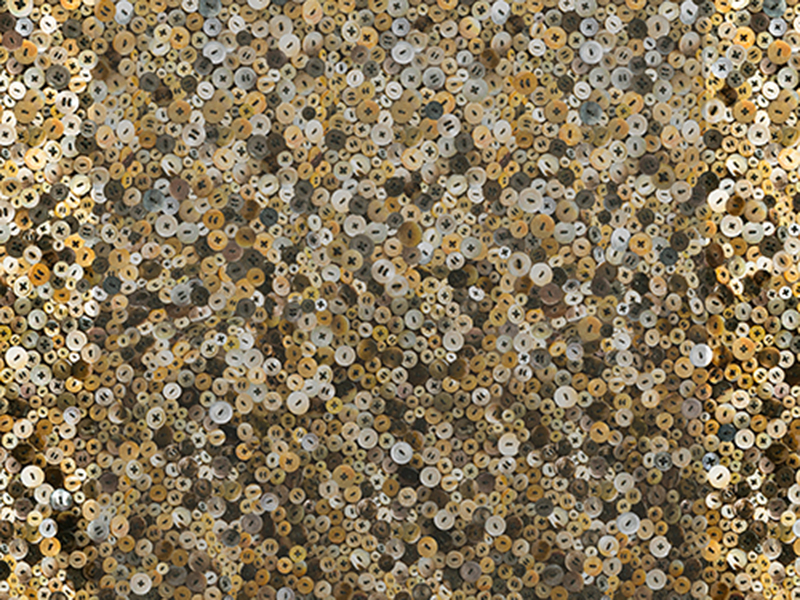
At first glance, Knoll Textiles Button looks like a curtain with an exceptionally good jewelry collection. Step closer, however, and the pattern reveals a deeper story about collecting, craftsmanship, movement, and the transformation of ordinary objects into art. Designed by acclaimed American artist Nick Cave for KnollTextiles, Button turns the humble fastener into a large-scale drapery composition capable of changing the mood of an entire room.
This is not a timid textile designed to disappear behind a sofa. Button is a digitally printed window fabric inspired by the vintage buttons Cave has gathered from antique markets and incorporated into his celebrated Soundsuits. The result is theatrical without being chaotic, highly decorative without feeling sugary, and practical enough for professionally specified interiors. In other words, it has personality, but it still knows how to behave in a design meeting.
What Is Knoll Textiles Button?
Button is a wide-width decorative drapery from the Nick Cave collection for KnollTextiles. The collaboration translated Cave’s sculptural language into upholstery, wallcovering, and window fabrics. Rather than simply copying his artworks as flat images, the development team studied their scale, rhythm, materials, color relationships, and sense of motion.
For Button, the source material was especially personal. Cave regularly searches antique markets for one-of-a-kind objects, including old buttons with unusual shapes, patinas, colors, and histories. Buttons appear across several of his Soundsuits, where thousands of small pieces become a dense, shimmering surface. KnollTextiles reinterpreted that visual abundance as a digitally printed drapery with an organic light-to-dark gradation.
The pattern gives the impression of a hand-built accumulation, even though it is reproduced with modern printing technology. That tension is part of its appeal: the eye sees hundreds of individual objects, while the room experiences one sweeping composition.
The Artistic Story Behind the Button Pattern
From Everyday Object to Visual Language
A button is easy to overlook. It is small, functional, and usually appreciated only after it falls off a favorite shirt five minutes before an important meeting. In Cave’s work, however, buttons become evidence of memory, labor, identity, and reuse. A discarded object can carry traces of the clothing it once fastened, the person who wore it, or the era in which it was made.
By gathering vintage buttons in large quantities, Cave removes them from their original jobs and gives them a new collective presence. One button may be quaint; hundreds become architecture. Button drapery preserves that sense of accumulation while making it suitable for interiors. The fabric does not pretend to be an actual hand-sewn curtain covered in heavy objects. Instead, it captures the visual energy of that idea in a lightweight textile.
The Connection to Nick Cave’s Soundsuits
Cave’s Soundsuits merge sculpture, fashion, performance, sound, and found materials. They may incorporate beads, raffia, sequins, twigs, toys, doilies, wire, fabric, and buttons. When worn in performance, the materials move, collide, rustle, and disguise the body beneath them. The suits can appear joyful and spectacular, yet they also carry serious ideas about protection, visibility, race, gender, and social identity.
Button does not reproduce the full physical experience of a Soundsuit, but it brings several of its qualities into a room. The printed objects create visual rhythm. The fabric shifts with air movement. Daylight changes the apparent density of the pattern. The large scale can make a window feel less like an opening that needs covering and more like a stage.
Material, Scale, and Technical Specifications
Button is made from 100% Trevira CS polyester and is intended for window applications. Trevira CS fibers are engineered with permanent flame-retardant properties built into the polymer rather than applied only as a surface treatment. That characteristic helps explain why the material is frequently used for hospitality, workplace, public, and other contract interiors where fire-performance requirements matter.
The fabric is manufactured in Italy and has no added finish or backing. Its published width is an unusually generous 128 inches, or approximately 325 centimeters. The standard repeat is 128 inches vertically by 55.5 inches horizontally. When viewed railroaded, those dimensions reverse, and the manufacturer specifically presents Button in that direction.
That wide format is not a trivia-night detail. It can reduce the number of visible seams across tall windows, allow the ombré-style composition to read more continuously, and support dramatic floor-to-ceiling installations. The listed bolt size is 35 yards, and the weight is approximately 12.3 ounces per linear yard.
Manufacturer color presentations include Shell and Pearl. Both lean into the idea of collected buttons while offering different tonal impressions. Because screen images flatten texture and alter color, a memo sample should be treated as the beginning of the decision process, not the final word.
How Button Changes a Room
Light Becomes Part of the Pattern
Drapery is never seen under one fixed condition. Morning sun, cloudy daylight, evening lamps, and exterior darkness can make the same textile look like four different products. Button benefits from this variability. In bright daylight, the field can appear airy and layered. At night, with light coming from inside, the printed button forms may look denser and more graphic.
The organic transition from pale to dark gives designers a built-in tool for guiding the eye. Depending on how the panels are cut and oriented, the darker portion can anchor the bottom, emphasize one side, or create gradual visual movement across a wall of glass. It is worth planning that placement deliberately. Random cutting may waste the most distinctive feature of the design.
Large Scale Without Loud Color
Many statement textiles rely on saturated color. Button demonstrates another strategy: use scale, detail, and tonal contrast. From across the room, the composition reads almost like an atmospheric field. Up close, individual button shapes become visible and invite inspection. This dual reading makes it suitable for spaces that need visual interest without a rainbow shouting match.
In a minimalist room, Button can serve as the primary decorative event. In an eclectic interior, it can connect vintage furniture, collected objects, metal finishes, and handmade accessories. It is especially effective when surrounding surfaces are relatively calm, allowing the fabric’s intricacy to breathe.
Where Knoll Textiles Button Works Best
Residential Interiors
In a home, Button can elevate a living room, dining room, primary bedroom, library, or double-height stair landing. It pairs naturally with warm wood, stone, plaster, brushed metal, quiet upholstery, and sculptural furniture. The textile is expressive enough to replace several smaller decorative gestures, which can help a room feel edited rather than cluttered.
For bedrooms, consider how much privacy and light control are required. Button is a decorative drapery, so a separate lining, shade, or blackout layer may be appropriate. Layering allows the printed fabric to remain visually light while another treatment handles sleep, glare, or street-facing privacy.
Hospitality, Workplace, and Cultural Spaces
Button is particularly compelling in boutique hotels, destination restaurants, executive lounges, gallery-adjacent spaces, creative workplaces, and reception areas. Its connection to contemporary art gives a designer a meaningful narrative to share, while its tested performance profile makes it more than a purely decorative novelty.
In public interiors, scale is an advantage. Small patterns can disappear in large rooms, especially when viewed from a distance. Button’s broad repeat holds attention across open space. It can frame a view and introduce movement without requiring a kinetic installation or a maintenance team with circus training.
Performance, Care, and Environmental Information
The published maintenance guidance allows machine washing at up to 86°F or 30°C, followed by gentle extraction and air or cabinet drying. Tumble drying is not recommended. Actual care should always be coordinated with the fabricator, installer, and facility team because curtain construction, hardware, lining, pleats, and panel size may affect what is practical.
Button has published flammability test results that include NFPA 701, CAN/ULC-S109, BS 5867, and EN 13501. Its listed lightfastness testing exceeds 60 hours under AATCC 16.3. These results can be valuable for contract projects, but design professionals should still verify that the exact fabric, colorway, treatment, and installation meet local codes and project-specific requirements.
The product is listed as GREENGUARD Gold Certified, OEKO-TEX certified, LBC Red List Free, REACH compliant, and free of intentionally added PFAS. These labels address different aspects of chemical emissions, harmful-substance testing, material screening, and regulatory compliance. They should not be collapsed into one vague claim that the textile is “perfectly green.” Responsible specification means understanding what each certification covers and comparing it with the project’s actual sustainability goals.
How to Specify Button Successfully
1. Order a Sample and View It Vertically
A small swatch on a desk will not fully communicate a 128-inch composition. Hang the sample vertically near the intended window, then observe it during the day and after dark. When possible, request a larger cutting or create a digital elevation showing the full repeat.
2. Confirm Pattern Direction Before Calculating Yardage
Because Button is shown railroaded and has an expansive repeat, cutting direction must be discussed early with the workroom. Confirm which portion of the gradation will appear at the top, bottom, and panel edges. Pattern placement may influence yardage more than basic window dimensions suggest.
3. Coordinate Fullness with the Artwork
Very deep pleats can hide significant portions of a large image, while insufficient fullness may make the drapery look flat. There is no universal answer. Ripple-fold systems, tailored pleats, and softer gathered treatments will each change the visibility and movement of the printed buttons. A mock-up is far less expensive than discovering the wrong effect after installation.
4. Plan the Supporting Layers
Decide whether the fabric will stand alone or work with a lining, sheer, shade, or blackout treatment. Hardware should support the finished weight and allow the panels to move without abrasion. In commercial settings, accessibility, cleaning, sprinkler clearance, and fire-code details should be coordinated with the broader design team.
5. Avoid Competing Hero Patterns
Button does not require every neighboring surface to become beige, but it deserves visual hierarchy. Pair it with solids, subtle textures, quiet geometrics, or materials whose character comes from grain rather than print. Two dramatic patterns can coexist, but they need a reason beyond “both looked fun in the sample library.”
Advantages and Possible Limitations
The strongest advantage of Knoll Textiles Button is its ability to function as both window treatment and artwork. It carries a recognizable artistic narrative, offers exceptional width, and balances intricate detail with a controlled tonal palette. Its polyester construction, published flame tests, washable care instructions, and environmental certifications broaden its usefulness beyond private homes.
Its limitations are mostly consequences of its ambition. The large repeat requires careful planning. A tiny sample cannot show the complete effect. The directional gradation may create additional waste when panels must match. The design can also dominate a small room if paired with too many other attention-seeking finishes.
Budgeting should include more than the price per yard. Consider pattern placement, fabrication, lining, hardware, installation, possible motorization, and future cleaning. Premium drapery is a system, not merely a roll of attractive cloth.
Who Should Choose Knoll Textiles Button?
Button is a strong choice for clients who appreciate contemporary art, collected objects, layered meaning, and interiors that reward close looking. It suits designers who want a statement textile that feels sophisticated rather than trendy. It is also useful when a project needs a dramatic visual element with documented contract-oriented performance characteristics.
It may be less suitable for someone seeking a nearly invisible sheer, a traditional floral, or a basic budget curtain. Button is not background music. It is the interesting guest at dinner who arrives wearing something fabulous and knows the history of every object in the room.
Real-World Experience: What It Is Like to Design with Button
The most important practical lesson when working with a textile like Button is that the sample-room experience can be misleading. On a table, the fabric looks like a collection of charming circular details. Hung at full height, it becomes a landscape. The eye stops counting buttons and starts reading density, shadow, movement, and negative space. That shift is exactly why full-scale visualization matters.
Imagine specifying it for a tall living room with pale plaster walls, walnut furniture, and a large west-facing window. During the afternoon, sunlight comes through the fabric and softens the darker printed areas. The button imagery becomes less literal and more atmospheric. By evening, warm interior lighting makes the pattern feel richer and more object-like. Guests walk closer because they initially assume the surface is embroidered or physically embellished. The discovery that it is digitally printed does not reduce the effect; it makes the translation from sculpture to textile more interesting.
Fabrication conversations tend to focus on three issues: where the gradation should land, how much pattern should disappear into folds, and how adjacent panels should relate. A workroom may recommend marking the intended top and bottom on every cut. That sounds excessively cautious until one panel is rotated and the visual flow suddenly takes an unscheduled vacation. Photographing each panel layout before sewing can prevent expensive confusion.
Button also teaches restraint. Once it is installed, the room usually needs fewer decorative accessories. A shelf crowded with small objects can compete with the hundreds of printed forms in the drapery. Removing a few accessories often improves the composition immediately. The textile provides detail; the furniture and architecture can provide calm.
In commercial spaces, reactions are often strongest from a distance first and up close second. From the lobby entrance, the drapery reads as a broad tonal gesture. Near the seating area, individual buttons appear, and the Nick Cave connection becomes a conversation point. That layered discovery is valuable in hospitality design because it gives repeat visitors something more to notice than a logo wall and an aggressively scented candle.
Maintenance planning should begin before installation. Large panels may be technically washable, but removing, labeling, cleaning, drying, pressing, and rehanging them requires coordination. A facility team benefits from panel maps, care instructions, spare yardage, and photographs of the original installation. The glamorous part is opening day; the smart part is making sure the curtain still looks intentional three years later.
Keeping extra fabric from the original dye and production lot can also be useful. Future repairs, replacement panels, or alterations may be difficult to match if a colorway changes or is discontinued. The spare yardage should be labeled, wrapped in breathable protective material, and stored away from sunlight, moisture, dust, and enthusiastic employees searching for craft supplies.
The overall experience is rewarding when Button is treated as a designed composition rather than generic yardage. It asks for thoughtful cutting, disciplined surroundings, and attention to light. In return, it offers something rare: a window treatment that changes throughout the day, carries a legitimate artistic story, and gives an interior emotional depth without sacrificing practical performance.
Conclusion
Knoll Textiles Button succeeds because it transforms a familiar object into an immersive interior surface. Nick Cave’s vintage-button inspiration, KnollTextiles’ technical development, the wide-width Trevira CS construction, and the carefully controlled gradation all contribute to a drapery that feels simultaneously artistic and usable.
For the best result, designers should evaluate the full repeat, coordinate pattern direction with the workroom, study the textile in changing light, and verify current technical requirements before ordering. Button is not merely fabric with circles printed on it. It is a thoughtful translation of collecting, craft, performance, and memory into a material that moves every time the curtain does.
Editorial note: Product specifications, color availability, pricing, certifications, and warranty terms may change. Confirm current information with the manufacturer and request a physical sample before final specification. This article was developed from manufacturer data and reporting by established design publications, museums, art institutions, and textile-certification organizations.