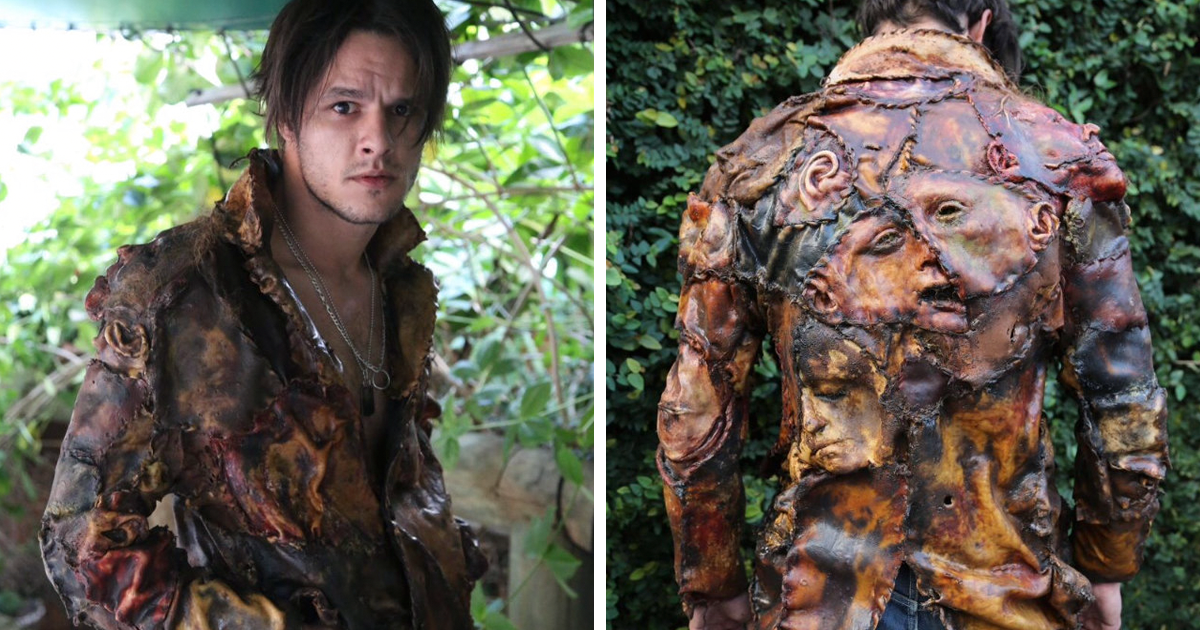
Fashion has given us many things: shoulder pads big enough to land a helicopter on, jeans that looked pre-shredded by a raccoon, and shoes so uncomfortable they should come with a waiver. But every once in a while, a clothing line appears that makes the usual runway weirdness look like a cardigan sale at the mall. Enter the “Ed Gein” inspired clothing and accessories created by artists Kayla Arena and Toby Barrona handmade horror-fashion collection designed to look like it was stitched from human flesh.
Before anyone drops their coffee into their lap, no, the pieces were not made from human skin. They were crafted using materials such as latex, silicone, and other special-effects components. Still, the visual effect is so convincing that your brain may briefly file a complaint with your stomach. The collection included a jacket, boots, wallets, purses, hats, lamps, and other accessories that looked like they belonged in a slasher movie prop room rather than a closet.
So, is this the most terrifying clothing line ever? It might be. Not because it is dangerous, illegal, or actually made from human remains, but because it hits several fear buttons at once: true crime, body horror, handmade realism, wearable art, and the uncomfortable question of how far fashion can go before it stops being style and starts becoming a dare.
The Story Behind the “Human Skin” Clothing Line
The collection became widely discussed online in 2017 after images circulated showing garments and accessories that appeared to be made from patched human skin. The pieces were associated with the name “Ed Gein,” referencing one of America’s most infamous criminals, whose crimes inspired decades of horror cinema. That name alone is enough to make most people close the browser tab, turn on the lights, and suddenly remember they have laundry to fold in another room.
Kayla Arena and Toby Barron approached the concept from a special-effects and horror-art perspective. The pieces were not mass-market fashion in the traditional sense. They were handmade, theatrical, intentionally grotesque objects that used realistic textures, seams, discoloration, and sculpted details to imitate the visual language of horror films. In other words, this was less “ready-to-wear” and more “ready-to-scare-your-neighbor-into-moving.”
The most famous piece was a jacket designed to look like it had been assembled from mismatched patches of flesh. Reports at the time described custom jackets priced around $1,200, with related accessories such as shoes and wallets also drawing attention. For buyers in the horror community, that price reflected handmade special-effects work. For everyone else, it raised a practical question: where exactly does one wear a fake human-skin jacket? Brunch? A first date? Parent-teacher conference? None of these seem ideal unless your goal is to be remembered forever and invited nowhere.
Why the Clothing Looks So Disturbingly Real
The power of the collection lies in realism. Halloween costumes often announce themselves with cartoon blood, shiny plastic bones, and the subtle elegance of a clearance aisle. Arena and Barron’s work, by contrast, leaned into the language of practical effects. Latex and silicone can mimic skin texture, wrinkles, pores, scars, and sagging flesh with remarkable accuracy. When painted by skilled artists, those materials can move from “spooky” to “please put that back in the nightmare drawer.”
That realism matters because clothing is intimate. We understand garments as things that touch the body. A jacket is meant to protect the skin; a wallet lives in a pocket; boots carry us around town. When those everyday objects are made to look like bodies themselves, the result is a powerful form of body horror. The collection turns the familiar into the forbidden. It asks viewers to imagine wearing something that looks aliveor worse, formerly alive.
This is why the clothing line spread so easily online. It was not merely ugly, shocking, or strange. It created an instant reaction. Even people who would never buy horror fashion could not resist looking. The images worked like a visual jump scare: you know it is fake, but your nervous system still bangs a tiny gong and yells, “Absolutely not.”
Who Was Ed Gein, and Why Does the Name Matter?
The name “Ed Gein” carries heavy cultural baggage. Edward Theodore Gein was a Wisconsin murderer and grave robber whose crimes were uncovered in the 1950s. Authorities discovered that he had used human remains to create objects and household items. His case became one of the most disturbing in American criminal history and later influenced fictional horror characters including Norman Bates from Psycho, Leatherface from The Texas Chain Saw Massacre, and Buffalo Bill from The Silence of the Lambs.
That background is important because the clothing line does not merely look scary. It borrows from a real criminal case that continues to shape the American horror imagination. For some viewers, the reference makes the pieces more fascinating as macabre art. For others, it makes them feel exploitative or tasteless. Both reactions are understandable. True crime has always lived in an uneasy space between history, entertainment, grief, and spectacle. Wearing a fake “skin” jacket named after a real killer is not exactly the same as wearing a Dracula cape. Dracula did not leave behind real victims and devastated families.
That is where the line becomes more than a viral oddity. It forces a question: when artists use horror inspired by real events, are they exploring fearor selling it? The answer may depend on the intent, execution, and audience. But the question refuses to stay neatly folded in the closet.
Horror Fashion Is Not NewBut This Is an Extreme Example
Fashion and horror have been flirting for decades like two goths at a fog-machine convention. Designers have long borrowed from vampires, witches, ghosts, funeral clothes, haunted brides, and post-apocalyptic survival gear. High fashion has embraced ripped lace, skeletal silhouettes, red contact lenses, latex, black leather, distressed textures, and runway shows that look like they were staged inside a very elegant nightmare.
Horror films also shape fashion. The white-streaked hair of the Bride of Frankenstein, the polished blondness of Hitchcock heroines, the creepy innocence of doll-like dresses, the punk darkness of vampire movies, and the leather-mask iconography of slashers all helped build a visual vocabulary that designers still revisit. The difference is that most horror-inspired fashion remains symbolic. It suggests danger without looking like evidence.
Arena and Barron’s pieces pushed past suggestion. They were not simply black, torn, gothic, or spooky. They directly imitated flesh. That is a different level of intensity. A skull print on a T-shirt says, “I enjoy Halloween.” A fake-human-skin wallet says, “Please do not ask what is in my basement.”
Is It Fashion, Costume, Prop Art, or Shock Marketing?
The answer is probably all of the above. The “Ed Gein” inspired collection sits at the intersection of wearable art, horror prop design, costume culture, and internet spectacle. It is fashion in the sense that it can be worn. It is costume in the sense that it transforms the wearer into a character. It is prop art because it relies on special-effects craftsmanship. And it is shock marketing because the entire concept depends on people gasping, sharing, debating, and maybe whispering, “Who asked for this?”
That does not make it automatically bad. Shock has always had a place in art. From punk clothing to surrealist objects, from Alexander McQueen runway drama to horror-movie costume design, fashion often uses discomfort to make a point. Clothing can challenge beauty standards, question social rules, and expose the strange rituals we accept without thinking. After all, leather, fur, and exotic skins are already normalized in luxury fashion, even though they come with ethical debates. A fake human-skin jacket may look monstrous, but it also reflects something uncomfortable back at the viewer: humans already wear skin. We just usually call it leather and put it near a nice zipper.
This is why similar “human leather” concepts have been used in animal-rights campaigns. By pretending to sell clothing made from human skin, activists have tried to jolt consumers into reconsidering animal-derived materials. The tactic is intentionally grotesque. It asks: why does one kind of skin horrify us while another becomes a handbag?
The Ethics of Wearing Nightmare Fuel
Ethically, the collection invites several conversations. First, there is the true-crime issue. Naming a fashion object after a real killer can feel insensitive, especially when the reference risks turning violence into aesthetic branding. Horror fans may understand the context, but broader audiences may see only the glamorization of a murderer.
Second, there is the public-space issue. Wearing one of these pieces to a horror convention is very different from wearing it on a subway at 8:00 a.m. next to someone just trying to eat a granola bar in peace. Clothing communicates. It affects not only the wearer but also everyone forced to visually process it. A realistic flesh jacket may be art, but art can still be a lot before breakfast.
Third, there is the marketplace issue. Platforms such as Etsy have rules restricting human remains and certain violent or mature content. Since these pieces were reportedly made with artificial materials, they were not actual human remains. Even so, products that imitate gore can raise questions about labeling, presentation, and where shock art belongs in online shopping environments.
Why People Are Drawn to Terrifying Clothing
It is easy to dismiss horror fashion as weird for the sake of weird, but the appeal is more layered. Horror fans often enjoy controlled fear. A scary jacket, like a haunted house or a monster movie, allows people to approach taboo imagery safely. The wearer knows it is fake. The audience knows it is probably fake. The thrill comes from that little “probably.”
Terrifying clothing also offers identity. Some people do not want fashion that says, “I am polished, approachable, and ready for a networking event.” They want fashion that says, “I own fog machines emotionally.” Extreme horror pieces create community among collectors, makeup artists, haunt performers, cosplayers, metal fans, and practical-effects enthusiasts. To that audience, a fake-skin wallet is not just an accessory. It is craftsmanship, fandom, and a conversation starterthough admittedly one that may start with screaming.
There is also the simple fact that humans are curious about the forbidden. We look at things we claim we do not want to see. Viral culture rewards that impulse. A terrifying clothing line succeeds online because it makes people click with one hand while shielding their face with the other.
Could You Actually Wear It?
Technically, yes. Socially, proceed with caution. A piece like this might work at a horror convention, haunted attraction, film set, Halloween event, music video shoot, gallery opening, or themed photoshoot. It would not work as office wear unless your job title is “assistant crypt keeper.”
The pieces are most successful when treated as art objects or performance garments. They are not designed to blend into daily life. That is the point. They create a scene around the wearer. The jacket does not quietly complete an outfit; it enters the room first, shakes everyone’s nerves, and asks if the lighting could be more dramatic.
For collectors, the appeal may be the detail and rarity. Handmade horror effects require time, skill, and a strong stomach for sculpting wrinkles that look distressingly biological. For casual shoppers, however, there are friendlier ways to embrace horror fashion: vintage monster tees, black boots, gothic jewelry, distressed denim, dark florals, or a jacket that does not make strangers wonder whether they should call someone.
Is This the Most Terrifying Clothing Line Ever?
In terms of pure visual shock, it is a serious contender. Plenty of fashion lines have been controversial, strange, or unsettling. Some have used animal bones, extreme silhouettes, masks, medical imagery, or apocalyptic styling. But the “Ed Gein” inspired pieces stand out because they combine hyper-realistic body horror with a real true-crime reference and wearable everyday forms. That combination makes them uniquely difficult to ignore.
The clothing line is terrifying not because it fools experts or crosses into actual criminal material, but because it plays with the deepest boundary in fashion: the boundary between body and garment. Clothes usually cover the body. These pieces look like the body has become the clothes. That reversal is deeply creepy, and it is exactly why the images continue to circulate years after the original viral moment.
So yes, this may be one of the most terrifying clothing lines ever created. It is also a fascinating example of how horror, fashion, craft, ethics, and internet culture can collide in one spectacularly uncomfortable wardrobe. Whether you call it genius, gross, art, costume, or a hard no with buttons, it proves one thing: fashion can still shock us. Sometimes all it takes is latex, silicone, a needle, and a very questionable sense of inspiration.
Experience: What It Feels Like to Encounter Clothing This Creepy
Imagine scrolling casually through fashion images, expecting the usual parade of boots, jackets, and accessories. Maybe you are looking for style inspiration. Maybe you are avoiding work with the noble discipline of a professional procrastinator. Then suddenly, there it is: a jacket that appears to be stitched from human skin. Your first thought is not “great tailoring.” Your first thought is “why did my screen just threaten me?”
That first encounter is part of the experience. Terrifying clothing works differently from ordinary clothing because it does not begin with desire. It begins with reaction. You do not calmly evaluate the cut, color, and styling. You recoil, laugh nervously, zoom in, regret zooming in, and then show someone else because fear is more fun when shared. It is the same social instinct that makes people say, “Smell this, it’s awful.” Humanity is mysterious.
Seeing a piece like the faux-human-skin jacket also makes you think about context. On a mannequin, it looks like evidence from a fictional crime scene. On a horror performer, it might look brilliant. In a gallery, it could be interpreted as commentary on the body, violence, consumerism, or the ethics of wearing animal skin. On someone buying cereal at a grocery store, it would become a public emergency in aisle five.
The emotional experience is a mix of disgust and admiration. Disgust comes from the imagery: the patchwork texture, the fleshy tones, the suggestion of seams where seams should not be. Admiration comes from the craft. It takes real skill to make artificial materials look organic. Horror effects are often underrated because the result is supposed to repulse us. But good repulsion is not easy. It requires observation, sculpting, painting, restraint, and the confidence to make something ugly on purpose.
There is also an odd humor to the whole thing. The idea of a “human skin” wallet is so wildly inappropriate as a fashion object that it loops around into absurdity. What do you keep inside it? Loyalty cards from haunted pharmacies? A coupon for emotional damage? The joke does not erase the creepiness, but it makes the object easier to process. Horror and humor have always been neighbors. They both depend on timing, surprise, and the sudden violation of expectations.
For people who love horror, encountering this clothing line can feel like discovering a forbidden prop shop. It sparks the same excitement as practical movie monsters, haunted attractions, and handmade masks. It is not about wanting real violence; it is about appreciating the illusion. Horror fans often understand that distinction. They enjoy being scared by things that are carefully crafted, controlled, and fictional.
For people outside that world, the reaction may be very different. The pieces can feel tasteless, especially because of the Ed Gein reference. That discomfort is valid. True-crime-inspired art walks a narrow ledge. Lean too far one way and it becomes thoughtful horror commentary. Lean too far the other and it becomes souvenir culture for tragedy. This clothing line sits right on that ledge, tap dancing in boots that look like they came from a morgue.
Personally, the most interesting experience is not deciding whether the clothing is “good” or “bad.” It is noticing how quickly it exposes personal boundaries. Some viewers can enjoy it as fake gore. Others immediately reject it. Some admire the artistry while disliking the reference. Others want to know where to buy it, which is information best delivered with a side of social guidance.
That is what makes the topic so memorable. The most terrifying clothing line ever is not terrifying only because of how it looks. It is terrifying because it makes fashion feel unsafe for a second. It turns the closet into a horror set and asks whether clothing can be too realistic, too referential, too intimate, or too clever for its own good. And even if your final answer is “I would never wear that,” the image stays with you. Like a good horror movie, it follows you home. Unlike a good jacket, you may prefer it stays there.
Conclusion
The “Ed Gein” inspired clothing line by Kayla Arena and Toby Barron remains one of the most disturbing examples of horror fashion because it transforms wearable objects into realistic body-horror art. Made from artificial materials such as latex and siliconenot human skinthe collection uses special-effects craftsmanship to create a shocking illusion. It is creepy, controversial, darkly funny, and undeniably effective. Whether viewed as fashion, costume, prop work, or viral nightmare fuel, it proves that clothing can do more than express personality. Sometimes, it can make an entire room back away slowly.