A power outage has a special talent for arriving at the worst possible moment. It waits until the freezer is full, the sump pump is busy, the home office is hosting an important video call, and every phone in the house is hovering at 9 percent battery. A Briggs & Stratton standby generator promises to remove much of that drama by automatically restoring power without extension cords, gasoline cans, or a flashlight-assisted argument with a portable generator.
That convenience sounds wonderful, but a permanently installed generator can cost as much as a respectable used car. The obvious question is whether the comfort, automation, and whole-house power are worth the investment. A hands-on Bob Vila review of a Briggs & Stratton PowerProtect PPDX26 offers useful real-world evidence, while current product specifications, installation costs, maintenance requirements, and safety guidance provide the rest of the picture.
Quick Verdict: Is the Briggs & Stratton Standby Generator Worth It?
Yes, for the right household. A Briggs & Stratton standby generator is a worthwhile investment for homeowners who experience frequent or extended outages, depend on a well pump or sump pump, need reliable heating or cooling, work from home, use powered medical equipment, or simply cannot afford to let an outage shut down the house.
The Bob Vila tester awarded the installed 26-kilowatt model a score of 9.4 out of 10. During a simulated outage, it started automatically in about 10 seconds and powered every appliance the tester turned on, including the home’s HVAC equipment. The test also found the unit quieter than expected, although certainly not silent.
It is less compelling for homeowners who rarely lose power, have modest backup needs, cannot accommodate the installation clearances, or would be equally satisfied with a portable generator or battery system. This is not a universal “buy it immediately” product. It is more like premium insurance that also keeps the ice cream frozen.
Bob Vila field-test findings and rating.
What Bob Vila Actually Tested
The test setup
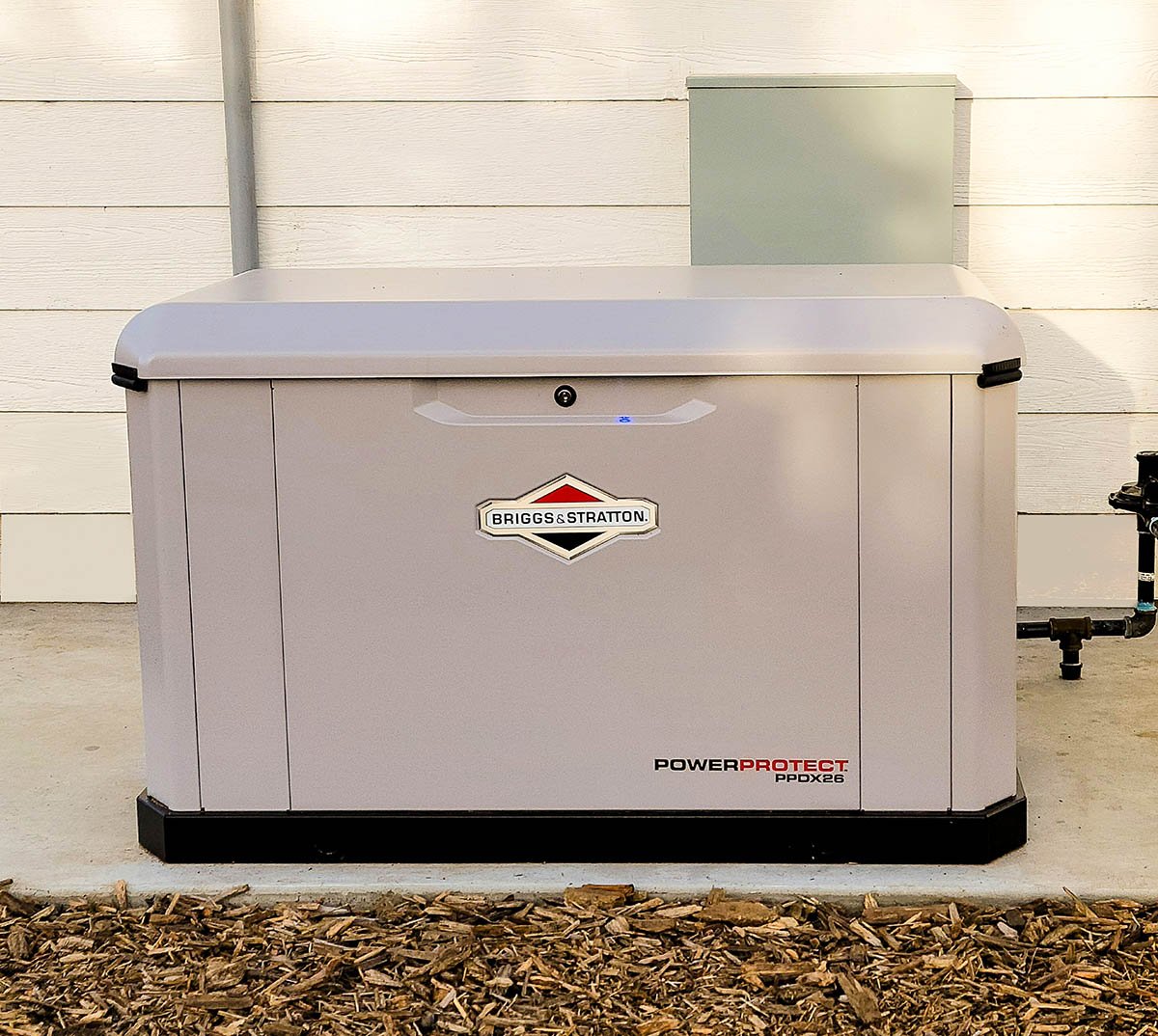
The product evaluated by Bob Vila was the Briggs & Stratton PowerProtect PPDX26, a permanently installed 26kW standby generator connected to a propane supply. The installation was performed at a rural home owned by product tester Glenda Taylor and her husband, a general contractor.
The generator was connected to the home through an automatic transfer switch. When utility power disappeared, the system detected the outage, disconnected the house from the electrical grid, started the generator, and transferred the home’s circuits to backup power. When utility electricity returned, the process reversed automatically.
That automatic transfer is one of the largest advantages over a portable generator. Nobody has to drag machinery out of a shed during a thunderstorm, locate a fuel can, pull a starter cord, and assemble an extension-cord sculpture across the living room.
Automatic startup and whole-house performance
To test performance, the homeowners switched off power at the main disconnect. The generator started in approximately 10 seconds. They then turned on household lights and appliances one at a time, ultimately confirming that the unit could operate everything they needed, including high-demand equipment.
This is where proper generator sizing matters. Refrigerators, pumps, compressors, and air-conditioning systems briefly require more power when their motors start than they use while running. A generator can appear large enough on a basic wattage spreadsheet yet stumble when several motor-driven appliances start together. Briggs & Stratton’s larger PowerProtect models are designed with substantial motor-starting capability to manage those short surges.
Current specifications vary by model and fuel. For example, the present PowerProtect DX 26kW model is listed at 26kW on liquid propane and 24kW on natural gas, with a 993cc commercial-grade Vanguard engine. Buyers should compare both fuel ratings rather than assuming the advertised model name represents identical output on propane and natural gas.
Current manufacturer specifications.
How loud was it?
The Bob Vila test recorded approximately 70 to 72.5 decibels from 8 feet away. The reviewer compared that sound level to an operating dishwasher, though the generator was slightly louder. Indoors, it was barely noticeable from the selected installation location behind a garage.
Current manufacturer listings for some PowerProtect models publish normal operating ratings around the mid-to-upper 60-decibel range. Those figures should not be compared too literally with the Bob Vila measurement because distance, electrical load, nearby walls, ground surfaces, weather, and measuring methods can all affect the result.
The practical lesson is simple: a standby generator is quieter and more civilized than many homeowners expect, but it is still a combustion engine. Installing it beside a bedroom window is unlikely to improve anybody’s sleep or neighborly relations.
What Has Changed Since the Original Bob Vila Test?
The Bob Vila field test was published in 2023, and Briggs & Stratton has continued updating the PowerProtect lineup. Current offerings include multiple capacities intended for smaller homes, mid-sized properties, and large whole-house loads. Newer product pages also emphasize improved motor-starting performance, corrosion-resistant enclosures, tool-free service panels, load-management options, and remote system monitoring.
Warranty terms have also evolved. Standard PowerProtect units may carry comprehensive coverage for multiple years, while certain dealer-exclusive DX models advertise longer coverage. Some current DX product pages list a 10-year comprehensive warranty, while other models may have different terms.
Do not purchase based only on a dealer’s oversized “10 YEARS!” graphic. Obtain the exact warranty document for the model number being quoted. Confirm whether parts, labor, technician travel, batteries, maintenance items, corrosion, and damage caused by improper installation are covered. A long warranty is valuable only when the fine print is invited to the party.
Current lineup and warranty information.
The Real Cost of a Briggs & Stratton Standby Generator
Equipment is only part of the bill
A realistic installed budget for many home standby systems is roughly $7,000 to $14,000. Large generators, complicated electrical work, lengthy gas-line runs, difficult excavation, service-panel upgrades, permits, or special site preparation can push the total higher.
The generator itself may account for only half of the project. A complete estimate can include:
- The generator and automatic transfer switch
- A concrete or approved composite mounting pad
- Electrical wiring, conduit, breakers, and panel modifications
- Natural gas or propane piping and regulators
- Trenching and landscape repair
- Permits, inspections, and utility coordination
- Delivery equipment for a unit weighing several hundred pounds
- Cold-weather accessories or load-management modules
The Bob Vila installation incurred about $2,700 in electrician charges, but that should not be treated as a typical turnkey price. The homeowners poured their own pad, excavated the trenches, moved the generator with heavy equipment, and performed other work because they had professional contracting experience. Most homeowners will need licensed tradespeople to complete substantially more of the project.
Installation-cost research.
Ongoing ownership costs
A standby generator does not become financially invisible after installation. It consumes fuel during outages and exercise cycles, requires engine oil, filters, spark plugs, periodic inspections, and eventually a replacement starting battery. Professional annual service may add a few hundred dollars to the ownership budget, depending on the market and service agreement.
Fuel consumption rises with electrical load. A large unit powering air conditioning, an electric water heater, cooking equipment, and multiple pumps can consume a substantial amount of natural gas or propane during a multi-day outage. Natural gas offers convenient continuous supply when the gas utility remains operational. Propane provides on-site fuel storage, but the tank must be large enough and sufficiently full before the storm arrives.
Maintenance intervals vary by model and operating hours, so the owner’s manualnot a neighbor named Garyis the correct authority. Briggs & Stratton generally recommends regular oil checks, periodic oil and filter changes, battery inspection, air-filter service, and scheduled professional maintenance.
Manufacturer maintenance guidance.
Installation Is Not a Typical DIY Project
A resourceful homeowner may be able to clear vegetation, prepare a location, dig an approved trench, or coordinate permits. Connecting a permanent generator to a home’s electrical service and fuel system, however, is normally work for licensed electricians and plumbers or gas fitters.
The automatic transfer switch must isolate the home from utility lines before generator power enters the electrical system. This prevents backfeeding, a dangerous condition that can energize utility equipment and threaten lineworkers repairing an outage. Gas pressure, pipe sizing, regulator selection, grounding, clearances, and commissioning must also meet applicable codes and manufacturer instructions.
Before buying the equipment, request a site visit. A qualified installer should calculate electrical loads, check the capacity of the gas meter or propane system, identify a legal placement area, evaluate exhaust direction, and determine whether the existing service panel needs modification. Buying a generator first and discovering later that the preferred location is prohibited is an expensive way to acquire an extremely heavy lawn ornament.
Carbon Monoxide Safety Deserves Extra Attention
Standby generators operate outdoors, but outdoor installation does not eliminate carbon monoxide risk. Exhaust can travel toward windows, doors, soffit vents, attic openings, neighboring structures, and other air intakes, especially when wind or nearby walls redirect it.
A 2025 U.S. Consumer Product Safety Commission staff report examined carbon monoxide incidents involving stationary generators and concluded that commonly permitted separation distances may not always prevent exhaust from entering a home. The report recommended greater separation from building openings and stressed that homeowners should never assume a permanently installed generator cannot introduce carbon monoxide indoors.
Homeowners should follow the latest manufacturer instructions, local codes, permitting requirements, and the recommendations of a qualified installer. The exhaust path should be evaluated rather than treated as an afterthought. Carbon monoxide alarms should be installed and maintained on every level of the home and outside sleeping areas according to current safety guidance.
This is one area where “close enough” is not a charming DIY philosophy. It is a reason to stop the project and obtain professional guidance.
Stationary-generator CO findings and alarm guidance.
Briggs & Stratton Standby Generator vs. Other Backup Options
| Backup option | Best advantage | Main limitation |
|---|---|---|
| Briggs & Stratton standby generator | Automatic, high-output, multi-day whole-house power | High installation cost, fuel use, noise, and maintenance |
| Portable generator | Much lower purchase price and flexible use | Manual setup, refueling, lower capacity, and greater misuse risk |
| Home battery system | Quiet operation, no local exhaust, and near-instant response | Limited stored energy unless a large and expensive system is installed |
| Portable power station | Simple indoor power for electronics and small appliances | Usually cannot operate major whole-house loads for long |
A portable generator is usually the economical choice for a homeowner who needs to run a refrigerator, several lights, a furnace blower, and phone chargers during an occasional outage. A battery system is attractive for quiet, emissions-free backup and can pair well with solar panels. A fuel-burning standby generator remains especially strong when the goal is to run central air conditioning, pumps, refrigeration, and most normal household loads for days rather than hours.
National outage averages can be misleading because local reliability varies dramatically. U.S. electricity customers averaged about 11 hours without power in 2024, with major weather events accounting for most of that duration. A homeowner on a reliable underground circuit may see almost no disruption, while a rural property surrounded by trees may lose power several times in one season.
Outage data and generator comparisons.
Who Should Buy One?
A Briggs & Stratton standby generator makes the strongest financial and practical case when one or more of the following conditions apply:
- Outages occur several times per year or commonly last many hours.
- The home relies on a sump pump, well pump, sewage pump, or electric heating equipment.
- Extreme heat or cold makes loss of HVAC more than a minor inconvenience.
- Someone in the home uses essential powered medical equipment.
- The homeowner works remotely and cannot tolerate extended downtime.
- The property contains large quantities of refrigerated food or temperature-sensitive supplies.
- The occupants travel frequently and want automatic protection while away.
It may not be worthwhile when outages are extremely rare, the household can comfortably relocate during emergencies, only a few small devices need backup, or installation would require unusually expensive utility and structural work.
Extended Ownership Experience: What Living With One Is Really Like
The most valuable part of a standby generator is not the moment it roars to life. It is the collection of small problems that never happen. The basement does not flood because the sump pump stopped. The refrigerator does not warm up while everyone debates whether the outage will last another hour. The homeowner does not stand in freezing rain trying to remember which extension cord is rated for outdoor use.
The experience described in the Bob Vila test illustrates that change clearly. Once the system had been installed and commissioned, operating it required almost no effort. The generator monitored utility power, performed scheduled exercise cycles, and displayed a visible status light indicating that it was ready. During the simulated outage, it handled the transition automatically and supplied enough electricity for the household to continue using normal appliances.
Imagine a summer thunderstorm knocking out the neighborhood at 2 a.m. In a home without automatic backup, the air conditioner stops, bedroom fans fall silent, the security system shifts to battery power, and someone begins searching for the utility’s outage map. With a properly sized standby system, there is a brief dark pause, the engine starts outside, and selected circuitsor the entire homereturn to service. The coffee maker may not understand the engineering achievement, but it will participate enthusiastically the next morning.
There are less glamorous moments. The weekly exercise cycle may begin while someone is enjoying a quiet backyard lunch. Maintenance reminders still need attention. An owner may occasionally check for leaves, snow, animal nests, or vegetation around the enclosure. After a long outage, fuel use can be surprisingly noticeable, especially with propane. The system also needs periodic service even if it has rarely generated emergency power, because an engine that waits for years without care is not necessarily an engine that will behave heroically on command.
Load management can influence the experience as well. A smaller generator may prioritize the furnace, refrigerator, well pump, and essential outlets while temporarily preventing several large appliances from operating simultaneously. That approach can reduce equipment and fuel costs without leaving the household powerless. A larger 22kW or 26kW system can provide a more normal whole-house experience, but paying for unused capacity makes little sense. The best generator is not automatically the biggest one; it is the model that starts the required equipment reliably without spending every outage producing electricity nobody uses.
Noise is another ownership detail that depends heavily on placement. The Bob Vila reviewer found the tested generator surprisingly unobtrusive indoors because it was positioned behind a detached structure and away from primary living spaces. The same machine near a patio, bedroom, or reflective masonry wall might seem far louder. Thoughtful placement is therefore part of the product experience, not merely an installation checkbox.
The greatest psychological benefit is confidence during uncertain weather. When a forecast predicts ice, high winds, or a tropical storm, the homeowner does not need to join the rush for gasoline, batteries, and the final loaf of supermarket bread. The generator cannot repair the grid, clear fallen trees, or stop the family from eating all the emergency snacks on the first evening. It can, however, preserve many of the systems that make a house safe and livable.
Final Verdict
The Bob Vila test supports the conclusion that a properly sized Briggs & Stratton standby generator can deliver strong whole-house performance, dependable automatic startup, manageable noise, and convenient self-testing. The product’s commercial-grade engine options, substantial motor-starting capability, dual-fuel configurations, and competitive warranty coverage strengthen its case.
The investment is most worthwhile when an outage creates meaningful financial, safety, health, or property risks. It is harder to justify when backup power is merely a luxury used once every several years. Before purchasing, obtain at least two detailed installation quotes, request a written load calculation, verify fuel capacity, examine the exact warranty, and insist on a careful exhaust and carbon monoxide assessment.
For a storm-prone, rural, medically dependent, or all-electric household, the answer is frequently yes: a Briggs & Stratton standby generator can be worth every dollar. For everyone else, the correct answer depends less on the shiny generator brochure and more on what an powerless house would actually cost.
Note: The Bob Vila field test covered the PowerProtect PPDX26 configuration available at the time of testing. Briggs & Stratton has since updated portions of its product lineup, specifications, and warranty coverage. Confirm the exact model number, fuel output, written warranty, placement rules, and local code requirements before purchasing or installing a system.