Note: This article is formatted for direct web publishing and intentionally excludes source links in the HTML.
PC power supplies do not usually get invited to the glamour side of hardware journalism. They are the broccoli of desktop components: important, healthy, and tragically under-photographed. But Intel’s ATX12VO standard changed that by turning a sleepy piece of infrastructure into a debate about efficiency, regulation, motherboard design, upgrade culture, and the future of desktop PCs.
ATX12VO, short for ATX 12 Volt Only, sounds like a tiny naming tweak. In reality, it represents a pretty major rethink of how desktop power is delivered. Instead of asking the power supply unit, or PSU, to provide multiple rails such as 12V, 5V, and 3.3V, ATX12VO tells the PSU to focus on 12V output and standby power while pushing more of the voltage conversion work onto the motherboard. That may sound like Intel shuffled chores from one room to another and called it innovation. In some ways, that is exactly what happened. The difference is that the shuffle was designed to cut waste, especially when a PC is sitting around doing very little.
And that is the real story. ATX12VO is not mainly about making gaming rigs faster. It is about making desktop systems more efficient at idle and low loads, where many computers spend a surprisingly large chunk of their lives. That focus makes ATX12VO one of the more practical standards Intel has pushed in years: not flashy, not dramatic, but highly relevant in a world of stricter energy regulations and millions of desktops that spend more time waiting than working.
What ATX12VO Actually Changes
Traditional ATX power supplies were built for a different era of computing. Back when more components depended directly on 5V and 3.3V rails, it made sense for the PSU to generate several voltages at once and distribute them through the familiar 24-pin motherboard connector. Modern PCs, however, lean heavily on 12V. CPUs, GPUs, fans, pumps, and many other major loads already live there. The remaining lower-voltage needs still matter, but they usually account for a much smaller share of system power than they once did.
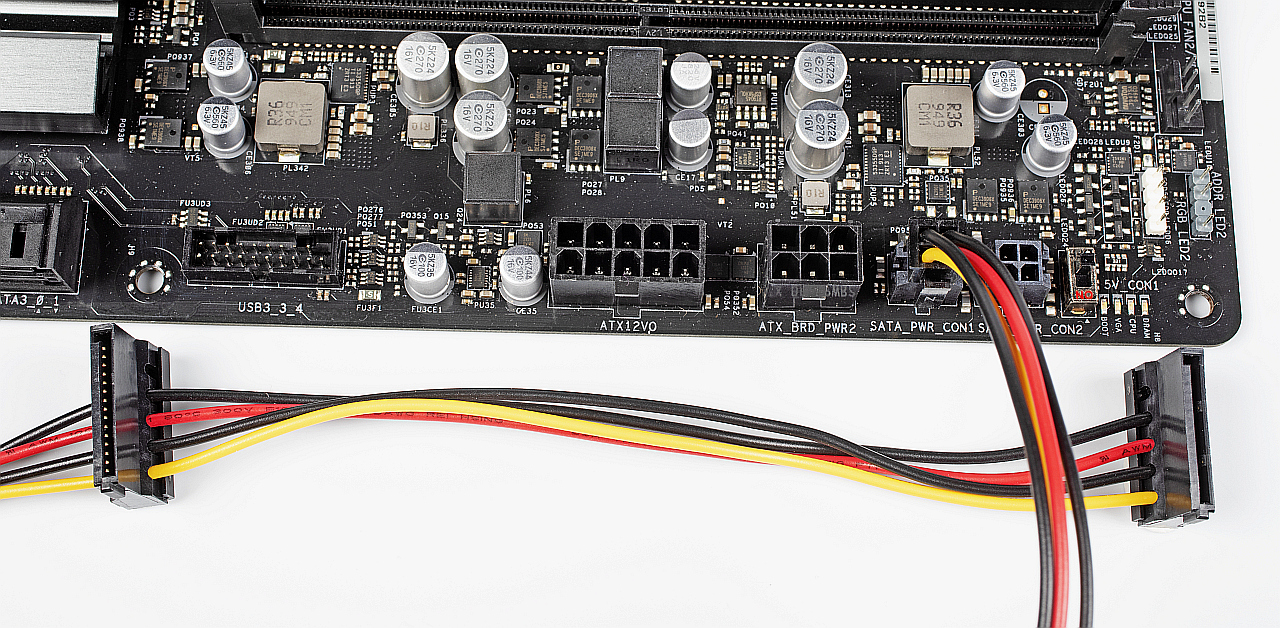
ATX12VO takes that reality and formalizes it. The PSU supplies 12V for main power and a 12V standby rail, while the motherboard handles local DC-to-DC conversion for components that still need 5V or 3.3V. In practical terms, that means the big 24-pin connector shrinks to a smaller 10-pin main power connector. It also means some power delivery responsibilities move onto the board itself.
That last point matters more than the smaller plug, even though the smaller plug is the part that gets all the photo ops. The connector reduction cleans up cabling and can simplify airflow and cable routing. But the deeper change is electrical. ATX12VO strips unnecessary conversion work out of the PSU during low-demand conditions and lets the motherboard generate lower voltages closer to the devices that need them.
Why that matters for efficiency
Every conversion step wastes a little energy. In older multi-rail designs, the PSU had to keep multiple rails ready even when a desktop was doing almost nothing. That is not ideal when modern idle power targets are getting tighter and tighter. A low-load desktop does not need a whole orchestra warming up backstage; it needs a competent soloist with excellent manners.
By focusing the PSU on 12V delivery, ATX12VO reduces the overhead of maintaining lightly used voltage rails inside the power supply itself. Lower-voltage conversion then happens on the motherboard, where it can be tailored more precisely to the actual devices in use. The result is usually a noticeable gain in low-load efficiency, which is where the standard earns its keep.
Why Intel Pushed ATX12VO In The First Place
Intel did not wake up one morning and decide the 24-pin connector had become emotionally exhausting. The company had a clear motivation: desktop energy regulations were tightening, especially around idle and low-power operation. Programs such as ENERGY STAR and rules from the California Energy Commission placed more emphasis on efficiency at lower load points, not just the classic headline numbers at 20%, 50%, and 100% load.
That shift matters because desktops do not spend most of their lives at full tilt. Office machines, home desktops, family PCs, and even many creator systems sit idle, sleep, or cruise through light tasks for long stretches. A few watts shaved off idle draw may not sound thrilling, but scale it across fleets of machines and it becomes economically and environmentally significant.
Intel’s own messaging around ATX12VO has been remarkably candid on this point. The standard was created to help original equipment manufacturers and system integrators hit more aggressive idle-power goals. That is why ATX12VO has always felt more OEM-first than DIY-first. It is a standard born from compliance pressure and efficiency targets, then later translated into enthusiast-facing language.
The idle-power battlefield
Low-load efficiency is where conventional PSU certification can get awkward. Many PSU buyers know 80 PLUS ratings, and those ratings are useful. But low-load behavior has historically been trickier than the sticker on the box suggests. A unit can look excellent at common certification points and still be less graceful when a system is idling far below those loads.
That is where ATX12VO aims to be smarter. Intel’s design guidance pays unusually close attention to low-load conditions, including 10-watt testing for smaller supplies and 2% load targets for larger ones. In other words, ATX12VO is less interested in flexing at the hardware gym and more interested in not wasting energy while standing in the hallway.
How ATX12VO Improves Power Supply Efficiency
The efficiency argument for ATX12VO comes down to three main ideas: simpler PSU design, better low-load behavior, and more targeted voltage conversion.
1. A simpler PSU can waste less power
A 12V-only PSU has fewer conversion duties than a traditional multi-rail desktop PSU. That simplification can reduce internal component count, trim some cost on the PSU side, and help the unit perform more efficiently at low loads. It also reduces cabling clutter, which may not change your electric bill, but certainly makes the inside of a case look less like a spaghetti intervention.
2. Low-load performance gets the spotlight
Intel’s published examples helped sell the concept. One widely cited comparison showed that at a 20W load, a 500W ATX12VO 80 PLUS Gold unit could reach around 83% efficiency, versus roughly 64% for a comparable traditional 500W ATX 80 PLUS Gold supply. That kind of gap is enormous in percentage terms, even if the absolute watt savings depend on the workload and system design.
Intel also highlighted an early ASRock ATX12VO motherboard design that reduced idle power by 27% compared with a similar motherboard using a traditional ATX multi-rail power arrangement. That does not mean every future ATX12VO build will magically slash idle draw by the same amount. It does mean the architecture can produce meaningful real-world gains when the whole platform is designed around it.
3. DC-to-DC conversion moves closer to where it is needed
Instead of generating 5V and 3.3V centrally inside the PSU and then distributing them across the system whether they are heavily needed or not, ATX12VO lets the motherboard create those lower voltages locally. That can be more efficient because the conversion stages can be sized around actual use cases such as SATA devices, USB power, RGB controllers, and standby features.
In effect, ATX12VO treats lower-voltage power more like an on-demand service instead of a utility left running around the clock. It is not magic. It is just better choreography.
What The Current Specification Reveals
The most recent ATX12VO design material shows that Intel did not treat the standard as a one-and-done experiment. The spec has continued to evolve, and that matters because it shows ATX12VO is not frozen in a 2020 proof-of-concept moment.
Intel’s current guide keeps the core idea intact: 12V main power, 12V standby, and a 10-pin main motherboard connector. For smaller to mid-size boards, that main connector can supply enough power on its own, while higher-power boards can add extra board power connectors when needed. The spec also reserves room for telemetry features and incorporates current-era graphics power expectations, including support tied to the newer 12V-2×6 auxiliary connector ecosystem in the broader design guide.
On the efficiency side, Intel’s baseline ATX12VO requirements line up with 80 PLUS Bronze-class minimums at standard load points, while also adding tougher low-load expectations. That combination is the standard’s signature move. ATX12VO is not trying to reinvent efficiency at 50% load. It is trying to stop desktop PSUs from going lazy and wasteful when the computer is basically checking email, syncing a cloud folder, or staring thoughtfully at the wallpaper.
The Trade-Offs Nobody Should Ignore
ATX12VO is clever, but it is not free. It shifts complexity, and anything that shifts complexity in PC hardware tends to send invoices somewhere.
Motherboards get more complicated
Once the PSU stops generating 5V and 3.3V directly for the whole system, the motherboard has to pick up that job. That means more onboard conversion circuitry, more thermal planning, and more design work. PSU cost may go down, but motherboard cost and complexity can go up. For large OEMs, that trade can make sense. For DIY buyers who upgrade parts separately, it is less obviously a win.
Compatibility becomes messier
One of the biggest reasons ATX12VO has not steamrolled the retail market is compatibility friction. A standard ATX PSU and an ATX12VO motherboard are not simply plug-and-play compatible with a passive cable. Standby power differences complicate the picture. That is why products like Corsair’s ATX12VO adapter cable exist: the market saw enough awkwardness to monetize it.
Even then, adapters are not the same as broad, elegant ecosystem support. Builders generally prefer standards that make upgrades easier, not standards that require an explanatory flowchart and a mild existential pause.
DIY users do not feel the same urgency as OEMs
OEMs and system integrators have clear incentives to chase compliance, reduce fleet idle power, and standardize product lines. DIY enthusiasts care about efficiency too, but they also care about reuse, flexibility, availability, and clean upgrade paths. ATX12VO solves a real problem, yet it solves it most urgently for the companies shipping complete systems into regulated markets.
Why Adoption Has Been Slow
For all its logic, ATX12VO has not become the default retail desktop standard. The reasons are practical rather than mysterious.
First, it is a two-sided transition. You need compatible motherboards and compatible power supplies at the same time. That is always harder than upgrading one component category. Second, many enthusiast and gaming systems have historically been insulated from the strictest efficiency pressure, especially where regulatory definitions around high expandability and discrete graphics created room for traditional designs to keep breathing.
Third, the existing ATX ecosystem is deeply entrenched. The 24-pin connector may be bulky, but it is familiar, cheap, and supported everywhere. Hardware standards do not die because they are inelegant. They die when replacement becomes easier than inertia, and ATX12VO has not quite reached that tipping point in DIY desktop land.
That said, the standard never disappeared. MSI has offered ATX12VO motherboards, Corsair has sold adapter hardware, and Intel’s design guide has continued to move forward. Tom’s Hardware also noted renewed traction as more products appeared in late 2023. So while ATX12VO has not conquered retail desktops, it is not a ghost story either.
Practical Experiences And Lessons From The ATX12VO Ecosystem
When you look past the specification sheets and efficiency charts, the most interesting part of ATX12VO is how it behaves in the real world. The pattern that emerges from platform demos, board launches, manufacturer commentary, and builder reactions is pretty consistent: ATX12VO works best when the entire system is planned around it from the beginning.
In small-form-factor desktops, office machines, and OEM-style builds, the advantages are easy to understand. Cable routing becomes cleaner because the huge 24-pin cable disappears. The PSU itself can be simpler. Low-load efficiency becomes more respectable. And because many of these systems spend their lives idling, sleeping, waking, syncing, updating, and then idling again, even modest savings matter over time. In those environments, ATX12VO feels less like an experiment and more like overdue housekeeping.
The experience is less straightforward in enthusiast systems. Builders are used to treating the PSU as one of the longest-lived parts in a PC. A good unit can survive multiple cases, motherboard swaps, CPU upgrades, and the occasional misguided RGB phase. ATX12VO complicates that tradition because motherboard and PSU compatibility become more tightly linked. If you switch one side of the equation, you may need to rethink the other. That is not catastrophic, but it does remove some of the plug-and-play freedom that makes DIY desktop building so appealing.
Another recurring lesson is that ATX12VO does not erase complexity; it relocates it. PSU design becomes cleaner, while motherboard design becomes busier. Engineers now need to budget space and cooling for onboard conversion stages that used to live inside the PSU. That can be manageable on boards designed with the standard in mind, but it is one reason motherboard vendors have not all sprinted toward 12VO with confetti cannons and free T-shirts.
Storage and peripheral power are another practical wrinkle. Older assumptions about PSU cabling no longer apply cleanly when 5V and 3.3V are not distributed the old-fashioned way. Some boards and ecosystem products handle that neatly; others remind you that standards transitions are rarely elegant in their early years. The result is a user experience that can feel wonderfully modern in one build and mildly annoying in the next.
There is also a more subtle lesson here about right-sizing power supplies. ATX12VO helps low-load efficiency, but it does not turn bad sizing decisions into brilliant ones. A wildly oversized PSU can still be a silly choice for a modest machine. One of the smartest ways to benefit from any efficient power architecture, including ATX12VO, is still choosing wattage that matches the actual system instead of shopping as if future upgrades will include a moon launch.
Overall, the lived experience around ATX12VO suggests that Intel identified a genuine engineering problem and proposed a technically sound answer. The challenge is not whether the answer works. The challenge is whether the desktop market wants the trade-offs that come with it. For OEMs, the answer is often yes. For mainstream DIY builders, the answer is still, “Interesting idea, but I would like my old upgrade habits back, please.”
Final Verdict: Smart Standard, Narrow Revolution
Intel’s ATX12VO standard is one of those rare PC-platform changes that makes more sense the longer you look at it. It addresses a real inefficiency in modern desktop power delivery, especially at idle and low loads. It aligns with the direction of energy regulations. It simplifies PSUs, shrinks the main connector, and creates a cleaner path toward lower wasted power in complete systems.
But it also asks the market to accept more motherboard complexity, trickier compatibility, and a less flexible upgrade story. That is why ATX12VO has made the most sense in OEM and system-integrator environments, where whole platforms are designed together and idle efficiency is a boardroom metric rather than just a nice bonus.
So is ATX12VO the future? Probably, at least in parts of the market where efficiency pressure keeps rising and system design is tightly controlled. Is it the future for every DIY tower under every desk? Not yet. Maybe not ever in a dominant way. Still, as a study in increasing computer power supply efficiency, ATX12VO is a serious and revealing case. It shows that the next leap in desktop power design may not come from making PCs consume more power heroically, but from making them waste less power quietly.