German numbers have a reputation for being the language equivalent of assembling furniture without the instructions. At first glance, words like einundzwanzig and zweihundertfünfundvierzig look less like numbers and more like somebody fell asleep on a keyboard. The good news is that German numbers are not random. In fact, they are wonderfully logical once you see the pattern.
If you want to count in German, write dates correctly, read prices, understand addresses, or stop panicking every time you see a long compound word, learning how to write German numbers is a smart first step. This guide breaks the system into three manageable stages, so you can go from “What on earth is sechsundsechzig?” to “I have totally got this.”
Let’s make German numbers much less scary and a lot more useful.
Step 1: Learn the Building Blocks First
Before you can write long German numbers, you need the small pieces that everything else is built from. Think of these as the Lego bricks of the system. If you know the basics, the larger numbers become far easier to decode and write.
Memorize 0 Through 12
The numbers from 0 to 12 mostly need to be memorized because they do not all follow a neat formula. Here are the essentials:
| Number | German |
|---|---|
| 0 | null |
| 1 | eins |
| 2 | zwei |
| 3 | drei |
| 4 | vier |
| 5 | fünf |
| 6 | sechs |
| 7 | sieben |
| 8 | acht |
| 9 | neun |
| 10 | zehn |
| 11 | elf |
| 12 | zwölf |
These are worth drilling until they feel automatic. If you hesitate on the small numbers, the big numbers will start looking like alphabet soup.
Understand the Teen Pattern
From 13 to 19, German usually adds -zehn, which means “ten.” So the pattern is pretty friendly:
- 13 = dreizehn
- 14 = vierzehn
- 15 = fünfzehn
- 18 = achtzehn
- 19 = neunzehn
But German likes to keep learners humble, so there are two famous spelling exceptions:
- 16 = sechzehn, not sechszehn
- 17 = siebzehn, not siebenzehn
Those missing letters are a classic beginner trap. German is basically saying, “You knew the rule? Excellent. Now here are two tiny surprises.”
Learn the Tens
Next, memorize the main tens:
| Number | German |
|---|---|
| 20 | zwanzig |
| 30 | dreißig |
| 40 | vierzig |
| 50 | fünfzig |
| 60 | sechzig |
| 70 | siebzig |
| 80 | achtzig |
| 90 | neunzig |
Notice a few things here. Thirty is dreißig, not a simple copy-and-paste version of drei. Also, 60 and 70 drop letters just like 16 and 17 do: sechzig and siebzig. Once those are locked in, the rest of the German number system gets much easier.
Step 2: Build German Numbers Like Puzzle Pieces
This is the step where German numbers begin to look long, but they also become highly predictable. The secret is that German often builds numbers as one connected word, and for numbers from 21 to 99, it says them in a “backward” order compared with English.
Write 21 to 99 with the Ones First
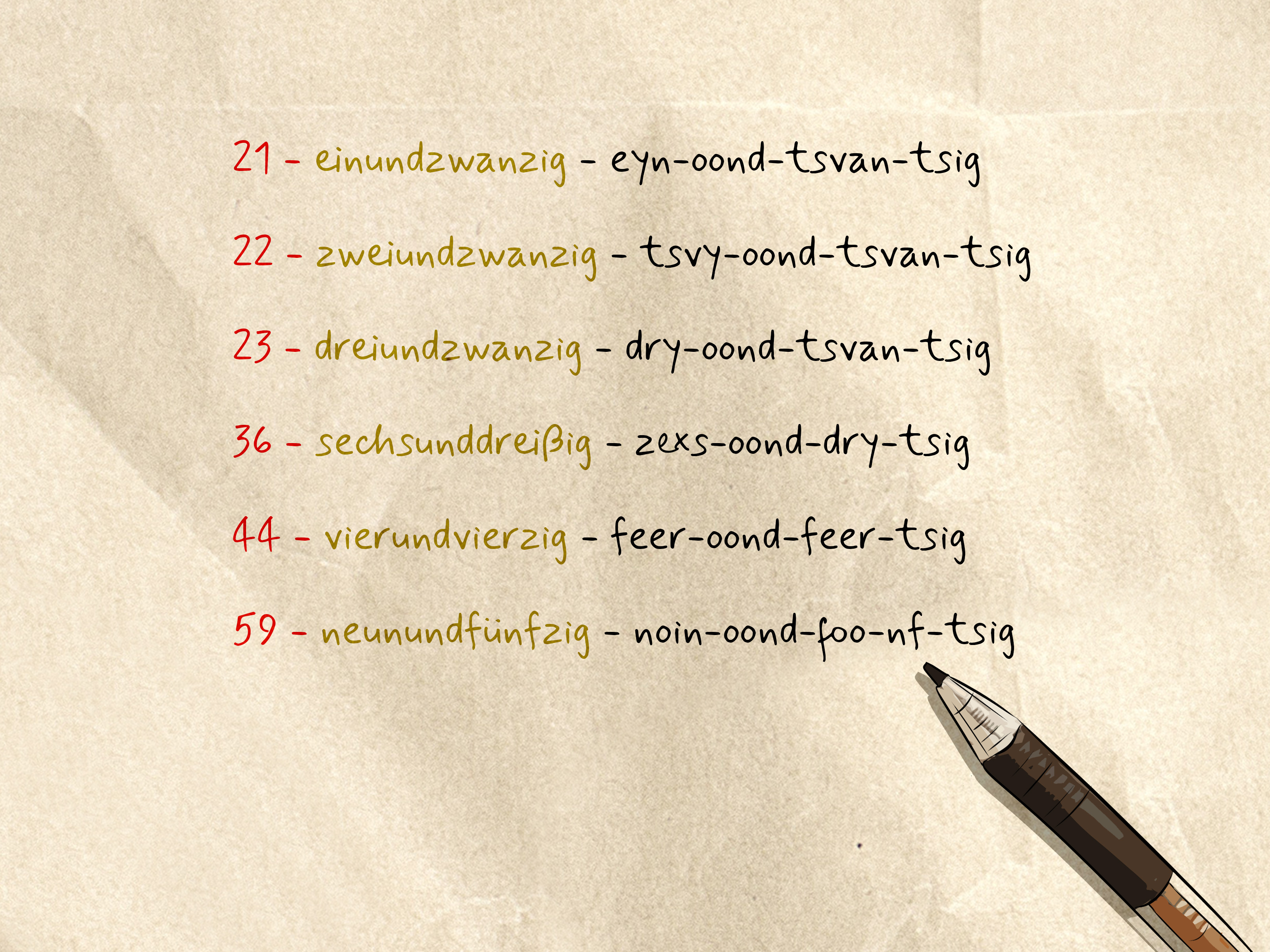
In English, we say “twenty-one.” German flips that order and says “one-and-twenty.” That means the formula looks like this:
ones + und + tens
Examples:
- 21 = einundzwanzig
- 22 = zweiundzwanzig
- 34 = vierunddreißig
- 46 = sechsundvierzig
- 59 = neunundfünfzig
- 77 = siebenundsiebzig
- 99 = neunundneunzig
There are three big rules here:
- Put the ones digit first.
- Add und in the middle.
- Write it as one word.
So if you want to write 28, do not think “twenty-eight.” Think “eight and twenty,” which becomes achtundzwanzig.
This “backward” structure is the reason German numbers feel odd to English speakers at first. The moment you accept that 23 is literally “three-and-twenty,” the fog starts to lift.
Write Hundreds and Thousands as Compounds
Now for the big stuff. German usually writes hundreds and thousands by stacking the pieces together into one long compound word.
Here is the basic pattern for hundreds:
- 100 = hundert or einhundert
- 200 = zweihundert
- 500 = fünfhundert
Then you attach the rest of the number:
- 125 = einhundertfünfundzwanzig
- 367 = dreihundertsiebenundsechzig
- 999 = neunhundertneunundneunzig
Thousands work the same way:
- 1,000 = tausend or eintausend
- 2,000 = zweitausend
- 10,000 = zehntausend
And then you keep building:
- 2,350 = zweitausenddreihundertfünfzig
- 46,903 = sechsundvierzigtausendneunhundertdrei
- 231,795 = zweihunderteinunddreißigtausendsiebenhundertfünfundneunzig
Yes, these words get long. Very long. German does not see that as a bug. German sees that as a personality trait.
Know the Special Case of “Million”
Most smaller written numbers get glued together into one compound word, but Million is different. It behaves like a noun, so it is written separately and capitalized:
- 1,000,000 = eine Million
- 2,000,000 = zwei Millionen
- 3,400,000 = drei Millionen vierhunderttausend
That is a useful dividing line to remember. Up through thousands, you are mostly building compounds. At Million, German switches gears.
Step 3: Use German Numbers Correctly in Real Writing
Knowing the forms is great, but using them naturally is where things really click. This is the difference between recognizing vierundvierzig in a textbook and actually writing a date, a price, or an address without freezing like a laptop in the middle of an update.
Use Ordinal Numbers for Dates and Order
Cardinal numbers tell quantity: one, two, three. Ordinal numbers show order: first, second, third. In German, ordinals matter when writing dates and talking about sequence.
Common examples include:
- first = erste
- second = zweite
- third = dritte
- seventh = siebte
- eighth = achte
A useful rule is this:
- For 1 through 19, ordinals generally take -te
- From 20 upward, ordinals generally take -ste
That gives you forms like:
- 10th = zehnte
- 20th = zwanzigste
- 21st = einundzwanzigste
When writing dates with digits, German commonly adds a period after the number:
- am 5. Mai = on May 5
- der 21. Oktober = October 21
That tiny dot matters. Without it, the number is just a number. With it, the number becomes ordinal in the date.
Watch Out for Number Formatting
German number formatting also differs from American English. In many contexts, large numbers are grouped with a period or a space, and decimals use a comma.
- 1,000,000 in American English may appear as 1.000.000 or 1 000 000 in German formatting
- 9.95 dollars in American-style formatting would look like 9,95 in German-style notation
This does not change the words themselves, but it absolutely changes how numbers look on the page. If you are writing for learners, travelers, or students, this is a handy detail to know.
Common Mistakes Beginners Make
- Writing 24 as zwanzigvier instead of vierundzwanzig
- Forgetting that 16 is sechzehn and 17 is siebzehn
- Splitting compound numbers into separate words when they should be one word
- Forgetting that Million is separate and capitalized
- Missing the period in ordinal dates like 3. or 18.
The best way to avoid these errors is to practice writing full numbers, not just reading them. Writing forces your brain to notice the order, spelling, and structure. It is a little less glamorous than binge-watching a drama series in German, but it works.
Conclusion
If German numbers have ever looked like a wall of letters marching straight toward you, take a breath. They are not as wild as they seem. Once you learn the basic building blocks, understand the backward pattern from 21 to 99, and practice using numbers in real writing, the system becomes surprisingly manageable.
The real trick is not memorizing every possible number. It is learning the structure. German numbers reward pattern recognition, and once the pattern sticks, you can write everything from fünfzehn to zweihundertachtundvierzig with much more confidence.
So the next time you run into a number like siebenundsechzig, do not panic. Just break it apart, trust the formula, and remember: German may enjoy long words, but it also loves logic.
Real-Life Experiences With Learning to Write German Numbers
For many learners, the first real experience with German numbers is not in a grammar book. It happens when they try to read a train platform, write down a phone number, order two pastries, or understand a date spoken out loud at what feels like the speed of light. On paper, German numbers look intimidating. In real life, they feel like a puzzle you can solve if you stay calm for two extra seconds.
One of the most common learner experiences goes like this: you feel confident up to 20, maybe even 30, and then someone says 47. Your brain hears a blur of sounds, recognizes the und, and suddenly wonders why the number seems to be upside down. That is often the exact moment people realize that German does not build 47 the English way. It is not “forty-seven.” It is siebenundvierzig, or “seven and forty.” At first, that feels like the language is trolling you. Then, after enough repetition, it becomes oddly satisfying.
Another experience learners often mention is writing long numbers for the first time. Seeing zweitausenddreihundertfünfzig can be dramatic. It looks like a full sentence disguised as a number. But once you split it into chunks, it stops being scary. Two thousand. Three hundred. Fifty. Suddenly the monster word is just a stack of familiar pieces wearing a very long coat.
There is also a funny psychological shift that happens when learners begin to trust compound words. In English, we are used to spaces helping everything breathe a little. German tends to say, “No spaces here, we ride together.” Once you accept that, your reading speed improves. You stop trying to find breaks that are not there and start identifying patterns instead. That is often when confidence grows fast.
Dates are another classic battlefield. A learner may easily understand Mai or Oktober, but the period after the number can be confusing at first. Then comes the lightbulb moment: the period marks the ordinal. It is not just 5, it is the 5th. Suddenly forms like am 12. Juni or der 3. Januar stop looking mysterious and start looking efficient. German often feels that way once you crack the code: strict at first, elegant later.
Many people also discover that German numbers improve through ordinary routines rather than dramatic study sessions. Reading apartment numbers, practicing prices, writing grocery quantities, and saying the time out loud all help. A learner might spend an hour memorizing lists and retain half of it, then spend one week noticing numbers in daily life and retain almost everything. Numbers become easier when they stop being abstract and start doing real jobs.
Perhaps the most encouraging experience is this: the system really does get easier all at once. For a while, German numbers feel clunky and unnatural. Then one day you read einundzwanzig without translating it in your head. You write fünfundvierzig without second-guessing the order. You spot sechzehn and do not try to sneak the missing letter back in. That moment feels small, but it is a huge milestone. It means the structure has moved from memorization to instinct.
So if you are learning how to write German numbers and the experience feels awkward right now, that is normal. Nearly everyone starts there. The good news is that German numbers are not chaos. They are a system. And once you experience that system enough times in real situations, the long words stop looking impossible and start looking familiar.