Settling an estate comes with a strange mix of emotions and paperwork. One minute you are sorting through family photos, and the next you are staring at tax forms that seem to have been designed by someone who thought “clear instructions” were bad for character development. Among the first practical tasks many executors face is learning how to obtain a tax ID number for an estate.
The good news: getting an estate tax ID number is usually simpler than it sounds. In most cases, the number you need is an Employer Identification Number, commonly called an EIN. Despite the name, the estate does not need to have employees. The EIN works like a Social Security number for the estate, allowing banks, the IRS, brokers, and other institutions to identify the estate as a separate tax entity.
This guide explains what an estate EIN is, when you need one, who can apply, what information to gather, how to complete the IRS application, and what to do after the number is issued. Think of it as a paperwork survival guide, minus the coffee stains and panic scrolling.
What Is a Tax ID Number for an Estate?
A tax ID number for an estate is usually a federal Employer Identification Number issued by the Internal Revenue Service. It is a nine-digit number used to identify the estate for tax reporting, banking, and administration. The estate becomes a separate tax entity after a person dies, especially when assets continue to earn income before they are distributed to heirs or beneficiaries.
For example, suppose a deceased person owned a savings account, a brokerage account, rental property, or dividend-paying stocks. After death, income from those assets may belong to the estate, not the individual. That income may need to be reported on Form 1041, U.S. Income Tax Return for Estates and Trusts. To file that return, the estate needs its own tax ID number.
One common mistake is assuming the executor can use the deceased person’s Social Security number. That number is used for the decedent’s final individual tax return, not for the estate’s ongoing income, bank account, or fiduciary tax filings. The estate needs its own EIN because it is being administered as a separate legal and tax entity.
When Does an Estate Need an EIN?
An estate typically needs an EIN when the executor or personal representative must open an estate bank account, file an estate income tax return, receive income on behalf of the estate, sell estate assets, or handle payments made payable to “Estate of [Decedent’s Name].” Banks often require the estate EIN before they will open an estate account. This is true even if there is only one heir and everyone agrees on what should happen next.
An estate may also need to file Form 1041 if it earns more than $600 in annual gross income or has a nonresident alien beneficiary. Income can include interest, dividends, rent, business income, or capital gains generated after the date of death. If the estate earns income, the EIN becomes the tax ID number used to report that income.
Here is a simple example. Maria’s father dies in March. His final Form 1040 reports his personal income through the date of death. After that date, his brokerage account continues to generate dividends while the estate is being settled. Those dividends may belong to the estate. Maria, as executor, opens an estate bank account and applies for an EIN so she can properly report the income and manage deposits. The EIN keeps the estate’s tax life separate from her father’s final personal tax return and from Maria’s own finances.
Who Can Apply for an Estate Tax ID Number?
The person who applies should generally be the executor, administrator, personal representative, or fiduciary legally responsible for managing the estate. In many cases, this person is appointed by a probate court and receives documents such as Letters Testamentary or Letters of Administration. These documents prove authority to act for the estate.
The IRS application asks for a “responsible party.” For an estate, that is usually the executor, administrator, personal representative, or another fiduciary who controls or manages the estate’s funds and assets. A beneficiary who does not have authority to manage the estate is usually not the responsible party. In plain English: being interested in the money is not the same as being legally in charge of the paperwork.
If an attorney, accountant, or tax professional helps with the application, they may act as a third-party designee only with proper authorization. However, the responsible party should still be the appropriate fiduciary, not a random helper, friend, or “I’m good with forms” cousin.
Information You Need Before Applying
Before starting the estate EIN application, gather the key information. The online IRS application must be completed in one session, so preparation saves you from the classic modern tragedy: getting almost done, timing out, and having to start over while muttering at your laptop.
Basic estate information
You will usually need the legal name of the estate. This is commonly written as “Estate of [Decedent’s Full Legal Name].” You should also have the decedent’s Social Security number, date of death, and last address. If probate has been opened, use the name and details consistently with court records.
Executor or fiduciary information
You will need the responsible party’s name, taxpayer identification number, mailing address, and contact information. For most individual executors, this means a Social Security number or Individual Taxpayer Identification Number. The IRS generally requires the responsible party to be an actual person, not another entity, unless a special exception applies.
Administrative details
The application may ask about the reason for applying. For an estate, the correct reason is generally related to administering an estate. You may also need to choose a closing month for the estate’s accounting year. Many estates use December, but some choose a fiscal year depending on timing and tax planning. When in doubt, ask a qualified tax professional, especially if the estate owns a business, rental property, complex investments, or assets in multiple states.
How to Obtain a Tax ID Number for an Estate Online
The fastest way to obtain an estate tax ID number is usually through the IRS online EIN application. The IRS does not charge a fee for an EIN. If a website wants money just to issue a basic EIN, take a deep breath and check whether you are actually on the official IRS site. Paying for convenience may be a business choice, but the EIN itself is free from the IRS.
Step 1: Go to the IRS EIN application
Start at the IRS page for getting an Employer Identification Number. The online tool asks interview-style questions and guides you through the process. It is available during specific operating hours, and the session expires after a period of inactivity. Have your documents ready before you begin.
Step 2: Select the entity type
When asked what type of legal structure needs an EIN, choose “Estate.” This tells the IRS that the number is for a deceased person’s estate, not for a corporation, partnership, nonprofit, or trust. Choosing the wrong entity type can cause confusion later, so do not rush this step.
Step 3: Enter the decedent’s information
Provide the deceased person’s legal name, Social Security number, and other requested details. Use the full legal name as it appears on official documents. If there are spelling differences between documents, resolve them before applying whenever possible. Banks and tax agencies are not famous for their sense of humor about mismatched names.
Step 4: Enter the responsible party information
Next, enter information for the executor, administrator, or fiduciary. This person is the responsible party for IRS purposes. The responsible party should be someone with authority to control and manage estate assets, not merely a beneficiary or informal family spokesperson.
Step 5: State the reason for applying
Choose the reason that best fits estate administration. Typically, this is because you are administering an estate and need an EIN for banking, tax filing, or asset management. Keep your answers accurate and consistent with the estate’s actual situation.
Step 6: Review everything carefully
Before submitting, review the estate name, decedent’s Social Security number, responsible party details, mailing address, and entity type. A typo in an EIN application is like a tiny pebble in a shoe: small at first, extremely annoying later.
Step 7: Save the confirmation letter
If the online application is approved, the IRS usually issues the EIN immediately. Download, print, and save the EIN confirmation letter. Banks, accountants, attorneys, and brokerage firms may ask for it. Store both a digital copy and a paper copy with the estate records.
How to Apply by Fax or Mail
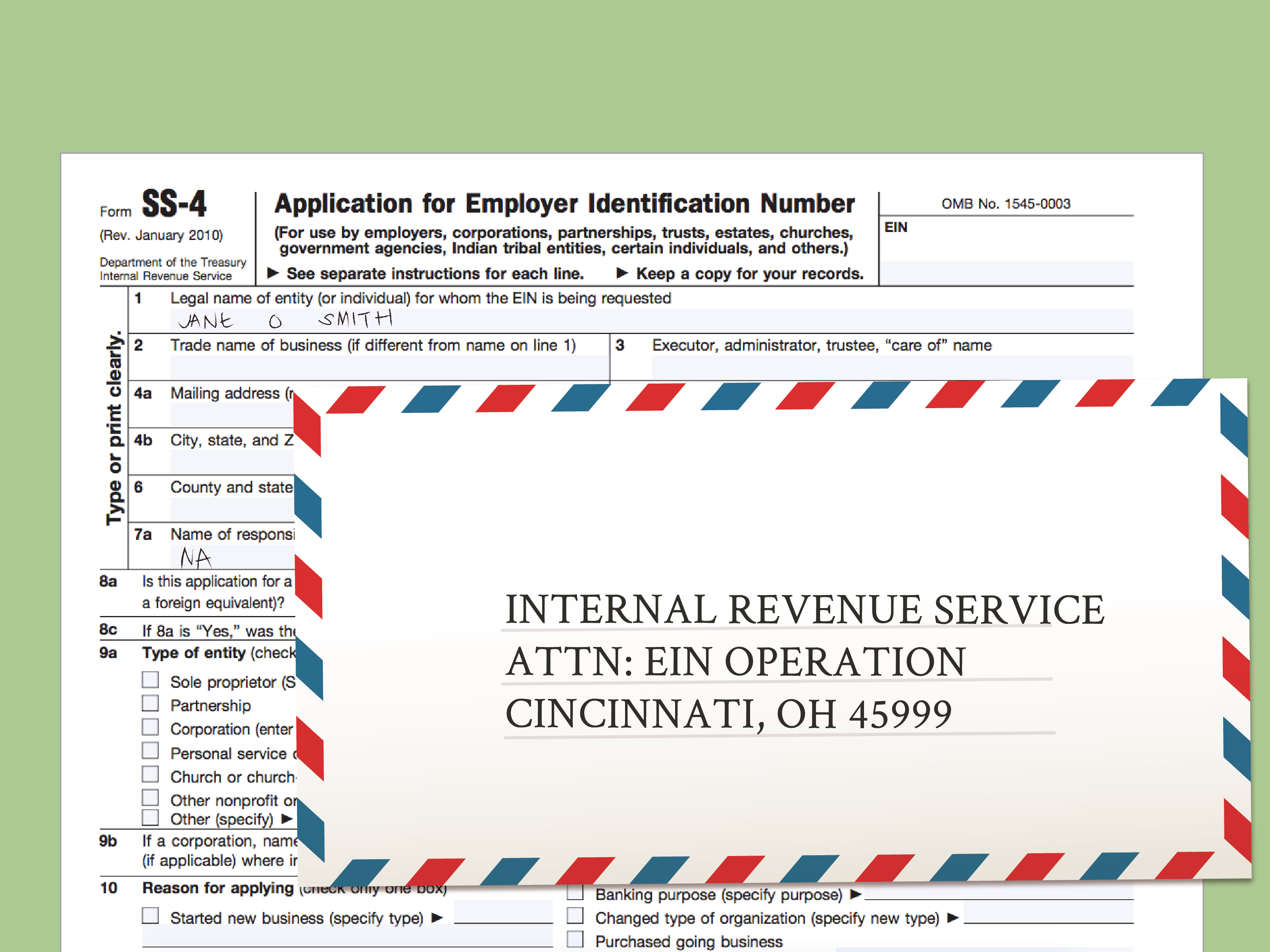
If you cannot use the online application, you can apply using Form SS-4, Application for Employer Identification Number. Fax is usually faster than mail. The IRS provides fax numbers and mailing addresses in its EIN instructions. When applying by fax, the IRS may return the EIN by fax if you provide a fax number. Mail applications take longer, so this route is best when timing is not urgent.
Form SS-4 asks for the legal name of the entity, the executor or fiduciary information, the type of entity, and the reason for applying. For an estate, the legal name is usually “Estate of [Decedent’s Name].” The executor’s name may be entered as the fiduciary or responsible person, depending on the form line. Read the current instructions carefully because IRS forms and addresses can change.
If the estate needs to open a bank account quickly, online application is usually the most practical option. If the online system rejects the application or the responsible party does not meet the online eligibility rules, fax or mail may be necessary.
What to Do After You Receive the Estate EIN
Receiving the EIN is not the finish line; it is more like getting the key to the paperwork room. Once you have the number, use it consistently for estate business.
Open an estate bank account
Many executors open a separate estate checking account. This account can receive refunds, insurance checks payable to the estate, proceeds from asset sales, rent, dividends, and other estate income. It can also be used to pay funeral expenses, valid debts, taxes, court costs, attorney fees, and distributions to beneficiaries.
Do not mix estate funds with your personal bank account. Even when everyone trusts you, clean records protect you. If a beneficiary later asks where money went, a dedicated estate account makes the answer much easier than a shoebox of receipts and nervous laughter.
Provide the EIN to financial institutions
Banks, brokerages, title companies, and other institutions may request the estate EIN before releasing funds or retitling accounts. They may also ask for a death certificate, court appointment documents, personal identification, and estate account paperwork.
Use the EIN on Form 1041 if required
If the estate must file Form 1041, use the estate EIN on that return. The final individual income tax return for the deceased person is separate and generally uses the decedent’s Social Security number. This distinction matters because income before death and income after death are treated differently.
Consider filing Form 56
Form 56, Notice Concerning Fiduciary Relationship, may be used to notify the IRS that you are acting as fiduciary for the estate. This can help establish who is authorized to receive notices and act on behalf of the estate in tax matters. If the fiduciary relationship later ends, a follow-up filing may be appropriate to notify the IRS that your role has ended.
Common Mistakes to Avoid
The EIN application is not difficult, but a few mistakes can create headaches. Avoid these common problems when applying for a tax ID number for an estate.
Using the decedent’s Social Security number for estate business
The decedent’s Social Security number belongs on the final individual return and certain personal records. The estate EIN should be used for estate income, estate accounts, and estate tax reporting after death.
Selecting the wrong entity type
An estate is not the same as a trust, corporation, LLC, or sole proprietorship. If you are administering a probate estate, select “Estate” when applying. If a trust is involved, especially a revocable trust that became irrevocable after death, get professional advice because trust EIN rules can differ.
Applying before you have authority
Being named in a will does not always mean you can immediately act. In many states, the probate court must formally appoint the executor. Banks may refuse to open an estate account until you have court-issued letters. Get your authority documents in order before you promise everyone the estate will be wrapped up “by next Tuesday.”
Misplacing the EIN confirmation letter
The confirmation letter is important. Save it immediately. If you lose it, you may be able to recover the EIN through IRS procedures, but that is extra work during a process that already comes with enough paperwork to wallpaper a small hallway.
Ignoring state tax requirements
A federal EIN is not always the only tax issue. Some estates may have state income tax filing requirements, state estate or inheritance tax concerns, or local procedures for probate assets. Rules vary by state, so check with a local attorney or tax professional if the estate is more than very simple.
Estate EIN vs. Final Tax Return: Know the Difference
One of the most confusing parts of estate administration is understanding that the deceased person and the estate are not the same taxpayer for every purpose. The final Form 1040 reports the decedent’s personal income up to the date of death. The estate’s Form 1041 reports income earned by estate assets after death and before distribution.
For example, if James died on June 1, wages he earned before June 1 belong on his final Form 1040. But if his rental property collected rent in July while the estate was still open, that post-death rental income may belong on the estate’s Form 1041. The estate EIN is the number used for that estate return.
This separation helps prevent tax records from becoming tangled. It also helps beneficiaries understand what belongs to the decedent personally, what belongs to the estate, and what may eventually be distributed.
Practical Experience: What Executors Often Learn the Hard Way
In real estate administration, the EIN itself is usually not the hardest part. The challenge is everything around it: timing, documents, family expectations, bank procedures, and the emotional weight of handling someone’s final affairs. Executors often expect the process to move like a normal errand. Instead, it sometimes moves like a government form wearing ankle weights.
One useful experience is to gather documents before touching the online application. Executors who start too quickly often discover they are missing the decedent’s Social Security number, exact legal name, date of death, court appointment papers, or mailing address for the estate. The IRS online session is not designed for leisurely detective work. If you pause too long, the session may expire. A simple folder with the death certificate, court letters, will, contact information, and asset list can make the application feel manageable.
Another practical lesson is that banks may have their own requirements beyond the EIN. Some banks ask for certified Letters Testamentary, a death certificate, the EIN confirmation letter, the executor’s identification, and sometimes a copy of the will. Others require specific account titles, such as “Estate of John A. Smith, Jane Smith, Executor.” Calling the bank before visiting can save a wasted trip. Nobody wants to stand at a teller window with a folder full of documents only to hear, “We need one more thing.” That sentence has ruined many afternoons.
Executors also learn that family communication matters. When heirs hear that an estate account has been opened, some assume distributions are coming immediately. In reality, the executor may need to collect assets, pay debts, wait for creditor periods, file tax returns, resolve property issues, and keep reserves for expenses. The EIN is a starting tool, not a magic wand. A calm explanation can reduce pressure and prevent misunderstandings.
Recordkeeping is another area where experience teaches discipline. Every deposit into the estate account should have a source. Every payment should have a reason. Keep receipts, invoices, bank statements, tax forms, and correspondence. Even simple estates can become complicated if records are sloppy. The executor’s best defense is a clean paper trail. Future you will be grateful, and future you is probably already tired.
Finally, many executors discover when to ask for help. A small estate with one bank account may be straightforward. But if the estate includes rental property, business interests, investment accounts, multiple beneficiaries, disputes, out-of-state assets, foreign beneficiaries, or large taxable income, professional guidance can be worth it. An estate attorney or tax professional can help prevent mistakes that cost more than the advice would have.
Conclusion
Obtaining a tax ID number for an estate is one of the first practical steps in responsible estate administration. The estate EIN allows the executor or fiduciary to open an estate bank account, report estate income, manage financial transactions, and keep the estate’s tax identity separate from the deceased person’s Social Security number.
The process is usually straightforward: gather the decedent’s information, confirm your authority as executor or administrator, apply through the IRS online EIN system when eligible, save the confirmation letter, and use the number consistently for estate business. If online application is not available, Form SS-4 can be submitted by fax or mail.
While the form itself may be simple, the responsibility behind it is real. Good records, separate accounts, accurate tax reporting, and clear communication with beneficiaries can make the estate process smoother. When the estate is complex, professional help is not a luxury; it is often the safest route through the maze.
Note: This article is for general educational purposes and is not legal or tax advice. Estate rules can vary by state and by situation. Executors should consult a qualified estate attorney, CPA, or tax professional for guidance on complex estates, disputed estates, business assets, trust issues, or state-specific requirements.