High school classrooms are often described as places of learning, personal growth, and careful academic discussion. Technically, that is true. They are also places where someone may prepare breakfast during an English lesson, confuse Shakespeare’s tragic lovers with passengers on the Titanic, or develop an unexpectedly passionate opinion about the geopolitical history of the Cars universe.
High school English teacher Andrea Michelle, known online as Educator Andrea, has collected dozens of these wonderfully unpredictable moments. Her stories reveal students as accidental comedians, fearless critics, enthusiastic philosophers, and occasional creators of problems nobody covered in teacher-training courses. Her collection of 36 classroom encounters went viral because it captures a truth educators know well: teenagers rarely follow the script, even when the script is printed, highlighted, and displayed on the board.
Meet the Teacher Behind the Speechless Moments
Andrea did not originally imagine herself building a career in education. As a teenager, she was more interested in the social side of school than in becoming an academic superstar. Her path changed while she was training young grocery-store employees during college. Working with teenagers felt surprisingly natural, and teaching eventually became the profession that found her.
Years later, she began sharing amusing classroom experiences online. Much of the public conversation about education focusesunderstandablyon exhaustion, low pay, administrative pressure, and teacher shortages. Andrea wanted to show another side: teaching can be difficult while also being outrageously funny. In her view, students sometimes resemble a roomful of talented comedians who have not yet discovered editing, timing, or the wisdom of keeping certain thoughts private.
Why Her Stories Feel So Familiar
The specific jokes may be unusual, but the atmosphere is recognizable. Every teacher has experienced a carefully designed lesson being interrupted by a bizarre question. Every student remembers a classmate who said something so strange that even the teacher needed several seconds to reboot.
These moments are not simply evidence that teenagers are chaotic. They show young people experimenting with language, identity, humor, independence, and social status. The results can be creative, confusing, hilarious, inappropriate, or all four before the bell rings.
The Funniest Themes Within the 36 Classroom Moments
1. Teenagers Treat Language Like a Public Playground
As an English teacher, Andrea works in a subject built around vocabulary, interpretation, and communication. Her students appear determined to conduct independent research in all three areas.
One student described a novel as making her feel “swampy,” a word Andrea wisely chose not to investigate. Another transformed an offensive expression into such an elaborate, formal construction that the teacher could not help noticing the student’s command of language. It was inappropriate, certainly, but grammatically ambitious.
This kind of verbal invention is common among teenagers. Slang helps adolescents establish identity and belonging, but it evolves so quickly that adults may feel as though they are receiving updates several software versions late. A phrase can move from social media to the lunchroom and then disappear before a teacher learns whether it was a compliment, an insult, or a warning.
2. Historical Figures Are Not Safe From Teen Commentary
While introducing the background to Animal Farm, Andrea displayed an image of Joseph Stalin. A student immediately expressed an attraction to the dictator. The teacher attempted to explain why romantic enthusiasm for brutal authoritarian leaders was not the preferred learning objective. The student, however, remained committed to the bit.
The incident demonstrates one of the great challenges of teaching history and literature: educators may present industrialization, political oppression, or revolutionary ideology, while teenagers identify the mustache.
Yet even an absurd response can create an opening for instruction. A skilled teacher can acknowledge the joke, restore appropriate boundaries, and redirect attention to propaganda, power, symbolism, or why historical context matters. Classroom management does not always require crushing the humor. Sometimes it means steering the runaway shopping cart back toward the correct aisle.
3. Literature Can Become Spectacularly Misunderstood
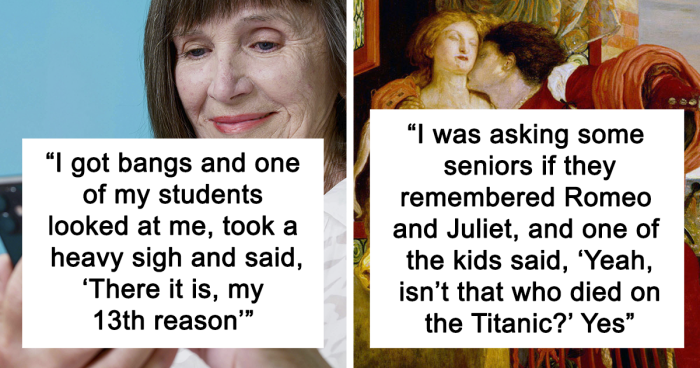
When Andrea asked seniors what they remembered about Romeo and Juliet, one student confidently connected the couple to the sinking of the Titanic. The answer was wrong in several centuries, two continents, and at least one fictional universe, but it was delivered with impressive certainty.
Another ambitious lesson involved decorations, music, collaborative activities, and an immersive introduction to Lord of the Flies. Andrea worked hard to create an unforgettable experience. The classroom descended into the exact kind of disorder the novel explores. Afterward, one student complained that they had expected to do something fun.
Teachers everywhere felt that one in their bones. A lesson can include props, technology, music, movement, snacks, and enough planning to coordinate a small wedding. A teenager may still respond, “Are we doing anything today?”
4. Food Appears Whenever It Is Least Convenient
One morning, a student produced bread, peanut butter, and jelly before making sandwiches during class. When questioned, he calmly explained that he was preparing breakfast and politely offered the teacher some.
Andrea accepted.
This was either a collapse of classroom discipline or a successful example of community dining. Possibly both.
Food also became a source of unexpected judgment when Andrea served homemade pulled pork after a reading activity. A student praised the meal but explained that he had assumed she was the type of person who found pepper too spicy. Compliments from teenagers often arrive carrying a tiny decorative dagger.
5. Students Can Detect Every Change in a Teacher’s Appearance
Teachers might believe students have not noticed the homework written in enormous letters on the board. Students have noticed, however, that their teacher changed one eyebrow, wore different shoes, or trimmed half an inch from her hair.
Andrea once arrived wearing two mismatched shoes. Her students quickly created a nickname based on the mistake. On another occasion, she returned after a break with bangs, prompting a student to react as though the haircut had created a personal crisis.
No performance review is as immediate as walking into a room full of teenagers after changing your appearance. They provide feedback quickly, freely, and without the inconvenience of being asked.
6. Teen Logic Deserves Its Own Academic Department
When Andrea discouraged marijuana use, a student defended it by claiming ancient Egyptians used the substance and still managed to build the pyramids. The argument would not survive rigorous historical review, but it did demonstrate rapid improvisation.
Another student offered the observation that every war in human history must also have occurred somewhere in the universe portrayed by Pixar’s Cars. This raises questions no curriculum committee was prepared to answer. Were there tank vehicles? Diplomatic sedans? A Treaty of Radiator Springs?
Teenagers are developing the ability to reason abstractly, challenge authority, and explore complicated social ideas. Their brains are also still maturing in areas connected to planning, decision-making, and impulse control. Peer attention can make an outrageous comment feel more rewarding than a sensible one, especially when the entire class is available as an audience.
7. Some Situations Become Serious Without Warning
Not all of Andrea’s speechless moments are harmless jokes. She has described fights, vaping, risky behavior, inappropriate remarks, and students revealing personal struggles. Teachers often move from explaining a novel to resolving a conflict, identifying a safety concern, or listening to a distressed student within the same class period.
National data reflect that reality. During the 2020–2021 school year, 32 percent of public school teachers reported that student misbehavior interfered with teaching, while 37 percent said tardiness or class cutting caused interference. Newer national research released in June 2026 found that 55 percent of public K–12 teachers experienced frequent job-related stress, and managing student behavior was the most frequently cited stressor.
The funny stories therefore sit beside a heavier truth. Educators are expected to teach content, manage behavior, recognize emotional distress, protect student safety, communicate with families, document incidents, and remain calm while someone explains why a snail urgently needed a fistful of milkshake.
Why Humor Matters in a High School Classroom
Humor can make a classroom feel warmer and more human. A shared laugh can reduce tension, restore attention, and help students see their teacher as an approachable adult rather than a grading machine powered by coffee.
Students themselves frequently say that humor increases engagement. When a teacher uses a playful example, a ridiculous analogy, or a harmless running joke, difficult material can become more memorable. Active-learning strategies also give students opportunities to communicate, collaborate, and connect course content to real situations.
Humor Works Best When It Does Not Target a Student
There is an important difference between laughing with students and turning a student into the punchline. Gentle, content-related humor can build community, while sarcasm aimed at a young person can create embarrassment or resentment. Teenagers may laugh publicly even when a remark hurts them privately.
Educators therefore need to read the room. A joke about a fictional character is different from a joke about a student’s intelligence, body, family, accent, clothing, or mistakes. Productive classroom humor creates safety. Unproductive humor establishes a winner and a loserand the adult should never need a teenage loser to earn a laugh.
The Strong Relationships Behind the Chaos
Andrea’s students are comfortable enough to speak openly around her, which explains both the warmth and the wildness of her stories. Familiarity does not eliminate boundaries, but it can indicate trust. Students are more likely to ask for help, admit confusion, or share concerns when they believe a teacher respects them.
The Centers for Disease Control and Prevention describes school connectedness as the feeling that adults and peers care about students as individuals and about their learning. Connected students are more likely to attend school, earn stronger grades, and graduate. Teacher caring is especially important for young people experiencing uncertainty, trauma, or other serious pressures.
Relationship-centered secondary schools also support motivation, engagement, resilience, and academic achievement. Research-based approaches include advisory groups, smaller learning communities, restorative conversations, culturally relevant instruction, student choice, and consistent opportunities for young people to be heard.
Being Supportive Does Not Mean Allowing Everything
A teacher can care deeply about students while still confiscating a vape, stopping a fight, correcting an offensive comment, or insisting that bathroom updates do not require audio attachments.
Effective classroom management combines warmth with predictability. Students need to know that the teacher likes them, believes in their potential, and will still enforce reasonable expectations. Strong relationships are not a replacement for structure. They make structure more credible.
Education organizations consistently recommend relationship-centered management rather than relying only on control or punishment. Clear directions, calm corrections, restorative conversations, and consistent consequences help preserve dignity while keeping the classroom functional.
What Viral Teacher Stories Leave Out
A sixty-second video can capture the punchline, but not the paperwork afterward. Viewers may see a funny student comment without seeing the lesson planning, grading, parent communication, mandatory reporting, counseling referral, or administrative follow-up surrounding it.
Teachers also have to protect student privacy. Responsible educators avoid sharing identifying information and should maintain professional boundaries on social platforms. Guidance for student teachers includes refraining from becoming personal social-media friends with students, while privacy resources warn against posting student details or content without proper protections.
Andrea’s storytelling succeeds because the focus is generally on the universal absurdity of classroom life rather than on humiliating identifiable teenagers. The best teacher stories invite audiences to appreciate students’ personalities while remembering that the adults still carry a duty of care.
Five Lessons Hidden Inside the 36 Speechless Moments
Teenagers Need Room to Be Strange
Adolescence is an experimental stage. Young people test jokes, identities, arguments, styles, and social roles. Not every experiment is brilliant. Some are the conversational equivalent of microwaving aluminum foil. A supportive classroom allows students to be imperfect while teaching them how their choices affect others.
Teachers Need a Flexible Plan B
The projector may fail. The activity may collapse. A student may begin making sandwiches. Another may announce an unrelated theory about animated automobiles. Successful teaching depends partly on knowing the curriculum and partly on being able to continue after reality throws a folding chair into the lesson plan.
Students Remember How Adults Respond
A calm, funny response can defuse embarrassment. A cruel response can remain in a student’s memory for years. Teachers cannot control every unexpected event, but they can control whether their reaction creates safety, shame, curiosity, or conflict.
Laughter Does Not Erase Professional Stress
Humor helps educators cope, but it is not a substitute for adequate staffing, administrative support, counseling resources, fair compensation, planning time, or effective behavior policies. Funny stories can celebrate teachers without romanticizing unreasonable working conditions.
Connection Is Often the Real Curriculum
Students may forget a worksheet. They often remember the teacher who attended their game, noticed they were struggling, offered another chance, or laughed with them after an innocent mistake. Academic content matters enormously, but students learn it most effectively when they feel safe enough to participate.
Additional Classroom Experiences: What It Feels Like From the Teacher’s Desk
Imagine beginning the day with a beautifully organized plan. The learning objective is written on the board. Copies are stacked neatly. The presentation has been tested. The teacher has even remembered to bring lunch, which already feels like a professional achievement.
Three minutes into first period, a student raises a hand and asks whether ghosts are legally permitted to own property. The question has no connection to the assigned novel, but the student insists it is “kind of related” because the story contains an old house. Half the class joins the debate. Someone proposes a ghost tax. Another student begins researching inheritance law.
The inexperienced teacher might panic because the lesson has drifted off course. The experienced teacher gives the class thirty seconds to settle the matter, uses the discussion to introduce the idea of ownership as a literary theme, and quietly writes “investigate ghost tax” in the margin of the lesson plan.
Later, a normally energetic student arrives unusually silent. The teacher notices but does not interrogate the student publicly. During independent work, the teacher checks in privately. The student does not reveal much, but asks whether they can remain in the classroom during lunch. Suddenly, the adult’s most important task is no longer explaining symbolism. It is providing a safe chair and a calm room.
That emotional switching is one of teaching’s least visible demands. An educator may move from comedian to instructor, referee, technology technician, editor, nurse, counselor, and snack distributor before noon. The change can happen in seconds, and the teacher must make it look normal enough that the rest of the class continues learning.
Then there are the small moments that become permanent memories. A student who has resisted every assignment finally submits a thoughtful paragraph. A shy teenager volunteers to read aloud. A senior who once claimed to hate books asks for another recommendation. A former student returns months later and says, with awkward teenage sincerity, that the class mattered.
Those moments rarely go viral because they do not have explosive punchlines. They are quieter. They arrive after weeks of repetition, redirection, encouragement, and occasionally asking someone to stop balancing a ruler on their forehead.
Teachers also learn to accept unusual forms of affection. Students may communicate appreciation by giving a sincere thank-you note. They may also express it by inventing a nickname, drawing the teacher as a medieval warrior, or saying, “You’re my biggest supporter and my biggest hater.” The translation is usually simple: “You expect something from me, and I know you care.”
Of course, affection does not make every day easy. A class can be noisy, resistant, distracted, or openly unimpressed. A creative activity may fail. A carefully chosen joke may land with the emotional force of a wet sock. Teachers go home replaying conversations and wondering whether they were patient enough, clear enough, firm enough, or helpful enough.
The next morning, they return and try again.
That may be the central experience connecting Andrea’s 36 stories. Teaching is not a smooth performance delivered to a silent audience. It is an ongoing relationship with young people who are still becoming themselves. Their mistakes can be exhausting. Their honesty can be brutal. Their humor can be magnificent.
And just when a teacher believes nothing could possibly be more surprising, a student opens a backpack and removes an entire loaf of bread.
Conclusion
“High School Teacher Shares 36 Moments That Left Her Speechless” is funny because it captures the speed, confidence, and unpredictability of teenage behavior. Andrea Michelle’s classroom stories include strange arguments, unexpected meals, literary confusion, social-media language, brutally honest observations, and moments of genuine trust.
Beneath the comedy is a serious portrait of education. Teachers manage more than assignments. They build relationships, protect boundaries, respond to emotional needs, redirect unsafe behavior, and create spaces where teenagers can learn how to become thoughtful adults.
The best classroom stories are not funny because students are foolish. They are funny because young people are creative, unfinished, and gloriously unfiltered. Teachers stand close enough to witness the processand occasionally far enough away to avoid the flying spaghetti.