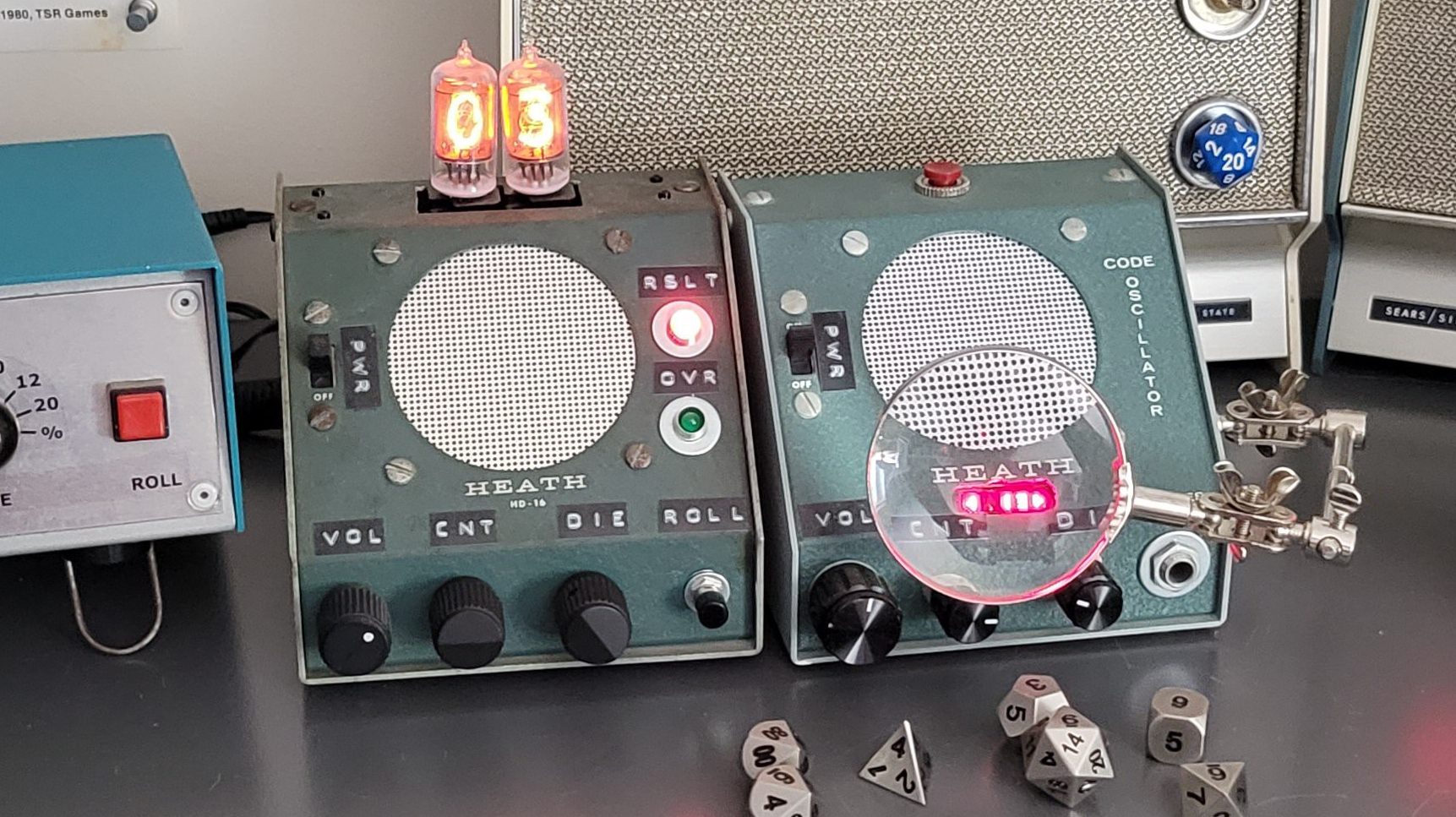
Some projects whisper, “I solved a practical problem.” Others burst through the door wearing a wizard hat, carrying a soldering iron, and asking whether anyone has seen a spare d20. Hackaday Prize 2022: Digital Dice Towers Built In Beautiful Retro Cases belongs proudly in the second category.
At first glance, John Anderson’s digital dice towers look like lovingly preserved pieces of mid-century test gear: Heathkit cases, old digital multimeter enclosures, tabletop radio shells, Nixie tubes, chunky rotary switches, thumbwheel selectors, and enough retro charm to make a basement workbench smell faintly of warm dust and ambition. But under those beautiful vintage cases lives a modern purpose. These machines roll dice for tabletop role-playing games like Dungeons & Dragons, display or speak the result, and make the act of rolling feel like operating equipment from a secret fantasy laboratory.
The result is part open-source hardware, part accessibility tool, part nostalgia machine, and part “why didn’t my Dungeon Master have one of these in 1982?” It is also a perfect example of the spirit behind the 2022 Hackaday Prize: reuse, repair, revamp, and turn old technology into something useful, delightful, and slightly magical.
What Is a Digital Dice Tower?
A traditional dice tower is a physical tabletop accessory. You drop dice into the top, they tumble through internal baffles, and they roll out the bottom with less chaos than a full-arm barbarian throw across the snack table. A digital dice tower keeps the idea of generating a random result but replaces tumbling plastic with electronics, code, switches, displays, and sometimes audio output.
In Anderson’s builds, the user selects how many dice to roll, chooses the die type, and presses a button. The microcontroller then generates the result and presents it through period-appropriate displays or speech. That means a player can roll a d4, d6, d8, d10, d12, d20, or even d100 without grabbing a fistful of polyhedral dice. For D&D players, that is a practical feature. For electronics fans, it is an excuse to make Nixie tubes and 1970s-style switches do something wonderfully unnecessaryand therefore necessary.
The Hackaday Prize 2022 Connection
The 2022 Hackaday Prize was built around big themes: sustainability, resiliency, and circularity. Instead of treating obsolete hardware as junk, the competition encouraged makers to rethink what old devices could become. One of the challenges, “Hack It Back,” focused especially on bringing old technology back to life in new forms.
Anderson’s Resto-Mod Audible Digital Dice Towers fit that idea beautifully. The project was not about hiding a modern gadget in a random box. It was about respecting the original character of vintage equipment while giving it a fresh job. A Heathkit code oscillator still looks like a Heathkit code oscillator. A Bell & Howell multimeter still carries the industrial personality of old educational lab gear. But now these boxes can help a paladin smite, a rogue sneak, or a wizard accidentally set everything on fire.
That is the magic of a good resto-mod. It does not erase history; it gives history a new reason to sit on the table.
Why Retro Cases Make the Project So Good
Modern electronics projects can be compact, efficient, and tidy. They can also look like a tiny circuit board trapped in a plastic lunch container. Retro equipment, by contrast, often arrives with personality already installed.
Old Heathkit, Bell & Howell, Sears Silvertone, and similar cases have strong visual identities. They use metal panels, textured paint, large knobs, readable labels, mechanical switches, and proportions designed for human hands rather than touchscreen swipes. Their controls invite interaction. Turning a rotary selector feels intentional. Pressing a panel-mounted button feels dramatic. Watching digits glow on a vintage display makes even a low roll look important.
Anderson’s builds use that design language to make dice rolling feel like an event. In a tabletop role-playing game, that matters. Rolling a d20 is not just math. It is suspense. It is the breathless second before a door opens, a trap springs, or the bard tries to negotiate with something that has too many teeth. A digital dice tower wrapped in retro hardware amplifies that moment.
The Electronics Inside: Old Soul, Modern Brain
The heart of these digital dice towers is modern embedded hardware, particularly AVR microcontrollers. AVR chips are popular in hobbyist and educational electronics because they are approachable, capable, and well-supported. They are also a great match for a project that needs simple inputs, predictable outputs, and reliable behavior.
Inside the towers, the microcontroller handles the dice logic. The user’s input comes from vintage-style controls such as thumbwheel switches, rotary switches, rotary encoders, or buttons. The output may appear on Nixie tubes, seven-segment LED displays, bubble LED displays, or through spoken audio depending on the build.
That pairing is clever. Vintage displays and switches provide the tactile and visual drama; the microcontroller quietly does the computation. It is like hiring a modern accountant to work inside a 1970s science-fiction control panel.
Pseudorandom Dice Rolls
Digital dice need random numbers. In Anderson’s approach, the device uses a pseudorandom number generator seeded by timing-related data such as chip uptime. For casual tabletop gaming, this is a practical and entertaining method. The machine does not need casino-grade cryptographic randomness to decide whether your ranger hits a goblin. It needs results that feel fair, fast, and varied during play.
The device can emulate common polyhedral dice and roll multiple dice at once. That is especially useful in D&D, where a single turn might involve attack rolls, damage dice, spell effects, saving throws, and enough modifiers to make everyone at the table briefly become a tax professional.
Displays With Character
One of the most eye-catching elements of these builds is the use of old display technology. Nixie tubes, for example, are gas-discharge numeric displays famous for their warm orange glow. They were once common in technical equipment such as voltmeters, frequency counters, and early digital instruments. Today, they are beloved by retro electronics fans because they look like numbers summoned by electricity and nostalgia.
Seven-segment LED displays and bubble displays bring a slightly different flavor. They evoke calculators, early digital watches, test equipment, and laboratory devices. When used in a dice tower, they make the result feel official, as though your critical failure has been certified by a government agency.
Accessibility: The Most Meaningful Feature
One of the strongest aspects of the project is its accessibility angle. Anderson noted that some versions were built for visually impaired tabletop players. In those builds, the device can speak the dice results, allowing players to roll independently without needing another person to read the number.
That detail transforms the project from “cool retro gadget” into something much more important. Tabletop gaming is social. It is about agency, participation, and being part of the story. When a player can control their own dice rolls and hear their own results, the game becomes more independent and inclusive.
Good maker projects often begin with curiosity, but the best ones discover a human use along the way. The audible dice tower does exactly that. It keeps the fun, keeps the style, and adds real value for players who benefit from spoken feedback.
Why This Project Resonates With Makers
The popularity of projects like this comes from several overlapping pleasures. First, there is the joy of reuse. Old electronics are full of useful parts: cases, speakers, transformers, switches, knobs, displays, wiring harnesses, and mechanical structures. Even when the original device is no longer needed, its physical design can still be excellent.
Second, there is the pleasure of reverse engineering. To repurpose vintage hardware, a maker must understand what can be preserved, what must be replaced, and how old parts can safely interface with new electronics. That process teaches practical skills that a fresh-from-the-box development kit rarely provides.
Third, there is aesthetic satisfaction. A digital dice tower could be made with a modern OLED screen and a 3D-printed case. It would work. But placing the same function inside a 1970s multimeter case gives the object a story. It feels discovered rather than manufactured.
The Dungeons & Dragons Factor
Dungeons & Dragons has always depended on dice. The d20 is central to many checks and attacks, while other dice determine damage, healing, random effects, and tables. The physical act of rolling dice is part of the ritual. Players develop favorite dice, suspicious dice, dice jail, dice superstition, and occasionally dice-based betrayal.
So why replace dice with a digital tower? The point is not replacement for everyone. It is enhancement. A digital dice tower can speed up complicated rolls, support players who need audio output, reduce clutter, and add theatrical flair. It also works beautifully as a themed table prop. For a retro-futuristic campaign, a dungeon-crawler game, or a cyberpunk fantasy setting, a glowing digital dice tower looks right at home.
Imagine a party exploring an ancient machine temple. Instead of rolling a handful of dice, the Dungeon Master presses a large red button on a restored lab instrument. The numbers glow. The speaker announces the result. Everyone leans in. That is not just a roll; that is stagecraft.
Beautiful Examples From the Builds
The Bell & Howell IMD-202 digital multimeter build is one of the standout examples. It reuses a vintage multimeter case and Nixie display elements, then adds new dice-selecting controls and a modern controller board. The finished object looks like it belongs on the bench of an engineer who moonlights as a dungeon cartographer.
Other versions use Heathkit cases, including code oscillator-style enclosures, as well as tabletop radio cases from the 1960s and 1970s. These builds take advantage of original speakers, knobs, and panel layouts. In some cases, the original purpose of the device becomes part of the joke. A code oscillator becomes a fantasy randomizer. A radio case becomes a talking dice oracle. A multimeter becomes a machine for measuring the voltage of fate.
That playful transformation is the project’s signature. It does not merely install electronics into old shells; it reimagines what those shells want to be.
Lessons for DIY Electronics Fans
For makers, this project offers several useful lessons. The first is to design around the enclosure. Many beginners build the circuit first and worry about the case later. Resto-mod work flips that process. The enclosure sets the constraints: available space, mounting points, control positions, display windows, speaker openings, and power options. Those constraints make the final design more cohesive.
The second lesson is to keep the interface simple. The dice towers do not need a menu maze. They need a clear way to select number of dice, choose die type, and roll. That is exactly the kind of task vintage switches handle beautifully.
The third lesson is that polish matters. Custom faceplates, labels, careful wiring, thoughtful display placement, and period-appropriate parts make the difference between “electronics stuffed in a box” and “artifact from an alternate timeline.”
Safety and Practical Considerations
Working with vintage electronics can be rewarding, but it requires care. Old devices may contain high-voltage supplies, aging capacitors, brittle insulation, and unknown modifications. Nixie tube projects, in particular, can involve voltages far higher than typical five-volt microcontroller circuits. Anyone attempting a similar build should understand the original device, test safely, discharge capacitors, and avoid treating old power supplies like harmless decoration.
There is also the preservation question. Not every vintage device should be modified. Rare, historically important, or fully working equipment may deserve restoration rather than conversion. But damaged, incomplete, common, or otherwise neglected hardware can be excellent material for creative reuse. The best projects respect the object while giving it a new life.
Why the Project Feels So Hackaday
Hackaday culture loves projects that combine technical skill with personality. The digital dice towers hit that sweet spot. They include microcontrollers, hand-wired boards, reused cases, vintage displays, accessibility, gaming culture, and a strong visual identity. They are useful, but not boring. They are whimsical, but not careless. They are deeply nerdy in the best possible way.
This is why the project stood out during the Hackaday Prize 2022 cycle. It showed how obsolete technology can become playful and relevant without losing its old-world charm. It also proved that sustainability does not have to look like a beige spreadsheet. Sometimes sustainability glows orange, speaks dice results, and looks ready to open a portal beneath the gaming table.
Experiences Related to Digital Dice Towers in Retro Cases
Anyone who has spent time around tabletop gaming knows that dice are never just dice. They are tiny drama engines. A plastic d20 can turn a confident plan into a comedy disaster in one bounce. Now imagine moving that emotional moment into a retro electronic case with a glowing display and a decisive button. The experience changes immediately.
At the table, a digital dice tower can become a shared ritual. Players gather around it the way people once gathered around radios. The person rolling selects the number of dice, chooses the die type, pauses for flair, and presses the button. That pause matters. It creates anticipation. The device turns probability into performance.
For a Dungeon Master, this kind of build can also become a storytelling prop. A retro dice tower fits naturally into campaigns with ancient machinery, wizard laboratories, crashed starships, artificer guilds, or post-apocalyptic bunkers. Instead of saying, “Roll for the machine,” the DM can physically operate the machine. The prop becomes part of the fiction. Players remember that.
There is also a personal maker experience hidden in projects like this. Building inside an old case forces patience. You cannot simply drag a rectangle in CAD and print a new enclosure when a screw post is inconvenient. You measure, test, adapt, and sometimes stare at the inside of a vintage radio shell while muttering like a gnome with a deadline. That challenge is frustrating, but it also creates better design decisions. The object pushes back, and the maker responds.
Another satisfying experience is preserving tactile interaction. Modern devices often hide their workings behind glass screens. Retro hardware does the opposite. It exposes switches, labels, screws, lamps, bezels, and mechanical decisions. When repurposed into a dice tower, those parts make the player feel connected to the machine. Turning a knob to choose a d20 feels more deliberate than tapping a phone screen. A physical roll button feels like launching a tiny mission.
The accessibility experience may be the most meaningful of all. A speaking dice tower gives visually impaired players a more independent way to participate. That may sound like a small feature to someone who can easily read dice, but at a gaming table, independence matters. It means the player controls the roll, hears the result, and stays fully inside the moment without needing someone else to interpret the outcome. In a hobby built on imagination and shared agency, that is powerful.
Finally, these projects remind us that technology does not have to be disposable. An old multimeter, radio, or code oscillator may no longer serve its original purpose, but it still contains design value. Its case still has presence. Its controls still feel good. Its display still makes people smile. The digital dice tower experience is really the experience of seeing potential where others see clutter. That is the maker mindset at its best: a little practical, a little sentimental, and always one button away from adventure.
Conclusion
Hackaday Prize 2022: Digital Dice Towers Built In Beautiful Retro Cases is more than a clever electronics project. It is a love letter to Dungeons & Dragons, vintage test equipment, accessible gaming, and the maker tradition of turning yesterday’s hardware into tomorrow’s conversation piece.
John Anderson’s work shows how old cases, classic switches, Nixie tubes, LED displays, AVR microcontrollers, and thoughtful design can come together in a way that feels both useful and enchanted. The project rolls dice, yesbut it also rolls together sustainability, nostalgia, engineering, and play.
In a world where many devices are sealed, disposable, and visually bland, these digital dice towers remind us that hardware can have character. It can be repaired, reused, modified, and made joyful again. And if it can help a wizard cast Fireball with a glowing retro display, all the better.
Note: This article was written for web publication in standard American English and is based on verified public information about the Hackaday Prize 2022, John Anderson’s Resto-Mod Audible Digital Dice Towers, Dungeons & Dragons dice mechanics, AVR microcontrollers, vintage display technology, and retro electronics reuse.