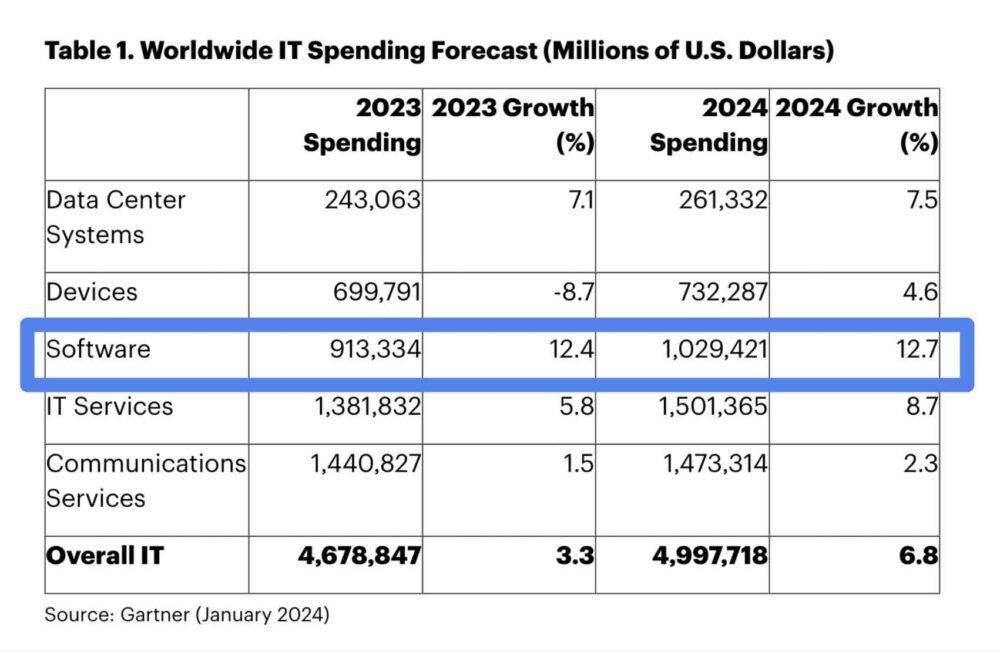
Software vendors entered 2024 with two apparently conflicting messages. The first was that buyers were tired, budgets were being examined with a flashlight, and every new contract needed to arrive carrying a believable return-on-investment story. The second was that worldwide software spending was still expected to cross $1 trillion for the first time.
That is not a contradiction. It is the central business story of enterprise technology in 2024: the market grew, but growth became harder to win. Money continued flowing into cloud platforms, cybersecurity, data tools, automation, and AI-enabled products. At the same time, CIOs delayed projects, consolidated vendors, demanded faster payback, and favored suppliers they already trusted. The pie became enormous. Getting a slice of it still required elbows.
The $1 Trillion Milestone Was RealEven as Forecasts Moved
Gartner’s October 2023 forecast projected worldwide software spending of roughly $1.04 trillion in 2024, up 13.8% from 2023. That headline was extraordinary. Software was no longer merely one large category inside information technology; it was becoming an economy-sized market of its own.
Then reality began doing what reality enjoys most: editing the spreadsheet. In January 2024, Gartner lowered its forecast for overall IT spending growth from 8% to 6.8%. The software outlook also softened slightly, though it still remained above $1 trillion. By April, Gartner had raised the overall forecast again, and by July it projected approximately $1.10 trillion in software spending for the year, representing 12.6% growth.
The quarterly revisions matter because they show why a single forecast should not be treated like a stone tablet. Exchange rates, vendor pricing, cloud consumption, device demand, consulting backlogs, and the speed of AI infrastructure investment all moved during the year. The exact growth rate changed. The larger direction did not: software remained one of the fastest-growing major IT categories.
Why 2024 Felt Tougher Than the Top-Line Number Suggested
Change Fatigue Slowed New Projects
Gartner repeatedly highlighted “change fatigue” among CIOs and technology teams. After years of emergency digitization, cloud migrations, security upgrades, remote-work rollouts, and restructuring, many organizations were not eager to adopt one more platform with a cheerful onboarding deck and 47 mandatory workshops.
That fatigue did not eliminate spending. It changed its destination. Buyers leaned toward projects that reduced costs, improved efficiency, automated labor-intensive work, or addressed unavoidable risks. Experimental initiatives with vague benefits faced more resistance, while mission-critical renewals and modernization projects were more likely to survive.
Higher Prices Absorbed Part of the Growth
A rising market does not automatically mean customers bought dramatically more software. Gartner noted that cloud price increases and greater use of existing services contributed materially to spending growth. In other words, part of the trillion-dollar milestone came from customers consuming more, and part came from the same technology becoming more expensive.
That distinction matters for vendors. If market growth is partly price-driven, a startup cannot simply point to a double-digit category forecast and assume double-digit demand for every new product. Buyers may already be spending their incremental dollars on contract uplifts, usage charges, premium security features, and AI add-ons from established suppliers.
Procurement Became More Selective
Public company results throughout 2024 showed a divided environment. Large cloud providers continued reporting strong demand, particularly around infrastructure and AI. Yet companies such as Salesforce discussed intense budget scrutiny and longer deal cycles, while IBM saw pressure in discretionary consulting even as its software business performed better.
This was a “yes, but” market. Yes, enterprises were spending. But they wanted fewer overlapping tools, stronger security, easier integration, and proof that a purchase would produce measurable value. The novelty premium shrank. Nobody wanted to buy another dashboard merely because it had a tasteful gradient.
Where the Software Money Actually Went
Public Cloud and SaaS Kept Expanding
Gartner expected public cloud end-user spending to grow more than 20% in 2024. Forrester separately predicted that SaaS would account for the majority of new enterprise software purchases as late adopters in areas such as ERP and supply chain management continued moving away from on-premises systems.
The appeal was practical. Cloud software can be deployed faster, updated continuously, and connected across distributed teams. It also turns capital purchases into recurring operating expenses, which can simplify adoption. Of course, “simple” is doing some heroic work there. Flexera’s 2024 cloud research found that managing cloud spending remained a leading challenge, reinforcing the need for FinOps, usage controls, and better cost visibility.
Cybersecurity Stayed Close to Nonnegotiable
Security spending remained resilient because the alternative was not “save money”; it was “accept more risk and hope nobody notices.” Gartner’s forecasts placed 2024 global information security spending well above $180 billion. IBM’s research also found that the average cost of a data breach reached a record level, strengthening the business case for identity, endpoint protection, data security, compliance, and incident response tools.
Okta’s app-usage research similarly showed continued interest in security and compliance products. When boards, insurers, regulators, customers, and attackers are all asking questions at once, the security budget tends to find a chair at the meeting.
AI Spending Arrived Through Existing Platforms
Generative AI dominated technology conversations in 2024, but the spending pattern was more complicated than a sudden corporate stampede toward standalone AI products. Gartner initially argued that GenAI would not materially change total IT spending in the near term. Instead, organizations would spend 2024 planning, preparing data, modernizing infrastructure, and testing use cases.
That is largely what happened. Microsoft, Amazon Web Services, and Google Cloud reported strong cloud demand associated with AI workloads. McKinsey found that regular organizational use of generative AI rose sharply, especially in marketing, sales, product development, service operations, and IT. Yet much of the money flowed through cloud consumption, model access, productivity suites, data platforms, and AI features attached to products enterprises already owned.
For software vendors, this created both an opportunity and a bill. Gartner described GenAI as resembling a “tax” for some providers because revenue from AI add-ons could flow back to model and infrastructure partners. Adding AI was not free, even when the marketing page made it look suspiciously effortless.
What the Forecast Meant for Software Vendors
The trillion-dollar market was encouraging, but it did not rescue weak positioning. Vendors still needed to answer four questions clearly: Why this product? Why now? Why not an existing platform? How quickly will the customer see value?
Incumbents held an advantage because they already had contracts, data integrations, security reviews, and executive relationships in place. A new vendor asking for budget was also asking the buyer to accept implementation risk, procurement work, and another renewal date. That meant challengers had to offer a meaningful improvement rather than a slightly nicer version of something the customer already owned.
Winning vendors tended to connect their products to urgent outcomes: lowering cloud waste, protecting sensitive data, automating expensive workflows, improving revenue operations, or consolidating multiple tools. They also reduced adoption friction through transparent pricing, shorter implementation timelines, strong integrations, and focused pilots.
The biggest mistake was confusing category growth with easy selling. A market can expand by $100 billion while thousands of individual vendors struggle. Growth pools concentrate around specific problems, platforms, and suppliers. The job is to find the pool, not to stand in the parking lot celebrating that water exists.
What CIOs and Buyers Could Learn
For technology buyers, the 2024 forecast was a reminder that “spending more” and “getting more value” are not synonyms. A disciplined software strategy required visibility into licenses, usage, renewal dates, integrations, data access, and business outcomes.
Organizations benefited from grouping software into three buckets: systems that run the business, tools that reduce measurable cost or risk, and experiments that may create future value. Each bucket deserved a different approval standard. A payroll system cannot be evaluated like an AI writing pilot, and an AI writing pilot should not receive a seven-year contract because someone used the phrase “strategic transformation” twice.
Buyers also needed to model total cost, not only subscription price. Implementation, migration, training, security controls, data preparation, premium support, API usage, and AI tokens could materially change the economics. The strongest business cases included a baseline, a target outcome, an accountable owner, and a date when the organization would decide whether the investment was working.
Experience-Based Field Notes: What a 2024 Software Budget Review Looked Like
The most useful way to understand the “tough market, record spending” paradox is to imagine a realistic midyear software review at a growing company. This is a composite scenario based on common enterprise buying patterns rather than a claim about one specific organization.
The company begins with a familiar problem: software expenses have risen faster than revenue. No single purchase looks outrageous. The trouble is accumulation. There are two project-management platforms, three analytics tools, several security products with overlapping features, dozens of small departmental subscriptions, and a cloud bill that behaves like it has recently discovered espresso.
The CIO, CFO, security leader, and department heads meet to review the portfolio. The first surprise is that nobody owns the complete inventory. Finance sees invoices. IT sees core systems. Security sees approved applications. Department managers see tools charged to their budgets. Shadow software sits between all four views, waving politely.
The team does not freeze spending. Instead, it becomes more deliberate. The identity platform is renewed because it supports access controls and compliance. The cloud data warehouse is expanded because product and finance teams depend on it. A security monitoring contract is upgraded after a risk assessment. Those purchases contribute to market growth even though the company describes its budget as “tight.”
At the same time, a proposed standalone AI assistant is postponed. The organization already receives similar capabilities through its productivity suite, and the new vendor cannot demonstrate enough incremental value. A customer-success tool is consolidated into the CRM platform. An underused analytics subscription is cut after usage data shows that only eight employees logged in during the previous quarterthree of them apparently by accident.
The company then approves two focused pilots. One uses generative AI to summarize support cases and suggest replies. The other automates invoice classification. Each pilot has a narrow scope, a business owner, a security review, and a 90-day measurement period. Success is defined in operational terms: reduced handling time, fewer manual corrections, and higher throughput without additional headcount.
This experience reveals why software spending could cross $1 trillion while many sales teams still felt as though they were pushing a sofa up a staircase. Customers were not abandoning technology. They were reallocating money toward tools with stronger proof, lower deployment risk, and closer ties to existing platforms. A canceled niche subscription could be replaced by a larger cloud commitment, an identity upgrade, and an AI feature attached to a suite contract.
For vendors, the lesson is to make purchasing easier to defend internally. Provide a credible implementation plan. Show the baseline cost of the current process. Explain which existing tools can be retired. Offer usage reporting. Put security documentation within reach of an actual human. Most importantly, define value in the customer’s language, not in a fog bank of “reimagining,” “unlocking,” and “next-generation synergy.”
For buyers, the lesson is equally practical: optimization should not mean indiscriminate cutting. Removing a lightly used tool may save money, but underinvesting in security, data quality, or core modernization can create larger costs later. The goal is not the smallest software bill. It is the highest return from a controlled, understandable portfolio.
Conclusion: A Bigger Market With a Higher Bar
Gartner’s 2024 software spending outlook captured a durable shift. Software became more central to how organizations operate, compete, secure data, serve customers, and build AI capabilities. That structural demand was strong enough to push worldwide spending beyond $1 trillion even amid economic uncertainty and cautious procurement.
But the milestone did not mean easy growth for every vendor. Buyers consolidated products, extended decision cycles, prioritized incumbents, and demanded measurable outcomes. The winners were not simply companies selling software. They were companies making a credible case that their software deserved to survive the budget meeting.