An English roll arm leather chair has a rare talent: it can look as though it belongs in a centuries-old country library while remaining perfectly comfortable beside a modern glass coffee table. It is traditional without being stuffy, luxurious without requiring a velvet rope, and relaxed enough to survive actual daily life.
The recognizable silhouette combines low, rounded arms, a generous seat, restrained tailoring, and exposed or partially exposed legs. Add leather, and the chair gains warmth, texture, durability, and the potential to develop a handsome patina. In other words, it is the furniture equivalent of a well-made leather jacketonly considerably harder to hang in a closet.
This guide explains what defines an English roll arm leather chair, how to evaluate its construction, which leather finish suits your lifestyle, how to style it, and what ownership is really like after the showroom lighting is gone.
What Is an English Roll Arm Leather Chair?
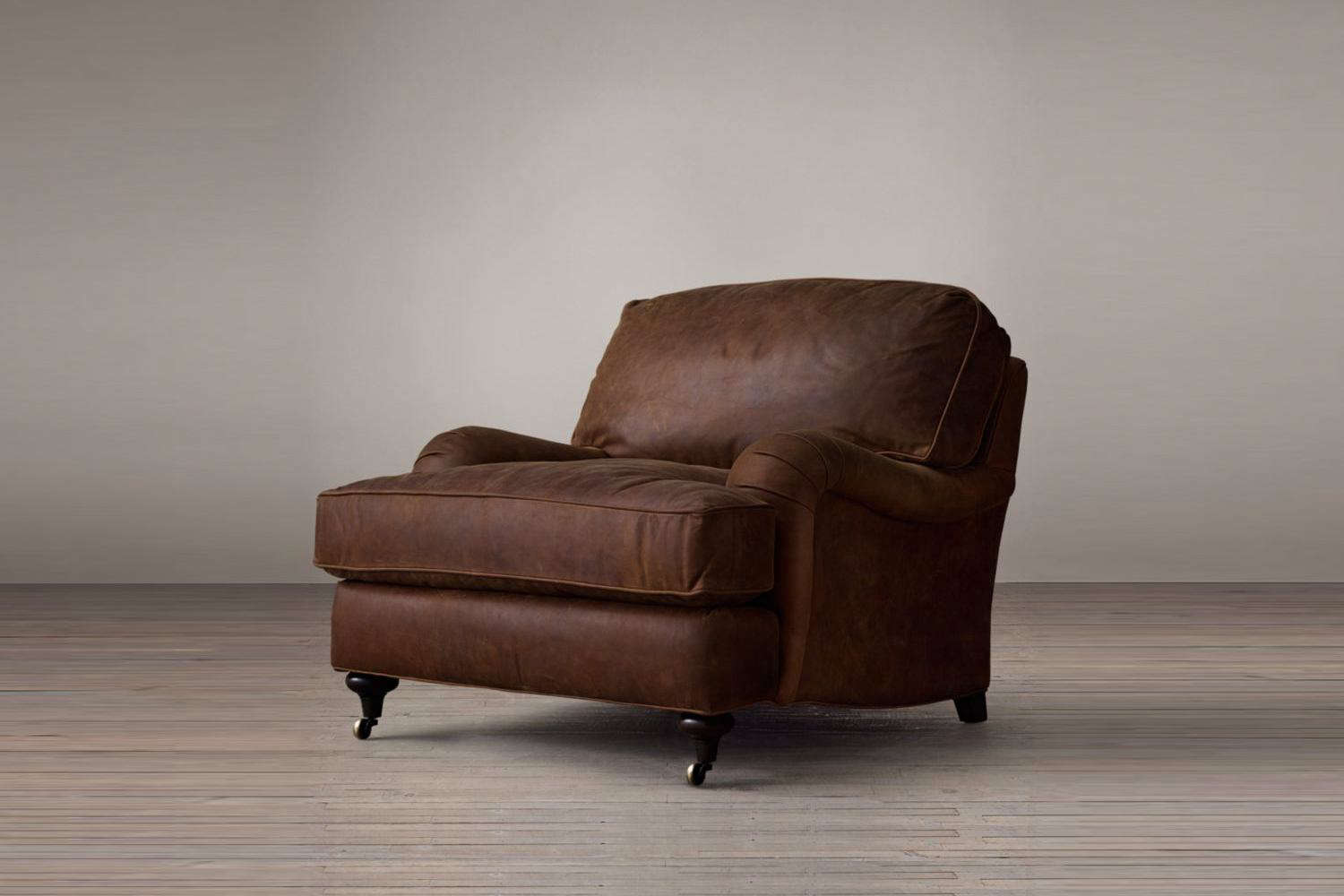
An English roll arm chair is an upholstered lounge chair inspired by classic British seating. Its defining features generally include rounded arms that curve outward, an arm front set slightly behind the front edge of the seat, a relatively deep cushion, and a tailored back. The setback arms give the chair a lighter, more compact appearance than bulky conventional roll-arm furniture. Architectural Digest describes the related English roll arm sofa as a style associated with British country houses, commonly featuring outward-curving arms, a tight back, and a compact silhouette.
The design should not be confused with a Chesterfield chair. A Chesterfield typically has arms that rise to approximately the same height as the back, along with deep button tufting and a more formal, architectural presence. An English roll arm chair usually feels softer, lower, and less ceremonial. It looks prepared to discuss literature, but it will not insist that you address it as “Sir.”
Modern versions vary considerably. RH describes its English Roll Arm Leather Chair as having setback rounded arms, an angled back, and large loose cushions for a relaxed feel. Ethan Allen interprets the style with loose welted cushions over a hardwood frame, describing it as a contemporary update of antique British furniture.
The Signature Design Details
Low, Rounded Arms
The arms are the headline feature. Rather than forming a tall cylinder or an oversized scroll, a proper English arm curves gently outward and rolls discreetly at the top. It should provide a comfortable place for an elbow without consuming half the room.
A Setback Arm Position
The front of each arm often ends behind the leading edge of the seat cushion. This exposes the corners of the cushion and creates the familiar T-shaped seat. The arrangement makes the chair appear more open and can provide a little extra space for shifting positions.
Loose or Tailored Cushions
Traditional interpretations may use a tight back, while more relaxed versions have a loose back cushion. Loose cushions look casual and can be rotated or fluffed. Tight backs retain a cleaner outline and require less rearranging. Neither option is automatically better; the correct choice depends on whether you prefer sink-in softness or orderly support.
Visible Legs and Optional Casters
Tapered, turned, or block-style wooden legs keep the chair visually elevated. Some traditional models add small front casters, a historic-looking detail that also makes a heavy chair easier to reposition. Just remember that “easier” is relative. A full-size leather chair is still unlikely to glide across the room like a shopping cart.
A Deep but Controlled Seat
English roll arm seating is commonly associated with a generous seat and a relaxed posture. According to 1stDibs, the style is recognizable by its deep seat, tight untufted back, and rolled arms. A chair version should preserve that inviting character without becoming so deep that shorter users need a search party to locate the floor.
Why Leather Works So Well on This Chair
Leather emphasizes every curve in the silhouette. It stretches smoothly over the rounded arms, highlights welted seams, and develops subtle tonal changes where hands and clothing repeatedly touch the surface. High-quality leather can soften and gain character with use rather than merely looking worn.
Pottery Barn notes that the aniline-dyed top-grain leather on one of its roll-arm chairs naturally softens, lightens, and develops a richer patina over time. It also explains that variations in grain, tone, and texture are inherent because every hide is different. These variations are usually a feature rather than a defect. Perfectly uniform leather may be practical, but natural markings give a chair individuality.
Leather also has useful functional qualities. It does not trap loose pet hair as aggressively as many woven fabrics, and minor crumbs are easier to see and remove. Spills may be manageable when blotted promptly, although leather is not invincible. Red wine still believes in consequences.
Understanding Leather Types and Finishes
Full-Grain Leather
Full-grain leather retains the natural outer surface of the hide. It may show healed scratches, growth marks, grain variations, and tonal differences. It is valued for durability and character, but it is generally more sensitive to spills, sunlight, and careless cleaning than heavily protected leather.
Top-Grain Leather
Top-grain leather is also made from the upper portion of the hide, although the surface may be lightly corrected for a more consistent appearance. It is widely used for quality upholstered furniture because it can balance softness, strength, and visual uniformity. Both Pottery Barn and Room & Board offer chairs using top-grain leather, illustrating how common the material is in better-quality seating.
Aniline Leather
Aniline leather receives transparent dye that allows the natural grain to remain visible. It usually feels soft and luxurious and develops a pronounced patina. The tradeoff is lower resistance to staining and fading. It is ideal for owners who welcome natural aging and do not panic at the first tiny mark.
Semi-Aniline Leather
Semi-aniline leather adds a light protective finish while preserving much of the hide’s natural appearance. Room & Board, for example, identifies a semi-aniline top-grain option on its rolled-arm Louise chair and describes it as suitable for family and pet use. This category is often the practical middle ground for people who want real leather character with improved everyday resistance.
Protected or Pigmented Leather
Protected leather has a more substantial surface coating. It is usually easier to clean, more consistent in color, and better suited to busy households. It may not feel as buttery or develop as dramatic a patina, but it can be the smarter option when children, pets, snacks, and reality all occupy the same room.
How to Judge Construction Quality
The leather may receive all the compliments, but the frame and suspension do the heavy lifting. A beautiful hide wrapped around a weak frame is simply an expensive future problem.
Examine the Frame
Look for kiln-dried hardwood, engineered hardwood panels used strategically, strong corner blocking, and dependable joinery. Pottery Barn specifies a corner-blocked, kiln-dried hardwood frame with mortise-and-tenon joinery on its Turner chair. Ethan Allen describes a durable hardwood frame with engineered panels on its English-arm model.
Press firmly against the arms in a showroom. They should feel secure, not wobbly. The Spruce recommends checking that upholstered furniture arms are tight and that the frame uses sound joining methods rather than relying only on staples, nails, or glue.
Check the Suspension
Common suspension systems include sinuous steel springs, webbing, coil systems, and eight-way hand-tied springs. Well-designed examples of each can provide good support. Pottery Barn uses no-sag sinuous springs in one leather roll-arm chair, while Room & Board specifies a bench-made hardwood frame with webbing suspension for its more upright rolled-arm design. Stickley uses a proprietary coil system in its customizable English-arm chair.
Evaluate the Cushion
A high-resiliency foam core offers shape retention and support. Fiber or down wrapping adds softness. A down-heavy cushion can feel wonderfully plush but requires more fluffing. A firm foam cushion is tidier and easier to rise from, although it may feel less cloud-like.
Consumer Reports identifies a kiln-dried hardwood frame and strong spring construction as quality indicators and notes that foam cores wrapped in down or synthetic down can combine support with softness. The best cushion is ultimately the one that returns to shape, supports your preferred posture, and does not require a wrestling match every evening.
Measure Before You Buy
English roll arm chairs can range from relatively trim accent chairs to chair-and-a-half models large enough to host one adult, one child, and a dog who insists it was there first.
Record the overall width, depth, height, inside seat width, seat depth, seat height, arm height, and diagonal depth. For context, current retail examples vary dramatically: Room & Board lists one tailored rolled-arm chair at 29.5 inches wide and 33 inches deep, while Pottery Barn offers roll-arm configurations reaching approximately 48 inches wide and 43.5 inches deep.
Measure doorways, stairwells, elevators, hallways, and sharp turns. Bassett specifically advises buyers to check the complete delivery path, not just the final room. A chair that fits beautifully on a floor plan but cannot pass the entryway becomes a very elegant porch decoration.
For comfort, compare your body to the seat dimensions. Shorter users often prefer a seat depth near 20 to 22 inches. Taller users or enthusiastic loungers may appreciate deeper seating. A seat height around 18 to 20 inches is common, but personal mobility matters more than averages.
How to Style an English Roll Arm Leather Chair
Create a Classic Reading Corner
Place the chair beside a bookcase, an adjustable floor lamp, and a compact side table. Add a wool rug and a linen or cashmere throw. The result feels collected and inviting without needing to install a secret passage behind the bookshelf.
Use It as a Transitional Anchor
The chair’s traditional curves pair well with modern elements. Try a cognac leather chair beside a pale oak table, an abstract print, and a simple black floor lamp. Bassett emphasizes that customizable roll-arm chairs can work across classic, transitional, and modern interiors.
Balance Dark Leather With Lighter Textures
Dark brown or black leather can feel visually heavy. Better Homes & Gardens recommends balancing traditional dark leather with cream, pastel, or white textiles and lighter rugs. It also suggests using a leather accent chair rather than a matching leather suite to create a more collected room.
Treat Brown Leather as a Neutral
Brown leather works with more than plaid, antlers, and fictional detectives. It can ground jewel tones, warm whites, navy, olive, rust, dusty blue, and soft pink. Better Homes & Gardens notes that dark leather can complement styles ranging from dark academia to contemporary farmhouse and midcentury-inspired rooms.
Choose a Timeless Base
House Beautiful’s sofa-buying guidance recommends classic silhouettes and neutral palettes for long-term versatility, specifically citing the English roll arm as a timeless form. In leather, cognac, tobacco, saddle brown, oxblood, charcoal, and black are reliable choices. Green, navy, or burgundy can be equally enduring when they suit the broader palette of the home.
Leather Chair Care and Maintenance
Begin with the manufacturer’s care label. Leather finishes differ, and a cleaner that behaves perfectly on protected leather may stain or darken an unprotected hide.
Dust and Vacuum Regularly
Use a soft, dry cloth to remove surface dust. Vacuum seams, cushion edges, and the gap beneath removable cushions with a soft upholstery attachment. American Leather states that routine dry-cloth dusting and vacuuming in crevices are generally sufficient under normal conditions.
Respond Quickly to Spills
Blot liquid with a clean absorbent cloth instead of rubbing it deeper into the surface. Use distilled water only when permitted by the care instructions, and allow the leather to dry naturally. Avoid hair dryers, which can accelerate drying and damage the finish.
Avoid Household Cleaning Experiments
Saddle soap, ammonia, solvent cleaners, detergent, furniture polish, and random oils can discolor or degrade furniture leather. Pottery Barn, Bassett, and American Leather all warn against aggressive or inappropriate products.
Protect It From Sunlight and Heat
Strong sunlight can fade leather, while nearby heating vents may dry it unevenly. Bassett recommends using window treatments to reduce sunlight exposure and keeping leather away from heating and air outlets when possible.
Test Every Product First
Apply any approved cleaner or conditioner to a hidden area before treating the visible surface. Stickley cautions that leather-care products are not universal and that a product suitable for one hide may damage another.
Common Buying Mistakes
- Choosing by appearance alone: A gorgeous chair with the wrong seat depth will become expensive sculpture.
- Ignoring the leather finish: Delicate aniline leather may not suit a household where grape juice travels independently.
- Forgetting the delivery route: Measure every doorway, landing, stair turn, and elevator.
- Assuming softer is always better: Extremely plush cushions may require frequent fluffing and can be difficult for some people to rise from.
- Buying a complete matching set: One leather chair often adds more personality than a room filled with identical leather furniture.
- Expecting natural leather to remain unchanged: Patina, wrinkles, and tonal variation are part of the material’s appeal.
Is an English Roll Arm Leather Chair Worth It?
It is worth considering when you want a chair that combines recognizable design, long-term decorating flexibility, and substantial comfort. The silhouette is sufficiently classic to outlast short-lived trends, yet simple enough to coexist with modern furniture.
The strongest value comes from buying the construction rather than merely buying the look. Prioritize a stable hardwood-based frame, a proven suspension system, resilient cushions, appropriate leather, replaceable components when available, and dimensions that genuinely suit the user.
A quality English roll arm leather chair may cost more than a generic accent chair, but it can also serve more purposes. It can anchor a reading corner, soften a modern living room, add authority to an office, or become the seat that every guest silently claims within five minutes of arriving.
Living With an English Roll Arm Leather Chair: A Practical Ownership Experience
The first thing many owners notice is that the chair looks more formal than it feels. In photographs, the rolled arms, wooden legs, and tailored leather may suggest a chair designed for sitting upright while discussing estate planning. In actual use, the deep cushion and gently angled back usually make it an easy place to relax with a book, laptop, or mug of coffee.
During the first few weeks, new leather may feel firmer and cooler than expected. The cushions have not yet softened, the surface has not adjusted to regular use, and the chair may seem almost too pristine. This stage passes. The seat gradually conforms to common sitting positions, while the leather becomes more supple where it bends around the cushion and arms.
The rolled arms quickly prove useful. They are low enough for a natural elbow position, and their rounded shape is more comfortable for leaning than a hard track arm. However, the arms also become magnets for repeated contact. Watches, rings, belt hardware, pet claws, and denim rivets can leave marks. On protected leather, many minor marks wipe away or remain barely visible. On aniline leather, they may become permanent members of the chair’s biography.
Loose cushions introduce a small maintenance ritual. Every week or two, the seat may need to be rotated, patted, or fluffed, especially when one person consistently occupies the same corner. Down-wrapped cushions look relaxed and luxurious but tend to display use more openly. Firmer foam-and-fiber cushions require less attention and retain a neater profile.
The chair’s depth also affects daily habits. A deeper model encourages curling up sideways or adding a lumbar pillow. Shorter users may discover that sitting fully against the back leaves their feet hovering above the floor. A small ottoman solves the problem and completes the traditional arrangement, although it also becomes a convenient platform for newspapers, pets, and laundry that was supposedly being folded.
Temperature is another noticeable characteristic. Leather initially feels cool in winter and warm when exposed to direct summer sun. After a few minutes, it usually adjusts to body temperature. Breathable clothing and a lightweight throw make the chair comfortable across seasons, while careful placement away from intense windows reduces both heat and fading.
Styling tends to become easier after the chair arrives. Rich brown leather functions as a grounding neutral, allowing pillows and throws to change with the seasons. Cream linen brightens it in spring, a plaid wool throw adds autumn character, and a deep green pillow turns the chair into the unofficial headquarters of holiday reading.
Cleaning is generally straightforward when approached conservatively. Dust shows along seams and beneath the cushion, but a soft cloth and gentle vacuuming handle most routine care. Spills are more stressful than difficult when blotted immediately. The greatest danger often comes from well-intentioned cleaning experiments involving wipes, polish, oil, or a mysterious internet recipe containing three pantry ingredients and unreasonable confidence.
Over several years, a well-made chair should feel less like a showroom object and more like part of the household. The leather may crease, the color may deepen, and the seat may soften. These changes are not evidence that the chair has failed. They are evidence that it has participated. A quality English roll arm leather chair becomes more attractive when it records life gentlyone reading session, conversation, nap, and unauthorized dog visit at a time.