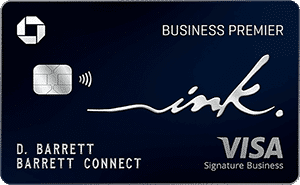
The Chase Ink Business Premier® Credit Card does not pretend to be a cute little starter card for buying printer paper and the occasional team lunch. It is designed for companies that spend serious money, make large purchases, and have enough cash flow to pay most charges in full each month.
Its headline feature is simple: earn unlimited 2% cash back on ordinary business purchases and 2.5% cash back when an individual purchase posts for at least $5,000. Travel booked through Chase Travel earns 5% cash back. The catch is a $195 annual fee, no introductory 0% APR period, and a payment structure that behaves more like a charge card than a conventional revolving credit card.
That combination can be extremely rewarding for a well-established business. For a smaller operation with unpredictable revenue, however, it may feel like hiring a full-time accountant to organize three receipts and a coffee-stained invoice.
Chase Ink Business Premier at a Glance
| Feature | Current Card Terms |
|---|---|
| Annual fee | $195 |
| Welcome offer | $1,000 bonus cash back after spending $10,000 on purchases in the first three months |
| Standard rewards | Unlimited 2% cash back on business purchases |
| Large-purchase rewards | Unlimited 2.5% cash back on individual purchases of $5,000 or more |
| Travel rewards | 5% cash back on travel purchased through Chase Travel |
| Lyft rewards | 5% total cash back on qualifying Lyft purchases through September 30, 2027 |
| Foreign transaction fee | None |
| Introductory APR | None |
| Flex for Business APR | Variable APR, currently listed at 17.74% to 28.49% |
| Employee cards | Available at no additional cost |
Offers, eligibility rules, APRs, and card benefits can change. Applicants should review the issuer’s current pricing and offer details before submitting an application.
How the Cash-Back Program Works
Earn 2% on Everyday Business Spending
The card earns unlimited 2% cash back on most eligible business purchases that do not qualify for a higher rate. There are no rotating categories to activate and no quarterly reward calendars to babysit.
That simplicity matters for businesses whose expenses refuse to fit neatly into traditional bonus categories. A construction company may buy lumber, safety equipment, software, vehicle parts, and industrial coffee in the same week. A flat 2% rate rewards all those purchases without requiring the owner to conduct a small archaeological dig through the card’s category rules.
Earn 2.5% on Purchases of $5,000 or More
The card’s signature benefit applies when a single purchase bills and posts to the account for at least $5,000. A $5,000 transaction earns $125. A $10,000 purchase earns $250. A $40,000 equipment order earns $1,000, assuming it posts as one qualifying transaction.
The posting requirement is important. Suppose a supplier accepts a $12,000 order but separately bills three shipments at $4,000 each. Each posted transaction falls below the $5,000 threshold, so the purchases earn 2%, not 2.5%. Ask vendors how they will process a large order before mentally spending rewards that may never arrive.
Earn 5% Through Chase Travel
Flights, hotels, rental cars, cruises, and other eligible travel booked through Chase Travel can earn 5% cash back. That is a competitive return for companies comfortable booking through an issuer portal.
Direct booking may still be preferable in some situations. Hotel loyalty benefits, corporate rates, flexible cancellation policies, or direct customer service could be more valuable than the additional rewards. Five percent back is nice, but not when a reservation problem leaves an employee explaining to a hotel receptionist that the portal definitely promised a room.
The Welcome Bonus: Valuable, but Only With Organic Spending
The current offer provides $1,000 bonus cash back after $10,000 in qualifying purchases during the first three months after account opening. For a company already planning to buy inventory, renew software contracts, or replace equipment, the spending requirement may be easy to meet.
The bonus should never become permission to manufacture unnecessary expenses. Spending an extra $4,000 to earn a $1,000 reward is not financial optimization. It is shopping while wearing a spreadsheet as a disguise.
Plan the application around a naturally expensive quarter. Tax payments that accept cards, insurance premiums, advertising bills, inventory orders, professional services, and annual software subscriptions may help satisfy the requirement, although processing fees and transaction eligibility should always be checked first.
Understanding the Pay-in-Full Structure
The Ink Business Premier is not a traditional credit card on which every purchase can automatically revolve from month to month. It includes a Pay in Full balance that must be paid each billing cycle and a separate Flex for Business portion that may allow eligible purchases to be carried with interest.
Purchases can be allocated to Flex for Business when enough of the assigned Flex limit is available. Once that limit is exhausted, additional charges may be placed in the Pay in Full balance. Chase can also modify or restrict the Flex limit. In other words, business owners should not assume that every large expense can be financed merely because the card approved the transaction.
This structure is excellent for disciplined companies that pay card balances from operating cash. It is a poor match for businesses that regularly need several months to pay suppliers, advertising bills, or emergency expenses.
Why Interest Can Destroy the Reward Value
At a variable APR that can exceed 20%, carrying a balance can quickly overwhelm a 2% or 2.5% reward. A $10,000 purchase might earn $250, but even a few months of interest could consume that reward and continue chewing through the company’s budget like a hungry office shredder.
Businesses primarily seeking financing should consider a card with a 0% introductory purchase APR or a lower-cost business line of credit. Rewards should be treated as a rebate on purchases the company can afford, not compensation for expensive debt.
How Much Must You Spend to Justify the $195 Fee?
The welcome bonus makes the first-year calculation favorable for qualified applicants who reach the spending requirement. The long-term decision requires more arithmetic.
Compared With a 1.5% No-Annual-Fee Card
If every purchase earns 2%, the Ink Business Premier provides an additional 0.5 percentage point over a no-fee card earning 1.5%. You would need approximately $39,000 in annual spending to recover the $195 fee:
$195 ÷ 0.005 = $39,000
If all spending qualified for the 2.5% large-purchase rate, the advantage over a 1.5% card would be one full percentage point. The break-even level would fall to approximately $19,500.
Compared With a 2% No-Annual-Fee Card
A no-fee card earning 2% produces the same base return without the $195 cost. In that comparison, only the extra 0.5% earned on $5,000-plus purchases helps offset the fee. You would need about $39,000 per year specifically in qualifying large transactions to break even.
Some no-fee 2% business cards cap their elevated rate or impose other restrictions, so compare your actual annual spending rather than choosing a card based on the largest number printed in the advertisement. Independent reviewers consistently identify frequent big-ticket spending as the main reason to choose the Premier over cheaper alternatives.
Additional Business and Travel Benefits
The rewards program receives most of the attention, but the card also includes protections that may deliver meaningful value when something goes wrong.
Purchase Protection and Extended Warranty
Eligible new purchases may receive protection against covered damage or theft for a limited period. Extended warranty protection can add time to qualifying manufacturers’ warranties. These benefits are especially useful when the card is used for electronics, equipment, tools, or other expensive business assets.
Cell Phone Protection
Eligible phones may be covered when the monthly wireless bill is paid with the card. Coverage limits, deductibles, exclusions, claim documentation, and the number of permitted claims apply, so read the current Guide to Benefits rather than assuming every cracked screen will receive a heroic rescue.
Travel Coverage
Benefits may include primary auto rental coverage for qualifying business rentals, baggage delay insurance, lost luggage reimbursement, travel accident insurance, roadside assistance, travel and emergency assistance, and trip cancellation or interruption coverage.
These protections can reduce the cost of separate coverage, but they are not blanket insurance. Cardholders must satisfy payment requirements, covered-reason rules, documentation standards, deadlines, and benefit limits.
Employee Cards and Spending Controls
Employee cards are available without an additional card fee. The account owner can establish individual spending limits while earning rewards from employee purchases. This can simplify expense tracking for sales teams, project managers, or employees who routinely purchase supplies. The business and authorizing officer remain responsible for charges made by authorized users.
Important Weaknesses to Consider
The Annual Fee Is Not Automatically Worth Paying
A 2% reward rate is strong, but several competing business cards offer solid rewards without an annual fee. Businesses spending less than roughly $39,000 annually on noncategory purchases may receive similar or better net value elsewhere.
There Is No Introductory 0% APR
Startups frequently need time to generate revenue from inventory, marketing, or equipment investments. This card does not provide an interest-free introductory purchase period, making it unsuitable for financing a launch or expansion.
Rewards Are Built for Cash Back, Not Luxury Travel
Rewards are tracked as Chase Ultimate Rewards points, but the Ink Business Premier is fundamentally a cash-back product. It does not provide the same travel-partner transfer opportunities commonly associated with cards such as the Ink Business Preferred. Travelers chasing outsized airline or hotel redemptions may find the Premier surprisingly earthbound.
The $5,000 Threshold Applies Per Posted Transaction
Five separate $1,000 transactions do not become a qualifying $5,000 purchase simply because they appear on the same statement. Split shipments, partial deposits, installment billing, and separate vendor invoices can all prevent a large order from receiving 2.5% back.
Who Should Get the Chase Ink Business Premier?
The card is particularly well suited to:
- Established businesses with consistent monthly cash flow
- Companies making frequent purchases of at least $5,000
- Owners who prefer uncomplicated flat-rate cash back
- Businesses spending enough to offset the $195 annual fee
- Companies that pay card balances in full every month
- Businesses wanting employee cards and purchase protections
- Owners who value cash rewards more than airline or hotel transfers
Examples may include contractors buying materials, medical practices purchasing equipment, retailers ordering inventory, agencies paying large advertising invoices, manufacturers sourcing components, and property managers handling renovation expenses.
Who Should Choose Another Business Card?
Consider a different option when:
- Your annual business spending is modest
- Most transactions are well below $5,000
- You need a 0% introductory APR to finance purchases
- Your cash flow is unpredictable
- You want transferable airline or hotel points
- Your spending is concentrated in categories that can earn 3% to 5% elsewhere
- You dislike paying annual fees
The Ink Business Unlimited may appeal to owners seeking simple rewards without an annual fee. The Ink Business Cash can be more rewarding for eligible office supply, internet, cable, and phone expenses. Travel-focused owners may prefer the Ink Business Preferred or another card offering transferable points.
A Realistic Experience: What Using the Card May Feel Like
Consider an established commercial cleaning company with eight employees and approximately $120,000 in annual card spending. The owner regularly purchases floor machines, bulk chemicals, uniforms, replacement parts, online advertising, fuel, software, and hotel rooms for projects outside the company’s home city.
During the first three months, the company spends $6,800 on two commercial floor scrubbers and $4,200 on ordinary operating expenses. It reaches the $10,000 welcome-bonus requirement without buying anything unnecessary. The $6,800 equipment purchase earns 2.5%, producing $170, while the remaining $4,200 earns 2%, producing $84. Combined with the $1,000 bonus, the company earns $1,254 before accounting for the annual fee.
The first surprise arrives when the owner places a $9,600 supply order. The vendor ships it in three batches and bills $3,200 each time. The owner expected $240 at the 2.5% rate but receives $192 at 2%. The difference is only $48, but it teaches an important lesson: the posted amount matters more than the original order total.
The second lesson involves payment management. The owner initially assumes that every purchase can be carried under Flex for Business. After reviewing the account, she discovers that only part of the credit access line is available for balances paid over time. The rest must be paid in full. From then on, the company’s bookkeeper reviews the Pay in Full and Flex balances separately instead of treating the card like an ordinary revolving account.
Over one year, suppose the company makes $60,000 in qualifying purchases of $5,000 or more and spends another $60,000 on smaller expenses. The large purchases generate $1,500. The remaining expenses generate $1,200. Total annual rewards equal $2,700, or $2,505 after subtracting the $195 annual fee.
A no-fee card earning 1.5% would return $1,800 on the same $120,000. In this scenario, the Ink Business Premier comes out $705 ahead before considering its welcome bonus or secondary benefits. That is meaningful moneyperhaps enough to cover software subscriptions, employee training, or an impressive quantity of industrial-strength mop heads.
Now consider a freelance designer spending only $24,000 per year, with no transaction exceeding $3,000. At 2%, the card earns $480. After the annual fee, the net return is $285. A no-fee 1.5% card would earn $360, while a no-fee 2% card could earn as much as $480. For this owner, the Premier’s impressive marketing becomes underwhelming arithmetic.
The experience ultimately depends less on whether the card is “good” and more on whether the business naturally matches its design. Owners should download the previous 12 months of transactions, identify how many individual purchases exceeded $5,000, calculate the likely rewards, and compare the result with no-fee alternatives. Real numbers are less glamorous than a metal card, but they rarely send an invoice for $195.
Final Verdict: Is the Chase Ink Business Premier Worth It?
The Chase Ink Business Premier is a powerful cash-back card for businesses with substantial spending, frequent large transactions, and reliable cash flow. Its unlimited 2% base rate is competitive, while the 2.5% rate on purchases of $5,000 or more can make it especially rewarding for equipment, inventory, materials, and high-value professional services.
However, the card is not universally attractive. The $195 annual fee requires enough spending to justify it. The absence of a 0% introductory APR limits its usefulness as a financing tool. Its pay-in-full structure demands careful cash management, and travelers seeking premium point transfers may receive more value from a dedicated travel rewards card.
Bottom line: Choose the Ink Business Premier when large purchases are already part of your normal operating budget and you can pay the required balance on time. Skip it when you would need to increase spending, carry expensive debt, or perform Olympic-level accounting gymnastics merely to recover the annual fee.
Note: Card offers, rates, rewards, eligibility requirements, and benefits may change. Review the current issuer terms before applying. This article is educational and does not constitute individualized financial, tax, or legal advice.