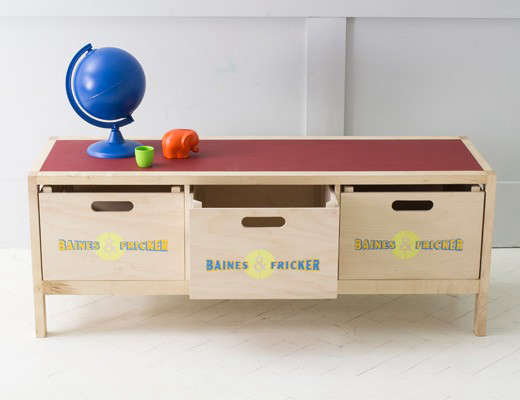
The Baines & Fricker Fruit Crate Unit is what happens when an ordinary market box receives an architectural education. Inspired by the humble wooden containers traditionally used to move produce, this distinctive storage design turns a familiar object into a carefully composed piece of contemporary furniture.
At first glance, the idea seems almost suspiciously simple: take a group of fruit-crate-style boxes and organize them into a larger storage unit. Look more closely, however, and the appeal becomes clearer. The design balances utility, craftsmanship, modular thinking, and a playful appreciation for everyday objects. It does not disguise its inspiration behind decorative doors or polished luxury surfaces. Instead, it proudly announces, “Yes, I resemble a stack of fruit cratesand I look excellent doing it.”
Designed by Brighton-based Baines & Fricker, the unit reflects the studio’s broader interest in practical British furniture, robust materials, industrial references, and ordinary objects that deserve a second look. This guide explores the design’s background, materials, visual character, practical uses, styling potential, and the experience of living with crate-based storage.
What Is the Baines & Fricker Fruit Crate Unit?
The Baines & Fricker Fruit Crate Unit is a freestanding storage system built around multiple crate-shaped compartments. The original individual Fruit Crates were made from birch plywood and designed to be stackable. The larger unit developed that small modular idea into a more substantial piece of furniture suitable for toys, books, household objects, office supplies, and decorative collections.
Archival design coverage described the individual birch-ply crates as separate products and presented the larger storage unit as a coordinated furniture piece made from them. Historical listings placed the complete unit at approximately £1,250, while individual crates were listed at about £50 each. Those figures should be treated as archival rather than current retail prices, especially because product ranges, production methods, and availability can change over time.
The significance of the unit is not limited to its capacity. Its design gives the cratenormally a temporary tool of transportationthe permanence of household furniture. A container that would usually disappear into a storeroom becomes the main event.
The Designers Behind the Fruit Crate Unit
Baines & Fricker was established in 2011 by Steve Baines and Eliza Fricker. Their partnership brought together furniture making, illustration, printmaking, and a shared interest in simple British design. Working from Brighton, they became known for pieces influenced by utility furniture, street graphics, church seating, workshops, industrial buildings, and other overlooked elements of daily life.
The studio’s philosophy centered on the belief that furniture for the home should be worth keeping. That idea sounds straightforward, but it places an important demand on every design. A lasting object must be useful enough to survive changing routines, visually interesting enough to avoid becoming boring, and well made enough to tolerate years of real-life treatment.
The Fruit Crate Unit fits that philosophy particularly well. Its recognizable form gives it personality, while its open compartments allow it to adapt to different rooms and storage needs. It is playful without becoming childish and practical without looking like warehouse equipment accidentally delivered to the living room.
Why the Fruit Crate Became a Design Object
Fruit crates are naturally appealing building blocks for furniture. Their basic form is efficient, repeatable, portable, and easy to understand. A crate has a floor, walls, open access, and enough structure to hold a useful amount of weight. Place several together and they immediately suggest shelving.
Designers have repeatedly returned to crates, boxes, and modular cubes because these forms offer clarity. There is no mystery about what a crate does. It contains things. The creative challenge is to improve its proportions, materials, construction, and relationship to the surrounding room.
The Baines & Fricker Fruit Crate Unit goes beyond a casual do-it-yourself stack. Its attraction lies in the transition from improvised storage to intentional furniture. The repetition of evenly formed boxes creates rhythm, while the visible openings break up the unit’s mass. Light passes through and around the compartments, making the piece appear less heavy than a fully enclosed cabinet of similar size.
From Agricultural Utility to Domestic Furniture
Traditional produce crates were designed for handling, ventilation, stacking, and transportation. They were tools rather than treasures. Their visual identity emerged from necessity: slatted sides reduced material use, openings improved airflow, and standardized proportions made stacking easier.
When this language enters the home, it brings a sense of honesty. The construction is visible. The purpose is obvious. There are no elaborate moldings pretending the unit belongs in a palace. It is a practical object elevated through proportion and workmanship.
A Familiar Form with a Playful Twist
People often respond positively to furniture that reminds them of something familiar while presenting it in an unexpected context. A school desk becomes an elegant writing table. A church pew becomes hallway seating. A fruit crate becomes a designer storage system.
That small shift creates humor without requiring cartoon shapes or bright plastic. The joke is subtle: an object associated with apples and market stalls is now displaying art books and carefully arranged ceramics.
Birch Plywood and the Material Character
Birch plywood is central to the visual and practical identity of the Fruit Crate concept. Unlike inexpensive rough-sawn shipping boxes, well-made birch plywood provides a clean surface, consistent thickness, crisp edges, and a layered profile that can become a decorative detail in its own right.
Plywood is produced by bonding thin wood veneers in alternating grain directions. This layered construction generally provides useful dimensional stability and strength in more than one direction. For furniture makers, it also makes efficient use of sheet material and supports precise, repeatable components.
The pale color of birch plywood gives the unit a warm but relatively neutral appearance. It works with Scandinavian interiors, modern family homes, creative studios, children’s rooms, and spaces featuring industrial details. Against white walls, it feels quiet and architectural. Beside colorful objects, it becomes a calm frame rather than competing for attention.
Why Exposed Plywood Edges Matter
In low-quality furniture, exposed panel edges are often hidden because they reveal unattractive cores or inconsistent layers. In better plywood furniture, the edge can become a feature. Repeated veneer lines create a graphic striped effect that emphasizes how the material was made.
This honesty suits the Fruit Crate Unit. A crate-inspired piece should not look overly precious. Visible layers, straightforward joints, and open compartments reinforce its workshop-like personality.
Questions to Ask When Buying Plywood Furniture
Anyone considering an original, vintage, custom, or crate-inspired plywood unit should ask about the grade of plywood, surface finish, adhesives, edge treatment, repair options, and intended load. U.S. buyers should also check whether newly manufactured or imported composite-wood products meet applicable emissions requirements.
Good plywood should feel solid and consistent rather than unusually light or hollow. Check for separating layers, swollen edges, rough splinters, large internal voids, loose joints, and signs of prolonged moisture exposure.
Practical Uses for the Fruit Crate Storage Unit
Open modular storage earns its place by being flexible. The Baines & Fricker Fruit Crate Unit can serve multiple roles, although the best use depends on the size of the compartments, how the unit is secured, and the weight rating of its construction.
Children’s Toy Storage
The design was widely presented as an appealing toy catchall. Open crates make it easy for children to see where objects belong, which is useful because a complicated organization system rarely survives contact with an enthusiastic five-year-old.
Different compartments can hold blocks, stuffed animals, art supplies, puzzles, and books. Smaller removable bins may be placed inside the openings to control tiny pieces. For family use, the unit should be anchored appropriately so climbing, pulling, or uneven loading cannot cause it to tip.
Living Room Books and Display Objects
Used as a bookcase, the Fruit Crate Unit creates a more casual impression than a traditional library cabinet. Books may be arranged vertically, stacked horizontally, or mixed with plants, framed pictures, ceramics, and small sculptures.
The main styling challenge is restraint. Filling every compartment to maximum capacity can turn an airy design into a wall of visual static. Leaving several areas partially empty allows the geometry of the crates to remain visible.
Entryway Organization
In an entry, the unit can organize shoes, bags, hats, reusable shopping totes, and outdoor accessories. Open storage makes daily items easy to grab, although less attractive clutter may need baskets or fabric bins. Nobody needs to admire a heroic exhibition of tangled dog leashes.
Creative Studio or Home Office
The crate format is especially suitable for studios because it accommodates objects of different sizes. Paper rolls, sketchbooks, material samples, tools, camera accessories, and reference books can occupy separate compartments without requiring a perfectly matched set of organizers.
Labeling removable boxes can improve efficiency while preserving the larger unit’s visual simplicity. The result feels organized but not corporatea useful distinction when the office is also where ideas are expected to occur.
Retail and Hospitality Display
Crate-inspired shelving also works naturally in boutiques, cafés, bakeries, and small hotels. The form connects visually with markets, craftsmanship, and local production. It can display packaged goods, folded textiles, books, or decorative accessories while making the interior feel less formal.
How to Style a Baines & Fricker Fruit Crate Unit
The unit has a strong visual identity, but it is not difficult to integrate. Its pale wood and open grid provide a neutral structure capable of supporting several decorative directions.
Keep the Palette Simple
A limited palette allows the repeated crate forms to read clearly. White, gray, black, natural linen, and warm wood tones create a calm setting. Add one or two stronger colors through books, toys, artwork, or storage bins.
Mix Practical and Decorative Objects
A display composed entirely of decorative objects may look staged, while one filled only with practical supplies can resemble a stockroom. Combine both. A stack of magazines can sit beside a handmade bowl; a toy basket can share space with a framed print.
Use Baskets Sparingly
Baskets are helpful for hiding cables, loose toys, paperwork, and other visual troublemakers. However, placing identical baskets in every opening can erase the unit’s crate-inspired character. Use enclosed containers only where they solve a real problem.
Create Visual Balance Rather Than Symmetry
The grid naturally provides order, so the objects inside do not need to be perfectly mirrored. Balance a tall plant in one section with a group of books elsewhere. Repeat colors at different heights. Allow a few compartments to breathe.
Fruit Crate Unit Versus Ordinary Cube Storage
Mass-market cube organizers and the Baines & Fricker Fruit Crate Unit may perform similar tasks, but they communicate very different ideas.
Standard cube storage usually prioritizes low cost, flat-pack convenience, and compatibility with fabric bins. The Fruit Crate Unit places more emphasis on material character, craftsmanship, visual narrative, and the transformation of an everyday object.
A basic organizer tries to disappear. The Baines & Fricker design expects to participate in the room. Its openings, crate references, and exposed wood give it enough personality to function as both storage and focal furniture.
That distinction also affects price. Small-batch workshop furniture is not priced like a disposable shelving unit manufactured in enormous quantities. Buyers are paying for design authorship, material selection, fabrication, finishing, and the survival of a specific creative idea.
Is the Fruit Crate Unit Suitable for Small Spaces?
Modular storage can work well in small homes because it combines display and organization within one footprint. Open-backed or visually open shelving may also feel lighter than a solid cabinet. Nevertheless, an open unit is not automatically space-saving.
Measure the wall, baseboards, door swing, walking path, and ceiling height before purchasing any large storage piece. Consider whether objects can be reached comfortably and whether the unit will dominate the room. In a narrow apartment, a lower arrangement may feel less imposing than a tall wall of crates.
Open storage also requires some discipline. A closed cabinet can conceal a chaotic collection of chargers, receipts, mystery screws, and instruction manuals for appliances no longer owned. An open crate displays the evidence.
Care and Maintenance
Birch plywood furniture is relatively straightforward to maintain when kept indoors and away from excessive moisture. Dust it with a soft cloth or vacuum using a brush attachment. For light marks, use a slightly damp cloth followed by a dry one.
Avoid soaking the surface or allowing water to sit along exposed edges. Moisture can stain veneers, raise fibers, soften some finishes, or contribute to delamination. Strong cleaners and abrasive pads may also damage the surface.
Inspect fasteners and joints periodically, particularly when the unit holds books or other heavy objects. Distribute weight across multiple compartments rather than concentrating everything in one area. Heavy items generally belong lower down, where they improve stability rather than creating a top-heavy tower.
Buying an Original or Commissioning a Similar Unit
Because archival coverage does not guarantee present-day availability, buyers should confirm current production directly with the relevant workshop or an authorized seller. A historical price should never be assumed to represent a current quotation.
When evaluating a used piece, request detailed photographs of joints, corners, plywood edges, fasteners, surfaces, and the underside. Ask whether any components have been replaced, refinished, repaired, or exposed to damp conditions.
A custom furniture maker may also create a crate-inspired storage system adapted to a particular room. In that case, discuss wall anchoring, plywood specification, maximum shelf load, finish, compartment dimensions, removable modules, delivery access, and future repairs. A beautiful unit that cannot fit around the stairwell corner is technically a sculptureand an inconvenient one.
Why the Design Still Feels Relevant
The Fruit Crate Unit remains appealing because it addresses several lasting design interests at once. It is modular, visually honest, adaptable, and connected to recognizable everyday life. It also avoids the exaggerated styling that can make novelty furniture age quickly.
Its most valuable lesson is not that every home needs expensive crates. The lesson is that humble forms can become meaningful furniture when designers improve their construction, proportions, and context. Good design does not always begin with a futuristic silhouette. Sometimes it begins with a box that once held apples.
Experiences Related to Living with a Fruit Crate Unit
The first experience people are likely to have with a Baines & Fricker Fruit Crate Unit is visual rather than practical. From across the room, the piece reads as a strong geometric composition. Move closer and the individual boxes become more obvious. That gradual recognition creates a small moment of discovery: the sophisticated shelving unit is based on one of the simplest containers imaginable.
Once objects are added, the unit begins to change personality. Fill it with children’s books and wooden toys, and it feels cheerful and informal. Add architecture magazines, ceramics, and monochrome artwork, and it becomes more like a gallery fixture. Use it for fabric samples, paper, and tools, and the same furniture suddenly resembles a working studio archive.
This adaptability is one of the most satisfying aspects of crate-based storage. Owners do not need to decide on one permanent identity for the piece. The arrangement can evolve as routines change. A compartment that once stored toy animals may later hold schoolbooks, records, or camera equipment. Furniture capable of surviving changing interests often stays useful longer than furniture designed for a single narrow purpose.
There is also a pleasantly low-pressure quality to open crate storage. Traditional display cabinets can make ordinary objects feel as though they need to pass an entrance exam. Crates are more forgiving. A slightly uneven stack of books looks appropriate. A basket of craft supplies belongs. Even a scratched wooden toy contributes to the informal atmosphere.
The disadvantage becomes apparent during untidy weeks. Open compartments do not provide diplomatic cover. Mail, cables, toys, shopping bags, and half-finished projects remain visible. The unit therefore encourages a simple organizing habit: assign broad categories rather than creating an elaborate system. One crate for art supplies is realistic. A twelve-stage classification system for crayons is a cry for help.
Cleaning can also require more attention than with a closed cabinet. Dust settles on the tops of objects and in the corners of open boxes. Fortunately, the accessible compartments make routine wiping or vacuuming easy, provided they are not packed tightly.
Another noticeable experience is the warmth of the material. Pale plywood softens the repetitive geometry, preventing the unit from feeling like a metal warehouse rack. In daylight, the veneer grain and layered edges add subtle variation. Over time, minor signs of use may make the furniture feel more relaxed, although water damage and loose joints should still be addressed promptly.
For families, the open design can improve independence. Children can identify a compartment, retrieve what they need, and return it without opening heavy doors. The same accessibility may require safety planning, including secure anchoring and careful placement of heavy or fragile objects.
In a home office, the unit can reduce the frustration of deep cabinets where useful materials vanish behind other useful materials. Open crates reveal their contents immediately. That visibility supports quick access, although attractive inner boxes may be needed for paperwork and small accessories.
Perhaps the most memorable experience is conversational. Visitors tend to notice furniture with a recognizable reference. The Fruit Crate Unit offers a story: an everyday transport container was reconsidered, refined, and transformed into lasting furniture. It demonstrates that thoughtful design can make ordinary life more interesting without making it less practical.
Conclusion
The Baines & Fricker Fruit Crate Unit succeeds because it does not overcomplicate its central idea. It takes the directness of a produce crate, applies careful furniture-making principles, and repeats the form until it becomes an architectural storage system.
Its birch-plywood construction, open compartments, modular character, and playful British design language make it suitable for homes, studios, children’s rooms, and creative commercial spaces. It may not hide clutter as effectively as a closed cabinet, but it offers something ordinary shelving often lacks: a clear point of view.
For admirers of practical furniture, exposed materials, and designs inspired by overlooked objects, the Fruit Crate Unit remains a compelling example of how modest ideas can produce memorable results.
Note: Prices, product descriptions, and availability mentioned in this article are based on archival design coverage. Confirm current specifications, production status, safety details, shipping costs, and quotations with the maker or seller before purchasing.