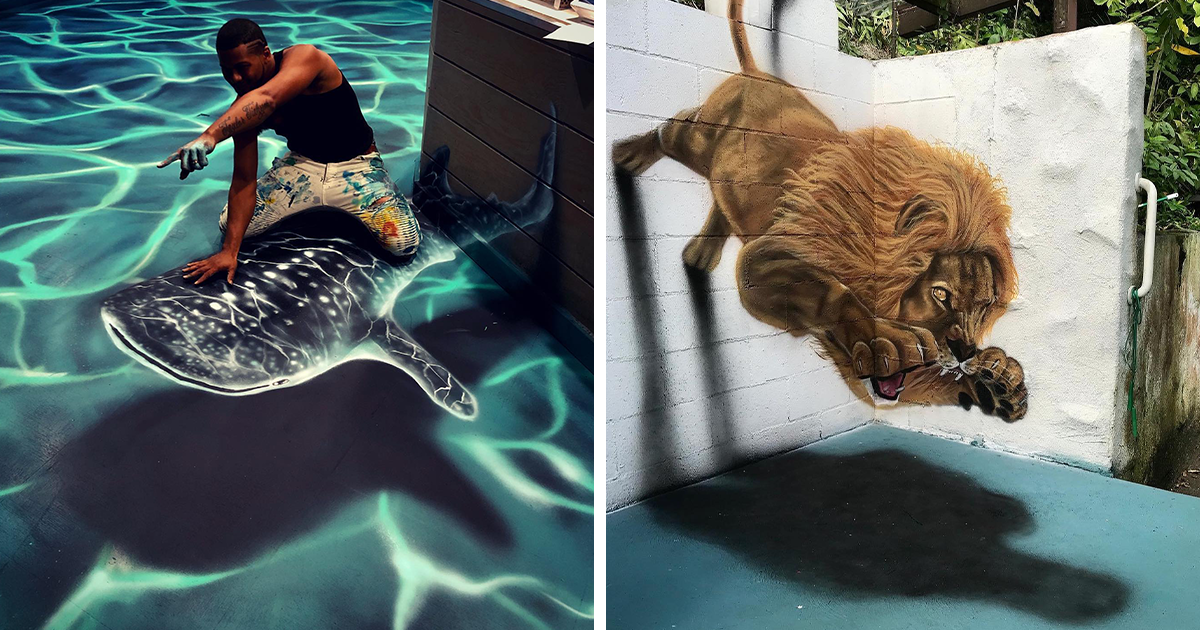
Some artists paint walls. Tehrell Porter seems to argue with them first, then convinces them to open up and reveal a tiger, a tunnel, a wave, or a full-blown visual ambush. His 3D mural work does not politely sit on the surface like a framed print waiting for applause. It lunges. It prowls. It pretends a flat wall is suddenly a living stage set, and your eyeballs are the unsuspecting audience.
That is what makes a gallery of 20 images featuring these murals so irresistible. You are not just looking at street art or decorative wall painting. You are looking at illusion art that bends perspective, tricks depth perception, and turns ordinary architecture into something theatrical. One second, it is a blank corner. The next, it looks like a creature is crawling out of it or a whole second world has been tucked inside the building. Honestly, it is the kind of work that makes your brain do a double-take and your camera work overtime.
In this article, we will take a closer look at why these 3D murals hit so hard, how anamorphic mural art works, why Tehrell Porter’s style feels so immediate, and why audiences cannot stop sharing this kind of wall art online. We will also dig into what makes these images more than just cool visuals. At their best, they transform public space, invite interaction, and remind people that a boring wall is really just an opportunity wearing a beige disguise.
Why 3D Murals Feel So Different From Ordinary Wall Art
Traditional mural art can be beautiful, symbolic, and deeply moving. But 3D murals add an extra layer of spectacle. They are designed not only to be seen but to be experienced from a specific angle. That perspective is everything. Move into the sweet spot and the painting suddenly appears to lift off the wall, sink into it, or burst through it. Stand a few feet away in the wrong spot and the illusion relaxes. Stand in the right place and the piece practically winks at you and says, “Gotcha.”
This is the magic of anamorphic art. It relies on distortion, careful scaling, and precise control of light, shadow, line, and shape. The artist stretches and bends forms across a surface so that, from a chosen viewpoint, the image snaps into believable depth. What looks warped while the mural is in progress can become shockingly realistic once finished. It is art, geometry, stagecraft, and a little harmless deception all rolled into one.
That is why these murals perform so well in photos. The camera loves a clean viewpoint, and 3D murals are built for that reveal. They create the perfect social-media moment without feeling cheap or gimmicky. The best ones reward both the casual viewer who wants a quick visual thrill and the more attentive observer who starts wondering how on earth the artist pulled it off.
Who Is Tehrell Porter?
Tehrell Porter is a muralist and designer known for large-scale works that combine strong draftsmanship with anamorphic illusion. While many artists dabble in perspective tricks, Porter’s work stands out because he pushes his murals toward immersion. His pieces do not merely suggest depth. They stage it. A creature appears to lean outward. A structure seems to crack open. A painted environment feels as if it continues beyond the wall rather than ending on it.
That ability is not just technical. It is theatrical. Porter understands that a mural in public space has to compete with everything around it: traffic, noise, storefronts, weather, signs, shadows, and people who are one coffee away from walking past without noticing anything. So he makes work that is impossible to ignore. His murals grab attention fast, then keep it by rewarding a closer look.
There is also something refreshingly democratic about this kind of public art. You do not need a museum ticket, a catalogue essay, or a degree in art history to enjoy it. You just need eyes and maybe a willingness to laugh when your brain briefly believes a painted animal is about to stroll off a cinderblock wall.
What Makes These 20 Pics So Addictive?
1. They Turn Flat Surfaces Into Visual Traps
A flat wall is one of the least exciting things in the world. It is architecture’s version of plain toast. But Porter treats flatness like a challenge rather than a limitation. In image after image, the surface becomes unstable. It appears to dent, split, bulge, or open up into another space. That transformation creates the instant hook. People love seeing familiar things behave in unfamiliar ways.
2. The Illusions Have Real Weight
One reason these murals feel so convincing is that they do not rely on random distortion alone. The shadows, highlights, contours, and proportions are all working together to simulate mass. Whether the subject is an animal, an object, or an abstract form, it feels like it occupies physical space. That sense of weight is what makes the mural seem ready to leap off the wall rather than simply float on top of it.
3. They Invite Participation
3D murals are naturally interactive. Viewers want to stand next to them, point at them, pose with them, and photograph them from the exact angle that sells the illusion best. In other words, the audience becomes part of the artwork’s life cycle. That is a huge reason images like these spread so quickly. They are not passive visuals. They are prompts for play.
4. They Balance Skill and Spectacle
Plenty of things on the internet are flashy. Fewer are genuinely well made. Porter’s murals work because the craftsmanship is obvious. Even when the subject matter is bold or dramatic, the execution gives it credibility. The lines are intentional, the perspective is disciplined, and the finish feels confident. Spectacle gets the click. Skill earns the respect.
The Technique Behind 3D Mural Art
Behind every convincing anamorphic mural is a pile of planning that most viewers never see. The final image may feel spontaneous, but the process is anything but casual. Artists working in this style often begin by identifying the ideal viewing angle. From there, they map out how the image must be distorted across the wall so it resolves correctly from that position.
That means the composition has to work with the architecture, not against it. Corners, surface texture, window placement, protrusions, shadows, and wall height all matter. In some cases, these “problems” become advantages. A corner can create the illusion of an object wrapping around a structure. A recess can help sell depth. A rough surface can add realism to a creature’s skin or a weathered scene.
Color also does a lot of heavy lifting. Strong contrasts create separation. Subtle gradients create roundness. Cast shadows tell the eye where to believe the subject sits in space. Without convincing light logic, the illusion collapses faster than a folding lawn chair at a family barbecue.
Then there is scale. Large murals are tricky because the distortion has to remain coherent across a big area. Every section must connect to the whole, and the artist often has to judge proportions while standing close to a wall that is too large to fully see at once. It is part painting, part engineering, part controlled chaos.
Why Audiences Love Illusion Murals
People are drawn to art that surprises them. That sounds obvious, but 3D murals deliver surprise in a particularly satisfying way because the effect unfolds in real space. This is not a digital filter or a screen-based trick. It is paint doing something your brain does not expect paint to do.
There is also a psychological pleasure in being fooled safely. Optical illusions let viewers experience confusion without risk. For one split second, the eye says, “That wall is opening,” and the brain scrambles to catch up. The result is delight. You feel impressed, curious, and slightly suspicious of your own vision, which is a fun combination when nobody is asking you to parallel park.
These murals also thrive in a photo-driven culture. They are highly shareable because they compress into a strong single image while still offering an in-person payoff. That makes them ideal for modern public art: memorable in real life, portable online, and emotionally immediate in both places.
More Than a Trick: The Artistic Value of 3D Murals
It would be easy to dismiss illusion murals as visual stunts, but that would miss the point. Great 3D mural art does more than trick the eye. It reshapes the way people move through space. It slows them down. It creates gathering points. It turns overlooked corners into destinations. It can even change how a neighborhood feels, especially when a neglected surface becomes a place people actively seek out.
That matters. Public art has always done more than decorate. It tells communities that place matters. A thoughtfully executed mural can add identity, pride, and curiosity to an area that once felt anonymous. In the case of anamorphic murals, it can also create a sense of wonder, and wonder is not exactly something cities have too much of these days.
Porter’s work fits into that tradition while bringing a distinctly contemporary energy. His murals are tuned to both physical space and digital circulation. They work for the passerby and for the person who discovers them later on a phone screen. That dual life is part of what makes them so successful.
What Emerging Artists Can Learn From This Style
Respect Perspective
3D murals are a reminder that perspective is not just a technical lesson from an art class you may or may not have slept through. It is the backbone of spatial illusion. Artists hoping to create similar work have to understand how viewers occupy space and how images shift when seen from different angles.
Design for the Environment
The wall is not a blank page. It is part of the artwork. Its shape, flaws, and surroundings all influence the outcome. The best muralists do not ignore that. They collaborate with the site, even when the site is stubborn.
Give Viewers a Reason to Stop
Public art is in constant competition with daily life. Great work needs an immediate hook. Porter’s murals succeed because they offer instant visual drama and deeper rewards after that first glance. They know how to start a conversation in under three seconds.
The Experience of Seeing 3D Murals in Person
Photos are impressive, but in person these murals hit differently. First, there is the scale. On a phone screen, a mural can look clever. Standing in front of it, the thing can feel enormous, immersive, and faintly ridiculous in the best way. You keep shifting side to side, trying to catch the illusion forming and dissolving. It becomes a little performance between you and the wall.
Then there is the social experience. Nobody looks at a successful 3D mural in total silence for very long. Someone laughs. Someone says, “Wait, stand right there.” Someone else insists the illusion looked even crazier from five feet to the left. Before you know it, strangers are discussing perspective like they are all part-time stage magicians. That communal reaction is one of the great pleasures of public art. It gives people a shared point of amazement.
There is also a childlike quality to the encounter. Adults spend a lot of time pretending to be unshockable, but illusion murals crack that shell pretty quickly. Suddenly everyone is delighted by a painted creature, a false opening, or a shape that seems to hover where it definitely should not. It is proof that visual wonder still works on people, even when their default facial expression suggests they have seen every possible thing on the internet.
Personal and Cultural Experiences Around 3D Murals
Experiences related to 3D murals tend to stick in memory because they mix art with place. You do not just remember the image. You remember where you were when you saw it, who pointed it out, what the weather felt like, and how long it took your eyes to understand what was happening. That is a powerful form of engagement. A mural becomes part artwork, part travel memory, part neighborhood landmark.
For many viewers, these murals also change expectations. After seeing a wall transformed so dramatically, ordinary buildings start to look less fixed and more full of possibility. You begin imagining what else a plain alley, side street, storefront, or parking structure could become with the right artist and enough paint. That shift matters because public art often starts by changing perception before it changes policy, funding, or civic priorities.
There is a deeper cultural experience at work too. Murals have long served as storytelling tools in communities that want to celebrate identity, history, aspiration, or resilience. 3D murals add a new visual language to that tradition. They can still carry emotion and meaning, but they do so with heightened immersion. Instead of simply representing a subject, they make it feel present. That sense of presence is part of why people respond so strongly.
Artists who work in this style also create moments of access. A person who might feel intimidated walking into a gallery can still stop on a sidewalk and enjoy a mural for free. A kid on the way to school can encounter world-class visual problem-solving before first period. A tourist can discover a city through its walls rather than just its guidebook highlights. Those everyday encounters are small, but they add up.
And then there is the experience of the artist, which is worth appreciating too. Creating a 3D mural is not just about painting well. It is about problem-solving in public, often under time pressure, with shifting light, changing weather, and people stopping to watch. That kind of work requires patience, stamina, adaptability, and confidence. The finished mural may look effortless, but the experience behind it rarely is.
In that sense, Tehrell Porter’s work is exciting not only because of how it looks but because of what it represents: the meeting point of imagination, labor, public interaction, and visual intelligence. These murals do not merely decorate walls. They turn walls into events.
Final Thoughts
“Artist Creates 3D Murals That Practically Jump Off The Wall (20 Pics)” is the kind of title that sounds like internet exaggeration until you actually see the work. Then the phrase feels pretty accurate. Tehrell Porter’s murals thrive because they combine technical control, theatrical composition, and a strong instinct for public engagement. They are visually clever, yes, but they are also generous. They invite people in, reward curiosity, and make everyday spaces feel charged with possibility.
At a time when so much visual culture is consumed in a split second and forgotten almost as quickly, 3D murals offer something richer. They surprise the eye, reshape the environment, and stick in the memory. Not bad for a wall and some paint. Actually, that may be the most impressive part of all.