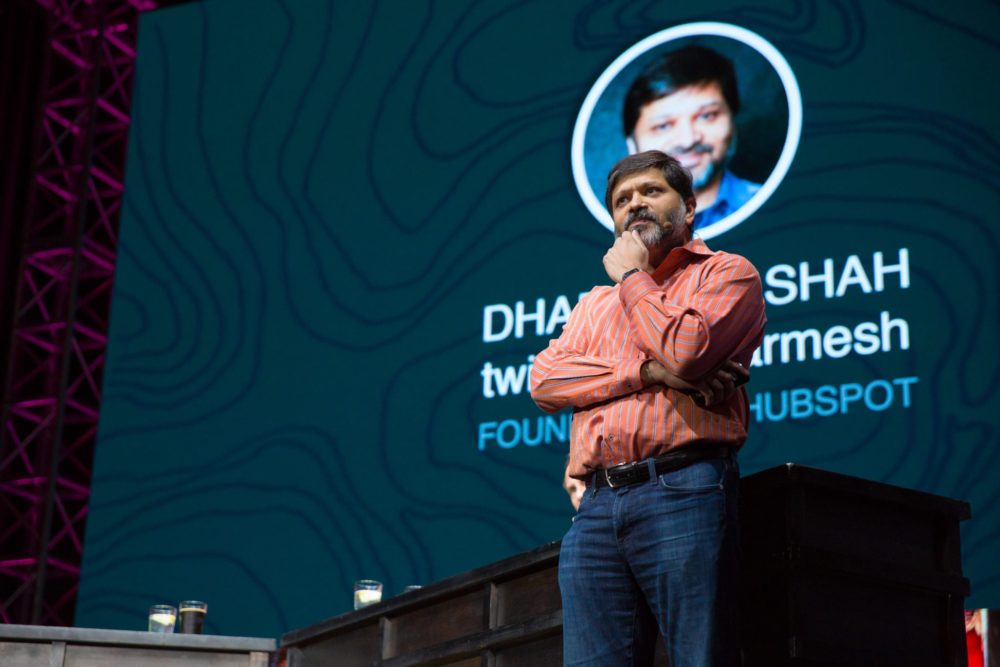
Some SaaS talks age like leftover conference coffee. Others age like a well-built product: the interface changes, the market gets louder, but the core lesson keeps working. Dharmesh Shah’s SaaStr sessions belong in the second category. As HubSpot’s co-founder and CTO, Shah has spent years explaining what actually happens when a startup grows from an idea, a thesis, and a slightly dangerous amount of optimism into one of the most influential software companies in the world.
These four SaaStr moments are more than highlight-reel appearances. They are a practical founder syllabus covering category creation, customer retention, company culture, second-product strategy, co-founder alignment, and the long, occasionally awkward transition from scrappy startup to durable SaaS platform. The charm is that Shah rarely sounds like someone polishing a victory speech. He talks like a builder who has seen the wiring behind the wall, found a few sparks, laughed nervously, and then fixed the circuit.
HubSpot’s story makes the lessons even more useful. Founded in 2006 by Brian Halligan and Dharmesh Shah after they met at MIT, HubSpot started with a belief that buyers were changing. People did not want to be interrupted by cold calls and ads; they wanted helpful information. That idea became the foundation of inbound marketing, and later, a broader customer platform spanning marketing, sales, service, content, operations, commerce, CRM, and AI-powered tools.
Looking back at these SaaStr sessions, the pattern is clear: HubSpot did not win because every decision was perfect. It won because the team kept learning faster than the business was breaking. That is the real magic trick. Not “never make mistakes,” which is adorable advice from people who have never shipped software. The trick is to build systems that turn mistakes into compounding intelligence.
Why Dharmesh Shah’s SaaStr Sessions Still Matter
The SaaS industry has changed dramatically since HubSpot’s early years. Freemium became mainstream. Product-led growth became a boardroom phrase. AI moved from demo-day sparkle to an operating system for go-to-market teams. Yet many of the hardest questions remain stubbornly familiar: How do you keep customer acquisition cost low? How do you reduce churn? When do you add a second product? How do co-founders avoid turning strategy meetings into polite cage matches?
Shah’s best SaaStr appearances matter because they answer those questions from lived experience. HubSpot has crossed multiple company chapters: early product-market fit, IPO, multi-product expansion, upmarket motion, platform consolidation, and the current AI era. In 2025, HubSpot reported $3.13 billion in full-year revenue and more than 288,000 customers, making these lessons especially valuable for founders who want advice that has survived contact with scale.
The sessions also stand out because Shah brings a technical founder’s brain to topics that are often treated like motivational posters. Culture becomes an operating system. Customer happiness becomes a model based on behavior. Product strategy becomes a series of trade-offs, not a heroic press release. And co-founder decision-making becomes a framework rather than a coin toss with better sweaters.
Session 1: From Day 0 to IPO What Went to Plan and What Definitely Did Not
The first standout SaaStr session is Shah’s classic reflection on HubSpot’s path from Day 0 to IPO. It is the kind of talk founders should watch before they write a “we cracked the code” LinkedIn post. HubSpot broke several pieces of conventional SaaS wisdom. The company focused on small and mid-sized businesses when many investors preferred enterprise buyers. It built a suite-like product before “suite” was fashionable again. It sold a new philosophy, inbound marketing, before the market had fully agreed that it needed a new philosophy at all.
The Category Creation Bet
One of the biggest lessons from this session is that category creation can be powerful, but it is not a casual weekend project. HubSpot did not simply name a category and wait for applause. It built content, tools, education, events, community, and a worldview around inbound marketing. That required persistence, capital, and a tolerance for explaining the same idea approximately 9,000 times without becoming visibly haunted.
The practical example Shah often points to is Website Grader, a free tool that helped prospects diagnose their marketing problems. Instead of giving away a small piece of the paid product, HubSpot gave away a tool that made the customer’s pain visible. That is a subtle but important distinction. Great free tools do not just create traffic; they create urgency. They help the customer say, “Oh no, my website is not fine. My website is wearing pajamas to a job interview.”
The Pricing Lesson Nobody Wants to Learn the Hard Way
Another memorable part of the Day 0 to IPO story is HubSpot’s early pricing. The company charged a simple monthly price that made the buying decision easy, but the same simplicity later limited expansion. In the beginning, low friction was a gift. Later, it became a ceiling. The lesson for SaaS founders is not “charge more immediately.” It is more nuanced: price is part of your product architecture. If your pricing cannot grow with customer value, you may accidentally train your best customers to underpay you forever.
This session also introduced one of HubSpot’s most useful retention ideas: measuring pre-churn. Shah described how the company looked at behavioral data, product usage, sales history, and customer signals to predict whether a customer might cancel before the cancellation happened. In a SaaS world obsessed with dashboards, this is still refreshing. The point is not to admire churn after it has already punched you in the face. The point is to see the fist moving.
Session 2: How to Build Happier Employees Culture as a Product
The second amazing SaaStr session paired Dharmesh Shah with Katie Burke, HubSpot’s Chief People Officer, for a conversation about culture, employee happiness, and diversity. This could have been vague. It was not. HubSpot’s culture work became famous partly because Shah treated culture like a product: something designed, shipped, measured, updated, and occasionally refactored when the code got messy.
Culture Is Not Office Wallpaper
One of the most durable ideas from this session is that culture is not the words painted above the snack shelf. It is the system by which people make decisions when nobody is watching. HubSpot’s Culture Code, first published publicly in 2013 and updated many times, became widely viewed because it was unusually transparent. It explained values such as humility, empathy, adaptability, remarkability, and transparency, while also making the case that culture should help people do better work, not simply decorate recruiting pages.
The session is especially useful because Shah and Burke were candid about what HubSpot learned late. They discussed the risk of “people debt,” a phrase that deserves to be stapled to every founder’s monitor. Technical debt is painful, but people debt can be worse because it affects trust, communication, leadership, retention, and inclusion. A messy codebase can be rewritten. A damaged culture may require years of careful repair and several uncomfortable conversations that no one can solve with a sprint ticket.
The CTO Who Got Drafted Into Culture
Part of the humor of the session comes from Shah admitting that culture was an unusual topic for a CTO. He is a software person at heart, the kind of founder who can still talk lovingly about coding. Yet that is exactly why his approach resonated. He did not frame culture as mysterious corporate incense. He framed it as an operating system for people.
For SaaS companies, the lesson is clear: employee experience is not separate from customer experience. If your team is confused, burned out, or afraid to tell the truth, your customers will eventually feel it. Bugs ship faster than values statements. Poor handoffs become poor onboarding. Internal mistrust becomes external friction. Culture is not “soft.” It is simply difficult to quantify until it breaks.
Session 3: How, When, and Why to Launch a Second Product
The third SaaStr session focused on one of the hardest moves in SaaS: launching a second product. This is where HubSpot’s journey from marketing software to CRM platform becomes especially instructive. Many startups become prisoners of their first success. The market knows them for one thing, customers buy them for one thing, sales teams pitch one thing, and suddenly the company is wearing a name tag it cannot remove.
The “Second Act” Problem
Shah’s second-product lesson is that many SaaS companies eventually need a second act to keep scaling. A single product can take a company far, but expansion revenue, retention, and platform value often improve when customers can buy more from the same trusted vendor. HubSpot’s move into CRM and sales software was not random adjacency hunting. It was connected to the same customer record, the same go-to-market workflow, and the same belief that growing companies needed an easier, unified system.
The difficulty, of course, is that the market may not immediately believe you. HubSpot was strongly associated with inbound marketing. Asking buyers to also see it as a CRM and sales platform required years of education. That is a practical warning for founders: your brand is an asset, but it can also become a box. When you add a second product, you are not just building features. You are rebuilding market perception.
Free Can Be Brilliant, Dangerous, or Both
HubSpot launched its CRM as a free product, which helped remove friction and allowed existing customers to try it quickly. The strategic beauty was that many potential customers were not deeply committed to a traditional CRM. Some used Salesforce, some used other tools, and many used spreadsheets or nothing formal at all. HubSpot could enter through the “nothing is working well” door, which is often wider than the “replace a beloved incumbent” door.
The caution is that free products must still support a business model. Free can create adoption, but adoption alone does not pay AWS invoices. The best version of free creates a path to usage, trust, expansion, and measurable customer value. In HubSpot’s case, CRM became a foundation for a broader suite. That is the difference between free as a growth engine and free as a very busy hobby.
Session 4: Scaling to $2 Billion+ ARR Founder Lessons with Brian Halligan
The fourth amazing SaaStr session brought together Brian Halligan and Dharmesh Shah to look at HubSpot’s bigger scaling journey. This is where the story moves from startup lessons to founder durability. The conversation covered contrarian strategy, co-founder alignment, the SMB market, product-led growth, content, pricing, churn, and the long game of building a company that can keep changing without losing its center.
The Contrarian SMB Bet
HubSpot’s decision to focus on small and mid-sized businesses was not the obvious investor-friendly answer in the early days. Enterprise software companies often love enterprise buyers because contracts are larger and logos look impressive on slides. HubSpot believed the internet would give smaller companies more power and that those businesses needed modern tools to compete.
That bet became more sophisticated over time. HubSpot did not simply chase the tiniest companies forever. It expanded across a broad “M” market, serving companies that were growing, adopting more software, and needing stronger systems without wanting enterprise complexity. The lesson is that SMB SaaS can work, but only if the model respects the economics. You need low CAC, strong retention, expansion paths, and a product experience that does not require a consulting army to install.
Co-Founder Alignment Is a System
Another highlight from the founder session is the Halligan-Shah partnership. Long-running co-founder relationships are rare because companies create pressure, and pressure reveals every tiny crack in communication. HubSpot’s founders reduced that risk by discussing hard questions early: What are we trying to build? What happens if someone wants out? How do we handle major disagreements? What if an acquisition offer arrives?
Their decision framework was simple but powerful. If both founders agreed, they moved forward. If one felt extremely strongly and the other did not, the stronger conviction carried the decision. If both felt strongly in opposite directions, they needed a tie-breaker. This is not glamorous, but it is useful. Many companies do not fail because they lack ideas. They fail because humans with equity, ambition, and caffeine cannot decide what to do next.
What Founders Can Learn from All Four Sessions
1. Use Content to Build Mindshare Before the Market Catches Up
HubSpot’s content engine was not an accessory. It was part of the company’s product-market strategy. Content helped teach a new category, attract customers, lower acquisition cost, and build trust before buyers were ready to talk to sales. For modern founders, the lesson is not to publish generic blog posts because “SEO said so.” The lesson is to use content as a thinking machine. Write to clarify the problem, educate the market, and make your company easier to discover when customers finally feel pain.
2. Measure Customer Happiness by Behavior, Not Vibes
Surveys can help, but customer behavior usually tells a louder truth. Are people logging in? Are they using the sticky features? Are they inviting teammates? Are they expanding usage? Are they ignoring onboarding emails with the dedication of a teenager avoiding chores? HubSpot’s Customer Happiness Index idea remains relevant because it pushes teams to act before churn becomes a historical fact.
3. Treat Culture as Infrastructure
Culture is not a retreat topic. It is infrastructure. It determines how quickly decisions happen, how honestly problems surface, how safely people challenge weak ideas, and how consistently teams solve for customers. HubSpot’s Culture Code became influential because it made culture explicit. Startups do not need to copy HubSpot’s values, but they should copy the discipline of writing down how they want to work and then updating it as reality provides feedback.
4. Add a Second Product Only When the Customer Logic Is Strong
A second product should not be a panic move because growth slowed or a competitor launched something shiny. It should come from a clear customer need, a strong adjacency, and a credible distribution advantage. HubSpot’s CRM expansion worked because it connected to the customer data and go-to-market workflows already central to the company’s mission. That is the difference between platform strategy and product sprawl.
5. Build for the Business You Want, Not Only the Business You Have
Several of Shah’s lessons come down to this: early decisions compound. Pricing, product architecture, culture, customer segments, and founder agreements may look small at first. Later, they become the rails the company runs on. If the rails point in the wrong direction, scale simply makes the train faster and the panic more cinematic.
Why These SaaStr Sessions Feel Especially Relevant in the AI Era
The current software market is being rewritten by AI, automation, and agentic workflows. HubSpot itself has moved aggressively into AI with Breeze and agent-focused product development. That makes Shah’s older SaaStr lessons feel surprisingly current. Why? Because AI does not erase the fundamentals. It magnifies them.
If your customer data is messy, AI will produce messy confidence. If your culture punishes experimentation, AI adoption will become theater. If your product strategy is already scattered, adding agents may create more confusion, not more leverage. If your customers do not understand the value of your platform, AI features will sound like expensive confetti.
The companies that benefit most from AI will likely be the ones that already understand customer workflows, data structure, adoption patterns, and trust. In that sense, HubSpot’s path from inbound marketing tool to unified customer platform offers a useful map. The future may be more automated, but it will still reward companies that know their buyers, build useful products, and make complexity feel simple.
Experience Notes: What It Feels Like to Apply These Lessons
Revisiting these four SaaStr sessions is a little like opening an old product roadmap and realizing half the “future trends” are now ordinary Tuesday problems. The lessons sound clean on stage, but they become more interesting when applied inside real teams. For example, “create a category” sounds inspiring until you are the person writing the 47th explanation of why your software is not quite marketing automation, not quite CRM, and not quite whatever the analyst report says this quarter. Category creation requires patience, repetition, and a thick skin for blank stares.
The same is true for culture. Most founders like the idea of a strong culture until the culture asks them to change their own behavior. Writing values is easy. Living them during hiring, performance reviews, pricing pressure, and product delays is harder. The HubSpot lesson is that culture becomes real when it affects decisions. If transparency is a value, leaders must share context before employees invent their own Netflix documentary version of events. If customer success is a value, the roadmap must make room for retention work, not just shiny launch announcements.
The second-product lesson also feels very real for growing teams. A company with one successful product often develops muscle memory. Sales knows the pitch. Marketing knows the story. Support knows the failure points. Finance knows the model. Then the second product arrives and everyone briefly becomes a confused tourist holding a map upside down. The product team wants speed, sales wants clarity, customers want integration, and executives want the chart to go up and to the right, preferably by Thursday. Shah’s SaaStr advice helps because it frames the second product as a company-wide transformation, not merely another SKU.
Customer happiness is another lesson that becomes more powerful with experience. Many SaaS teams wait too long to define what healthy usage actually looks like. They celebrate signups, demos, trials, and pipeline, then act shocked when customers leave after never adopting the product properly. The smarter move is to identify the behaviors that predict success. Maybe healthy customers invite teammates in the first week. Maybe they connect data sources. Maybe they publish a campaign, build a workflow, or complete onboarding. Whatever the signal is, find it early and operationalize it. Retention is not a department; it is a design principle.
The co-founder lessons may be the most quietly valuable. Startups often romanticize chemistry, but chemistry is not a governance model. Two founders can like each other and still disagree about hiring, fundraising, product quality, acquisition offers, remote work, or whether the company should sponsor a booth with beanbags. The Halligan-Shah example shows the value of deciding how to decide before the argument arrives. That may sound boring. So does insurance, until the kitchen is on fire.
In the end, the experience of applying these SaaStr lessons is humbling. They remind builders that great companies are not built by avoiding contradiction. HubSpot was sales-led before it became more product-led. It served SMBs while building a platform with enterprise-grade ambition. It invested in culture through a technical founder’s lens. It used free products while still caring deeply about monetization. Those tensions are not flaws in the story. They are the story.
Conclusion
Dharmesh Shah’s four amazing SaaStr sessions remain valuable because they do not offer a tidy myth of startup success. They offer something better: a realistic picture of how durable SaaS companies learn. HubSpot’s journey includes bold bets, pricing mistakes, category creation, culture design, second-product expansion, retention modeling, founder alignment, and a continuous willingness to evolve.
For founders, operators, marketers, and product leaders, the takeaway is both simple and demanding. Build the market, not just the product. Watch what customers do, not only what they say. Treat culture like infrastructure. Launch a second product only when the customer logic is strong. And when the company grows, keep asking whether the systems that got you here can get you there.
That is why these SaaStr sessions still deserve a look back. They are not nostalgia. They are operating instructions with better jokes.
Note: This article is original, rewritten for web publication, and synthesized from public information about SaaStr sessions, Dharmesh Shah, HubSpot’s company history, culture work, product strategy, and financial scale.