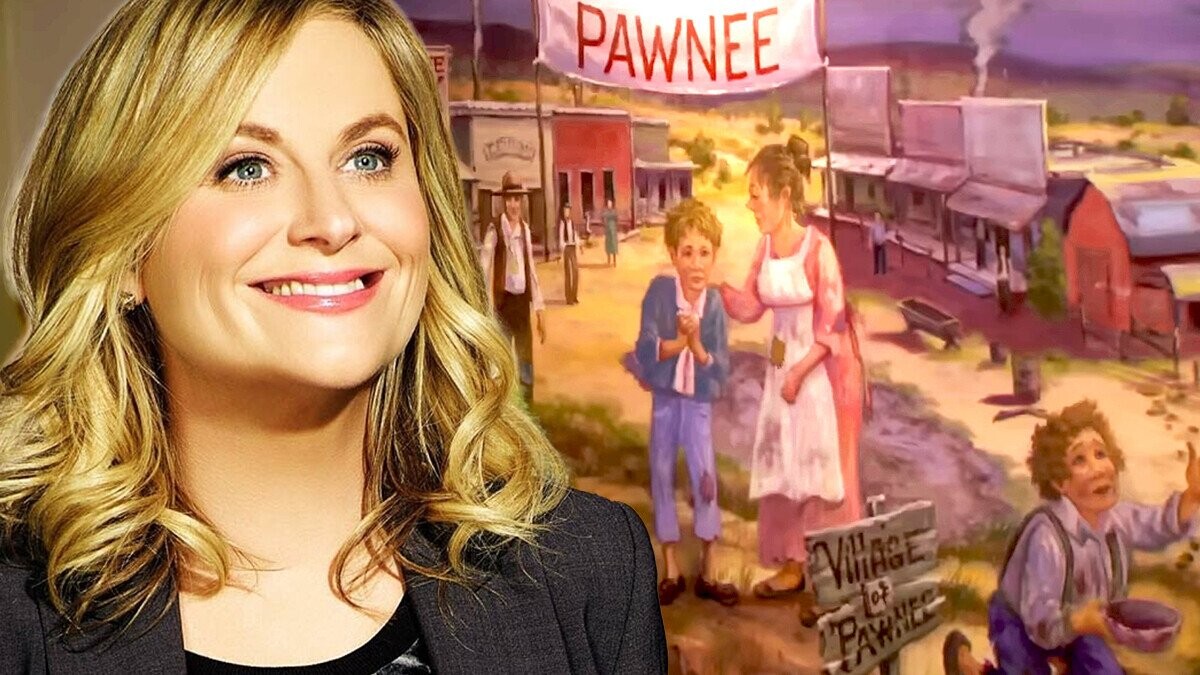
The fictional town of Pawnee, Indiana, has many treasures: aggressively sweet breakfast food, a beloved miniature horse, citizens who consider public meetings a full-contact sport, and enough raccoons to establish a shadow government. Yet few pieces of Pawnee history are as memorableor as horrifyingly well framedas the murals hanging inside City Hall.
Throughout Parks and Recreation, Leslie Knope proudly presents paintings commemorating the town’s past. At first glance, they resemble the respectable civic artwork found in courthouses, post offices, libraries, and municipal buildings across America. Then the camera moves six inches to the left and reveals a massacre, an execution, a human being displayed like a zoo animal, or some other atrocity Pawnee has inexplicably classified as local heritage.
The joke is not simply that the murals are offensive. It is that Pawnee has preserved them, polished them, titled them, and placed them in prominent public spaces. Leslie, an idealistic government employee played by Amy Poehler, often explains their history with the enthusiasm of a museum guide who has not yet noticed the cannon aimed at the prisoner. That collision between civic pride and civic shame turned the murals into one of the show’s sharpest recurring jokes.
Why Pawnee’s Murals Look Disturbingly Authentic
The murals were not designed as random background decorations. Art director Ian Phillips and the show’s creative team modeled their visual language partly on government-sponsored murals from the New Deal era. During the 1930s and early 1940s, federal programs commissioned large numbers of artworks for post offices and other public buildings, often asking artists to illustrate regional history, industry, settlement, and an idealized version of American progress.
Many genuine public murals remain artistically important. They brought original art into communities that had few galleries and employed artists during the Great Depression. However, some also reflected the racial stereotypes, romanticized frontier narratives, and unequal power structures of their period. Native Americans, immigrants, laborers, and women could appear as symbols in somebody else’s heroic story rather than as people with histories of their own. Nearly 400 New Deal-era murals reportedly included Native American subjects, yet only a small share were created by Native artists.
Parks and Recreation exaggerated that tradition until every symbol of “progress” became an accusation. The paintings use solemn compositions, warm historical colors, grand landscapes, and official-looking titles. Visually, they say, “Please respect this important chapter in our community.” The details say, “Our founders should not have been allowed near another human being.”
The First Masterpiece of Municipal Horror
The Battle of Koniga Creek
The murals establish their tone in the pilot episode. Leslie introduces Ann Perkins to what she calls one of City Hall’s finest works. The painting initially appears to show a heroic pioneer woman raising an ax. As the camera reveals the full scene, viewers discover that the supposed symbol of hardworking frontier life is threatening a Native American woman carrying a child.
According to Phillips, the creative objective was essentially to invent the worst image Leslie could still describe as Pawnee’s crown jewel. That principle became the formula for the entire running gag: create something visually readable, morally appalling, and just plausible enough to resemble an artifact a misguided town might have preserved.
The camera movement matters. The scene lets the audience accept Leslie’s interpretation for a moment before exposing what she has overlooked. It is a visual punchline, but it also tells us something important about her character. Leslie loves government and Pawnee so sincerely that she sometimes treats their traditions as automatically valuable. Her optimism is admirable; her historical quality-control system could use a software update.
A Guided Tour Through Pawnee’s Worst Decisions
The Trial of Chief Wamapo
The title promises a legal proceeding. The painting delivers a Native chief tied in front of a cannon. There is no jury deliberation, no defense attorney, and apparently no concern that artillery might be an excessively firm sentencing guideline.
The mural’s composition was designed to communicate the joke instantly. By placing the cannon extremely close to the captive chief, the image makes it obvious that the “trial” is an execution disguised by ceremonial language. This is Pawnee’s preferred method of historical editing: rename violence until it sounds like paperwork.
The Trading Post
Traditional paintings of trading posts often depict settlers and Native Americans exchanging tools, food, textiles, or animal hides. Pawnee’s version naturally asks, “What if the merchandise were babies?” The image portrays white settlers trading an infant, transforming a familiar frontier scene into a grotesque commercial transaction.
The mural is offensive in several directions at once, which is practically Pawnee’s municipal motto. It mocks exploitative frontier mythology while also showing how casually the fictional town converts human suffering into a charming local anecdote. Leslie’s account of what later happened to the pioneer involved is delivered with the breezy rhythm of a tourism brochure written during a gas leak.
Sunday Boxing
“Sunday Boxing” depicts a minister fighting a widowed mother while children watch. The event is presented not as a shocking crime but as an ordinary weekly tradition. The mural’s historical dignity makes the scene even stranger: everyone is posed as though gender-based bare-knuckle combat belonged on the town calendar between church services and a pancake breakfast.
The production team reportedly discussed where the minister’s punch should land and added young spectators to clarify that Pawnee regarded the fight as family entertainment. The joke is disturbingly efficient. One glance communicates the town’s sexism, appetite for violence, and complete inability to recognize either problem.
When Eagleton Abandoned Pawnee
Pawnee’s rivalry with wealthy neighboring Eagleton also received the mural treatment. One side shows Eagleton as a bright, fertile paradise filled with greenery, birds, and cheerful weather. The Pawnee side is brown, barren, stormy, and populated by people who appear to have recently lost an argument with civilization.
The details make the separation less like the peaceful founding of a new town and more like a hostile breakup conducted by frontier aristocrats. An Eagleton resident throws an incendiary object toward Pawnee, while a child kicks dirt at the people left behind. Even in painted form, Eagleton’s children have apparently completed advanced coursework in being unbearable.
The Turnbill Wedding Massacre
One of the show’s best mural reveals begins with what looks like a progressive historical moment: a white woman marrying a Wamapoke chief in the 1860s. The camera then widens to show that the wedding reception has become a bloodbath. Pawnee celebrates the ceremony as evidence of tolerance while treating the slaughter that followed as an unfortunate catering complication.
The visual setup demonstrates how carefully these background jokes were constructed. The center of the artwork could be framed as romantic and hopeful. Only when the full mural entered the shot did the audience see the surrounding violence. The painting was not merely a prop with a funny description; it was designed around the timing of the camera.
The Zoo of Curiosities
Another mural addresses Pawnee’s supposedly “tricky” relationship with foreign visitors. It shows an Orthodox Jewish traveler displayed inside a cage while townspeople inspect him as an unidentified curiosity. The man sits reading, which somehow makes the scene both calmer and more absurd. He appears to have accepted that explaining religious diversity to Pawnee would take longer than waiting for the cage door to rust.
The satire targets ignorance presented as innocent curiosity. Pawnee’s residents do not understand someone, so they label him “unknown” and turn him into an exhibit. The exaggerated scenario reflects a real pattern in which public imagery has reduced cultural groups to costumes, stereotypes, or exotic objects rather than allowing them to represent themselves.
Sarah Nelson Quindle’s Punishment
Sarah Nelson Quindle exposes her elbow outdoors, an offense Pawnee classifies as a serious crime. Her punishment is to be placed on an iceberg and pushed into Lake Michigan. The mural shows her standing proudly as waves crash around her, looking less like a convicted elbow-owner and more like the patron saint of refusing to apologize.
Unlike some paintings that reveal their horror through crowded action, this one depends on majestic stillness. Quindle is composed and heroic; the punishment is ridiculous and cruel. The contrast suggests a recurring truth about Pawnee’s history: strong women may be remembered with admiration, but only after the town has attempted to freeze, exile, silence, or punch them.
Pawnee’s Witch Burnings
At least two murals were developed around Pawnee’s habit of burning supposed witches. The most memorable story involves a traveling magician who performed the revolutionary act of pulling a rabbit from a hat. The frightened crowd concluded that stage magic was sorcery and responded with fireduring the twentieth century, when most communities had already discovered television and basic skepticism.
The joke required far more production work than its brief appearance suggests. Phillips recalled that a mural could involve weeks of discussion and sketching, followed by several days of painting. Two separate witch-burning artworks were developed even though the paired concept was never fully explained onscreen. Pawnee may be careless with human life, but its fictional art department respected craftsmanship.
The Spirit of Pawnee Becomes the Diversity Express
The murals move from recurring background gag to full story engine in “The Camel,” the ninth episode of Season 2. The city decides that the “Spirit of Pawnee” mural has been vandalized too many times and should be replaced. The artwork combines racist caricatures of Native Americans, Chinese railroad workers, Irish residents, and other groups into one panoramic celebration of prejudice. Even Leslie acknowledges that Pawnee needs both stronger security and less offensive history.
The Parks Department employees create competing designs. Donna reimagines The Last Supper with famous people associated with Indiana. Tom buys an abstract painting, insults it, and then unexpectedly experiences a genuine emotional response. April produces something assembled from trash. Ann delivers aggressively unconvincing park art. Jerry creates a skillful pointillist image of City Hall, but everyone dismisses it after he accidentally calls it a “murinal.” It is a flawless summary of Jerry’s office life: do excellent work, mispronounce one syllable, and become lunchroom prey.
Unable to select one proposal, Leslie combines pieces from all of them. The result is the titular camela horse designed by committeeand includes a surreal blend of celebrity figures, tragedy, color, and incompatible artistic ideas. A bland alternative from Mark Brendanawicz would probably win because nobody could strongly object to it. Leslie ultimately submits the chaotic group project instead because it represents her team.
The city’s final solution is classic Pawnee. Rather than pay for a new mural, officials keep the old one and rename it “The Diversity Express.” The images do not change. Only the label becomes more cheerful. That ending transforms the episode from an art competition into a joke about institutions that address historical harm through branding exercises, revised plaques, and meetings that produce no actual change. Critics at the time praised the episode’s ensemble comedy and its willingness to let every character contribute a uniquely ridiculous idea.
The Murals Were More Than Shock Jokes
It would have been easy for the series to use offensive imagery merely for surprise. What keeps the murals effective is that the joke consistently points at the people who commissioned, celebrated, or misunderstood them. Native people, immigrants, Jewish travelers, and women are not treated as the cause of Pawnee’s absurdity. The target is the official historical narrative built by the town’s powerful residents.
That distinction matters because real communities continue to debate what should happen to public artwork containing degrading stereotypes or scenes of racial violence. Possible responses include removal, preservation, relocation, new interpretation, or adding work by artists whose perspectives were originally excluded. Legal and cultural debates surrounding New Deal-era murals show that renaming an offensive image without explaining its history rarely resolves the deeper question of what a public institution appears to honor.
Pawnee chooses the laziest option every time. It treats context as a public-relations slogan. A massacre becomes a wedding story. An execution becomes a trial. Racist caricatures become a diversity mural. The language grows more polite while the picture remains untouched.
The Rare Murals That Actually Celebrate Something
Wildflowers
Not every painted wall in Pawnee is a historical crime scene. “Wildflowers” is a sincere mural associated with one of Leslie’s favorite places in City Hall and later with her relationship with Ben Wyatt. Its beauty represents the Pawnee Leslie wants to create rather than the Pawnee she has inherited.
This tonal exception gives the mural jokes more depth. Leslie is not wrong to believe public spaces can inspire people. She is wrong when her affection for the institution prevents her from examining what the institution has chosen to display. “Wildflowers” shows the positive version of civic art: something that makes a shared building feel warmer, more human, and connected to the community it serves.
Jerry’s Centaur Painting
Jerry’s mythological painting in the Season 3 episode “Jerry’s Painting” presents Leslie as a powerful, topless centaur and Tom as a cherub. A conservative activist demands its destruction, while Leslie sees the image as empowering. The episode reverses the City Hall mural formula: this time, the artwork is not secretly cruel. The controversy comes from viewers projecting scandal onto it.
The painting also continues the show’s favorite art-related truth: Jerry is astonishingly talented, and his coworkers are astonishingly committed to ignoring that fact. Phillips later recalled that Amy Poehler may have taken the original painting after the series ended, an appropriately happy retirement for one of Pawnee’s few masterpieces that did not include artillery, exile, or a minister punching somebody.
Experiencing the Pawnee Murals on a Modern Rewatch
Rewatching the mural scenes today produces a peculiar sequence of reactions. First comes recognition: the stately style, the frontier poses, and the warm institutional lighting look familiar. Then the eye catches the central atrocity. Finally, Leslie begins describing the scene with unstoppable hometown enthusiasm. The laughter comes from processing all three layers at once.
A useful way to experience the murals is to watch the characters before studying the paintings. Leslie’s face often tells the audience that the object deserves reverence. She stands like a docent unveiling a national treasure, creating expectations of courage, sacrifice, or community spirit. The mural then provides something closer to evidence for a criminal investigation. Amy Poehler’s complete sincerity is essential. A sarcastic guide would weaken the joke; Leslie’s genuine pride makes the contradiction sparkle.
On a second viewing, the background details become the main attraction. Children observe the Sunday fight. Eagleton’s landscape looks suspiciously heavenly while Pawnee resembles soil rejected by other soil. A man remains quietly occupied with a book while imprisoned in a human zoo. Tiny figures, signs, costumes, weather, and facial expressions expand jokes that may appear onscreen for only a few seconds.
“The Camel” is the best episode for understanding how the murals fit the show’s larger comic world. The story is not simply about replacing racist artwork. It is about creativity, ego, teamwork, budgeting, public taste, and the ability of local government to turn one straightforward decision into a committee process involving sewage employees and an accidental “murinal.” The final failure to replace the painting feels absurd, yet recognizable to anyone who has watched an organization rename a problem and declare it solved.
Viewing the fictional murals alongside real American civic art adds another layer. The comparison should not imply that every historical mural is equivalent to Pawnee’s deliberately monstrous paintings. Many genuine works are thoughtful, complex, and valuable. The connection lies in the authoritative power of public display. A mural inside a government building does more than decorate a wall; it suggests that the institution approves the story being told.
That realization changes the experience from “Look at this ridiculous painting” to “Who selected this version of history, and who was missing from the room?” Pawnee’s murals answer with comic bluntness: the wrong people were in charge, nobody checked their work, and the plaque was written by someone who considered euphemism a moral philosophy.
The most satisfying rewatch includes the gentler art stories as a palate cleanser. “Wildflowers” demonstrates that public art can embody hope. Jerry’s paintings show that creative work can reveal unexpected dignity in people whom others underestimate. Tom’s reaction to abstract art in “The Camel” suggests that viewers do not need training or perfect vocabulary to be emotionally moved. Sometimes the artwork resembles a reptile having a candy-related emergency, and it still reaches you.
Ultimately, the murals remain memorable because they are not disposable jokes pasted behind the cast. They help build Pawnee into a town with an institutional memory, a visual identity, and centuries of spectacularly poor judgment. Each painting expands the fictional world while reinforcing the show’s central optimism: communities inherit terrible stories, irrational traditions, and broken systems, but determined people can still try to make the next chapter kinder.
Conclusion
The offensive murals of Parks and Recreation combine elaborate production design with sharp satire about history, representation, government, and institutional denial. Their humor depends on contrast: dignified artwork contains disgraceful events, Leslie offers joyful narration for appalling scenes, and Pawnee repeatedly mistakes preserving history for celebrating every terrible thing its residents ever did.
The paintings also demonstrate why the show’s world-building remains so effective. Pawnee feels real because its absurdity extends beyond dialogue and plot. It is carved into monuments, printed in guidebooks, debated at public meetings, and painted across City Hall. The murals are windows into the town’s pastand warning labels for anyone considering moving there.