Two weeks before starting maternity leave, most expectant parents are thinking about hospital bags, feeding schedules, and whether a newborn genuinely needs seventeen different types of blankets. They are not expecting to become unpaid investigators in an HR mystery involving deleted messages, questionable paperwork, and an employer suddenly desperate to retrieve the evidence.
Yet that is what one pregnant worker in the United Kingdom said happened after her company claimed she was not eligible for Statutory Maternity Pay. According to her self-reported account, HR blamed her zero-hours contract, stopped responding when she challenged the explanation, and deleted the original WhatsApp message. She then found a completed SMP1 form containing the same disputed reasonand her employer asked her to return it after she confronted him.
The story quickly attracted attention because it combines three workplace anxieties in one dramatic package: losing income before childbirth, being misled by the department responsible for explaining company policy, and watching potentially important evidence disappear. It also offers a larger lesson for employees everywhere: a confident statement from HR is not automatically a correct statement of the law.
What Allegedly Happened in the Maternity Pay Dispute?
HR delivered the denial through WhatsApp
The worker said she was 32 weeks pregnant and preparing to begin maternity leave in approximately two weeks. An HR representative contacted her through WhatsApp and stated that she was not eligible for Statutory Maternity Pay, commonly called SMP. She was also told that documents relating to the decision were waiting for her at the office.
The employee believed she satisfied the main eligibility requirements. Instead of accepting the decision, she questioned it. According to her account, HR did not provide a detailed calculation or cite an official rule. The representative allegedly stopped replying and deleted the message containing the denial. That did not exactly inspire confidence. When an important benefits decision vanishes from a chat, it creates the corporate equivalent of someone whistling while slowly backing away from a broken lamp.
She contacted HMRC and checked the rules herself
The employee then contacted His Majesty’s Revenue and Customs, or HMRC. She reported that HMRC confirmed her eligibility and told her that she could open a formal dispute. Under current UK guidance, Statutory Maternity Pay generally depends on factors such as continuous employment through the qualifying week, average earnings above the applicable threshold, proper notice, and proof of pregnancy. A zero-hours label does not, by itself, appear as an automatic reason for disqualification.
This distinction matters because employment arrangements are often more complicated than their labels. A person’s rights may depend on employment status, payroll history, earnings, continuity of work, notice, and other facts. “Zero hours” is not a magic phrase that makes every statutory entitlement disappear in a puff of payroll smoke.
The SMP1 form became the critical piece of evidence
Remembering that HR had mentioned documents belonging to her, the woman said she entered the office early and retrieved them. Among the paperwork was an SMP1 form, which employers use when deciding that an employee is not entitled to SMP or when payments cannot continue.
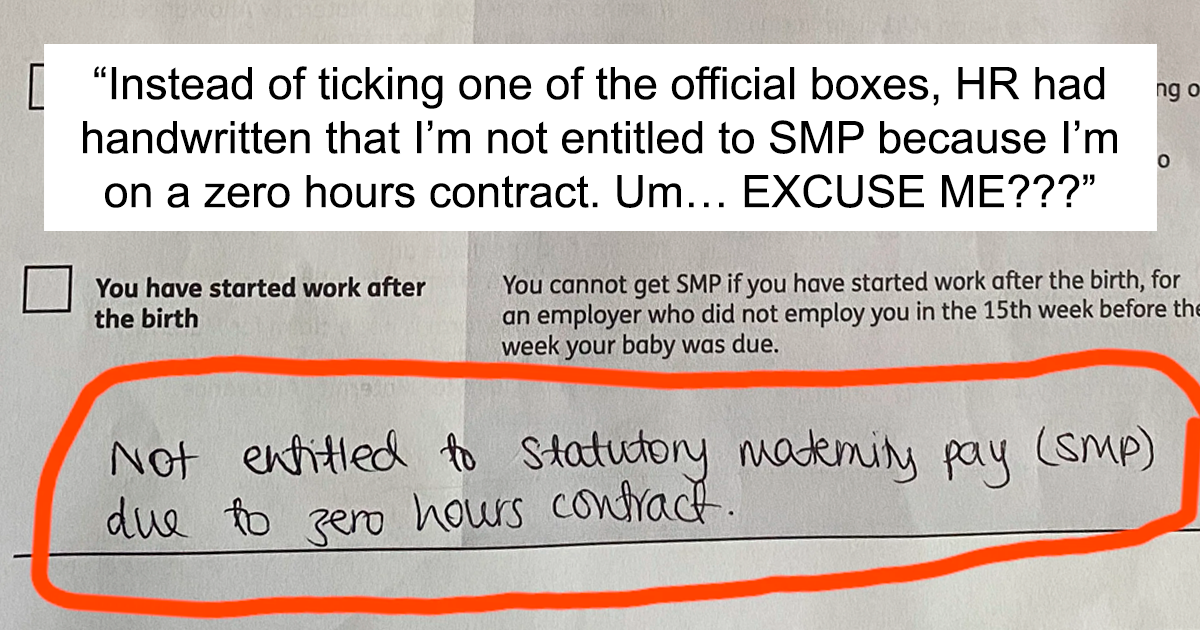
The worker claimed that instead of selecting an applicable official reason, HR had handwritten that she was ineligible because she was on a zero-hours contract. UK guidance says employers refusing SMP must provide the employee with an SMP1 form within the required time limits. The form is intended to explain the decision and can also help the worker pursue Maternity Allowance or challenge the refusal.
In other words, this was not an abandoned sticky note saying, “Maybe no maternity money?” It was reportedly the formal document used to justify the denial.
Her employer wanted the paperwork returned
After the employee contacted her employer, he initially said he would investigate. The following day, she claimed he told her the forms were “wrong” and asked her to bring them back.
She refused to surrender what she considered the only physical evidence of the company’s original explanation. Instead, she photographed, scanned, and safely stored the paperwork. She also began documenting her communications and said she planned to contact HMRC’s Statutory Payment Dispute Team and ACAS if the issue was not resolved promptly. HMRC specifically provides a dispute channel for workers who believe an employer has wrongly refused statutory pay or paid the incorrect amount.
Why the Alleged Excuse Raised So Many Red Flags
A contract label is not a complete eligibility analysis
The central problem was not merely that the company reached an unfavorable decision. Employers sometimes make legitimate eligibility determinations that employees dislike. The problem was that the reported explanation appeared disconnected from the actual statutory criteria.
Current UK rules generally require an eligible employee to have sufficient continuous service, remain on payroll during the qualifying week, meet the average earnings requirement, provide notice, and supply proof of pregnancy. The worker said she met those conditions, and she claimed HMRC agreed.
If an employer believes a worker is ineligible, the responsible approach is to show the dates, earnings figures, employment records, and rule supporting the determination. “Your contract sounds casual” is not the same thing as a properly documented calculation.
Deleting a message makes a routine disagreement look suspicious
A deleted WhatsApp message does not independently prove unlawful conduct. People delete messages for many reasons, including errors, privacy concerns, or the sudden realization that they have typed something spectacularly unhelpful.
However, when a message contains a benefits denial and disappears immediately after the employee challenges it, the deletion can damage trust. Asking for the physical form back after the worker has identified a questionable explanation makes the situation look even worse, whether the underlying cause was deliberate misconduct, poor training, or administrative confusion.
The employer could usually recover most statutory payments
The worker expressed confusion about why the company would resist paying SMP when employers can reclaim much of the statutory cost. UK guidance says employers can generally recover 92% of qualifying statutory payments, while businesses eligible for Small Employers’ Relief can currently recover 109%. That does not mean administering maternity pay is completely cost-free, but it undermines the idea that every pound necessarily comes straight from the employer’s pocket with no reimbursement.
This makes accurate payroll administration essential. HR and payroll teams are not merely distributing an optional company perk. They may be administering a legal entitlement under a government-backed system.
The Important U.S. Context: Maternity Leave and Maternity Pay Are Not the Same
Although the viral account occurred in the UK, American readers should not assume that the same rules apply in the United States. The terminology alone can create confusion. In everyday conversation, Americans frequently use “maternity leave” to describe any time away from work after childbirth. Legally, however, job protection, wage replacement, disability benefits, employer-paid parental leave, paid time off, and pregnancy accommodations may come from different laws and policies.
FMLA leave is generally job-protected but unpaid
The federal Family and Medical Leave Act allows eligible employees of covered employers to take up to 12 workweeks of job-protected leave for qualifying reasons, including childbirth, bonding with a new child, prenatal care, and certain pregnancy-related health conditions. Federal FMLA leave is generally unpaid, although paid time off or employer benefits may run concurrently with it. Eligibility also depends on factors such as employer size, length of service, hours worked, and worksite staffing.
Consequently, an American employee can qualify for protected leave without qualifying for wage replacement. Another employee may receive paid parental benefits under a company plan while not yet qualifying for FMLA. A third may have rights under a state program. Benefits administration is less a single road than a highway interchange designed by someone who had recently discovered ramps.
Federal law prohibits pregnancy discrimination
The Pregnancy Discrimination Act prohibits covered employers from treating workers unfavorably because of pregnancy, childbirth, or related medical conditions. An employer generally cannot deny opportunities, terminate employment, reduce assignments, or apply benefit rules differently because an employee is pregnant. Federal law also protects employees from retaliation for opposing unlawful discrimination or participating in an equal employment opportunity process.
The Pregnant Workers Fairness Act adds accommodation rights
The federal Pregnant Workers Fairness Act requires most employers with at least 15 employees to provide reasonable accommodations for known limitations related to pregnancy, childbirth, and related medical conditions unless doing so would create an undue hardship. Possible accommodations may include additional breaks, schedule modifications, temporary duty changes, seating, telework, or leave. Employers are also prohibited from retaliating against workers for requesting or using qualifying accommodations.
These protections do not automatically create universal paid maternity leave. They do, however, make it harder for covered employers to push pregnant workers out simply because temporary changes are inconvenient.
Paid family leave remains a patchwork
The United States still does not have a general federal program guaranteeing paid family leave to every private-sector employee. The Department of Labor reports that 13 states and the District of Columbia have enacted paid family and medical leave programs, while several other jurisdictions use different or voluntary models. Employees must therefore check federal law, state law, local rules, employer policies, union agreements, short-term disability coverage, and any private parental leave plan that may apply.
Access also varies sharply among workers. The Bureau of Labor Statistics reported that only 27% of civilian workers had access to paid family leave in March 2023. Research has repeatedly found that access tends to be better for higher-paid workers and employees in professional occupations than for lower-wage and service-sector workers.
How to Preserve Evidence Without Creating a New Workplace Problem
The most useful lesson from this maternity pay denial is not “sneak into the office before sunrise.” Employees should avoid trespassing, entering restricted areas, accessing another person’s account, taking confidential company data, or secretly recording conversations without understanding applicable law and company policy.
The safer principle is to preserve records that the employee lawfully possesses or is entitled to receive.
Save benefits documents and employment records
Workers should retain copies of their employment contract, employee handbook, parental leave policy, benefits summaries, pay stubs, time records, performance reviews, accommodation requests, medical certifications, and leave applications. When possible, store personal copies outside an employer-controlled email account that may become inaccessible during leave or after termination.
Request important decisions in writing
After a verbal meeting, an employee can send a calm follow-up email: “Thank you for meeting with me. My understanding is that the company has denied my maternity benefit because of X. Please let me know if I have misunderstood.”
This approach gives the employer an opportunity to correct an error while also creating a contemporaneous record. It is less dramatic than arriving with a trench coat and magnifying glass, but it is often more useful.
Keep a factual timeline
A strong timeline records dates, participants, statements, documents, and follow-up actions. It should distinguish between facts and assumptions. “HR told me on July 6 that I did not qualify” is a fact. “HR has hated me since the holiday party” may be a theory, even if the karaoke incident was unforgettable.
Preserve originals carefully
When an employee receives an original document intended for them, preserving it can be important. Make clear scans or photographs, note when and how the document was obtained, and avoid altering it. When ownership or confidentiality is uncertain, an employment attorney, union representative, government agency, or worker-rights organization can provide guidance before the document is distributed.
Use official complaint channels
Workers in the UK may be able to contact their employer, HMRC, ACAS, a union, or an employment adviser. American workers may contact the Department of Labor, the Equal Employment Opportunity Commission, a state labor department, a state civil rights agency, a union, or an employment lawyer, depending on the issue. The correct filing deadline and agency vary, so waiting indefinitely for HR to “circle back” can be risky.
What Competent HR Should Have Done Instead
Even if the company believed the employee was ineligible, the dispute did not need to become a viral cautionary tale. A competent process would have included a written decision, the relevant eligibility calculation, an explanation of the appeal route, copies of all required forms, and prompt correction of any administrative mistake.
HR should also remember that its credibility depends on consistency. Deleting communications, using informal messaging for major benefits decisions, or requesting the return of disputed paperwork can make an innocent error resemble a cover-up.
For employers in the United States, the safest approach is to coordinate parental benefits with FMLA, disability plans, state paid-leave programs, the Pregnancy Discrimination Act, and the Pregnant Workers Fairness Act. Managers should be trained not to improvise legal interpretations based on contract labels, assumptions about attendance, or opinions about how much leave a new parent “really needs.”
Conclusion: Experience-Based Lessons From Maternity Pay and HR Disputes
Experience 1: Verbal reassurance is rarely enough
Many workplace disputes begin with a friendly sentence: “Don’t worry, we’ll take care of it.” Problems appear weeks later when payroll has a different understanding, the manager has forgotten the conversation, or HR says the policy was never approved.
Workers who have navigated maternity leave successfully often create a simple paper trail early. They submit the expected leave dates, request confirmation of eligibility, identify every benefit involved, and ask which forms must be completed. This is not hostile behavior. It is basic administrative hygiene, like washing your hands before cookingexcept the casserole is your household income.
Experience 2: Policy language and payroll reality may conflict
An employee handbook might promise paid parental leave while a benefits document imposes a service requirement. A recruiter might describe “three months of maternity leave” without clarifying whether it is paid, protected, or funded through short-term disability. Payroll may classify the benefit differently from HR.
The practical lesson is to request the full plan terms rather than relying on a headline. Ask how much will be paid, when payments begin, whether there is a waiting period, whether accrued vacation must be used, whether health insurance continues, and whether state benefits offset the employer’s payment.
Experience 3: HR is a company function, not a personal advocate
Good HR professionals can be enormously helpful. They correct errors, explain benefits, stop retaliation, train managers, and prevent small problems from becoming lawsuits. But HR’s institutional role is to manage employment matters for the organization. Employees should therefore approach HR conversations professionally while independently checking their rights.
This does not require treating every HR representative like a movie villain stroking a cat in a swivel chair. It simply means verifying significant decisions through official policies, government guidance, or qualified advice.
Experience 4: Pregnancy makes administrative uncertainty more damaging
A maternity pay dispute is not merely an accounting inconvenience. Expectant parents are often budgeting for medical expenses, childcare, housing, reduced working hours, and an unpredictable recovery period. A sudden income denial can create intense stress at a time when the worker may already be managing physical limitations and frequent medical appointments.
That is why employers should resolve pregnancy-related benefit questions quickly. Delays, vague answers, and disappearing messages impose real costs even when the money is eventually paid.
Experience 5: The cover-up can become more damaging than the mistake
Payroll errors happen. HR employees misunderstand rules. Forms are completed incorrectly. An organization can often repair the damage by acknowledging the mistake, correcting the payment, preserving the records, and explaining what changed.
The situation becomes far more serious when employees believe documents are being deleted, explanations are being rewritten, or evidence is being collected from them. Attempts to make an earlier decision disappear can support distrust and may raise questions about retaliation or interference with protected rights.
The pregnant worker’s account resonated because she did not simply accept a confident denial. She checked the official rules, obtained the document explaining the decision, made copies, and prepared to use formal dispute channels. Whether the incident resulted from deliberate wrongdoing or remarkable incompetence, the lesson is the same: important employment decisions should survive daylight, documentation, and basic fact-checking.
Note: This article analyzes a self-reported social-media account that has not been independently adjudicated. Its discussion of UK and U.S. employment protections is general information, not legal advice. Eligibility, evidence rules, deadlines, and available remedies depend on the worker’s location and individual circumstances.