You know that feeling when you’re shopping for a nightstand and suddenly every option is either (a) too tall, (b) too tiny, (c) the exact color of “office printer beige,” or (d) costs the same as a small used car? Welcome to the oddly emotional world of bedside furniture.
The good news: you don’t actually need “the perfect nightstand.” You need a bedside solution that fits your space, your habits, and your nightly routine (yes, that includes your water cup, your phone charger, and the book you swear you’re going to finish). This guide will help you troubleshoot what’s going wrongand give you smart, stylish, sometimes sneaky alternatives that work just as well (sometimes better).
Step 1: Figure Out What “Right” Means (Because It’s Not Just “Cute”)
Before you buy anything, get clear on the problem you’re solving. Most nightstand frustration comes from one of three issues: wrong size, wrong function, or wrong vibe. Occasionally all threelike a triple espresso of regret.
Check the height first (your arm shouldn’t have to do parkour)
A nightstand works best when it’s roughly level with the top of your mattressor just slightly lower. If it’s way lower, you’ll feel like you’re reaching into the Mariana Trench for your phone. If it’s too high, your water glass becomes a gravity experiment.
Quick method: measure from the floor to the top of your mattress (including any topper). That number is your “target zone.” When shopping, filter by height whenever possiblebecause “standard” doesn’t mean what it used to when mattresses got thicker and beds got taller.
Then the width (scale matters more than you think)
A nightstand should feel proportional to your bed. Too narrow looks like it’s renting space beside the bed. Too wide makes the room feel crowded and can block drawers, doors, or your ability to walk without turning sideways like a crab.
As a general visual guide, many designers like nightstands that land somewhere between “modest” and “confident” in width, not “life raft.” For larger beds (queen/king), a wider piece often looks balanced. For a twin or a very tight room, a slimmer option is usually the move.
And depth (the silent deal-breaker)
Depth is the sneaky dimension that ruins everything. A piece can be the perfect height and still stick out so far you bruise your shin nightly. If you’re working with a narrow walkway, prioritize shallow nightstands, wall-mounted options, or pieces with vertical storage.
Step 2: Write a “Bedside Job Description”
Pretend you’re hiring your nightstand like an employee. What must it do every day? What would be nice? What is absolutely not allowed? (If it wobbles, it’s fired.)
Common must-haves
- Surface space for the essentials: phone, water, glasses, book/Kindle, tissues.
- Lighting support: a lamp, a mounted sconce nearby, or space for a clip-on light.
- Charging plan: outlets nearby, cable routing, or a setup that won’t look like a robot octopus.
- Storage (optional but powerful): drawers or a shelf to keep clutter from breeding overnight.
Nice-to-haves that change your life
- A drawer that fits the “small stuff” category (lip balm, earplugs, meds, hand cream, the remote that disappears).
- Soft-close hardware (because slamming a drawer at midnight is a jump scare for your whole household).
- Easy-clean finish (especially if you’re a “tea in bed” person).
- Pet-proof or kid-proof stability (four-legged and two-legged chaos both count).
Step 3: Stop Searching for a NightstandSearch for a Bedside Solution
Here’s the secret interior designers don’t whisper because it’s not actually a secret: your bedside table does not have to be a nightstand. If every “nightstand” you see feels wrong, switch categories.
Nightstand alternatives that work shockingly well
- Small dresser or chest: more storage, more surface area, and it can replace a dresser in a tight room.
- Stool or accent chair: great for minimalists, renters, or anyone who wants “easy.” Add a tray for stability.
- Nesting tables: pull out extra surface space when you need it, tuck it away when you don’t.
- Bar cart: yes, really. Top shelf for lamp + book, lower shelves for linens, skincare, or “I live here now” clutter.
- Desk-as-nightstand: ideal if your bedroom doubles as a work zone. One piece, two jobs.
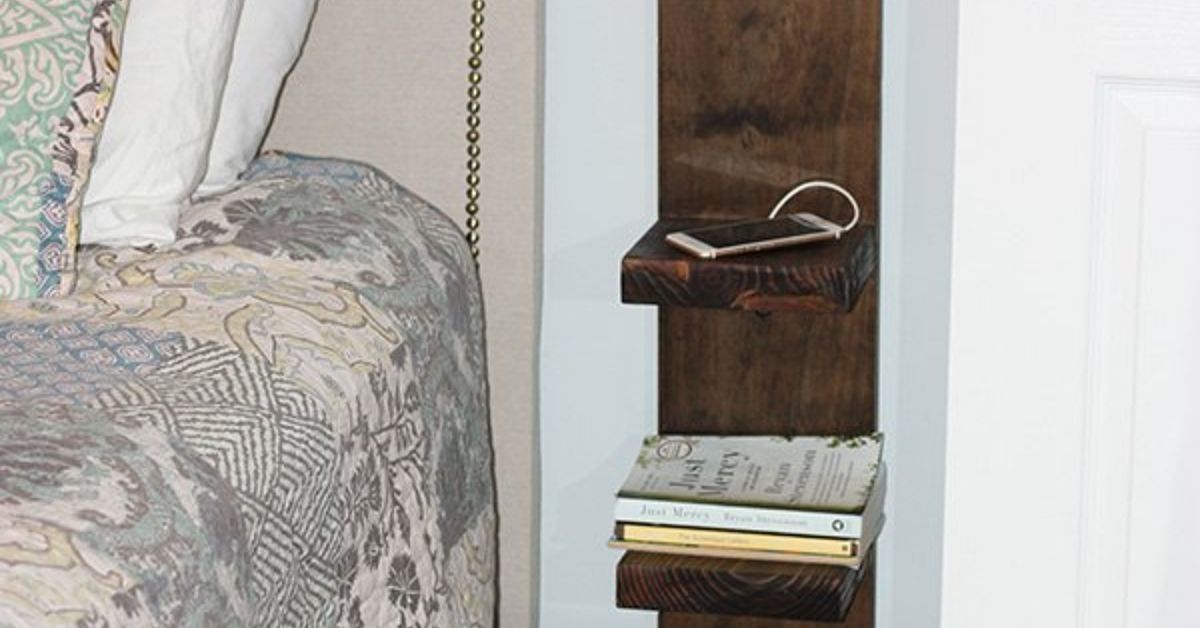
- Wall shelf: clean look, tiny footprint, and your toes will thank you.
- Book stack + tray: temporary, stylish, and surprisingly functionaljust keep it stable and not near liquids.
The trick is to match the alternative to your routine. If you need storage, don’t choose a single tiny stool and then act shocked when your stuff becomes a pile. If you need just a phone-and-water landing pad, don’t buy a bulky piece that eats half your floor.
Step 4: If Your Room Is Small, Go Vertical (And Cheeky)
Small bedrooms don’t need smaller lives. They need smarter geometry. When floor space is limited, your best friends are: wall-mounted storage, slim silhouettes, and lighting that doesn’t hog the tabletop.
Space-saving setups that feel intentional
- Floating nightstand or shelf: keeps the floor clear and makes the room feel bigger.
- Clip-on bedside shelf: perfect for dorms, bunk beds, and “I refuse to drill holes” renters.
- Wall sconce: frees up surface area and adds that boutique-hotel energy.
- C-table style side table: slides under the bed edge for a tight footprint.
- Headboard with built-in ledge: gives you a landing zone without adding furniture bulk.
Pro move: when you go minimal on the table, upgrade the organization. A small tray for nightly essentials and a drawer insert (or small bin) keeps “tiny table” from becoming “tiny disaster.”
Step 5: Mismatched Nightstands Are AllowedJust Make Them Look Like a Choice
If you’re stuck because you can’t find a matching pair, stop. Matching is optional. Coordinated is the goal. Two different pieces can look curated if they share one of these: height, material tone, shape language, or hardware finish.
Easy ways to unify mismatched bedside tables
- Keep the heights close so the bed line feels calm.
- Use matching lamps or matching art above each side for symmetry.
- Repeat a finish: black metal, warm wood, brass pullspick your “theme ingredient.”
- Balance visual weight: if one table is chunky, keep the other one visually grounded too (not spindly).
The only real mistake is trying to pretend two wildly different pieces “accidentally” ended up there. Own it. Design confidence is 80% posture.
Step 6: When the Piece Is Fine but the Finish Is Wrong, Upgrade It
Sometimes you actually found the right nightstand… and then it arrived looking like it belongs in a dentist’s waiting room from 1997. Luckily, nightstands are one of the easiest furniture items to tweak.
Simple upgrades that don’t require a woodworking degree
- Swap the hardware: new pulls can instantly change the style (modern, vintage, glam, minimal).
- Paint it: a matte neutral, a moody color, or a bold pop. Light sanding + primer helps it last.
- Peel-and-stick wallpaper inside drawers or on the back panel for a fun surprise.
- Add a liner: protects the surface from water rings and makes cleaning easier.
- Distress it lightly for cottage or vintage character (practice first so “charming” doesn’t become “oops”).
If you’re shopping secondhand, upgrades are even more satisfying because you’re rescuing a perfectly functional piece from the land of forgotten furniture. Very heroic. Very budget-friendly. Slightly smug (in a good way).
Step 7: If Your Nightstand Never Looks Right, Your Nightstand Might Not Be the Problem
Let’s talk about the real villain: bedside clutter. A nightstand can be the perfect size and still look “wrong” if it’s hosting a chaotic convention of cups, cords, lotions, receipts, and one lonely sock.
A practical declutter routine that actually sticks
- Sort into three piles: use nightly, belongs elsewhere, and done with it.
- Create a boundary: choose a small tray or container and only keep what fits inside it.
- Give cords a job: use clips, a cable box, or a charger tucked into a drawer.
- Use drawers on purpose: add dividers so items don’t become a junk soup.
- Do a 60-second reset: daily if you can, weekly at minimum. Your future self loves you for this.
Bonus tip: keep a small wastebasket nearby. A nightstand covered in tissues and wrappers will never look like the calming sanctuary you imaginedeven if the table itself is gorgeous.
Step 8: Shop Smarter (So You Don’t Buy and Return Your Way Into Despair)
If you’ve been scrolling for weeks, it’s time to change the strategy. Shopping fatigue makes everything look bad. Here’s how to tighten your search so the right nightstand (or bedside table) shows up faster.
Use better search terms
- Instead of “nightstand,” try: bedside table, narrow side table, floating nightstand, C-table, chairside table, small chest, bedside shelf, console table.
- If you want storage: add drawer, charging, cabinet, open shelf.
Mock it up before you commit
Use painter’s tape on the floor to outline the footprint, or stack boxes to approximate the height. Live with it for a day. If you keep bumping it, it’s too deep. If you can’t reach it comfortably, the height is off. If it feels like it’s swallowing the bed, it’s too big. This is the low-tech test that saves money and sanity.
Don’t ignore secondhand
Vintage shops, consignment, and online marketplaces are full of solid wood pieces that outlast many “fast furniture” options. Plus, a slightly weird vintage piece often looks more high-end than a perfectly matched set that screams “I clicked ‘Add Both to Cart.’”
Step 9: A Quick “Good Enough” Decision Framework
If you’re stuck, use this checklist. The “right nightstand” doesn’t need to be magicalit needs to be functional and visually calm.
- Comfort: Can you reach it easily from bed?
- Clearance: Can you walk past it without bruising yourself nightly?
- Capacity: Does it hold what you truly use (not what you imagine you’ll use)?
- Control: Can you keep it tidy with the storage it offers?
- Compatibility: Does it play nicely with your bed style and the room’s overall tone?
If you can say “yes” to most of these, you’ve found a winner. And if it’s not forever? Great. Temporary solutions are allowed. Your bedroom is not a museum exhibit. It’s where you sleep.
Conclusion
When you can’t find the right nightstand, don’t force it. Measure your bed, define your bedside needs, and broaden the search to smart alternativesfloating shelves, stools, small chests, bar carts, even a desk. Then finish strong with simple styling and clutter control so your bedside setup looks intentional, not accidental.
The best bedside table is the one that makes your life easier at 2:00 a.m.not the one that looked cute for five seconds on a product page.
Real-World Experiences: What People Actually Do When the Nightstand Hunt Goes Sideways
Here’s what tends to happen in the wild (aka actual bedrooms) when someone can’t find the right nightstand. These are the patterns, the workarounds, and the “why did I not do this sooner?” moments that show up again and again.
1) The “My mattress is basically a skyscraper” situation
Someone buys a new mattressmaybe a pillow-top, maybe a topper on a topper (we’re not judging). Suddenly, their old nightstand looks like it’s crouching. The fix that usually sticks isn’t buying a random taller table and hoping for the best. It’s measuring the true mattress height, then looking for a piece that lands close to that line. When options feel limited, people often pivot to a small chest or a compact dresser because those pieces are commonly taller and offer drawers. Bonus: the drawers become the official home for chargers, lip balm, and the “miscellaneous bedtime items” that love to multiply.
2) The “My room is the size of a generous closet” problem
In tiny bedrooms, the classic complaint is: “Every nightstand is too deep.” The workaround that actually feels good is going vertical. A floating shelf placed at the right height becomes a clean landing zone. People who can’t or won’t drill often choose a clip-on bedside shelf (especially in dorms and rentals). Pair it with a wall sconce or a clip lamp and suddenly the tabletop isn’t fighting for space with a lamp base the size of a dinner plate. The mood shifts from cramped to clever fast.
3) The couple who disagrees on what a nightstand is “for”
One person wants a minimalist surface: phone, water, book. The other person wants storage for everything short of a camping tent. This is where mismatched nightstands become the peace treaty. Two different pieces can absolutely work if they’re the same height and visually balanced. People often unify the look with matching lamps or matching art above the bed. The result feels curatedlike a boutique hotelrather than “we gave up halfway through shopping.”
4) The “I bought it online and it looked bigger in the photos” regret
This is extremely common. The table arrives, and it’s either dollhouse-small or comically large. The habit that prevents repeat offenses is the low-tech mock-up: painter’s tape on the floor for the footprint and stacked boxes for height. Living with the mock-up for a day reveals the truth. If you bump it constantly, it’s too deep. If you can’t open a drawer comfortably, the layout is off. If it blocks a closet door, it’s a no. People who start doing this rarely go back to blind buyingbecause shin bruises are persuasive teachers.
5) The “It’s the right size but it still looks wrong” mystery
Often the table is fine. The problem is the clutter ecosystem living on top of it. People try buying a new nightstand to fix the mess, but the mess just moves in and redecorates. The fix is boundaries: a small tray for nightly essentials, a drawer insert so items can’t form a chaotic pile, and a quick reset routine (even 60 seconds) so yesterday’s cups and wrappers don’t become a permanent installation. Once the surface is controlled, the nightstand suddenly “fits” the room. It’s not magic. It’s maintenanceand it’s way cheaper than replacing furniture again.
6) The “I need a nightstand now, not after 47 more tabs” emergency
The fastest wins come from repurposing: a stool with a tray, a small chair, a stack of sturdy books topped with something flat, or a slim side table already living elsewhere. People do this as a temporary fix and then realize… it’s actually working. The key is being honest about your routine. If you’re a “just my phone” person, minimal solutions feel great. If you’re a “water, meds, lotion, book, journal” person, you’ll be happier with drawers or a shelf. Either way, the biggest relief tends to come from choosing something functional now, then upgrading later when shopping feels fun again.