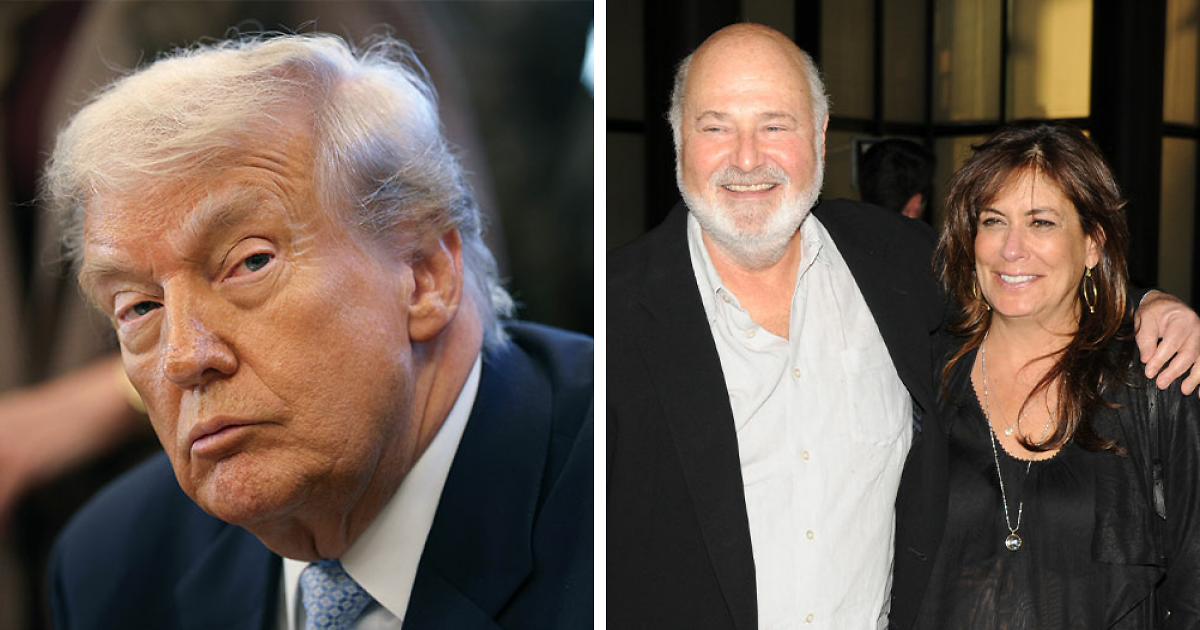
Note: This article is written from verified public reporting available as of June 17, 2026. It discusses a real political controversy and a real criminal case in a careful, non-graphic way. Nick Reiner has been charged, and the case should be treated as ongoing unless resolved by a court.
In American public life, there are moments when even the loudest political megaphone is expected to go quiet for a second. A family tragedy is usually one of them. But after the deaths of actor-director Rob Reiner and his wife, Michele Singer Reiner, President Donald Trump posted a message suggesting the couple’s fate was tied to what he called “Trump Derangement Syndrome,” or “TDS.” The reaction was fast, loud, and unusually bipartisan.
Some Trump supporters shrugged. Others winced. Critics called it cruel. One social media reaction summed up the mood in five sharp words: “This is seriously distasteful.” In an online culture where people will argue about literally anything pizza toppings, movie rankings, whether a hot dog is a sandwich the backlash stood out because it crossed the usual party lines. The issue was not simply whether people agreed with Rob Reiner’s politics. It was whether a violent family tragedy should be turned into a political punchline before the public even had time to process the facts.
Rob Reiner was not just another Hollywood celebrity with a verified account and a drawer full of opinions. He was a major figure in American entertainment: the actor known to millions as Mike “Meathead” Stivic on All in the Family, and the filmmaker behind classics such as This Is Spinal Tap, Stand by Me, The Princess Bride, When Harry Met Sally…, Misery, and A Few Good Men. He was also a vocal progressive activist and a frequent critic of Trump. Michele Singer Reiner, a photographer and producer, was his longtime partner in life and advocacy. Their deaths shocked Hollywood, political circles, and fans who knew Reiner’s work even if they had never followed his politics.
The Post That Sparked The Backlash
Trump’s post described Reiner as a once-talented director and comedy star whose life, in Trump’s telling, had been consumed by anger toward him. The most controversial part was the claim that Reiner and Michele died “reportedly” because of the anger Reiner supposedly caused through “Trump Derangement Syndrome.” That phrasing did two things at once: it mocked Reiner’s politics and appeared to connect those politics to a still-developing criminal investigation.
That was the part many readers found impossible to brush off. “TDS” is not a medical diagnosis. It is a political insult, usually used by Trump supporters to dismiss critics as irrationally obsessed with him. In ordinary campaign banter, the phrase is already abrasive. Dropped into a post about two newly deceased people, it landed like a cymbal crash at a funeral. Technically audible, yes. Socially advisable, absolutely not.
The backlash came from predictable places, including Democrats, Hollywood figures, and late-night hosts. But it also came from Republicans who rarely spend their day defending liberal filmmakers. GOP lawmakers including Rep. Mike Lawler, Rep. Thomas Massie, and Rep. Marjorie Taylor Greene publicly pushed back on the tone of the post. Greene, who had been a Trump ally before their public split, said the deaths were a family tragedy and not a matter of politics or political enemies. Massie criticized the post as inappropriate and disrespectful. Lawler called the overall message wrong and said the moment called for sympathy and compassion.
What We Know About The Reiner Case
Rob and Michele Reiner were found dead at their Los Angeles home in December 2025. Authorities opened a homicide investigation, and their son, Nick Reiner, was arrested and later charged with two counts of first-degree murder. Prosecutors also alleged special circumstances because there were two victims. As of the latest reporting, the case remains a legal matter, and guilt or innocence is for a court to determine.
That distinction matters. Public tragedies often become rumor machines, especially when a famous family, politics, and social media collide. In this case, official reporting established that investigators were treating the deaths as homicides and that Nick Reiner faced serious charges. What reporting did not establish was Trump’s claim that Reiner’s anti-Trump politics somehow caused the deaths. That is why many outlets and commentators described the claim as baseless or unsubstantiated.
In other words, the confirmed facts were already painful enough. Adding a political diagnosis to the situation did not clarify anything. It simply poured gasoline on a fire and then acted surprised that smoke appeared.
Why Rob Reiner Was Such A Political Target
To understand why Trump singled out Reiner, it helps to understand Reiner’s public identity. He was not a celebrity who occasionally posted “vote” once every four years and then returned to brunch. Reiner spent decades in progressive politics. He supported Democratic candidates, backed LGBTQ rights, advocated for early childhood programs, and helped fund efforts connected to marriage equality. He was also blunt in his criticism of Trump, often describing Trump as a danger to democracy.
That made him a familiar villain in pro-Trump media spaces. For some conservatives, Reiner symbolized the Hollywood liberal: wealthy, famous, politically outspoken, and not exactly shy with his opinions. But even people who strongly disagreed with Reiner’s politics argued that the timing and tone of Trump’s post were out of bounds. Political disagreement is one thing. Using a death announcement as a scoreboard is another.
Reiner’s career also complicates any attempt to flatten him into a partisan caricature. Millions of Americans who loved The Princess Bride or Stand by Me did not need to share his politics to appreciate his work. His films were about friendship, courage, memory, romance, grief, justice, and the strange human habit of making life both beautiful and ridiculous. Reducing that life to a political insult felt, to many, like trying to summarize the Grand Canyon as “a big ditch.” Technically related. Spiritually clueless.
The Meaning Of “TDS” In This Controversy
“Trump Derangement Syndrome” has long functioned as shorthand for “you dislike Trump too much to think clearly.” It is a phrase built for partisan combat, not emotional precision. In Trump-friendly circles, it can be used jokingly or aggressively to wave away criticism. But in the Reiner post, the phrase became more than a dig. It became the center of a national argument about decency, grief, and political dehumanization.
One reason the phrase triggered such anger is that it sounds clinical while remaining political. It borrows the language of illness without carrying the responsibility of medicine. That can be especially damaging when used around death, mental health, family crisis, or violence. In this case, critics said it turned a human tragedy into a taunt.
The controversy also exposed a broader fatigue in American politics. Many people are tired of every event being dragged into the same partisan mud pit. A movie star dies? Politics. A storm hits? Politics. Someone changes a cereal mascot? Somehow, politics. The public square has started to feel like a group chat where no one can mute the loudest person. Trump’s Reiner post became a symbol of that exhaustion.
Rare Republican Pushback Made The Story Bigger
Trump is no stranger to criticism, but criticism from his own side always changes the shape of a story. When Democrats object to Trump’s rhetoric, it is expected. When Hollywood objects, it is expected. When late-night hosts object, it is practically part of the job description. But when Republicans publicly say a Trump post went too far, the story gains a different kind of weight.
That is what happened here. Several Republican figures did not defend Reiner’s politics. They defended the basic idea that a family tragedy should be treated with restraint. This distinction matters because it shifts the conversation away from left versus right and toward a simpler question: What does public leadership require when someone dies?
Some Trump allies tried to redirect the conversation by pointing out that Reiner had made harsh comments about Trump in the past. That argument may explain resentment, but it does not erase the question of timing. Public figures criticize each other constantly. That is part of politics. But the ethical expectation after death is different. Most people understand this instinctively. You do not have to admire someone to avoid mocking their family tragedy. That is not political correctness. That is basic home training.
Hollywood’s Response: Grief, Anger, And Legacy
Hollywood’s response mixed grief for Reiner’s creative legacy with anger at Trump’s comments. Actors, directors, comedians, and fans remembered Reiner as a rare filmmaker who moved comfortably across genres. He could make a mockumentary, a coming-of-age drama, a fairy-tale adventure, a romantic comedy, a courtroom thriller, and a Stephen King adaptation without seeming like he had wandered into the wrong studio lot.
Late-night host Jimmy Kimmel was among those who sharply criticized Trump’s comments, calling them hateful and vile. That reaction was personal as well as political. Reiner had deep ties across the entertainment world, and many performers viewed him not only as a colleague but as a mentor, collaborator, and cultural architect.
There was also sadness over Michele Singer Reiner, whose life risked being overshadowed by the political firestorm around her husband. Michele was a photographer, producer, and advocate, and she had her own history of creative and social engagement. Critics of Trump’s post noted that any political jab at Rob also dragged Michele into a claim that had no confirmed basis. In a moment that should have centered two lives, the conversation became another national shouting match.
How Social Media Turns Grief Into Combat
The speed of the backlash was classic social media. A post goes up. Screenshots fly. Supporters defend. Critics condemn. Pundits assemble like someone lit the Bat-Signal, except the signal is a push notification and everyone is already angry before lunch.
That speed creates a problem: grief needs time, but social media rewards immediacy. The platform does not ask, “Is this thoughtful?” It asks, “Will people react?” And people did react. The post generated news stories, cable segments, quote posts, and moral arguments within hours. In algorithm terms, it was successful. In human terms, it was bleak.
This is the uncomfortable truth of the controversy: outrage is a business model. A shocking statement creates attention. Attention creates traffic. Traffic creates incentives for more shocking statements. The Trump-Reiner episode became another example of how public mourning can be swallowed by the machinery of political engagement.
Why The Backlash Resonated Beyond Politics
The phrase “seriously distasteful” resonated because it sounded like a moral line being drawn by someone who was not necessarily a political opponent. It was not the most dramatic criticism. It was not a ten-paragraph essay. It was a short, almost weary response: this is too much.
That kind of reaction matters. Many Americans are not shocked by political insults anymore. They have been marinated in them for years. But there are still moments when tone breaks through the numbness. Death is one of them. Family tragedy is another. When those two meet, people expect even rough-edged leaders to show restraint.
Trump’s defenders often argue that his bluntness is part of his appeal. He says what others will not. He ignores elite manners. He punches back. But the Reiner controversy revealed the limit of that argument for some supporters. Punching back at a living critic during a campaign rally is one thing. Punching at someone immediately after a violent death is another. The gloves-off style that energizes a crowd can look very different when the arena is a grieving family.
Leadership, Decency, And The Presidential Megaphone
Presidents are not ordinary posters. Their words carry institutional weight, even on social media. When a president comments on a tragedy, the message can comfort, divide, inflame, or clarify. That is why presidential statements after disasters, deaths, and attacks are usually scripted with care. They are meant to be bigger than the president’s personal feelings.
Trump’s post did the opposite. It made the moment smaller, more personal, and more partisan. Instead of honoring the dead, expressing sympathy, or waiting for law enforcement facts, it redirected attention to Trump himself. That is what critics found so jarring. The tragedy became another chapter in the endless Trump-centered political drama.
There is also a practical risk. When leaders speculate publicly about motive before investigators do, it can pollute public understanding. In high-profile cases, misinformation spreads quickly and can be difficult to correct. Even when a claim is later debunked or unsupported, the first version often sticks. That is why restraint is not just polite. It is useful.
The Bigger Lesson From The Reiner Controversy
The backlash over Trump’s Reiner post is not only about one message. It is about the condition of public speech in America. The country has become so accustomed to political combat that compassion can seem almost old-fashioned, like handwritten thank-you notes or phones with actual buttons. But the reaction to the post suggests that many people still want some boundaries.
Those boundaries do not require everyone to pretend Rob Reiner was apolitical. He was deeply political. They do not require conservatives to suddenly love his activism. They do not require Democrats to ignore his flaws or complexities. They simply require that death not be treated as a dunking opportunity.
That should not be a radical standard. It should be the floor. A low floor, yes, but apparently one we keep tripping over.
Experience And Reflection: What This Moment Teaches About Online Reactions
Anyone who has spent time reading political comment sections knows the pattern. A public figure dies, and within minutes the internet divides into teams. One side posts tributes. Another side posts receipts. Someone says “now is not the time.” Someone else replies, “It is always the time.” Then the argument becomes less about the person who died and more about who is allowed to feel what.
The Reiner controversy offers a useful experience-based lesson for readers, publishers, and anyone managing a public platform: timing changes meaning. A joke that might sound merely harsh in a debate can sound cruel in the shadow of a death. A political insult that might get applause at a rally can feel grotesque when a family is mourning. Context is not decoration. It is the whole room.
For writers and editors, this story is a reminder to slow down before amplifying claims. The most clickable angle is not always the most responsible one. A headline about “TDS” will attract attention, but a good article must also make clear what is verified and what is not. In this case, the verified facts include the deaths, the homicide investigation, the charges against Nick Reiner, Reiner’s long record of anti-Trump criticism, and the backlash to Trump’s post. The unverified leap is the suggestion that Reiner’s politics caused the tragedy. Responsible coverage should not let a provocative claim wear the costume of fact.
For public figures, the experience is even simpler: condolences are not hard. You can say, “This is a terrible tragedy. My thoughts are with the family.” That sentence will not win a Pulitzer, but it also will not launch a national decency debate before breakfast. Not every moment needs a brand voice. Not every tragedy needs a political angle. Sometimes the best message is the one that does not try to score.
For readers, the lesson is to notice emotional manipulation. Political language often tries to tell us whom we are allowed to mourn. It suggests that compassion is weakness if the person belonged to the wrong tribe. That is a dangerous habit. A society that can only grieve for its own side is not strong. It is brittle.
Rob Reiner lived a public life full of art, argument, activism, humor, success, criticism, and contradiction. Michele Singer Reiner lived a life connected to creativity, family, and advocacy. Their deaths deserved space for grief before becoming a weapon in the culture war. The fact that so many people, including some Trump supporters and Republicans, objected to the post suggests that the appetite for cruelty has limits.
That may be the small hope inside an ugly episode. Even in a polarized country, some moments still make people say, “No, not this.” The phrase “this is seriously distasteful” became memorable because it was not complicated. It was a human reaction to a human line being crossed.
Conclusion
The controversy over Trump’s post about Rob and Michele Reiner shows how quickly grief can be politicized in the social media age. Trump’s claim that Reiner’s death was connected to “TDS” was widely criticized because it appeared to mock a deceased critic, pull Michele Reiner into a partisan attack, and suggest a motive that authorities had not established. The backlash mattered not only because Democrats and entertainers objected, but because some Republicans did too.
Rob Reiner was a filmmaker, actor, activist, and outspoken Trump critic. That political history is part of the story. But it is not the whole story, and it does not justify turning a family tragedy into a partisan punchline. In a culture addicted to instant reaction, the Reiner controversy reminds us that restraint is not silence. Sometimes restraint is the last remaining evidence that we still recognize each other as human.