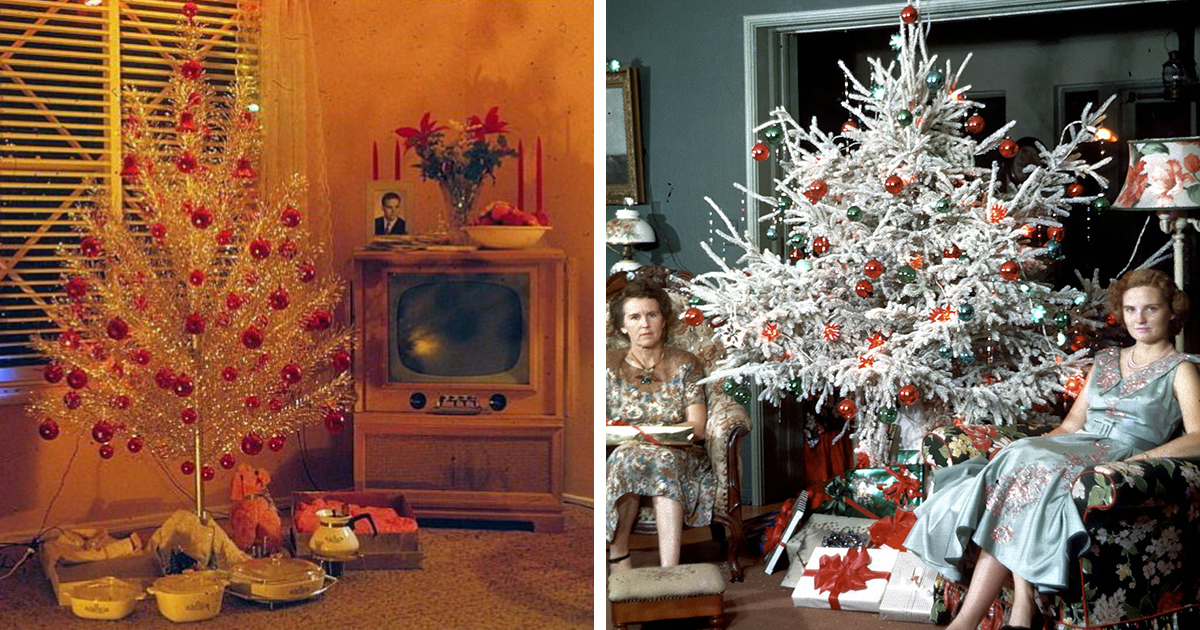
Look at enough Christmas home decor photos from the 1950s and 1960s, and one thing becomes clear: the holiday season did not simply arrive back then. It moved in, plugged itself into the nearest wall socket, shook a box of tinsel over the living room, and made itself comfortable next to the hi-fi cabinet.
These vintage Christmas photos are more than charming snapshots of trees, stockings, ornaments, and smiling families in suspiciously stiff holiday outfits. They are tiny time machines. In one frame, you might see a flocked tree glowing beside a console television. In another, an aluminum Christmas tree sparkles under a rotating color wheel like it is preparing for lift-off. A third photo may show a mantel crowded with candles, plastic reindeer, greeting cards, and a Santa figurine who looks both cheerful and mildly overwhelmed.
The title “50 Photos Of Christmas Home Decor In The 1950s And 1960s Show How Much Things Have Changed” works because the change is visible instantly. Today’s Christmas homes often feature coordinated themes, LED lights, oversized wreaths, influencer-approved garlands, smart plugs, neutral palettes, and ornaments chosen to match the couch. Mid-century homes were different. They were warmer, busier, shinier, more experimental, and sometimes gloriously impractical. If modern decor says, “I planned this aesthetic,” vintage decor says, “We found another box in the attic, and yes, every single thing is going on the tree.”
Why 1950s and 1960s Christmas Decor Still Fascinates Us
The Christmas decor of the 1950s and 1960s sits at the crossroads of nostalgia, postwar optimism, and rapidly changing American home life. After World War II, many families moved into suburban homes, bought new appliances, filled living rooms with modern furniture, and embraced a brighter consumer culture. Christmas decorating became part family ritual, part neighborhood performance, and part department-store dream.
In the 1950s, many homes still leaned toward traditional Christmas charm: green trees, glass ornaments, red bows, pine garlands, candles, stockings, and cozy living room scenes. But the decade also brought a new love of novelty. Flocked trees gave families a snowy look even if they lived nowhere near a snowdrift. Shiny Brite ornaments added bright color and sparkle to ordinary evergreens. Bubble lights brought movement to the tree, flickering like tiny holiday lava lamps before lava lamps had their big cultural moment.
By the 1960s, the mood became bolder. The space age had entered the living room. Aluminum trees, metallic garlands, pastel ornaments, starbursts, atomic shapes, and color wheels made Christmas feel futuristic. Some trees looked less like they came from the forest and more like they had been assembled by a cheerful engineer with a fondness for glitter.
What the 50 Photos Reveal About Mid-Century Christmas Homes
A collection of 50 vintage Christmas home decor photos from the 1950s and 1960s usually reveals patterns that are easy to miss when viewing just one image. Together, they show how people decorated, what they valued, how family rooms functioned, and how design trends moved from magazines and department stores into everyday homes.
1. The Christmas Tree Was the Undisputed Star
In most mid-century Christmas photos, the tree dominates the room. It is not tucked politely in a corner as a tasteful accent. It takes up visual space with confidence. A real evergreen might be loaded with glass ornaments, strands of tinsel, candy canes, electric lights, and a star or angel on top. Some trees were full and lush; others were sparse enough to let ornaments dangle properly. Either way, the tree was treated like the family’s seasonal celebrity.
Flocked trees were especially popular in the 1950s. Their white, snow-dusted branches matched the era’s love of drama and glamour. They looked fantastic in black-and-white photographs, where the pale branches popped against dark furniture and patterned wallpaper. A flocked tree beside a mid-century sofa could make an ordinary living room look like a department-store window display.
2. Aluminum Trees Made Christmas Look Like the Future
Nothing says “1960s Christmas” quite like an aluminum tree. These shiny artificial trees became famous for their metallic branches and their need for a rotating color wheel rather than traditional string lights. The wheel would cast red, blue, green, and amber light onto the silver branches, changing the mood of the room every few seconds. It was part Christmas tree, part science project, part living-room nightclub.
To modern eyes, aluminum trees can look wonderfully strange. They are not cozy in the classic pine-scented way. They are sleek, reflective, and a little theatrical. But that was exactly the appeal. In an era fascinated by rockets, modern appliances, chrome finishes, and futuristic design, a silver tree felt current. It said the future had arrived, and apparently it had brought ornaments.
3. Ornaments Were Smaller, Shinier, and More Sentimental
Many vintage Christmas photos show trees decorated with glass ornaments that were delicate, colorful, and often mass-produced. Shiny Brite ornaments, in particular, became an important part of the American holiday look. Their striped, stenciled, and brightly colored designs gave trees a cheerful sparkle without requiring a luxury budget.
Unlike many modern ornament collections, which may be oversized or carefully matched, mid-century trees often had a charming mix. Round glass balls sat beside bells, stars, Santas, angels, indented ornaments, and handmade pieces from children. A tree might include heirlooms, five-and-dime finds, school crafts, and one slightly mysterious ornament nobody remembered buying but everyone accepted as part of the family.
4. Tinsel Was Not a Detail. It Was a Lifestyle.
Modern decorators often use tinsel sparingly, if they use it at all. In 1950s and 1960s Christmas photos, tinsel frequently appears in generous amounts. It hangs from branches like silver rain, catches the glow of colored bulbs, and gives even a modest tree a glamorous shimmer.
The technique varied by household. Some people placed tinsel strand by strand with patient precision. Others appeared to have tossed it by the handful and trusted Christmas magic to handle the rest. Both methods produced memorable results. A heavily tinselled tree might look chaotic up close, but in a dim room with glowing lights, it could be breathtaking.
5. The Living Room Was a Holiday Stage
Christmas decor in mid-century photos often tells us as much about the living room as it does about the holiday. The tree usually stands near a sofa, fireplace, picture window, console TV, or stereo cabinet. Wrapped gifts spread across the floor. Children pose in pajamas. Adults sit nearby with coffee, cigarettes, or the focused expression of someone hoping the camera flash works the first time.
The living room was where the holiday happened. It was the place for gift opening, family photos, visiting relatives, Christmas music, and the display of new household pride. In many images, the furniture matters: tapered legs, patterned upholstery, kidney-shaped coffee tables, pole lamps, and wood-paneled walls all frame the Christmas decorations. The decor was not separate from mid-century design; it was woven into it.
1950s Christmas Decor: Cozy, Colorful, and Proudly Domestic
The 1950s holiday home was often built around warmth and abundance. Decor reflected the postwar household’s interest in comfort, family life, entertaining, and cheerful color. Red and green remained classic, but they were joined by silver, gold, pink, turquoise, and icy white.
Kitchen and dining spaces also received attention. Holiday tablecloths, printed napkins, candles, punch bowls, cake stands, and ceramic figurines appear again and again in vintage photos. Christmas was not limited to the tree. It spread across tabletops, shelves, hutches, windows, doors, and mantels. If there was a flat surface, someone could place a Santa on it. If there was no flat surface, someone could probably tape a bow to it.
Outdoor decor was simpler than what many neighborhoods display today. Instead of computerized light shows and inflatable snowmen taller than a garage, many homes used wreaths, candles in windows, a few strings of large colored bulbs, or greenery around the front door. The effect was often modest but inviting.
1960s Christmas Decor: Space-Age Sparkle Meets Family Tradition
The 1960s did not abandon tradition; it gave tradition a shiny new outfit. Many families still used natural trees, handmade stockings, nativity scenes, and classic red-and-green decorations. But the decade’s appetite for modern design changed the look of Christmas.
Artificial trees became more visible. Aluminum trees, PVC trees, tabletop trees, and color-coordinated displays gave homeowners more options. Some families embraced pastel ornaments and metallic garland. Others chose dramatic themes, inspired partly by the growing popularity of curated holiday displays in stores, magazines, and public spaces.
The idea of a themed Christmas tree also gained cultural momentum. Instead of simply hanging every ornament available, some decorators began thinking in terms of color schemes, concepts, and visual harmony. That shift feels very familiar today, where a tree might be “woodland farmhouse,” “champagne glam,” “Scandinavian minimal,” or “I saw this on Instagram and now my dining room has three kinds of ribbon.”
Then vs. Now: How Christmas Home Decor Has Changed
| Decor Element | 1950s and 1960s Style | Modern Style |
|---|---|---|
| Christmas Tree | Natural, flocked, aluminum, or early artificial trees | Pre-lit artificial trees, slim trees, themed trees, and realistic faux evergreens |
| Lighting | Large colored bulbs, bubble lights, and color wheels | LED lights, smart lights, app-controlled displays, and warm white strands |
| Ornaments | Glass balls, Shiny Brite ornaments, handmade crafts, tinsel, and family keepsakes | Coordinated ornament sets, personalized ornaments, oversized pieces, and designer collections |
| Color Palette | Red, green, silver, gold, white, pink, turquoise, and metallic tones | Neutral palettes, monochrome themes, jewel tones, blush, champagne, black, and natural textures |
| Decor Mood | Playful, shiny, sentimental, and sometimes wonderfully chaotic | Curated, layered, photogenic, and often more coordinated |
Why Vintage Christmas Photos Feel So Different
Part of the charm comes from the photography itself. Many 1950s and 1960s holiday photos were taken with film cameras, flashbulbs, and limited chances to get the shot right. People did not take 47 versions of the same pose and then choose the one where the dog looked most emotionally available. They took one or two pictures, hoped no one blinked, and moved on to dessert.
That gives vintage Christmas photos a candid honesty. The rooms are not styled to look perfect for social media. Wrapping paper may be scattered across the floor. A lampshade might sit crookedly in the background. The tree may lean slightly. The color balance may be odd. But the feeling is real. These images capture homes as people used them, not just as they wished strangers would admire them.
Another difference is scale. Today, holiday decorating can become a full-house production involving matching porch planters, staircase garlands, bedroom trees, bathroom hand towels, and a kitchen cocoa station that looks like it has its own booking agent. Mid-century decor could certainly be elaborate, but many homes focused on a few central areas: the tree, the mantel, the dining table, the front door, and maybe the picture window.
Specific Details to Look For in the 50 Photos
When viewing a gallery of 50 photos of Christmas home decor in the 1950s and 1960s, pay attention to the small details. They often tell the best stories.
Look for the Tree Topper
Stars, angels, finials, and lighted toppers were common. A topper can reveal whether the family preferred religious tradition, modern sparkle, or whatever was available after someone opened the ornament box and said, “Good enough.”
Look for the Mantel
Mid-century mantels often carried stockings, candles, greenery, greeting cards, ceramic figures, and miniature villages. The mantel was prime holiday real estate.
Look for the Gifts
Gift wrap in vintage photos often features bold graphics, simple ribbons, and classic holiday illustrations. The presents themselves might be stacked directly under the tree rather than arranged in a symmetrical magazine-style display.
Look for the TV
A console television in the background instantly places the scene in the mid-century home. Christmas specials, variety shows, and televised holiday events helped shape how families imagined the season.
Look for Homemade Decor
Paper chains, popcorn garlands, school ornaments, hand-cut snowflakes, and children’s crafts often appear beside store-bought decorations. That mix is one reason the rooms feel personal rather than showroom-perfect.
How to Recreate the 1950s and 1960s Christmas Look Today
You do not need a fully preserved ranch house or a museum-grade aluminum tree to borrow the look. Start with shine. Add glass ornaments in bright colors, a few metallic accents, and a strand of tinsel used with more courage than caution. Look for vintage-inspired ornaments with stripes, indents, bells, and reflector shapes.
If you want a 1950s mood, try a green or flocked tree with red, green, silver, and gold decorations. Add a classic tree skirt, ceramic Santa figures, bottlebrush trees, and a few old-fashioned candles on the mantel. For a 1960s mood, lean into silver, turquoise, pink, and atomic shapes. A tabletop aluminum tree or silver tinsel tree can create the look without taking over the whole room.
The key is not perfection. Mid-century Christmas decor worked because it felt collected over time. Mix old and new pieces. Use family ornaments. Display cards. Put something sentimental on the shelf even if it does not match. Especially if it does not match. That is where the good stuff lives.
What These Photos Say About How We Celebrate Now
The biggest change is not simply that decorations look different. It is that decorating has become more public. In the 1950s and 1960s, most holiday home decor was seen by family, neighbors, dinner guests, and whoever developed the film. Today, Christmas decor is photographed, posted, pinned, shared, and judged by people who may never step inside the house.
That visibility has made modern holiday design more polished. Many homes now follow a consistent theme from the entryway to the tree. There is nothing wrong with that; a beautifully coordinated Christmas room can be stunning. But vintage photos remind us that charm does not require perfection. Sometimes the most memorable decoration is the slightly lopsided ornament made by a child, the old Santa mug on the shelf, or the tinsel clump that refuses to behave.
Mid-century Christmas decor also reminds us that every generation thinks it is decorating in the normal way. In the 1960s, an aluminum tree with a rotating color wheel looked stylish and modern. Today, it looks retro and collectible. Fifty years from now, someone may look at our oversized porch inflatables, minimalist beige stockings, and app-controlled twinkle lights and say, “Wow, people really lived like this?” Yes. Yes, we did.
Experience: What It Feels Like to Step Into a Mid-Century Christmas Room
Imagine walking into a 1950s living room on Christmas Eve. The first thing you notice is the glow. It is softer than today’s LED brightness, a little warmer, a little moodier, and not entirely even. The colored bulbs on the tree throw red, green, blue, and amber reflections across glass ornaments. Tinsel catches the light in quick flashes. Somewhere nearby, a record player hums out a Christmas album, and the room smells faintly of pine, coffee, wax candles, and whatever is baking in the kitchen.
The tree is not perfect, but it has personality. A heavy ornament pulls one branch lower than the rest. A handmade paper decoration hangs beside a shiny store-bought ball. The angel on top tilts slightly, as if she has had a long December. Wrapped gifts sit underneath in patterned paper, some with crisp ribbons, others with corners that suggest an adult gave up and reached for tape as a survival tool.
Now picture a 1960s version of the same scene. The furniture has cleaner lines. The lamps are taller and more sculptural. The tree might be silver instead of green, and a color wheel slowly changes it from red to blue to green to gold. Children sit on the floor watching the branches shift color. Adults admire it because it feels modern, convenient, and impressive. It does not drop needles. It does not need water. It looks like Christmas has been redesigned by NASA’s festive cousin.
What makes these rooms so appealing today is not just the decor. It is the sense of effort. Someone unpacked boxes. Someone untangled lights. Someone arranged cards on a string or taped them around a doorway. Someone placed a ceramic reindeer on the television even though, technically, that was probably not the safest design decision. The holiday was built by hand, room by room, object by object.
Looking at 50 photos of Christmas home decor from the 1950s and 1960s can make modern decorating feel both easier and more complicated. Easier, because the photos prove that a home does not need to be flawless to be magical. More complicated, because they remind us how much feeling can live in ordinary things: a box of old ornaments, a wobbly tree stand, a faded stocking, a string of lights that takes three tries to work.
The best lesson from these vintage Christmas homes is simple: decorate for memory, not just appearance. A coordinated tree is lovely, but a tree with stories is better. The 1950s and 1960s gave us plenty of unforgettable holiday style, from flocked branches to aluminum sparkle. But the real reason these photos still matter is that they show homes filled with anticipation. The decor changed. The furniture changed. The technology changed. The feeling, somehow, did not.
Conclusion
These 50 photos of Christmas home decor in the 1950s and 1960s show a holiday world that was colorful, shiny, sentimental, and full of personality. The decorations may look different from today’s polished displays, but their purpose was the same: to make home feel special. From Shiny Brite ornaments and flocked trees to aluminum branches and glowing color wheels, mid-century Christmas decor captured the optimism and creativity of its time.
Modern Christmas decorating has gained convenience, safety, variety, and technology. Yet vintage holiday photos remind us that the most memorable rooms are not always the most perfect ones. They are the rooms where people gathered, laughed, opened gifts, took blurry photos, and created traditions that lasted long after the tinsel was packed away.