Sawdust has a remarkable escape plan. It settles on shelves, sneaks into tool cabinets, lands in wet finish, and somehow reaches rooms that have never seen a saw. The visible mess is irritating, but the finer airborne particles are the greater concern. Cutting, routing, turning, and especially sanding can release wood dust that irritates the eyes, skin, nose, and respiratory system. OSHA therefore favors engineering controls that capture dust where it is created rather than relying only on masks and cleanup after the cloud has spread.
The best workshop sawdust collection system is not one oversized machine. It is a layered plan: capture debris at the source, move it through correctly sized hoses or ducts, separate chips before they reach the filter, clean escaped airborne dust, and maintain everything before suction fades.
Why Good Sawdust Collection Matters
Large chips from planers, jointers, and routers are easy to see and generally easier to collect. Fine dust from sanding and sawing can remain airborne and drift beyond the work area. NIOSH testing has shown that well-designed local exhaust hoods can significantly reduce emissions from table saws, shapers, belt sanders, and orbital sanders.
Accumulated dust also creates housekeeping and fire concerns. OSHA warns against using compressed air to blow down wood dust because it can create a suspended dust cloud. Commercial systems may also be subject to combustible-dust provisions addressed by OSHA, NFPA 660, and local authorities.
Best Methods for Sawdust Collection in a Workshop
1. Capture Dust Directly at the Tool
Source capture is the best first step. The closer the pickup is to the blade, cutter, sanding pad, or chip stream, the less debris escapes into the room. Use the manufacturer’s port, but evaluate how well it follows the actual dust path.
Table saws often benefit from collection below the blade plus an overarm hood. Router tables may need a lower cabinet pickup and a fence port. Jointers generally collect through a hood below the cutterhead, while sanders need a tight tool connection. OSHA and NIOSH guidance emphasizes machine-specific hood placement rather than one universal nozzle pointed hopefully toward the mess.
2. Use a Shop Vacuum or Dust Extractor for Small Ports
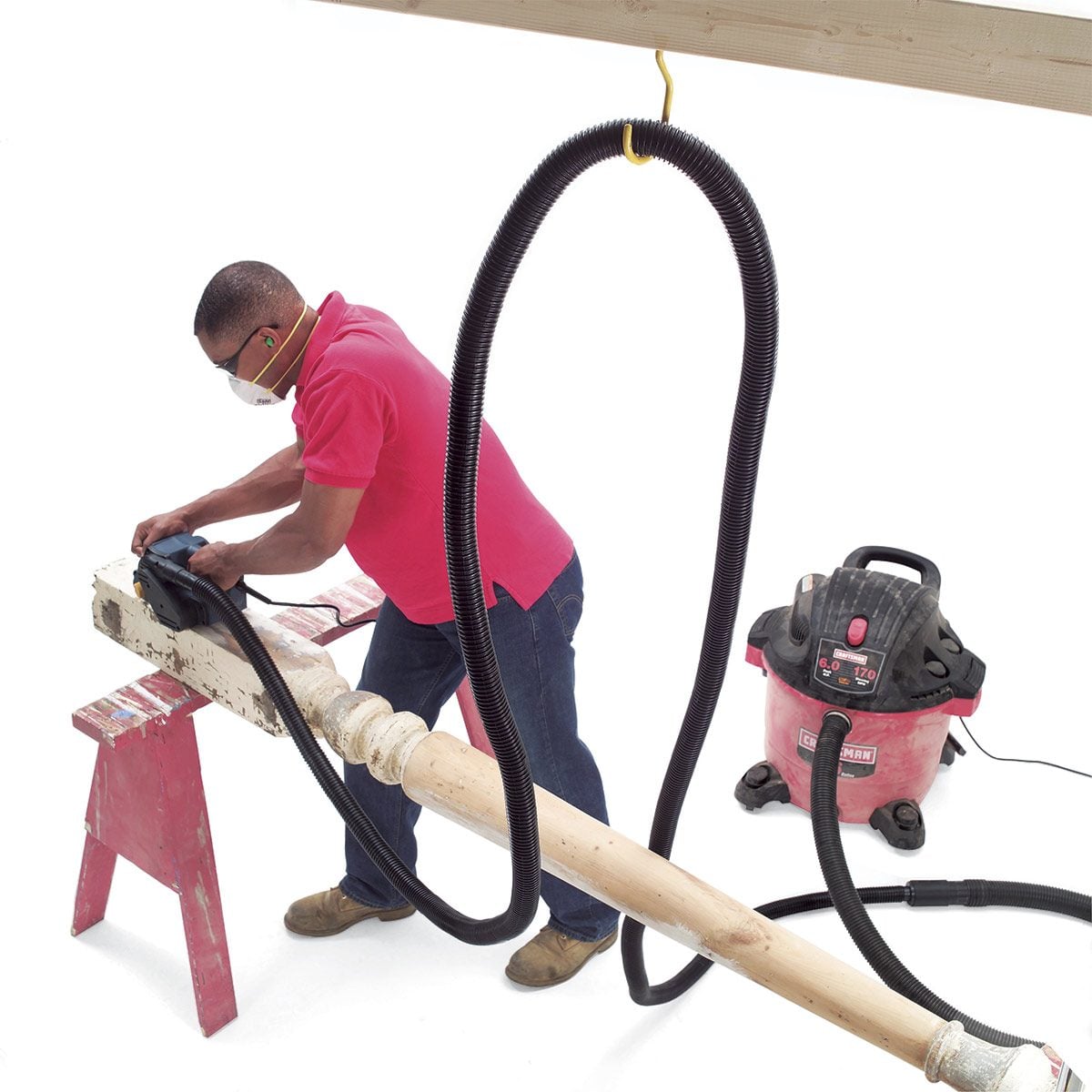
A shop vacuum or dust extractor is usually the right match for random-orbit sanders, track saws, handheld routers, biscuit joiners, and other tools with small ports. These machines typically provide higher static pressure, helping them pull air through narrow hoses and restrictive passages. Traditional dust collectors are designed more for high airflow through larger ducts.
For fine-dust work, consider a properly sealed HEPA-rated extractor or vacuum. EPA defines a HEPA filter as theoretically capable of removing at least 99.97 percent of particles measuring 0.3 microns, but a HEPA filter alone does not prove the entire vacuum is leak-free. Check the complete machine rating, filter-cleaning system, hose size, and replacement-filter cost.
A shop vacuum paired with short hoses and a cyclone separator can serve a compact workshop well. It is less suitable for the chip volume from a full-size planer or wide drum sander. Family Handyman likewise treats upgraded shop vacuums as practical for small-scale collection, not as universal replacements for full dust collectors.
3. Use a High-Airflow Dust Collector for Large Machines
Table saws, jointers, planers, bandsaws, drum sanders, and large router tables generally need a dedicated dust collector. Many woodworking machines require roughly 250 to 1,000 CFM, depending on machine size, hood design, port diameter, and simultaneous use. Oneida notes that average table saws, planers, and jointers commonly need about 300 to 600 CFM for effective pickup.
Do not choose a collector by advertised free-air CFM alone. Compare airflow at a stated static pressure. Filters, separators, long runs, flex hose, reducers, elbows, and tool hoods all add resistance. A collector that looks mighty with nothing attached can become surprisingly shy after 30 feet of corrugated hose.
4. Add a Cyclone or Pre-Separator
A cyclone spins the incoming airstream so heavier chips and much of the dust fall into a drum before reaching the filter. This keeps filters cleaner, preserves suction longer, and simplifies disposal. Two-stage collectors include the cyclone; compact separators can be installed ahead of a shop vacuum or single-stage collector.
The separator adds resistance, so it must match the hose diameter and airflow. Even so, the maintenance savings are often worthwhile. Laguna and Fine Woodworking both identify longer filter life and reduced cleaning as major benefits of cyclone separation.
5. Build Efficient Ductwork
Keep the main duct as large as the collector inlet and system design allow. Reduce diameter near the machine rather than shrinking the entire run early. Use smooth rigid duct for trunks and branches, with short flexible connections at movable tools. Corrugated hose, sharp elbows, abrupt tees, and unnecessary reducers increase resistance. Laguna specifically recommends maintaining larger inlets and limiting flex hose.
Choose wye fittings instead of square tees, use sweeping bends, seal every joint, and close unused blast gates. Follow manufacturer instructions for duct materials, grounding, and bonding. Do not assume that running a random wire through plastic pipe automatically resolves every static or combustible-dust issue. Commercial systems should be reviewed by a qualified designer and the local authority having jurisdiction.
6. Improve Hoods and Enclosures
Many weak collection systems are actually hood problems. Air must move through the zone where dust is generated. Watch the debris pattern during a safe test cut, then use brushes, skirts, baffles, or secondary ports to guide particles toward suction without obstructing guards, fences, cooling, or blade clearance.
A miter saw may need a generous rear hood because its factory port cannot catch the broad spray. A bandsaw may benefit from collection below the table as well as at the lower wheel housing. Never modify a guard in a way that increases contact, kickback, or entanglement risk. Dust control matters, but keeping all ten fingers remains an excellent workshop policy.
7. Add Ambient Air Filtration
An overhead air cleaner or portable air scrubber captures fine particles that escape source collection. It is a second line of defense, not a substitute for tool-connected extraction. EPA guidance treats air cleaning as one part of indoor-air management alongside source control and ventilation. Popular Mechanics also recommends ambient filtration as an additional layer after source capture and personal protection.
Size the unit for the room volume, position it to create broad circulation, and run it during work and afterward. Clean or replace its filters regularly; a clogged air cleaner is basically an expensive ceiling ornament.
8. Clean Safely and Use Respiratory Protection
Vacuum floors, ledges, machine tops, and hidden surfaces instead of blasting dust with compressed air. Avoid aggressive dry sweeping that raises a visible cloud. Wear a properly selected and fitted respirator when the task, wood species, finish, or remaining exposure calls for it. PPE is a backup layer, not permission to work in a brown fog.
Never use a wood-dust collector for hot metal sparks, burning debris, fireplace ash, silica, drywall dust, hazardous coatings, flammable liquids, or other excluded materials. Grizzly and Laguna manuals expressly limit woodworking collectors to appropriate wood dust and chips.
Choosing the Right System
| Workshop Need | Recommended Method |
|---|---|
| Handheld sanders, track saws, and small-port tools | Filtered shop vacuum or HEPA-capable dust extractor |
| Small garage with benchtop tools | Shop vacuum plus cyclone separator |
| Table saw, jointer, planer, or bandsaw | Dedicated high-airflow dust collector |
| Several stationary machines | Central collector, rigid ductwork, and blast gates |
| Lingering airborne fine dust | Ambient air cleaner added to source collection |
| Professional multi-user facility | Engineered, code-compliant collection system |
Practical Setup Examples
Budget Garage Shop
Connect a filtered shop vacuum to sanders, handheld tools, and a compact saw using short hoses and tight adapters. Add a cyclone drum and portable air cleaner. Move the hose between tools instead of building a long, undersized duct network.
Serious Hobby Shop
Use an appropriately specified collector for the table saw, jointer, planer, bandsaw, and router table. Install rigid branches, short flex drops, and blast gates so only one machine draws at a time. Keep a separate extractor for sanders and other small-port tools.
Professional Workshop
Base the design on measured machine demand, duct losses, simultaneous use, filter loading, makeup air, noise, collector placement, and combustible-dust requirements. OSHA has warned that improperly installed indoor collectors and unprotected duct systems can spread fire and explosion hazards.
Essential Maintenance
- Empty the drum before chips reach the separator outlet.
- Inspect lids, clamps, duct joints, hoses, and blast gates for leaks.
- Clean filters only by the manufacturer’s approved method.
- Check hoods and narrow fittings for blockages.
- Replace torn bags, cracked hoses, and damaged filters promptly.
- Keep motors, switches, and horizontal surfaces free of dust buildup.
Sudden piles around a machine, a change in fan sound, or slower chip movement usually means a clog, leak, full drum, dirty filter, or closed gate. Fixing the cause early is easier than discovering it after airborne dust settles into the final coat.
Workshop Experience: Lessons Learned From Living With Sawdust
The first lesson many woodworkers learn is that owning a collector is not the same as collecting dust. A machine can roar like a small aircraft and still leave a fluffy ridge behind the table saw if the blade shroud leaks, the port is badly positioned, or the hose is too restrictive. The fastest diagnostic method is observation. Make a short, safe cut, stop the machine, and inspect where chips collect. The evidence usually points toward a gap, dead zone, or escape path.
The second lesson is that convenience determines whether a system gets used. A perfect hose stored across the room might as well be on the moon when someone wants to make one quick cut. Tool-triggered vacuums, reachable blast gates, overhead hose supports, and adapters that remain attached to machines remove friction. When dust collection takes three seconds to activate, it becomes a habit. When setup requires a scavenger hunt for the correct reducer, the floor becomes the backup filter.
Small changes often outperform dramatic purchases. Replacing a long corrugated hose with smooth pipe and a short flex drop can restore noticeable airflow. Sealing a leaking drum lid can improve cyclone performance immediately. Adding an upper hood to a table saw may capture dust that the lower cabinet port never sees. Cleaning a loaded canister can make an aging collector feel unexpectedly energetic.
It also helps to separate chip collection from fine-dust control. A planer can fill a drum with curly shavings while leaving the air fairly clear when the hood and airflow are good. A random-orbit sander may leave almost nothing on the floor yet create a persistent airborne problem. That is why one workshop can reasonably need both a large-port collector and a high-quality dust extractor. They solve different airflow problems.
Noise matters as well. If a collector is painfully loud, people switch it off early or skip it for short operations. Locating equipment in an approved adjacent space, isolating vibration, maintaining the impeller, and wearing hearing protection can improve comfort. Any enclosure must preserve motor cooling and follow electrical, fire, and manufacturer requirements. Wrapping the collector in leftover carpet is not acoustic engineering.
Finally, good housekeeping changes the entire feel of a shop. Clean floors reduce slipping hazards, clean machine surfaces make layout marks easier to see, and cleaner air makes long sessions more pleasant. The goal is not a sterile showroom. Woodworking will always create some dust. The practical target is to capture most debris at the source, reduce airborne fines, protect finishes, and make cleanup a short closing ritual instead of a second hobby.
Conclusion
The best methods for sawdust collection work together. Capture dust at each machine, use a high-static-pressure vacuum for small ports and a high-airflow collector for large machines, protect filters with cyclone separation, and preserve airflow with smooth, properly sized ductwork. Add ambient filtration for escaped particles, vacuum surfaces rather than creating dust clouds, and maintain the system before performance drops.
A well-designed setup improves air quality, protects tools and finishes, reduces cleanup time, and makes the workshop more enjoyable. The only thing left hanging in the air should be your confidence after a perfect cut.
Note: System sizing, electrical work, collector placement, fire protection, and combustible-dust compliance vary by shop and jurisdiction. Follow equipment manuals and consult a qualified professional or local authority for commercial, multi-user, or high-volume installations.
Research basis: OSHA, NIOSH/CDC, EPA, NFPA, Fine Woodworking, Oneida Air Systems, Rockler, Laguna Tools, JET Tools, Grizzly Industrial, Family Handyman, and Popular Mechanics.