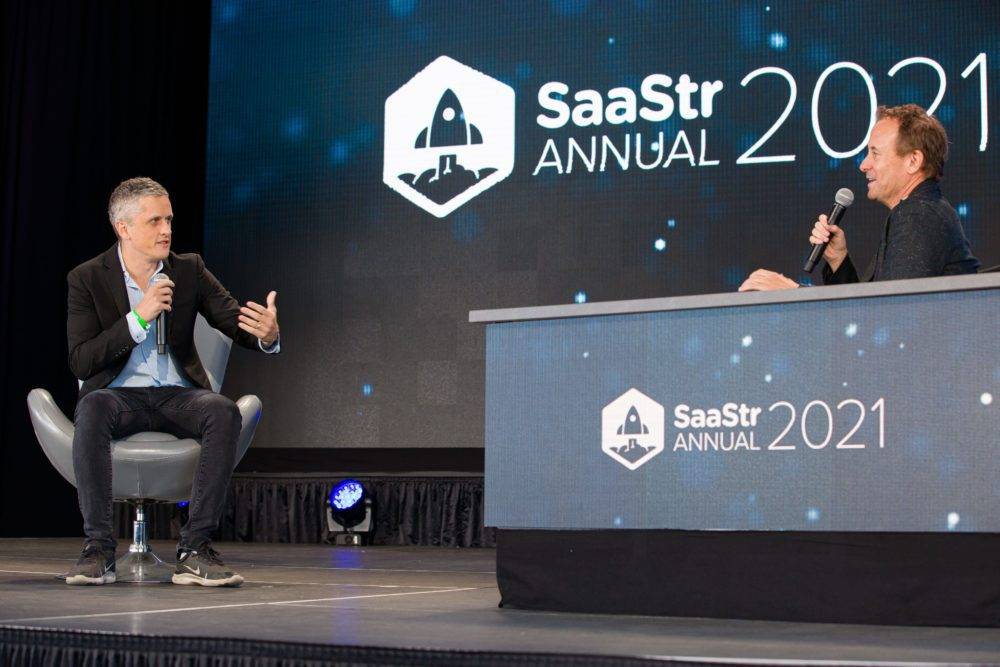
Note: This article interprets SaaStr Annual 2021 sessions. Speaker titles and session details reflect the event period.
There is a special kind of optimism that appears when a product team opens a roadmap. Everything looks possible. Another dashboard? Sure. AI assistant? Why not. A new pricing tier with seventeen checkboxes? Put it on the whiteboard.
Then reality arrives wearing a customer-support headset and asking why the onboarding flow still requires a spreadsheet, a calendar invite, and an interpretive dance.
That is why the best product conversations are rarely about shiny features alone. They are about difficult choices: which customer pain deserves obsession, which tempting deal should be declined, when a focused product should become a platform, and how enterprise software can feel useful rather than bureaucratic.
Four standout SaaStr Annual 2021 sessions featuring leaders from Brex, Box, Loom, Slack, Atlassian, Miro, and Mutiny offered a practical product-management playbook for exactly those questions. Together, they show that excellent SaaS product strategy is less about building more buttons and more about creating clearer value, stronger habits, and scalable systems that customers actually want to keep using.
Why These SaaStr Product Sessions Still Matter
Product trends change quickly. One year everyone is talking about growth loops; the next year every roadmap has an AI-shaped object in it. Yet the core questions behind durable SaaS products remain stubbornly familiar. What problem is painful enough that customers will change behavior? Can the product deliver value without a human guide standing nearby with a flashlight? Will the technical and commercial model still work when usage grows tenfold?
The four sessions covered different stages of the SaaS journey, but they shared one theme: a product becomes powerful when it earns a permanent role in a customer’s workflow. Brex and Mutiny focused on discovering an urgent problem and building from a sharp value proposition. Box explored the discipline required to scale a cloud product without becoming a museum of one-off customer exceptions. Loom examined the jump from a successful point solution to a broader platform opportunity. Slack, Atlassian, and Miro discussed how enterprise software must adapt to flexible, distributed, integration-heavy work.
In other words, this is not a collection of “add more features” advice. It is a collection of “make smarter trade-offs before your roadmap develops its own zip code” advice.
Session 1: Brex and Mutiny on Building a Product Customers Cannot Live Without
Start with a painful job, not a clever feature
In the session Designing a Product Your Customer Can’t Live Without, Brex co-founder Henrique Dubugras and Mutiny co-founder Jaleh Rezaei emphasized a deceptively simple principle: customers do not wake up hoping to buy your feature. They wake up trying to finish work, avoid risk, save time, impress a boss, or prevent a small operational disaster from becoming a meeting with five executives.
That distinction matters. A feature-centric team asks, “Would users like automated approval rules?” A customer-centric team asks, “Why does a finance manager spend Friday afternoon chasing employees about unapproved expenses?” The second question creates room for a complete solution. The first one may create a button that looks lovely in a product tour and quietly gathers dust afterward.
Brex’s early story illustrated the importance of founder-market fit as well as product-market fit. The founders did not begin with a blank-slate fantasy about changing every industry at once. They worked from experience in financial technology and identified a business problem they understood. That familiarity helped them recognize where conventional corporate-card experiences were frustrating, slow, and poorly designed for startups.
The lesson for SaaS founders is not “build a corporate card.” That would be a strange takeaway unless you happen to enjoy bank regulations, risk models, and conversations that include the phrase “credit underwriting.” The real lesson is to identify the unfair advantage in your own understanding. What workflow have you experienced repeatedly? What customer frustration feels obvious to you but invisible to outsiders? That is often a more useful starting point than a giant total addressable market slide with heroic-looking arrows.
Turn ambition into testable hypotheses
Mutiny’s approach adds an important twist. Early-stage companies need room to iterate, but chaos is not automatically a strategy. Rezaei described creating a structured set of hypotheses around what had to be true for the company’s vision to work. That turns product development into a learning system rather than a scavenger hunt for compliments.
A practical version might look like this:
- Can a new user reach a meaningful result within one session?
- Will a team invite at least one collaborator after seeing that result?
- Does the product improve a measurable business outcome?
- Can the experience be repeated without a customer-success rescue mission?
- Will customers pay enough to support the model?
These are not glamorous questions, but neither is churn. A company that answers them early has a much better chance of designing a product customers genuinely depend on.
The product lesson: make value painfully obvious
Great SaaS products reduce the distance between signup and relief. The user should not need to complete a graduate thesis in settings before receiving value. Brex framed its product around making financial operations feel more like a modern software experience than an old-fashioned administrative chore. Mutiny aimed to help businesses personalize customer journeys without requiring every company to build a custom experimentation engine from scratch.
For product leaders, the useful question is: What moment makes a new customer say, “Oh, this solves my problem”? Find that moment, shorten the path to it, and measure whether users reach it. A product customers cannot live without usually begins as a product that helps them breathe easier on an ordinary Tuesday.
Session 2: Box on Building a Scalable SaaS Product Without Losing the Plot
Choose an operating model you can defend
In The Secrets Behind Creating Scalable Products, Box co-founder and CEO Aaron Levie discussed the kind of product decision that makes sales teams nervous but can save a company from years of architectural regret. Box committed early to a multi-tenant cloud model and resisted making exceptions that would pull the company toward an on-premises approach.
That decision likely cost deals in the short term. It also protected the long-term product model. This is an uncomfortable truth for growing SaaS companies: not every large contract is a good contract. Some are Trojan horses filled with custom workflows, special infrastructure, odd deployment requirements, and future engineering meetings that begin with, “Remember that one customer promise from 2019?”
Scalability is not merely a technical word. It is a business choice. It means deciding whether the product can serve the next hundred customers without requiring a new version of reality for each one. It means recognizing that a custom feature for a major prospect may create maintenance costs, security complexity, slower releases, and an increasingly confused product experience for everyone else.
Product-led growth and enterprise readiness can coexist
Box also highlighted the power of cloud delivery, freemium adoption, and viral usage. That does not mean every enterprise product must offer a free plan and wait for magic. It means the product itself should help spread understanding, usage, and internal demand.
Consider a document collaboration tool. A user uploads a file, shares it with teammates, receives feedback, and suddenly the product is part of a group workflow. That is more powerful than a sales deck claiming “seamless collaboration.” The product has demonstrated the claim in the customer’s actual workday.
But enterprise growth adds a second requirement: the people responsible for security, compliance, governance, and procurement must also feel safe saying yes. The best product-led SaaS companies do not treat self-serve users and enterprise buyers as rival species. They create a graceful bridge between the two. Individual users need speed and simplicity. IT leaders need controls, reliability, visibility, and confidence that the product will not become tomorrow’s audit headache.
The product lesson: protect the core model
Product teams should create a “scale test” before accepting major roadmap requests:
- Does this request improve the core product for a meaningful customer segment?
- Can it be delivered through a repeatable capability rather than a one-off exception?
- Will it make the architecture, support model, or onboarding flow harder for everyone else?
- Does it strengthen the company’s long-term product strategy?
If the answer is mostly no, the request may still be worth doing. But it should be called what it is: a custom commercial decision, not proof of product strategy. Those are very different animals, and one of them tends to eat engineering capacity.
Session 3: Loom on Expanding from a Single Product to a Platform Play
Do not confuse popularity with platform readiness
Loom’s session, Growing Your Product: The Secrets of Expanding from a Single Product to a Platform Play, addressed one of the most tempting moments in SaaS: when a product has clear adoption and every adjacent opportunity starts waving from across the road.
A focused product can be beautiful because it solves one job exceptionally well. Loom made asynchronous video messaging easy to record, share, and understand. A user could explain a bug, walk through a design, provide customer feedback, or replace a meeting that should have been an email but somehow became a 47-minute video call.
Once users love a focused experience, the platform question appears. Should the company add analytics? Collaboration tools? Templates? Security controls? Integrations? Workflow automation? AI assistance? The answer is not “yes, because competitors have a tab for it.” Platform expansion requires evidence that the adjacent capability deepens customer value, improves retention, opens a meaningful revenue opportunity, or makes the original workflow more useful.
Look for market signals, not internal excitement
Anique Drumright’s product perspective centered on reading market signals and defining success clearly for stakeholders. That is critical because platform work is expensive. New product lines introduce new user types, new onboarding paths, new support burdens, new pricing questions, and new ways to accidentally schedule six meetings about taxonomy.
Before expanding, product leaders should look for repeated evidence:
- Customers are trying to solve the adjacent problem manually.
- Multiple customer segments request similar capabilities.
- The company has unique data, workflow context, or distribution that makes the expansion credible.
- The new capability increases the usefulness of the original product rather than distracting from it.
- The product organization can define success beyond “we launched it.”
For example, a video messaging product may discover that users repeatedly need a searchable record of decisions, action items, and feedback. That could justify expanding into summaries, transcripts, comment workflows, or integrations with project-management software. It is not expansion for the sake of a larger navigation bar. It is expansion because the customer’s job naturally continues beyond the video itself.
The product lesson: earn the right to become a platform
Platforms are not created by adding a developer page, a marketplace logo, and a heroic amount of caffeine. A true platform has a durable center of gravity. It gives customers, partners, or internal teams a stable foundation on which to solve more problems.
Product leaders should think of platform expansion as a sequence:
Win one important workflow. Learn where customers struggle next. Build repeatable extensions. Create integration points. Add governance and reliability. Then expand the ecosystem.
Skipping those steps can turn a clean product into a confusing multipurpose toolbox. Nobody wants that. Most people already own at least one drawer full of mystery cables.
Session 4: Slack, Atlassian, and Miro on the Future of Enterprise Software
Flexibility is now part of the product requirement
The panel How Product Leaders Are Building the Future of Enterprise Software brought together Slack CPO Tamar Yehoshua, Atlassian COO Anu Bharadwaj, and Miro CPO Varun Parmar to examine how remote and hybrid work reshaped software expectations.
The key message was clear: enterprise products can no longer assume that work happens in one office, during one time zone, through one standard workflow. Customers increasingly expect flexibility in where they work, when they contribute, how they communicate, and which tools they connect.
That changes product design. A collaboration feature cannot assume everyone is online at the same time. A project tool cannot assume the user saw a hallway conversation. A whiteboard cannot assume a facilitator is standing at the front of the room with a dry-erase marker and suspiciously optimistic handwriting.
Build for asynchronous work without abandoning human connection
The panel distinguished between task-focused work and the relational side of work: team building, informal conversations, creativity, trust, and shared context. Remote software needs to support both. The point is not to recreate an office pixel by pixel. Nobody needs a digital elevator where colleagues can pretend not to make eye contact. The point is to help teams coordinate clearly while preserving opportunities for lightweight connection and spontaneous collaboration.
Slack’s product evolution illustrated this mindset. Collaboration tools need to support communication while also providing enterprise-grade reliability, security, administrative controls, and integration options. An enterprise user may want a quick self-serve experience. An IT administrator may need audit logs, permission controls, data protection, and confidence that the system can scale. Both users are customers, even if one uses emojis more enthusiastically than the other.
Best-of-breed products win through strong integrations
The panel also argued that modern enterprise stacks increasingly depend on connected specialist tools rather than one giant monolithic suite. This creates a major product challenge. A SaaS company must make its product independently valuable while also making it easy to connect with the rest of the customer’s environment.
For a product leader, integrations are not merely a checklist for the sales deck. They are part of the customer experience. An integration should be discoverable, understandable, secure, and useful within the user’s workflow. It should not feel like a trapdoor leading to a three-page setup guide written by someone who considers “restart your browser” a personality trait.
Miro’s perspective was especially useful here: as users work more independently, their expectations of product quality rise. In an office, people can quickly ask a teammate for help. In a distributed environment, friction becomes louder. Confusing permissions, unclear handoffs, delayed notifications, and awkward onboarding are no longer minor inconveniences. They become productivity blockers.
The product lesson: design for users and administrators
Modern enterprise SaaS needs two kinds of excellence at the same time:
- User excellence: fast onboarding, intuitive workflows, useful collaboration, and visible value.
- Administrative excellence: controls, security, compliance, integration management, analytics, and dependable performance.
Neglect either side and adoption suffers. A delightful product that cannot pass security review will stall. A perfectly governed product that feels painful to use will invite workarounds, shadow IT, and the dreaded “we just use a spreadsheet instead.”
The Shared Product Playbook From Box, Brex, Loom, and Slack
These four SaaStr Annual sessions form a surprisingly coherent SaaS product strategy framework.
- Begin with a real, urgent customer problem. Brex and Mutiny showed that a valuable product starts with understanding a market and the customer’s actual job to be done.
- Create structure around learning. Big visions are useful, but measurable hypotheses prevent teams from mistaking activity for progress.
- Protect the scalable model. Box demonstrated that saying no to short-term exceptions can preserve long-term product speed and consistency.
- Expand only when the workflow earns it. Loom showed that platform strategy should come from customer signals, repeatable opportunities, and a clear definition of success.
- Design for a connected enterprise world. Slack, Atlassian, and Miro highlighted that flexibility, integrations, trust, and administration are now central product capabilities.
The common thread is disciplined empathy. Great product teams care deeply about users, but they do not respond to every request by tossing another feature into the release notes. They look for patterns, identify the underlying problem, and build solutions that can deliver value repeatedly at scale.
That is how a SaaS product becomes more than software. It becomes part of how customers get work done.
Extra Field Notes: What These Product Lessons Look Like in Real SaaS Work
Imagine a growing B2B SaaS company with a product that helps operations teams manage vendor approvals. The company has healthy early traction. Customers like the dashboard. Sales is excited. The roadmap is full. Somewhere, a product manager is staring at 173 feature requests and considering a career in beekeeping.
The Brex and Mutiny lesson would be to pause and identify the highest-stakes customer problem. Is the real pain that approval requests disappear in email? Is it that finance teams cannot see spending commitments? Is it that employees wait days for a simple purchase decision? The company should not build every requested feature. It should find the bottleneck that creates the strongest frustration and make that problem dramatically easier.
Next comes the Box lesson. A major enterprise prospect may ask for a dedicated private deployment, an unusual data model, and a custom workflow that only its procurement department understands. The sales team sees a big contract. Engineering sees several quarters of specialized work. Product leadership needs to ask whether the request strengthens the product’s repeatable value or pulls the business into a costly side road. Sometimes the correct answer is yes. Often, the wiser answer is to build a generalized capability, such as configurable approval rules, audit history, role-based permissions, or secure integrations that benefit many customers.
Then the Loom lesson appears. Customers may begin using the vendor-approval tool for contract reviews, onboarding, invoice questions, and policy updates. That does not automatically mean the company should launch a complete enterprise resource planning suite before lunch. It does mean the product team should investigate the adjacent jobs customers are repeatedly trying to solve. Perhaps a lightweight request portal, shared decision history, integration with communication tools, or reusable workflow templates would extend the core value naturally.
Finally, the Slack, Atlassian, and Miro lesson becomes essential. The product must work across distributed teams. It should notify the right people without creating notification confetti. It should integrate with the systems customers already use. It should allow an employee to complete a request quickly while giving administrators sensible controls over permissions, records, security, and compliance.
In practice, strong product leadership means saying four things often:
- “What customer problem are we actually solving?”
- “How will we know this worked?”
- “Can this scale beyond one important customer?”
- “Does this fit naturally into the customer’s broader workflow?”
Those questions may not produce a flashy keynote slide. They do, however, prevent teams from shipping expensive clutter. And in SaaS, avoiding expensive clutter is almost as valuable as creating a breakthrough feature. Almost.
Conclusion
The product wisdom from these SaaStr Annual sessions remains highly relevant because it avoids simplistic answers. Brex and Mutiny remind founders to earn product-market fit through deep customer understanding and disciplined experimentation. Box shows why scalable SaaS companies protect the operating model that makes growth possible. Loom demonstrates that platform expansion should follow customer behavior, not executive impatience. Slack, Atlassian, and Miro make the case that enterprise products must now be flexible, integrated, secure, and genuinely pleasant to use.
The best SaaS product strategy is not a contest to release the most features. It is the practice of helping customers solve important problems so consistently that going back to the old way feels ridiculous. That is when a product stops being “software we bought” and becomes “the way we work.”