Television is built to look effortless. A family argues in a Rhode Island kitchen, a detective waits for a restaurant table, or a dragon queen strolls through an inferno, and viewers are supposed to forget the armies of writers, performers, prop makers, stunt teams, executives, and nervous network lawyers standing just outside the frame. Then the behind-the-scenes stories arrive and reveal that TV history is less like a polished museum and more like a garage packed with genius, panic, duct tape, and one executive asking whether the audience will understand it.
These 26 TV trivia nuggets travel from early live variety shows to prestige dramas, animated classics, horror homages, and sitcoms that nearly sabotaged their own best episodes. Some facts explain how unforgettable characters were created almost by accident. Others show that television’s tiniest detailsa cheesecake box, a fictional skyline, or a made-up sign languagecan require astonishing thought. Consider this your Saturday, December 20th channel-surf through pop culture history, with the commercials removed and the strange production stories left in.
1. Quahog Borrows From Real Rhode Island
Family Guy places the Griffins in fictional Quahog, but its geography has recognizable Rhode Island DNA. Seth MacFarlane has linked the town to Cranston, while the Providence skyline repeatedly appears in the background. Apparently, even animated suburbs cannot resist a good downtown view.
2. A Futurama Joke Obeys Astrophysics
In Futurama, the slogan “What happens in Cygnus X-1 stays in Cygnus X-1” is more than a Las Vegas parody. Cygnus X-1 is associated with a black hole, making “stays there” a grimly scientific punch line. The writers slipped cosmology into a gag and trusted viewers to catch up later.
3. Stephanie Beatriz First Read for Amy Santiago
Before becoming the intimidating Rosa Diaz on Brooklyn Nine-Nine, Stephanie Beatriz initially auditioned for Amy Santiago. She later read for a character called Megan, who evolved into Rosa. One anxious audition therefore helped create two distinct detectives instead of one, which is an excellent return on nervous energy.
4. Adam McKay Helped Establish Succession’s Visual Language
Adam McKay served as an executive producer and directed the Succession pilot. That position gave him influence over casting, tone, visual style, and music, helping define the show’s restless camera work and uneasy comic rhythm. The Roy family’s chaos was carefully engineered before they began insulting one another professionally.
5. Kim Wexler Was Not Originally Guaranteed Center Stage
Better Call Saul creators initially understood Kim Wexler only in broad terms: a possible love interest and moral counterweight to Jimmy McGill. Vince Gilligan later acknowledged that she might have faded in importance. Rhea Seehorn’s performance instead made Kim indispensable, proving that fictional job security can be earned one perfectly controlled pause at a time.
6. Key and Peele Did Not Expect Their Fargo Roles
Keegan-Michael Key and Jordan Peele were surprised when Fargo creator Noah Hawley approached them to play FBI agents. The comedy duo accepted dramatic parts that still allowed their chemistry to operate beneath the surface. Sometimes casting against expectation works because the audience brings one rhythm while the show quietly supplies another.
7. Mad Men Rebuilt a Cheesecake Box From Photographs
For a scene involving a frozen Sara Lee cheesecake, the Mad Men prop department could reproduce the food more easily than its 1960-era box. Prop master Scott Buckwald studied thousands of period kitchen images, reconstructed the packaging from multiple angles, and rebuilt it digitally. Historical accuracy, it turns out, sometimes tastes like dessert and behaves like archaeology.
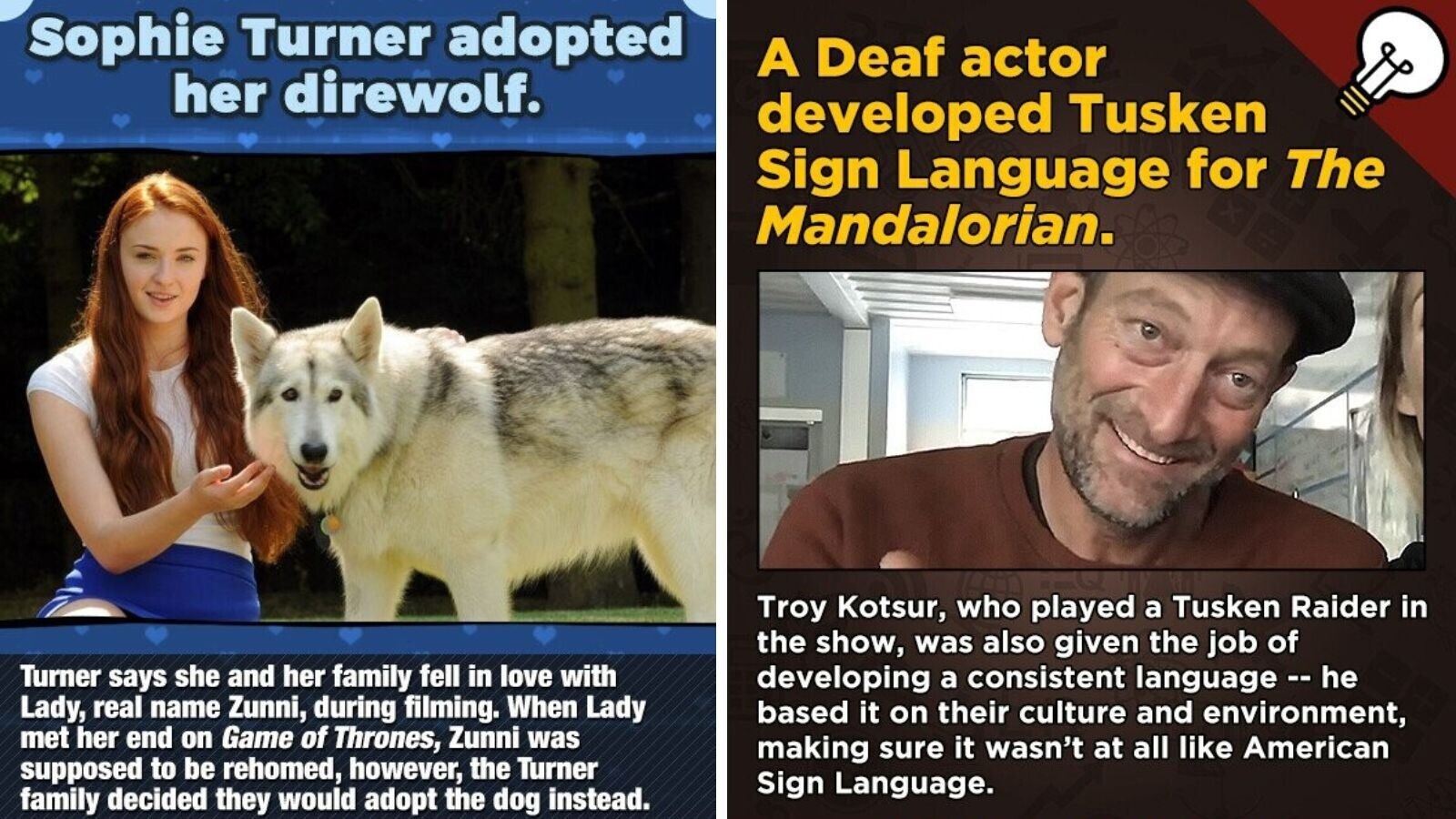
8. Troy Kotsur Developed Tusken Sign Language
Deaf actor Troy Kotsur helped create a visual language for the Tusken Raiders in The Mandalorian. Rather than simply using American Sign Language, he considered the desert environment, clothing, and culture of the characters. The result made communication feel specific to the fictional society instead of pasted onto it as a convenient effect.
9. Jim Parsons Considered Laurie Metcalf a Dream Co-Star
Jim Parsons described working with Laurie Metcalf during the first season of The Big Bang Theory as a dream come true. Metcalf played Sheldon Cooper’s mother, bringing warmth and steel to a character who could puncture Sheldon’s certainty with a single sentence. Even television geniuses need someone who can tell them to sit down.
10. Daenerys’ Temple Fire Used a Real Burning Set
When Daenerys burns the Dothraki temple in Game of Thrones, the production did not rely entirely on computer-generated spectacle. The set was constructed and burned for real, while visual effects and careful safety work completed the illusion. The sequence’s power comes partly from the fact that the flames had genuine scale, heat, and danger.
11. Stranger Things Season Four Saluted Freddy Krueger
Stranger Things cast Robert Englund, the actor most closely associated with Freddy Krueger, as Victor Creel. The season also layered in dream imagery, a fedora-like silhouette, and musical choices that echoed nightmare cinema. It was less a single Easter egg than a basket delivered directly from Elm Street.
12. Danai Gurira Brought Serious Sword Training to Michonne
Danai Gurira had stage-combat experience from her acting education, then trained intensely to portray Michonne on The Walking Dead. She practiced repeatedly, including during breaks while working in theater. That preparation helped make the katana feel like an extension of the character rather than a prop she had met five minutes before filming.
13. Sophie Turner Adopted Sansa’s Direwolf
The dog that played Lady, Sansa Stark’s direwolf, was named Zunni in real life. After Lady’s story ended, Sophie Turner and her family adopted the animal. In a franchise famous for separating characters from everything they love, this behind-the-scenes ending was unusually mercifuland probably involved fewer ravens and much better snacks.
14. A Game of Thrones Birthday Happened in Chains
Nikolaj Coster-Waldau celebrated a birthday while filming Game of Thrones, still dressed and restrained for the scene. Behind-the-scenes images showed the contrast between grim Stark-camp captivity and cheerful cupcakes. Television production is strange that way: one minute you are a prisoner of war, the next someone is singing off-key near the craft table.
15. Sherlock Holmes Owes a Debt to Dr. Joseph Bell
Arthur Conan Doyle drew major inspiration from Joseph Bell, a surgeon and teacher known for making sharp deductions from a patient’s appearance and behavior. Bell’s emphasis on observation helped shape Sherlock Holmes’s method. The world’s most famous consulting detective therefore began, in part, with a medical professor paying terrifyingly close attention.
16. Johnny Carson and Joan Rivers Never Repaired Their Rift
Joan Rivers became a major star through appearances and guest-hosting duties on Johnny Carson’s Tonight Show. Their relationship collapsed after she accepted a competing Fox late-night program in 1986. Carson never spoke to her again, and she did not return to The Tonight Show until Jimmy Fallon’s 2014 debut era.
17. The Wire Received Only Two Emmy Nominations
Despite its towering reputation, The Wire earned only two Primetime Emmy nominations, both for writing. It received no acting nomination and never competed for Outstanding Drama Series. Awards are supposed to preserve excellence, yet television history occasionally preserves the awards’ mistakes instead.
18. The Admiral Broadway Revue Was Hurt by Success
The 1949 variety series The Admiral Broadway Revue was sponsored by television manufacturer Admiral. Demand for the company’s sets reportedly outpaced its manufacturing capacity, so money spent on the popular program was redirected toward production. Few shows can claim they helped sell themselves off the air.
19. Elaine Was Missing From the Seinfeld Pilot
Elaine Benes does not appear in the original Seinfeld pilot. The early version centered on Jerry, George, Kramer, and a waitress character who did not continue as the ensemble evolved. Adding Elaine gave the series a sharper social balanceand someone capable of matching the men’s selfishness without needing remedial training.
20. Locke & Key Shared a School With Police Academy
The Toronto-area building used for Matheson Academy in Locke & Key had already appeared as the academy in the original Police Academy film. Locations often enjoy longer careers than actors, quietly changing names, genres, and student bodies while keeping the same masonry. That campus has seen both supernatural keys and very loud cadets.
21. Homeland’s Lead Was Written With Claire Danes in Mind
Although executives considered bigger movie-star casting possibilities, Homeland creators strongly favored Claire Danes. Early scripts even used the name Claire for the central character who became Carrie Mathison. The choice anchored the series in a performance that could move from brilliant analysis to emotional collapse without treating either as a gimmick.
22. Trey Parker Thought a Beloved South Park Episode Was Terrible
Before “Make Love, Not Warcraft” aired, Trey Parker became convinced the episode would damage South Park and begged for it to be withheld. Viewers loved it, and it became one of the show’s signature installments. Creative judgment is useful, but deadlines occasionally prevent artists from strangling their own classics.
23. The Golden Girls Grew From a Miami Vice Joke
During an NBC promotional presentation, a comedy bit called “Miami Nice” played on the popularity of Miami Vice by featuring older women in Florida. Executives saw potential in the premise, which helped lead to The Golden Girls. A throwaway network joke thus became a sitcom with considerably better cheesecake conversations.
24. Tina Fey and Liz Lemon Share a First Name
Tina Fey was born Elizabeth Stamatina Fey, so her 30 Rock character Liz Lemon shares her first name. “Tina” comes from Stamatina. The detail fits a series that constantly blended fictional television chaos with recognizable pieces of Fey’s own professional worldonly with more page jackets and fewer normal lunches.
25. Two 30 Rock Co-Workers Were Married in Real Life
John Lutz and Sue Galloway, who played fictional coworkers Lutz and Sue on 30 Rock, are married in real life. On-screen, they belonged to a writing staff powered by insults, snacks, and professional neglect. Off-screen, their relationship supplied a sweeter production fact than the show would ever allow either character to enjoy publicly.
26. NBC Nearly Blocked “The Chinese Restaurant”
NBC executives resisted the Seinfeld episode “The Chinese Restaurant” because its story consisted largely of Jerry, George, and Elaine waiting for a table. Larry David defended the real-time structure and threatened to leave if major changes were forced. The episode became a defining example of the show’s ability to turn nothing into excruciatingly precise comedy.
The Experience of Rewatching Television After Learning the Trivia
Learning behind-the-scenes television history changes the experience of rewatching a familiar show. The plot remains the same, but attention begins to drift toward details that once seemed invisible. A box in a freezer is no longer anonymous packaging; it represents hours of prop research. A Tusken Raider’s gesture is no longer simply alien movement; it reflects a performer designing communication around costume, landscape, and culture. The screen becomes layered. Viewers still follow the story, but they also begin noticing the labor that makes the story believable.
This can make comedy especially rewarding. Rewatching “The Chinese Restaurant” after learning about NBC’s resistance adds a second source of tension. The characters are waiting for a table, but the episode itself once waited for permission to exist. Every uneventful minute becomes a quiet argument between creative confidence and conventional network thinking. The same effect appears with “Make Love, Not Warcraft.” Knowing Trey Parker feared it was a disaster gives the finished episode an extra comic charge. The audience is watching a beloved success that its creator temporarily regarded as evidence of personal failurea useful reminder that panic is not a reliable review system.
Production trivia also deepens appreciation for performers. Kim Wexler’s evolution feels even more impressive when viewers know that the character was not mapped as the co-lead from the beginning. Rhea Seehorn’s choices helped writers discover possibilities they had not fully planned. Stephanie Beatriz’s journey from reading for Amy to defining Rosa offers a similar lesson: casting is not merely finding a person who matches a finished idea. Sometimes the audition changes the idea. The television character audiences remember can emerge from a collaboration, a surprise, or a room full of people realizing that their original plan is suddenly less interesting than the actor in front of them.
There is also pleasure in seeing how television preserves accidents and institutional blind spots. The Wire receiving only two Emmy nominations does not make the series smaller; it makes the awards look incomplete. The Admiral Broadway Revue disappearing because its sponsor needed to build more television sets sounds like satire, yet it captures the early medium’s strange commercial machinery. These stories reveal that pop culture history is not a clean procession in which quality is identified, rewarded, and carefully archived. It is a collection of rushed choices, missed opportunities, unexpected breakthroughs, and paperwork that probably went missing in a cabinet marked “miscellaneous.”
Most of all, trivia turns passive watching into a kind of informal media archaeology. A skyline invites questions about geography. A practical fire effect makes viewers think about stunt coordination and safety. A late-night feud opens a window onto power, loyalty, and competition in broadcasting. None of this requires abandoning the simple fun of television. It adds another channel to the experience: one showing the fictional world and another showing the human effort behind it. Once that second channel comes in clearly, even a rerun can feel newly transmitted.
Conclusion: Television History Is Better Behind the Curtain
The best TV trivia does more than supply an answer for game night. It reveals how fragile, collaborative, and occasionally ridiculous television production can be. A great character may begin as an afterthought, a classic episode may survive executive resistance, and a disposable food box may demand detective work worthy of Sherlock Holmes. These 26 pop culture history facts remind us that television magic is rarely magic. It is craft, argument, luck, preparation, and sometimes a birthday cupcake served to an actor wearing chains.