Birth rarely follows a tidy script. It can be quiet, chaotic, exhausting, funny, frightening, triumphant, and profoundly tendersometimes within the same five minutes. The 2023 Birth Photography Image Competition captured that emotional range through photographs made in bedrooms, hospitals, operating rooms, birthing pools, and the intimate spaces where families first meet.
Organized by the International Association of Professional Birth Photographers, or IAPBP, the 13th annual competition recognized images from professional photographers around the world. The entries documented labor, delivery, postpartum life, birth details, and hardship and loss. Rather than polishing childbirth into a pastel-colored greeting card, the winning photographs presented it as it actually happens: physical, unpredictable, deeply human, and occasionally equipped with a very unglamorous hospital toilet.
Content note: This article discusses childbirth, medical procedures, postpartum recovery, nudity, and pregnancy or infant loss. The original photographs remain copyrighted by their respective photographers and were published by the competition with permission from the families.
What Was the 2023 Birth Photography Image Competition?
The International Association of Professional Birth Photographers created its annual image competition to celebrate both the emotional importance of childbirth and the technical skill required to document it. Birth photographers cannot schedule a perfect sunset, move a hospital wall six feet to the left, or ask a baby to repeat an entrance because someone blinked. They work in real time, often under dim lighting, strict medical protocols, limited space, and rapidly changing conditions.
The 2023 competition reportedly received nearly 1,000 entries. Judges evaluated photographs using criteria that included lighting, technique, composition, creativity, storytelling, and emotional impact. The main categories covered Birth Details, Labor, Delivery, Postpartum, and Hardship & Loss. Black-and-white, documentary, and fine-art subcategories allowed judges to recognize different visual approaches within the same birth stages.
The widely shared collection of 26 touching photos combined major category winners, subcategory winners, Members’ Choice selections, and honorable mentions. Its numbered order should not be confused with the official competition ranking. Each image earned recognition in its own category, while online galleries sometimes rearranged the photographs according to reader engagement.
The 26 Touching Award-Winning Birth Photos
These photographs are memorable not because they make childbirth look easy, but because they refuse to pretend it is. Each title offers a doorway into a larger birth story.
-
“Waking Up at Sunrise” by Paula Beltrao, Brazil
Named Best in Birth Details, this photograph turns a newborn’s arrival into a moment of emergence. The title suggests warmth, awakening, and the beginning of an entirely new day for everyone in the room. It is an image about birth, but also about the instant a family’s internal clock resets forever.
-
“The Lovers After” by Natalie Broders, United States
The Best in Postpartum winner focuses on the couple after the intensity has passed. Exhaustion and affection coexist without competing for attention. There are no movie-star poses herejust two people who have traveled through something enormous and reached the other side together.
-
“Brace for Birth” by Laura Brink, Australia
Recognized in the Fine Art delivery category, this photograph emphasizes the physical force of birth. Its carefully framed perspective transforms anatomy, movement, and anticipation into a powerful composition without making the moment feel staged.
-
“The Expected Meeting” by Karoline Saadi, Brazil
This black-and-white delivery winner captures the long-awaited introduction between parent and child. Stripping away color concentrates attention on facial expression, touch, and astonishmentthe universal language spoken when a baby finally arrives.
-
“The Loyal Birth Attendant” by Laura Brink, Australia
Not every meaningful birth companion carries a medical chart. This black-and-white labor photograph celebrates steady companionship and the comfort of simply having a familiar presence nearby. Support sometimes arrives with professional credentials; sometimes it has paws.
-
“Chaos and Calm” by Stefany Pontes, Brazil
The title describes the strange duality of a delivery room perfectly. One person may be working at full speed, another may be watching breathlessly, and someone else may appear almost still. Birth can feel like an emergency and a meditation occurring simultaneously.
-
“Life Beneath the Surface” by Mary Beliz, United States
Named Best in Delivery, this image captures a water birth with remarkable timing. Water softens the scene visually, yet the photograph retains the urgency of arrival. The result feels both elemental and immediate, as if the border between two worlds has briefly become visible.
-
“Crossing the Veil” by Annemarie Fuckel, Germany
The competition’s Best Overall First Place winner presents birth as a passage rather than a single clinical event. Its fine-art quality gives the moment an almost mythic atmosphere while remaining grounded in a real body, a real baby, and a real family.
-
“First Touch” by Settia Tin, Netherlands
A Members’ Choice delivery winner, “First Touch” centers on the smallest possible gesture carrying the largest possible meaning. That initial physical connection becomes proof that the waiting is over and that the person imagined for months is suddenly here.
-
“Safe Space” by Jessica Innemee, Netherlands
Named Best in Labor, this photograph explores the quiet intervals between contractions. Labor is often portrayed as nonstop intensity, but rest is part of the story too. A shower, a supporting hand, a wall, or a partner’s shoulder can temporarily become the safest place in the universe.
-
“Holding Hands” by Ash Blythe, United States
This honorable mention demonstrates why hands appear so often in powerful birth photography. They grip, guide, reassure, catch, and communicate when complete sentences become unrealistic. During labor, a hand can function as an entire emotional support department.
-
“Hello, I Have Arrived” by Jessica Miles, United States
The documentary delivery winner captures a baby being revealed over a surgical drape. The raised hand gives the moment a delightfully expressive quality, almost as though the newborn has entered the room already prepared to greet the audience.
-
“Cry of Love” by Anne Lucy, Brazil
This honorable mention freezes an explosive first reaction. The parent’s expression communicates relief, joy, disbelief, and love before language has time to organize itself. It is not a quiet picture, even when viewed in complete silence.
-
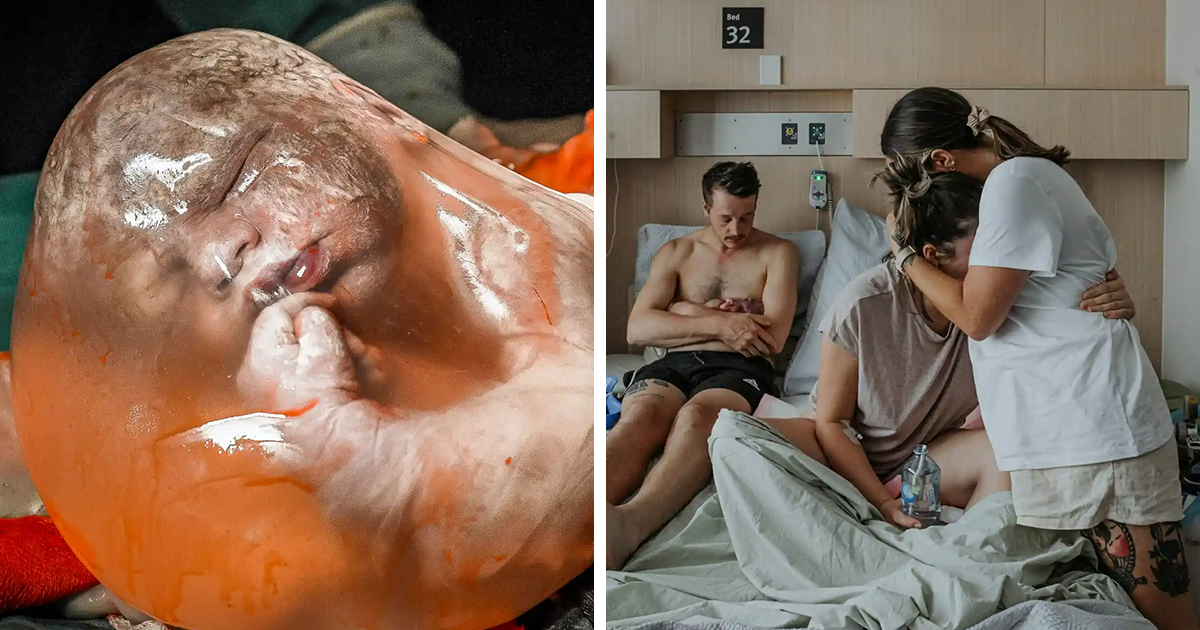
“Bed 32” by Dania Lauren, Australia
The documentary postpartum winner finds meaning in an ordinary hospital setting. A numbered bed could feel impersonal, but the people gathered around it transform the space into a family landmarkthe exact place where life changed.
-
“The Sovereign Family Tree” by Laura Brink, Australia
Recognized in the Fine Art postpartum category, this composition treats the new family as something rooted, connected, and enduring. Bodies and limbs become visual branches, suggesting that a family tree is not merely recorded on paper; it is formed through presence and touch.
-
“My First Seconds Here” by Julia Santiago, Brazil
This honorable mention focuses on the fleeting interval when a baby has just entered the world. Those first seconds are medically important, emotionally overwhelming, and photographically unforgiving. Miss them, and there is no reenactment scheduled for Tuesday.
-
“I Call Down My Power” by Nicole Hamic, United States
A Members’ Choice labor winner, this image frames the laboring person as active, capable, and formidable. Its title reflects concentration rather than passive endurance. The photograph honors the mental work of birth alongside the visible physical effort.
-
“Liminal Space” by Megan Angstadt-Williams, United States
“Liminal” describes a thresholda place between what was and what comes next. That makes it an ideal title for a birth photograph. The parent is no longer simply waiting, yet the new chapter has not fully settled into focus.
-
“Peaceful Arrival” by Annemarie Fuckel, Germany
This black-and-white postpartum winner emphasizes stillness after motion. Monochrome tones help the viewer notice shape, skin, closeness, and calm. The scene feels like the first deep breath taken after a room has collectively held its breath for hours.
-
“Bloodline” by Alannah Finn, United States
This honorable mention uses a visually direct title to connect biology, inheritance, and family history. Birth contains beauty, but it also contains blood, fluid, strain, and physical evidence of what the body has accomplished. The image does not separate those realities.
-
“Drowning in Exhaustion” by Laura Brink, Australia
The documentary labor winner refuses to romanticize fatigue. Labor can continue long after inspirational slogans have packed up and gone home. By showing exhaustion honestly, the photograph gives dignity to endurance rather than demanding constant visible strength.
-
“Beautiful Beautiful Boy” by Tiarra Doherty, United States
The repeated word in this honorable mention’s title feels spontaneous, like something said when one adjective is not enough. It captures the overflowing emotion of seeing a child clearly for the first time and needing language to catch up.
-
“The Final Drop” by Beth Lindsay, Australia
This honorable mention draws attention to a tiny detail at the end of an enormous process. Birth photography often succeeds through precisely this kind of observation: noticing one drop, one finger, one tear, or one glance that quietly summarizes the whole experience.
-
“All Lines Lead to You” by Laura Brink, Australia
The photograph’s composition directs attention toward the newborn, turning surrounding forms into visual pathways. Emotionally, the title also describes pregnancy and labor themselves: months of preparation, uncertainty, and effort converging on one small person.
-
“I Stand in My Power” by Lawren Snapka, United States
This honorable mention presents birth as strength expressed through posture and presence. Power does not always look like shouting or dramatic movement. Sometimes it looks like remaining upright, focused, and determined while the body performs extraordinary work.
-
“Postpartum Porcelain Throne Check” by Sarah Romero, United States
The title brings humor and blunt realism to postpartum recovery. Not every meaningful moment happens while someone is elegantly holding a swaddled baby near a window. Sometimes recovery involves a bathroom, careful assistance, medical checks, and the realization that sitting down has become an advanced-level activity.
Why These Birth Photographs Feel So Powerful
They Show the Full Story, Not Just the Baby
Traditional newborn portraits usually begin after the room has been cleaned, the baby has been wrapped, and everyone has had at least a theoretical opportunity to breathe. Birth photography starts earlier. It records the waiting, the support team, the physical effort, the medical environment, the first contact, and the dazed aftermath.
The newborn matters, of course, but the strongest images also recognize the transformation of parents. “The Lovers After,” “Safe Space,” and “Drowning in Exhaustion” remind viewers that childbirth changes the adults in the frame as surely as it introduces the baby.
They Balance Technical Skill With Restraint
A professional birth photographer must understand exposure, focus, composition, low-light performance, and rapid camera settings. More importantly, the photographer must know when not to interfere. A technically perfect image is worthless if obtaining it disrupts care, invades privacy, or distracts the people doing essential medical work.
The best birth photographers anticipate rather than direct. They position themselves carefully, work quietly, follow facility rules, and remain prepared for plans to change without warning. Babies have many admirable qualities, but respect for production schedules is rarely among them.
They Make Room for Complicated Outcomes
The 2023 competition continued its Hardship & Loss category, acknowledging that not every birth story ends with a healthy child going home. Images involving miscarriage, stillbirth, infant loss, medical emergencies, or difficult recoveries require extraordinary sensitivity.
For grieving families, photographs may become irreplaceable records of a child’s existence and of the love surrounding that child. Including loss in a birth photography competition does not make grief decorative. Done respectfully, it recognizes that painful stories also deserve remembrance.
Consent, Privacy, and Respect in Birth Photography
Birth photography involves people at their most physically exposed and emotionally vulnerable. Clear consent is therefore essential. Families should discuss what may be photographed, which images may be shared publicly, whether identifying details should remain private, and whether consent for publication can be changed later.
Hospitals and birth centers may have separate rules governing cameras, operating rooms, staff privacy, medical information, and emergency procedures. Permission from the birthing family does not automatically override facility policy or the privacy rights of other patients and medical workers.
The IAPBP stated that the competition photographs were shared with permission from both the families and photographers. It also asked viewers to respect copyright rather than downloading, printing, or republishing the images without authorization. That reminder matters: an image can be publicly viewable while still remaining private in meaning and protected by copyright.
Experiencing the 2023 Birth Photography Collection
Viewing these 26 photographs is different from casually scrolling through a collection of landscapes or celebrity portraits. Birth images tend to slow people down. Even viewers with no personal connection to pregnancy may recognize the expressions: fear before an uncertain event, relief after a difficult effort, tenderness between exhausted partners, and wonder when someone long imagined becomes physically present.
A useful way to experience the gallery is to avoid rushing toward the most dramatic delivery photographs. Begin with the labor images. Notice where people place their hands, how partners position their bodies, and how the environment changes from one birth to another. One family may be surrounded by hospital equipment; another may labor in water or at home. The circumstances differ, but the need for safety and reassurance remains remarkably consistent.
Next, look at the delivery photographs as stories of timing. A photographer has only a fraction of a second to capture a first breath, a lifted hand, a parent’s expression, or a baby passing from one set of hands to another. The moment cannot be restarted. That knowledge makes the successful frames feel almost improbable.
The postpartum photographs often create the strongest delayed reaction. At first, they may appear quieter than the delivery images. Then details begin to emerge: the weight of a partner leaning close, the protective curve of an arm, the exhaustion in a face, or the fragile scale of a newborn against an adult body. These are not merely “after” pictures. They document the first minutes of a relationship that did not exist in quite the same form before.
Humor also changes the viewing experience. “Postpartum Porcelain Throne Check” is funny because it is honest, not because postpartum recovery is trivial. Anyone familiar with childbirth knows that the first trip to the bathroom can feel like an expedition requiring planning, courage, and possibly a small support crew. Including such a photograph prevents the collection from becoming overly ceremonial. Life-changing events still contain awkwardness.
For parents who have given birth, the gallery may trigger vivid sensory memories: hospital lighting, running water, whispered encouragement, the pressure of a hand, or the strange quiet immediately after a baby cries. Some viewers may feel joy; others may experience grief, anxiety, or discomfort. There is no single correct emotional response.
The Hardship & Loss category deserves particularly careful viewing. These images should not be consumed as shocking content. They represent real families who chose to preserve and share deeply personal experiences. Pausing, reading the photographer’s description when available, and remembering the people beyond the frame are basic forms of respect.
For photographers, the collection offers lessons beyond camera settings. The most memorable frames depend on trust, preparation, emotional awareness, and the ability to remain unobtrusive. Dramatic light helps, but empathy is the more important piece of equipment. A photographer who understands the room can recognize when to move closer, when to step back, and when the most meaningful subject is not the baby but the person quietly supporting the parent beside the bed.
Finally, the gallery invites viewers to reconsider what a “beautiful” birth image means. Beauty here does not require spotless sheets, perfect hair, or carefully coordinated clothing. It may appear in sweat, blood, surgical drapes, tears, exhaustion, or a badly timed bathroom visit. The beauty comes from honesty, connection, and the unmistakable evidence that something difficult and significant has happened.
Conclusion
The 26 touching photos highlighted from the 2023 Birth Photography Image Competition reveal childbirth as a complete human experience rather than a polished final result. They honor physical strength, attentive partners, skilled medical teams, unexpected humor, quiet recovery, and the first fragile moments of family life.
They also demonstrate why professional birth photography is such a demanding discipline. The photographer must combine technical precision with patience, discretion, consent, and empathy. There is no controlled studio, no guaranteed lighting, and no second takeonly the responsibility to recognize a meaningful moment before it disappears.
Most of all, these photographs remind us that birth is not one universal story. It may happen through water birth, vaginal delivery, cesarean birth, assisted delivery, or circumstances shaped by hardship and loss. Each family enters the experience differently. A thoughtful photographer does not force those stories into the same visual mold; the photographer preserves what was uniquely true.