The Shining is the rare horror movie that keeps getting stranger after the credits roll. Stanley Kubrick’s 1980 adaptation of Stephen King’s novel is famous for the axe, the twins, the blood-filled elevator, and Jack Nicholson’s increasingly unhinged eyebrows. But its real superpower is the uneasy feeling that the Overlook Hotel is always hiding one more hallway, one more memory, and one more terrible joke behind the wallpaper.
Some details in The Shining are clearly deliberate visual choices. Others are fascinating interpretations built by attentive viewers over decades. The trick is knowing the difference. Kubrick was meticulous, but that does not mean every carpet pattern is a secret government memo written in mustard yellow. Still, the film invites close viewing because it turns architecture, color, repetition, mirrors, and silence into part of the horror.
Below are 15 of the most interesting references and hidden meanings in The Shining, from the Overlook’s impossible layout to the final photograph that refuses to let Jack Torrance leave the party.
1. The Overlook Hotel Is More Than a Haunted Building
The name “Overlook” does a lot of work. On the surface, it sounds like a grand mountain hotel with a scenic view. But to overlook something also means to ignore it. That makes the hotel a fitting symbol for buried violence, neglected trauma, and ugly history politely covered with elegant furniture.
The Overlook looks refined, expensive, and very proud of its wood paneling. Yet its beauty hides an appetite for cruelty. It does not simply contain ghosts; it seems to preserve them, polish them, and keep them available for special occasions. In that sense, the hotel becomes a metaphor for the past refusing to stay past.
2. The Hotel’s Impossible Architecture Makes You Feel Lost Before Anyone Gets Chased
One of the most discussed details in The Shining is the Overlook’s strange geography. Doors, windows, halls, and rooms do not always appear to fit together logically. Some spaces seem impossible when compared with the exterior of the hotel, while hallways can feel longer, narrower, or differently arranged from one scene to the next.
Whether every inconsistency was planned as a puzzle is impossible to prove. What matters is the effect: the Overlook never feels fully mappable. You can walk through it, but you cannot mentally own it. The building behaves less like a hotel and more like a dream where your childhood home suddenly has a bowling alley and an attic full of tax forms.
3. The Hedge Maze Is the Story’s Main Symbol
The hedge maze is not just an outdoor attraction for wealthy guests who enjoy being mildly inconvenienced by shrubbery. It is a visual model of the film itself. Every path seems to lead somewhere, but the routes become confusing, repetitive, and dangerous.
Jack becomes mentally trapped long before he freezes in the snow. His anger, alcoholism, resentment, and obsession with being wronged form a psychological maze. Danny, meanwhile, learns how to navigate it. He survives because he understands that escaping a maze sometimes requires changing direction instead of charging forward with an axe and a grudge.
4. The Miniature Maze Blurs Reality and Control
When Jack stares down at the miniature hedge maze inside the hotel, the film cuts to Wendy and Danny moving through the real maze below. The image suggests that Jack is watching them like tiny figures in a model world. It is one of the film’s most chilling visual transitions because it makes the family appear vulnerable, controlled, and already trapped.
The moment also raises a larger question: is Jack controlling the maze, or is the Overlook controlling Jack? Kubrick never hands us a neat answer tied with a haunted bow. The uncertainty is the point. Jack may believe he is becoming powerful, but he is really becoming another piece on the hotel’s board.
5. Danny’s Tricycle Rides Turn the Hotel Into a Predator
Many of the film’s most famous shots follow Danny as he pedals his tricycle through the hotel corridors. The camera glides low behind him, placing viewers at a child’s-eye level. The result is oddly playful at first, almost like a kid exploring a giant indoor playground. Then the wheels move from carpet to hardwood, the sound changes, and your nervous system quietly files for resignation.
The camera movement gives the hotel a stalking quality. The halls are not merely backgrounds; they seem to pull Danny forward. The Overlook feels watchful because the camera moves through it with too much confidence, as though the building already knows where everyone is headed.
6. Mirrors Turn “Redrum” Into a Lesson About Reversed Reality
“Redrum” is one of the most famous words in horror history because it becomes “murder” when seen in a mirror. But the mirror matters as much as the word. In The Shining, mirrors repeatedly reveal truths that characters resist seeing.
Jack sees himself while talking to ghosts. Danny’s warning becomes understandable only through reflection. Wendy discovers the horrifying message on the bathroom door through a mirrored reversal. The film uses mirrors to suggest that reality in the Overlook is never straightforward. The truth is there, but you may need to look sideways, backward, or while screaming at a bathroom door.
7. The Grady Name Change Makes Identity Feel Unstable
Early in the film, manager Stuart Ullman tells Jack about a former caretaker named Charles Grady, who murdered his family. Later, Jack meets a ghostly waiter who identifies himself as Delbert Grady. The mismatch is never explained directly.
That inconsistency could be a continuity oddity, but it works beautifully as a sign that the hotel distorts identity. Is Grady one man with two names? Are there multiple Gradys? Is Jack confusing what he has heard with what the hotel wants him to believe? The Overlook does not offer biographies. It offers roles. Once someone becomes useful to its violence, their original identity starts to dissolve.
8. The Gold Room Represents Jack’s Addiction and Fantasy Life
The Gold Room is where Jack finds comfort, attention, alcohol, and ghostly encouragement. It is essentially the worst possible bar for a man trying to stay sober. The room is warm, glamorous, and full of seductive nostalgia. It gives Jack exactly what he wants: a drink, a listener, and permission to blame everyone else.
Jack’s conversations with bartender Lloyd are important because they turn alcohol into more than a substance. Drinking becomes a doorway into self-pity. Jack does not just want a bourbon; he wants an excuse to feel betrayed. The Overlook understands this perfectly and serves his resentment with impeccable customer service.
9. “All Work and No Play” Shows Language Breaking Down
When Wendy discovers Jack’s manuscript, she finds pages filled with the sentence “All work and no play makes Jack a dull boy.” The repetition is terrifying because it turns writing, Jack’s chosen escape and ambition, into evidence of collapse.
The phrase is a familiar proverb, but Jack drains it of meaning by repeating it endlessly. His creative work has become mechanical. Instead of producing a novel, he produces a prison made of words. The scene captures a fear many writers understand: staring at a blank page for so long that the blank page begins staring back.
10. The Twins Are Like a Frozen Memory From the Hotel’s Past
The Grady twins are terrifying partly because they do very little. They stand still, speak politely, and invite Danny to play forever. Their stillness makes them feel less like ordinary ghosts and more like a memory that has been stuck on repeat.
The film suggests that the Overlook preserves traumatic events as images, performances, and invitations. The twins are not only victims; they are part of the hotel’s archive. Their appearance tells Danny that the building can replay violence whenever it wants. In the Overlook, the past is not over. It has excellent recall and no interest in therapy.
11. The Elevator of Blood Makes the Hotel’s History Overflow
The famous flood of blood from the elevator is not presented as a normal haunting. It is too large, too stylized, and too impossible. The image feels like all the violence inside the hotel has finally become too much to contain.
Blood pours outward through the hallways as if the Overlook’s polished surface has burst open. It is a visual warning that the hotel’s history is not buried safely beneath the carpet. It is waiting behind a door, accumulating pressure, and preparing to redecorate.
12. Room 237 Is a Real Production Change, Not a Proven Numerical Code
In Stephen King’s novel, the haunted room is Room 217. Kubrick’s film changes it to Room 237. The practical reason is simple: the Timberline Lodge, used for exterior shots of the Overlook, did not want viewers fearing its real Room 217. A fictional room number solved the problem.
Over time, Room 237 became the center of many fan theories, including claims about space travel, secret confessions, and hidden mathematical messages. Those ideas can be entertaining, but they are interpretations, not confirmed facts. Sometimes a room number is a powerful symbol. Sometimes it is also just a hotel management decision that accidentally created decades of film-school homework.
13. Danny’s Apollo 11 Shirt Invites a Theory Without Proving One
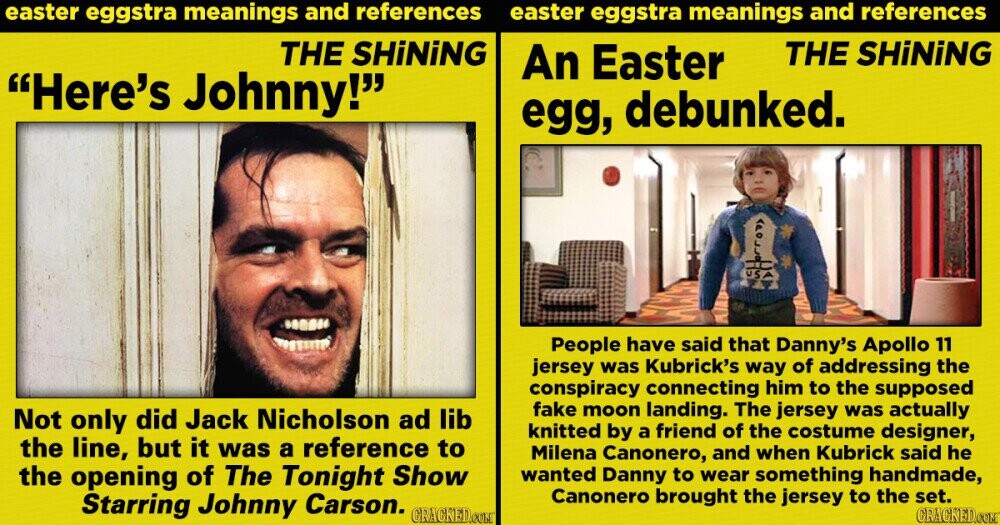
Danny wears an Apollo 11 sweater in one memorable scene, and that image has inspired theories connecting The Shining to the Apollo moon landing. Some viewers argue that Kubrick planted a coded confession about filming a fake moon landing. There is no reliable evidence for that claim.
Still, the shirt is worth noticing because it adds to the film’s interest in childhood, technology, American mythology, and the uneasy collision between wonder and isolation. Danny is a child wearing an emblem of national achievement while walking through a hotel built on secrecy and violence. That contrast is meaningful even without turning the sweater into a NASA subpoena.
14. Native American References Point to a Buried National History
During the job interview, Ullman says the Overlook was built on an “Indian burial ground.” The hotel also includes Native American-inspired décor and imagery. These details have led many critics and viewers to read the film as an exploration of American violence against Indigenous people.
That reading should be handled carefully. The movie does not announce a single official message, and decorative references alone do not prove a complete historical allegory. Yet the details support a broader idea: the Overlook is built upon unresolved harm. The hotel’s luxury depends on forgetting who was displaced, exploited, or destroyed before the party began.
15. The 1921 Photograph Suggests Jack Has “Always” Been There
The final photograph shows Jack at the Overlook Hotel’s July 4th Ball in 1921. It is one of cinema’s greatest final images because it refuses to explain itself neatly. Did Jack travel through time? Was he reincarnated? Did the hotel absorb him after his death? Was he always destined to become part of the Overlook?
Kubrick described the image as suggesting reincarnation, but the ending remains deliberately unsettling. The photograph transforms Jack from a failed writer and violent father into part of the hotel’s permanent collection. He wanted recognition, importance, and a place in history. The Overlook gives him all three, which is why getting exactly what you want has rarely looked so awful.
Why “The Shining” Still Feels So Unsettling
The hidden meanings in The Shining matter because the movie is built to make viewers participate. It does not simply show a haunted hotel; it makes you study carpets, stare at mirrors, question names, and wonder whether a hallway moved while you blinked.
Its most enduring mystery is not whether every theory is correct. Most are not, and some are delightfully wild. The real achievement is that Kubrick created a horror film spacious enough for viewers to get lost inside it. Like the hedge maze, The Shining keeps offering new routes, new dead ends, and the uncomfortable suspicion that the building knows more than you do.
What It Feels Like to Rewatch “The Shining”: A Viewer Experience
Watching The Shining for the first time can feel like entering a haunted house designed by an architect who hates explanations. You recognize the famous moments because pop culture has recycled them for decades: “Here’s Johnny,” the twins, the axe, the redrum mirror reveal. Yet when the movie actually begins, the most surprising thing is how quiet it is.
The opening drive does not rush. The camera floats over mountains while ominous music hums beneath the scenery. The road looks beautiful, but it also feels lonely enough to make a sandwich nervous. By the time Jack reaches the Overlook, the film has already created a sense that the family is moving away from ordinary life and toward something ancient, cold, and patient.
On a rewatch, the experience changes. Instead of waiting only for the famous scares, you begin noticing the small discomforts. Jack is irritated before the hotel has fully worked on him. Wendy laughs nervously even when nothing is funny. Danny seems to understand danger before the adults do. The film becomes less about a sudden transformation and more about a family arriving with existing wounds that the Overlook knows how to widen.
The hotel also feels different each time. At first, it looks enormous and luxurious. Later, it becomes sterile and oppressive. The bright corridors, patterned carpets, gleaming bathrooms, and large windows should make the Overlook feel open. Instead, they make it feel exposed. There is nowhere to hide, but there is also no way to understand where you are.
The scariest scenes are often not the loudest ones. Jack talking quietly to Lloyd can feel more dangerous than an axe attack because you can see him accepting the logic of his own anger. Danny stopping at the end of a hallway is frightening because you know something is waiting, but the movie gives you just enough time to imagine it first. Kubrick understands that anticipation is a monster with excellent posture.
By the final act, the maze chase feels both physical and emotional. Wendy and Danny are running from Jack, but they are also trying to escape the atmosphere of fear that has swallowed the hotel. Danny survives by thinking differently from Jack. He uses memory, patience, and misdirection. Jack uses rage, repetition, and brute force. The maze makes the difference painfully clear.
Then comes the final photograph. After all the running, screaming, snow, and panic, the movie becomes still. That stillness is what lingers. The Overlook has not been destroyed. Its history has not been solved. It has simply added another face to the wall.
Note: This article separates documented production details from interpretive readings. Symbolic theories can deepen a viewing experience, but not every recurring object, number, or visual coincidence should be treated as a confirmed message from Stanley Kubrick.