The Departed is the kind of crime thriller that walks into a room, slams the door, and dares everyone to breathe normally for the next two and a half hours. Directed by Martin Scorsese and released in 2006, the film gave audiences a blistering story of undercover cops, police corruption, Irish-American organized crime, and moral panic in Boston. It also gave movie fans one of the most quotable, tense, and nervy ensemble dramas of the 2000s.
But the movie’s off-screen story is almost as fascinating as the one on screen. From Brad Pitt’s producer role to Jack Nicholson’s unpredictable performance style, from Boston authenticity to Scorsese’s long-awaited Oscar night, The Departed was built from smart adaptation choices, sharp casting decisions, controlled chaos, and a few “only in Hollywood” production twists.
Below are 15 behind-the-scenes facts about The Departed that explain why the film still feels dangerous, funny, stylish, and emotionally wired nearly two decades after its release.
1. The Departed Was Adapted From a Hong Kong Thriller
Before The Departed became Martin Scorsese’s Boston crime epic, its core story came from the 2002 Hong Kong film Infernal Affairs. The original movie followed a similar double-mole setup: one criminal planted inside the police force and one undercover cop embedded in a criminal organization.
What made Scorsese’s version work was not simply copying the structure. Screenwriter William Monahan moved the story into a very specific American world: Boston, class tension, ethnic identity, political corruption, and the psychological pressure of pretending to be someone else for too long. The result was not a pale remake. It was a reinvention with its own accent, attitude, and moral weather system.
2. Brad Pitt Helped Make the Movie Happen
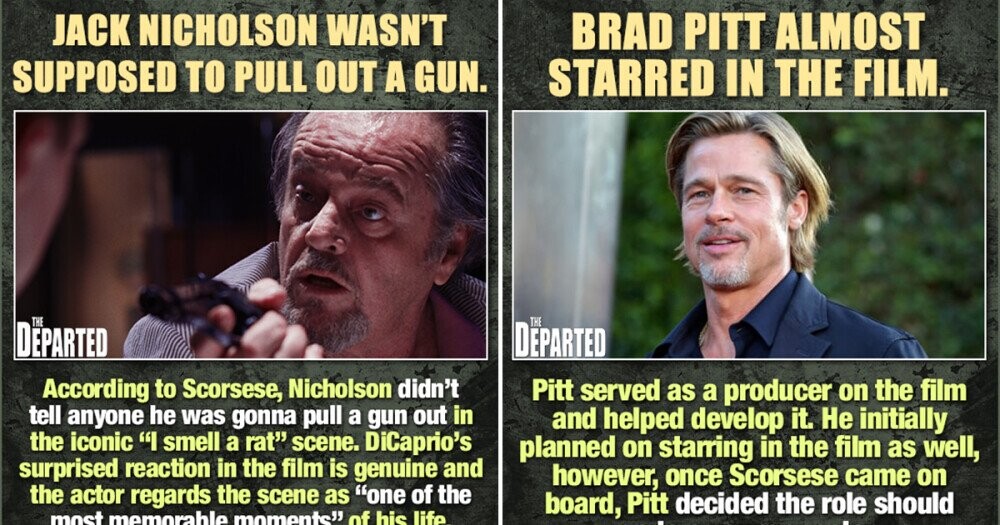
One of the best behind-the-scenes facts about The Departed is that Brad Pitt was central to the project even though he does not appear in the film. Pitt, along with producer Brad Grey and Warner Bros., helped secure the rights to remake Infernal Affairs. His company Plan B Entertainment was involved as a producer.
At one stage, Pitt was expected to act in the film, but he eventually stepped back from starring and remained behind the camera as a producer. That decision helped clear the way for Matt Damon and Leonardo DiCaprio to anchor the movie’s central rivalry. Not a bad trade: Pitt helped launch the machine, then let the younger Boston-versus-Boston chess match take over.
3. Matt Damon’s Boston Roots Became a Major Asset
Matt Damon was not just playing a Boston character; he brought lived-in familiarity to the role of Colin Sullivan. Damon grew up in the Boston area, and that background gave him an instinctive feel for the rhythm, confidence, and social codes of the character.
Sullivan is not a cartoon villain. He is charming, ambitious, disciplined, and morally hollow in a way that makes him more disturbing. Damon’s performance works because he understands the local texture without overplaying it. His Boston accent does not feel like a costume pulled from a drawer labeled “movie tough guy.” It feels like part of the character’s operating system.
4. Leonardo DiCaprio’s Billy Costigan Was Built on Anxiety
Leonardo DiCaprio’s Billy Costigan is a man trapped inside a role that is eating him alive. While Colin Sullivan rises through institutions by lying smoothly, Billy survives by lying desperately. That contrast is the engine of the movie.
Behind the scenes, the performance demanded a different kind of movie-star energy from DiCaprio. He spends much of the film tense, cornered, angry, sleep-deprived, or emotionally exposed. Instead of playing the coolest guy in the room, he plays the guy who looks like the room is shrinking around him. It is one of the reasons The Departed remains so rewatchable: the audience can feel Billy’s cover story becoming heavier in every scene.
5. Jack Nicholson Made Frank Costello More Unpredictable
Jack Nicholson’s Frank Costello is not subtle, and that is exactly the point. He behaves like a man who has spent so long avoiding consequences that reality itself has become optional. Nicholson reportedly brought improvisational energy to the role, pushing Costello into stranger, nastier, and more theatrical territory.
That unpredictability helps the film. Costello is not merely “the mob boss.” He is the wild card in a movie full of professional liars. When he enters a scene, the temperature changes. You never feel completely sure whether he is joking, testing someone, threatening someone, or all three before breakfast.
6. The Movie Drew Inspiration From Real Boston Crime History
The Departed is fictional, but it borrows atmosphere from real Boston crime history, including the shadow of the Winter Hill Gang, Irish-American organized crime, and the notorious relationship between criminal power and compromised law enforcement.
Frank Costello is not a direct biography of one person, but many viewers recognize echoes of Whitey Bulger in the character: a feared Boston crime figure whose connections to federal law enforcement became part of the public record. That real-world influence gives the film extra bite. The movie is not just about criminals hiding from police; it is about systems that become infected from the inside.
7. William Monahan Gave the Script Its Verbal Fireworks
The screenplay by William Monahan is one of the film’s secret weapons. Yes, Scorsese brings the camera movement, music, rhythm, and moral dread. But Monahan gives the characters their verbal knives.
The dialogue in The Departed is profane, funny, aggressive, and weirdly musical. Characters insult each other the way other people shake hands. Almost every conversation is a power contest. Even simple questions feel loaded. That style helps separate the film from generic crime thrillers. The language is not just decoration; it is how the characters defend themselves, attack others, and avoid saying what they really fear.
8. Mark Wahlberg Almost Feels Like He Walked in From Another Movie
Mark Wahlberg’s Staff Sergeant Dignam is one of the film’s most memorable characters, partly because he seems allergic to politeness. Dignam enters scenes like a human fire alarm: loud, useful, and not something you want going off next to your desk.
Behind the scenes, Wahlberg has spoken about tension around the role, including scheduling and appearance issues connected to another film he was preparing for. Yet that friction may have accidentally served the performance. Dignam’s irritation feels radioactive. He is not there to be liked. He is there to smell dishonesty and insult it until it confesses.
9. The Cast Was Ridiculously Stacked
One of the easiest facts to forget about The Departed is just how packed the cast is. Leonardo DiCaprio, Matt Damon, Jack Nicholson, Mark Wahlberg, Martin Sheen, Vera Farmiga, Alec Baldwin, Ray Winstone, Anthony Anderson, and James Badge Dale all show up with real purpose.
The film never feels like a parade of famous faces, though. Each actor has a sharp function. Alec Baldwin gives the movie a blast of institutional sarcasm. Martin Sheen adds warmth and moral weight. Vera Farmiga gives Madolyn Madden intelligence and emotional complexity, preventing the character from becoming merely “the woman between two men.” Ray Winstone brings bruised menace as Mr. French. The ensemble is big, but it is not bloated.
10. Scorsese Used Boston as More Than a Backdrop
Although parts of the movie were filmed in New York as well as Boston, the film’s identity is deeply tied to Boston. The State House, the neighborhoods, the accents, the class signals, the police culture, and the local resentments all matter.
Boston in The Departed is not postcard Boston. It is not just Fenway Park, lobster rolls, and someone yelling “wicked” near a Dunkin’ cup. It is a pressure cooker. The geography reflects hierarchy: who gets access, who gets watched, who gets used, and who gets buried emotionally long before the plot catches up.
11. Michael Ballhaus Helped Give the Movie Its Nervous Look
Cinematographer Michael Ballhaus, a longtime Scorsese collaborator, helped create the film’s clean but tense visual style. The Departed does not look like a gritty handheld documentary. It is sharper, more controlled, and often more elegant than people remember.
That control matters because the story itself is unstable. The camera often lets scenes breathe just long enough for dread to gather. Offices, bars, apartments, rooftops, and briefing rooms become traps. The film looks polished, but the people inside the frame are falling apart. That contrast gives the movie its sleek, anxious flavor.
12. Thelma Schoonmaker’s Editing Was Essential
Thelma Schoonmaker, Scorsese’s legendary editor, won an Academy Award for her work on The Departed. Her editing keeps the film fast without making it feel shallow. The movie runs over two hours, yet it moves like it drank three coffees and heard a rumor.
The structure could have become confusing: two moles, two institutions, multiple handlers, shifting loyalties, secret phone calls, and a pileup of betrayals. Schoonmaker’s editing gives the story clarity and rhythm. She lets the audience understand the game while still feeling the panic of the players. That is not easy. That is craft wearing a very sharp suit.
13. The Ending Was Not Designed for Franchise Comfort
One reason The Departed lands so hard is that it refuses to soften its ending for easy continuation. In later interviews, Scorsese discussed how studio thinking often favors franchise potential, but The Departed closes with a bleak finality that fits its moral universe.
The movie is not interested in leaving every door open for The Departed 2: Still Departing. It follows its characters to the logical end of their choices. That is part of why the final act feels so startling. The film does not reward cleverness, loyalty, or survival instincts in a neat way. It simply shows what happens when everyone has been lying for too long.
14. The Rat Shot Became Instantly Famous
The final image of a rat moving across the balcony railing has become one of the most debated shots in Scorsese’s career. Some viewers love it as a bold visual punchline. Others think it is hilariously on-the-nose, as if the movie leaned into the camera and said, “In case you missed the theme, behold: rat.”
Whether you admire it or roll your eyes at it, the shot is unforgettable. It turns the movie’s language of betrayal into a literal image. Subtle? Not exactly. Memorable? Absolutely. Sometimes cinema does not whisper. Sometimes it sends a rat across the screen and lets everyone argue about it for twenty years.
15. The Departed Finally Won Scorsese His First Oscar for Directing
For decades, Martin Scorsese had been viewed as one of America’s greatest filmmakers, yet the Academy Award for Best Director had famously avoided him. The Departed changed that. At the 79th Academy Awards, the film won Best Picture, Best Director, Best Adapted Screenplay, and Best Film Editing.
The Oscar moment felt bigger than one movie. It was a recognition of Scorsese’s career, but it was also a win for a film that combined entertainment, craft, performance, and old-school genre muscle. Scorsese did not win for a quiet museum piece. He won for a crime movie with teeth.
Why These Behind-The-Scenes Facts Still Matter
The reason these behind-the-scenes facts about The Departed remain interesting is simple: they show how many strong creative choices had to line up. A remake could have been lazy. A Boston crime story could have become cliché. A star-heavy cast could have turned into ego traffic. Instead, the film became a rare studio crime thriller that feels authored, entertaining, and dangerous.
Scorsese understood that the undercover plot was not only about suspense. It was about identity. Billy Costigan and Colin Sullivan are both acting every day, but for opposite reasons. Billy lies to survive and serve the law. Colin lies to rise and protect himself. The movie asks a brutal question: if you perform a false identity long enough, what is left when the performance ends?
That theme is why the movie’s craft choices matter. The editing creates paranoia. The cinematography creates pressure. The dialogue creates combat. The performances create moral confusion. Every part of the film pushes the same idea: everyone is watching everyone, and nobody is clean.
Extra Experience: Rewatching The Departed Like a Film Fan, Not Just a Viewer
Watching The Departed for the first time is usually about plot. You are trying to keep up with Billy, Colin, Costello, Queenan, Dignam, Madolyn, and the question of who knows what. It is a movie that makes you lean forward. The first viewing feels like being handed a police file while someone shakes the table.
But the real pleasure comes on rewatch. Once you know the major turns, you start noticing the smaller choices. Matt Damon’s Colin Sullivan smiles at exactly the wrong moments. He has the confidence of a man who thinks charm is the same thing as character. Leonardo DiCaprio’s Billy Costigan, meanwhile, looks like his nervous system is trying to escape his body. He is not just afraid of being caught; he is afraid that the role he is playing might swallow him whole.
One useful way to experience the movie again is to pay attention to rooms. In The Departed, rooms are never just rooms. Police offices are full of hierarchy. Apartments are full of secrets. Bars are full of tests. Even professional spaces feel unsafe because information is always leaking. Scorsese and Schoonmaker make conversations feel like action scenes. A glance, a pause, or a phone vibration can hit harder than a chase.
Another rewarding rewatch strategy is to follow Dignam. On a first viewing, he can seem like comic relief with a flamethrower vocabulary. On repeat viewings, he becomes more interesting. He is rude, yes, but he may also be one of the few characters who understands the sickness of the system early enough to distrust almost everyone. His insults are not random noise; they are a defensive style. He weaponizes contempt because softness is dangerous in his world.
The film also plays differently if you think about Boston as a character. The city is not presented as a tourist brochure. It is a maze of loyalty, resentment, class performance, and inherited identity. Colin wants to rise above his origins, but he remains chained to the very criminal power that helped him climb. Billy wants to escape the shadow of his family background, but that background is exactly what makes him useful undercover. Both men are trying to outrun where they came from. Neither runs fast enough.
For writers, filmmakers, and serious movie fans, The Departed is a terrific case study in adaptation. The smartest remakes do not merely translate plot. They relocate pressure. Infernal Affairs gave Scorsese and Monahan a brilliant dramatic skeleton, but The Departed adds Boston blood, American institutional rot, Catholic guilt, class anxiety, and a wicked sense of humor. It understands that adaptation is not photocopying. It is transplantation, and the new soil changes the plant.
Finally, the movie is a reminder that popular entertainment can still be formally sharp. The Departed is accessible, funny, tense, and packed with stars, but it is also carefully built. The performances are calibrated. The edits are precise. The music cues have swagger. The jokes are knives. That combination is why the film works for casual viewers and cinephiles at the same time. You can enjoy it as a cracking crime thriller, then revisit it as a master class in pressure, pacing, and performance.
Conclusion
The Departed remains one of the defining crime films of the 2000s because it combines a brilliant premise with fearless direction, razor-edged writing, and a cast that seems to understand exactly what kind of movie they are in. Its behind-the-scenes story reveals a production shaped by smart adaptation, bold casting, Boston authenticity, and Scorsese’s refusal to sand down the rough edges.
From Brad Pitt’s early producing role to Jack Nicholson’s volatile Frank Costello, from William Monahan’s streetwise dialogue to Thelma Schoonmaker’s Oscar-winning edit, every piece helped turn The Departed into more than a remake. It became a loud, stylish, morally bruised American crime classic.