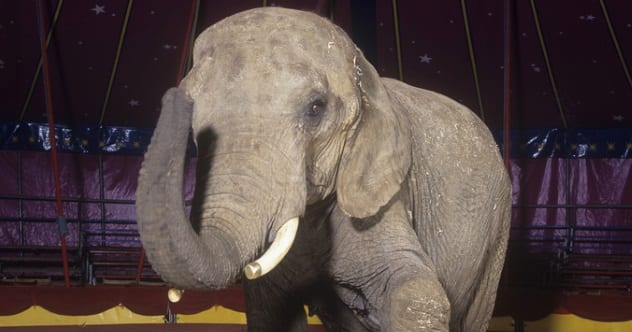
For generations, the circus sold audiences a glittering fantasy: roaring lions, dancing elephants, daring performers, and enough sequins to make the sun feel underdressed. Behind that spectacle, however, were wild animals living in an environment built around transportation schedules, rehearsals, crowds, chains, cages, and human control.
The most tragic circus animal deaths were rarely isolated accidents with simple explanations. Some followed escapes or attacks. Others occurred during transportation, training, or illness. Several became public spectacles of punishment. In many cases, people were also killed or injured, making these stories tragedies for everyone involved rather than easy tales of heroes and villains.
This list is not a mathematical ranking of suffering. It is a historical examination of ten especially heartbreaking cases that changed public attitudes toward performing animals. Because early newspaper accounts were sometimes sensationalized or contradictory, disputed details are identified rather than presented as unquestionable fact.
Heartbreaking Circus Animal Deaths That History Cannot Forget
1. Jumbo: The World-Famous Elephant Killed by a Train
Jumbo was already internationally famous before showman P.T. Barnum purchased him from the London Zoo in 1882. His enormous size helped turn his name into a synonym for anything unusually large. In Barnum’s traveling circus, he became one of the most recognizable animals on Earth.
On September 15, 1885, after a performance in St. Thomas, Ontario, Jumbo and other elephants were being led toward their railroad cars. A freight train entered the rail yard and struck him. Jumbo was mortally injured and died within minutes.
Barnum later promoted a dramatic version in which Jumbo deliberately placed himself in the train’s path to save a younger elephant. Historians have questioned that heroic account, which had all the subtlety of a brass band crashing through a library. The essential fact remains devastating: an animal made famous by constant travel died on the railroad tracks that enabled his endless touring.
2. Topsy: A Death Turned Into Public Entertainment
Topsy was an Asian elephant who spent decades performing with the Forepaugh Circus. Newspapers portrayed her as dangerous after several incidents, including the 1902 death of a spectator who had reportedly entered the elephant area and tormented her.
After being transferred to the unfinished Luna Park at Coney Island, Topsy was declared unmanageable. On January 4, 1903, she was fed poisoned carrots, restrained, and subjected to a powerful electrical current. A film crew from the Edison Manufacturing Company recorded the electrocution.
A popular myth claims Thomas Edison personally arranged Topsy’s death to discredit alternating current during the “War of the Currents.” Rutgers University’s Edison Papers and other historians have explained that Edison was not present and did not organize the execution; the famous electrical rivalry had largely ended years earlier.
Correcting that myth does not make the event less horrifying. Topsy’s death was planned for publicity, witnessed by invited spectators and reporters, and preserved on film. Her final moments became another commercial attraction after her performing career had ended.
3. Mary: The Elephant Hanged From a Railroad Crane
Mary was the star elephant of the Sparks World Famous Shows. In September 1916, the circus hired Walter “Red” Eldridge, an inexperienced worker, to help handle her. During a parade in Kingsport, Tennessee, Mary killed Eldridge. Stories about the precise trigger vary, although several later accounts say he struck or prodded her after she reached for food.
Public anger spread quickly. Communities threatened to prevent the circus from entering unless Mary was killed. Circus owner Charlie Sparks eventually transported her to Erwin, Tennessee, where she was hanged from a railroad derrick before a large crowd.
Some accounts state that the first chain snapped, dropping Mary and severely injuring her before a second attempt killed her. Historians continue to separate documented facts from folklore, but the central horror is undisputed: a captive animal was publicly executed as the circus attempted to preserve its business and calm an outraged public.
4. Black Diamond: Killed by a Firing Squad
Black Diamond was a massive Asian elephant associated with the Al G. Barnes Circus. He was usually restrained between calmer elephants during public appearances because handlers considered him unpredictable.
In October 1929, while the circus was in Corsicana, Texas, Black Diamond attacked and killed Eva Donohoo, who had arrived with his former trainer. The elephant was recaptured, but circus officials decided he could no longer be safely exhibited.
Several proposed methods of killing him were considered before handlers took him to Kenedy, Texas. There, while restrained, he was shot repeatedly by a firing squad. Reports disagree about the exact number of bullets required, but contemporary and later accounts describe multiple volleys before he died.
The circus continued performing during the days between the attack and his execution, benefiting from enormous press attention. Black Diamond’s death therefore became both punishment and promotiona deeply uncomfortable combination that reveals how quickly tragedy could be folded back into the show.
5. Janet: Shot After Bolting With Riders on Her Back
On February 1, 1992, Janet, also known as Janet Kelly, was giving elephant rides at the Great American Circus in Palm Bay, Florida. A woman and several children were reportedly on her back when she suddenly broke through the performance area and ran onto the circus grounds.
The riders were eventually brought to safety, but Janet remained difficult to control. Police officers opened fire after attempts to contain or load her failed. She died from the gunshots.
The incident raised obvious questions about placing members of the publicespecially childrenon a powerful wild animal in a noisy, crowded environment. Janet’s behavior was described at the time as a rampage, yet that word can hide the central problem: humans had created a situation in which fear, confusion, public safety, and animal welfare collided with no peaceful exit available.
6. Tyke: Gunned Down in the Streets of Honolulu
Tyke’s death is among the most widely recorded circus animal tragedies. On August 20, 1994, during a performance at Honolulu’s Blaisdell Arena, the African elephant attacked her groomer and killed trainer Allen Campbell. She then escaped through the arena and ran into the streets of the Kakaako district.
For roughly half an hour, police and emergency personnel attempted to contain her as residents watched from nearby buildings and streets. Officers ultimately fired dozens of bullets. Contemporary reports commonly place the total at 86 shots before Tyke collapsed and died.
There was no happy ending available once a frightened, agitated elephant was loose in a city. Police faced an immediate threat to human life, while Tyke faced the fatal consequence of a system that had transported and displayed her for years. Video of the attack and shooting spread around the world, transforming her into a lasting symbol of the risks associated with wild-animal performances.
7. Kenny: A Sick Young Elephant Who Died After Show Day
Kenny was a three-year-old Asian elephant traveling with Ringling Bros. and Barnum & Bailey Circus. In January 1998, while the show was in Jacksonville, Florida, he was suffering from a serious gastrointestinal illness.
Reporting and federal allegations indicated that Kenny participated in two performances. Although he did not perform in a third show, he was reportedly brought into the arena to watch. He died overnight in his stall.
The U.S. Department of Agriculture accused the circus of failing to provide timely veterinary care and requiring the sick elephant to appear before he could be adequately examined. Ringling representatives maintained that Kenny had been treated and that staff had tried to save him. The case was settled with a $20,000 payment directed toward elephant-related programs.
Kenny’s age makes the case especially painful. He was still a calf, yet his final day was structured around the demands of a touring production rather than the quiet care most people would expect for a critically ill animal.
8. Benjamin: A Young Elephant Who Drowned During a Travel Stop
Benjamin was a four-year-old Asian elephant with Ringling Bros. In July 1999, during a break between performances in Texas, he entered a pond for a recreational swim and drowned.
The circumstances became controversial. Later reporting described a handler using a bullhook when Benjamin would not leave the water. Witness accounts cited by animal-welfare organizations alleged that the young elephant moved farther into the pond while avoiding the handler. Federal officials investigated the incident.
Whatever his exact physical cause of death, Benjamin’s story showed how even an activity described as recreation remained governed by schedules and human commands. A pond that should have provided relief from heat and travel became the site of a young elephant’s final struggle.
9. Clyde: A Young Lion Who Died Crossing the Mojave Desert
Clyde was a two-year-old lion traveling with Ringling Bros. in July 2004. After performing in Phoenix, he was placed aboard the circus train for a journey across the Mojave Desert toward Fresno, California.
Clyde died during the trip. Animal advocates and a former circus employee alleged that the boxcar became dangerously hot and that ventilation and access to water were inadequate. The U.S. Department of Agriculture opened an investigation, while the circus disputed parts of the allegations surrounding the death.
The case drew attention to a side of circus life audiences rarely saw. Animals did not simply appear beneath bright lights and disappear into comfortable bedrooms afterward. They spent long periods in transport enclosures, moving between cities through extreme weather. Clyde survived the ring but not the road to the next performance.
10. Suzy: A Former Circus Tiger Shot After Escaping Transport
Suzy was a six-year-old tiger who had performed with Ringling Bros. After the circus ended its traditional touring production, she remained under the control of a private animal trainer and was being transported through Georgia in September 2017.
Suzy escaped from the transport convoy near Atlanta. She was later seen in a residential area, where she attacked a dog. Police officers shot and killed her after determining that she presented an immediate danger.
Her death occurred outside a circus ring, but it remained connected to the performing-animal industry. Suzy’s life continued to involve long-distance transportation and private ownership even after the show for which she had performed was gone. Her escape was dangerous, the police response was fatal, and the underlying chain of events began long before she entered that neighborhood.
What These Tragic Circus Animal Deaths Reveal
These ten cases span more than a century, yet several patterns repeat. Large wild animals were transported through unfamiliar environments, restrained for public safety, trained to perform unnatural routines, and placed near workers or spectators. When something went wrong, the final response was often lethal.
It is also important not to romanticize attacks that killed people. Trainers, workers, spectators, and bystanders suffered real injuries and deaths. A responsible account must recognize their humanity while also questioning why dangerous situations were created in the first place.
Historical reporting frequently labeled elephants and big cats as vicious, rebellious, mad, or murderous. Those descriptions made exciting headlines, but they encouraged the public to view an animal’s reaction as a moral crime. An elephant cannot understand a trial, a death sentence, a public-relations crisis, or the commercial consequences of refusing to perform.
The greatest lesson is not that certain animals were “bad.” It is that wild-animal entertainment repeatedly placed animals and humans in circumstances where stress, illness, transportation failures, fear, and commercial pressure could become deadly.
A 500-Word Reflection: The Experience of Reconsidering the Circus
Learning about these deaths can produce a strange emotional whiplash, particularly for people who visited animal circuses as children. The memories may still feel warm: the smell of popcorn, the booming music, the impossible size of an elephant seen from the front row. Children were not shown the transport cars, training sessions, veterinary disputes, or hours spent waiting between performances. They saw the polished result. Revisiting that experience as an adult can feel like discovering a hidden hallway behind a familiar stage.
The first reaction is often defensiveness. People may feel that criticism of animal circuses is also criticism of their families, childhoods, or communities. It is not. Most audiences attended because they loved animals, not because they wanted them to suffer. Parents bought tickets hoping to create wonder. The troubling part is that the industry often converted that sincere affection into support for practices the public did not fully understand.
A useful experience is to research one animal beyond the dramatic headline. Tyke was not only the elephant in the frightening street footage. Topsy was not merely an animal in an old electrical film. Jumbo was more than the origin of a popular word. Each had a long life before the final event: years of travel, handling, public display, illness, relationships with keepers, and repeated adaptation to human demands. That wider view replaces spectacle with biography.
Discussing these stories with children also requires care. Graphic details are rarely necessary. A simple explanationthat wild animals have complex needs and can become frightened or distressed when transported and made to performcommunicates the lesson without turning suffering into another form of entertainment. The goal is empathy, not shock.
The experience can also change how people choose entertainment today. Audiences can support circuses centered on acrobatics, comedy, dance, stagecraft, and human skill. They can visit accredited sanctuaries that prioritize lifetime care rather than tricks or close-contact encounters. Before buying a ticket to any animal attraction, visitors can examine how animals are housed, transported, trained, and retired. A smiling advertisement is not an animal-welfare reportmarketing departments tend to leave the complicated footnotes outside the tent.
Finally, these stories invite a healthier way of remembering. The animals should not be reduced to frightening video clips, gruesome trivia, or catchy labels such as “killer elephant.” The humans who died should not be treated as disposable characters either. Remembering responsibly means acknowledging every loss while examining the system that brought animals, employees, police officers, and spectators into preventable conflict.
The circus once asked audiences to believe that controlling a wild animal demonstrated human greatness. These deaths suggest a different standard. Greater wisdom may lie in recognizing when control is neither necessary nor humane. The most respectful tribute to Jumbo, Topsy, Mary, Black Diamond, Janet, Tyke, Kenny, Benjamin, Clyde, and Suzy is not another dramatic show. It is a future in which entertainment no longer requires wild animals to risk their lives for applause.