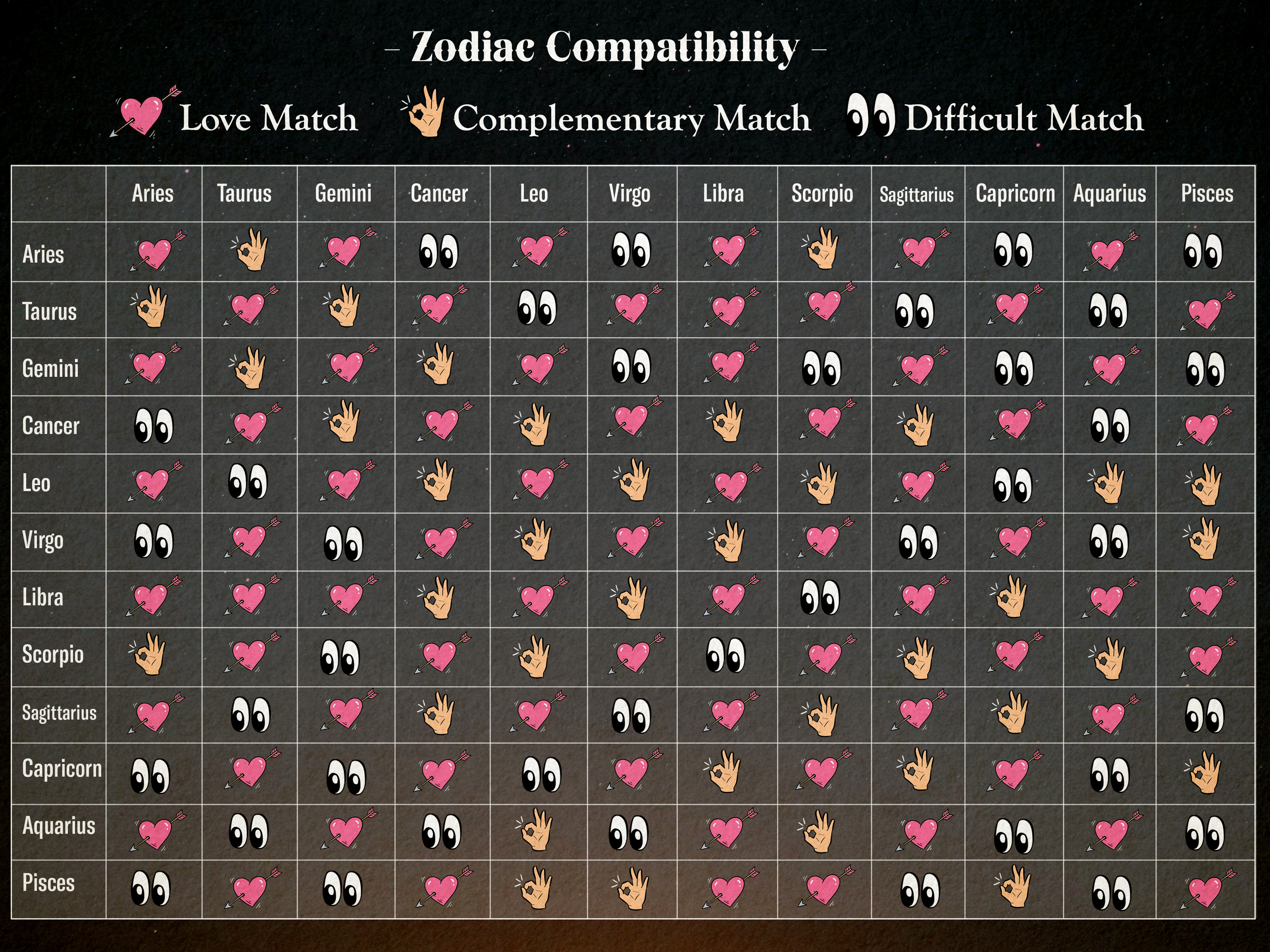
If you have ever asked, “So… what’s your sign?” before you asked for a last name, congratulations: you are keeping an ancient tradition alive. Zodiac compatibility has become part flirting tool, part pop-culture hobby, part late-night group chat sport. One person swears Aries and Leo are a fireworks factory. Another says Scorpio and Taurus are either soulmates or a beautifully dressed disaster. Meanwhile, astrologers everywhere are gently clearing their throats and reminding us that a relationship is more than two sun signs and a prayer.
That is what makes the conversation around zodiac compatibility so entertaining. On one side, you have the crowd wisdom angle: everyday readers, dating veterans, crush survivors, and people who once fell in love with someone solely because they used the right emoji at the right time. On the other side, you have professional astrologers, who tend to say, “Yes, your sun signs matter, but let’s also talk about your Moon, Venus, Mars, rising sign, synastry, and possibly your emotional baggage.” Suddenly the horoscope is not just a vibe. It is a spreadsheet with feelings.
So what happens when wikiHow-style user curiosity meets expert astrology insight? You get a more interesting answer than “This sign good, that sign bad.” You get a layered look at why some zodiac pairings feel effortless, why others feel electric but chaotic, and why supposedly incompatible matches still happen every day. Love, after all, enjoys ignoring neat little boxes. The stars may set the stage, but human beings still improvise.
Why Zodiac Compatibility Fascinates Literally Everyone With a Phone
Zodiac compatibility remains popular because it gives people a language for attraction. Instead of saying, “He texts like a raccoon with Wi-Fi,” astrology lets you say, “He’s an Aquarius with strong air-sign detachment and that explains everything.” It turns confusing chemistry into a story. Humans love stories almost as much as they love overanalyzing messages that ended with a period.
The appeal is not just romantic. Compatibility astrology promises insight into communication styles, emotional rhythms, conflict habits, values, and long-term pacing. In plain English: Are you both obsessed with adventure? Does one of you need reassurance while the other needs space? Is this a candlelit slow burn or a passionate mess that ends with someone posting a gym selfie captioned “growth”?
This is where both readers and astrologers often agree. People are not really searching for a cosmic permission slip. They are looking for patterns. They want to know why certain connections feel easy, why some relationships become a tug-of-war, and why one person feels like home while another feels like a caffeine overdose in human form.
What Astrologers Actually Mean by “Compatibility”
If you only know your sun sign, you know the headline version of your astrology. That matters, but it is not the whole article. Astrologers usually treat zodiac compatibility as a chart-to-chart conversation called synastry. In that framework, your Moon sign describes emotional needs, Venus points to love language and values, Mars reveals passion and pursuit style, and rising signs shape how you move through the world and how others first read you.
That is why two people with “incompatible” sun signs can still get along beautifully. Maybe their Moon signs understand each other. Maybe one person’s Venus lands in a place that makes the other feel adored. Maybe their Mars signs generate chemistry strong enough to power a medium-sized city. Or maybe they are simply mature, self-aware adults, which is not technically astrological, but it certainly helps.
Professional astrologers also pay close attention to aspects and patterns. Conjunctions can intensify attraction. Trines and sextiles often create ease. Squares bring tension, but not always doom. Sometimes tension is productive. Sometimes it turns into growth. Sometimes it turns into “we need to stop choosing the restaurant while hungry.” Again, astrology can explain a lot, but it cannot stop a bad dinner decision.
The Big Three Crowd Favorites: Elements, Opposites, and Vibes
1. Elemental Matches
The easiest entry point into zodiac compatibility is elemental pairing. Fire signs tend to energize air signs. Earth signs often blend smoothly with water signs. These combinations make intuitive sense. Fire and air feed movement, ideas, and momentum. Earth and water support growth, depth, and emotional grounding.
That is why pairings like Aries and Gemini, Leo and Libra, Taurus and Cancer, Virgo and Scorpio, Capricorn and Pisces, or Cancer and Taurus show up again and again in compatibility conversations. The chemistry may show up differently in each pair, but the emotional logic is easy to spot.
2. Opposites Attract
Another favorite? Opposite signs on the zodiac wheel. Aries and Libra. Taurus and Scorpio. Gemini and Sagittarius. Cancer and Capricorn. Leo and Aquarius. Virgo and Pisces. These pairs often fascinate both readers and astrologers because they can balance each other in dramatic ways.
Opposites do not always mean easy. They can mean magnetic, complementary, and slightly chaotic. One partner may bring what the other lacks. One may teach softness, structure, spontaneity, patience, or perspective. These relationships often feel important, even when they are not peaceful. Think less “matching sweaters,” more “same movie, different soundtrack.”
3. Pure Vibe Recognition
And then there is the unofficial category: the pairings people root for because the energy just feels right. Gemini and Aquarius? Banter for days. Scorpio and Pisces? Emotional telepathy with a side of mystery. Leo and Sagittarius? Main-character chemistry. Taurus and Virgo? Two people who probably own excellent blankets and know how to use them.
This “vibe test” is not scientific, but it is real in the way human attraction is real. People notice who feels easy to talk to, who matches their intensity, who shares their pace, and who naturally gets their weird. Astrology simply gives those instincts a symbolic framework.
Classic Zodiac Pairings People Keep Coming Back To
Aries with Leo or Sagittarius
This is the loud laugh table at the restaurant. Aries loves momentum, boldness, and action. Leo brings charisma and romance. Sagittarius adds adventure and honesty. These matches often feel exciting from the jump. The upside is huge energy and mutual enthusiasm. The downside is that nobody wants to be the person who apologizes first.
Taurus with Cancer, Virgo, or Scorpio
Taurus usually wants stability, sensuality, loyalty, and a love that does not feel like a software beta test. Cancer provides warmth and emotional devotion. Virgo adds reliability and practical care. Scorpio, Taurus’s opposite, offers depth, passion, and enough intensity to make the slow-burning Bull suddenly forget how to be chill.
Gemini with Libra or Aquarius
When these air signs click, conversation becomes foreplay, friendship, and survival strategy all at once. Gemini loves movement and mental spark. Libra brings social grace and relational focus. Aquarius contributes originality and big-picture thinking. Together, they can feel endlessly interesting. Their shared weakness? Sometimes too much talking, not enough grounding.
Cancer with Pisces or Capricorn
Cancer and Pisces can feel almost psychically aligned. Both are emotional, intuitive, and tuned into atmosphere. Cancer and Capricorn, by contrast, are opposites who can build something strong: Cancer brings care, Capricorn brings structure. One says, “How do you feel?” The other says, “What is the plan?” Oddly enough, that can be a beautiful duet.
Leo with Libra or Aquarius
Leo loves warmth, appreciation, and a little sparkle. Libra often knows exactly how to make a partner feel admired. Aquarius, Leo’s opposite, challenges Leo intellectually and offers freshness, independence, and vision. One pairing feels glamorous. The other feels electric. Both keep Leo from feeling emotionally underlit, which is very important for the zodiac’s favorite spotlight enthusiast.
Virgo with Taurus, Capricorn, or Pisces
Virgo often shines in relationships that value consistency, effort, and meaningful detail. Taurus and Capricorn understand the language of reliability. Pisces, Virgo’s opposite, brings softness, imagination, and emotional fluidity. That match can be especially compelling because each offers what the other forgets to pack.
When Compatibility Gets Complicated
Not every pairing is breezy. Some matches need more patience, clearer communication, and an industrial-strength sense of humor. Fixed signs can lock horns because nobody wants to budge. Mutable signs can struggle with consistency. Cardinal signs may compete for leadership. And certain elemental combinations can feel like trying to mix a thunderstorm with a filing cabinet.
But difficult does not mean impossible. This is one of the biggest points astrologers keep making. No sign is automatically doomed. A tense pairing may create friction, but friction can also create awareness. The question is not just “Are these signs compatible?” It is “Do these two people know how to work with what they have?”
That distinction matters. A couple with easy synastry can still fail if they avoid conflict or stop showing up for each other. A couple with challenging astrology can thrive if they understand their differences and learn how to meet in the middle. The stars can sketch the blueprint. They do not build the house.
What wikiHow-Style Reader Wisdom Gets Right
Everyday users tend to notice the practical side of compatibility. They care less about jargon and more about lived reality. Who communicates well? Who feels clingy versus loyal? Who turns date night into an adventure? Who remembers to bring snacks, emotional support, and an actual plan?
That reader-centered perspective is useful because relationships are experienced on the ground, not just in a birth chart app. People know when they feel seen. They know when a partner respects their pace. They know when chemistry is amazing but the logistics are a circus. In that sense, crowd wisdom acts like a reality check on abstract astrology.
Readers also tend to understand something experts emphasize: compatibility is not the same as sameness. The best pairings are not always the most identical ones. Sometimes the best match is the person who softens your extremes, steadies your spirals, or coaxes you into growth without making you feel like a fixer-upper project.
How to Use Zodiac Compatibility Without Losing the Plot
Use zodiac compatibility as a tool, not a verdict. Let it spark curiosity instead of panic. If someone’s sun sign looks like a tough match, do not sprint in the opposite direction while yelling “the synastry made me do it!” Look deeper. Ask better questions. Notice how they communicate, repair conflict, show affection, and handle disappointment.
A healthy way to use astrology is to treat it like a personality map with poetic lighting. It can reveal patterns, preferences, blind spots, and strengths. It can help you understand why you need reassurance, why your partner needs space, or why you both think you are “being direct” while absolutely not hearing each other.
An unhealthy way to use it is to excuse bad behavior, avoid accountability, or reduce a whole person to one sign. “Sorry I ghosted you, I’m a Sagittarius” is not relationship wisdom. That is branding.
What Zodiac Compatibility Feels Like in Real Life: Experience-Based Scenarios
Here are the kinds of experiences people often describe when zodiac compatibility actually shows up in day-to-day life. These are not fairy-tale guarantees. They are recognizable patterns, the sort of stories that make people say, “Okay, that was weirdly accurate.”
One common experience is the fire-and-air connection that starts with instant momentum. A Gemini and Leo might meet at a party, spend three hours talking, and somehow end up planning a weekend trip before dessert. The relationship feels bright, funny, fast, and creatively charged. They inspire each other. They also occasionally create chaos together, like two charming gremlins with excellent outfits. Still, the chemistry feels obvious because both people enjoy motion, spontaneity, and mutual hype.
Another experience shows up in earth-and-water pairings. Think Taurus and Cancer, or Virgo and Scorpio. These relationships often do not begin with fireworks. They begin with comfort. One person notices the other remembered their coffee order, checked in after a hard day, or quietly made life easier without announcing it like a TED Talk. Over time, trust builds. The compatibility feels less cinematic and more nourishing. It is the kind of bond that makes people say, “I can finally exhale around you.”
Opposite-sign relationships bring a different flavor altogether. A Libra and Aries pairing, for example, can feel thrilling because each person wakes something up in the other. Libra teaches diplomacy, reflection, and partnership. Aries teaches courage, decisiveness, and honest momentum. The experience can be magnetic, but it usually requires compromise. One wants peace, the other wants progress, and somehow both must learn that a relationship is not a courtroom or a boxing ring. When it works, it works because both grow.
Then there are the so-called “unlikely matches” that make astrologers point to the rest of the chart. Maybe the sun signs look awkward on paper, but the emotional bond is strong because the Moon signs click. Maybe the Venus-Mars chemistry is undeniable. Maybe both people simply learned how to love well. This is a common real-life experience: a couple hears they are astrologically mismatched, shrugs, and then goes home to their beautifully functional relationship. The lesson is simple. Sun-sign chemistry matters, but emotional maturity and deeper chart harmony matter more.
Finally, many people experience compatibility not as instant certainty, but as feeling understood. That may be the most meaningful pattern of all. The best zodiac match is often the person who gets your rhythm, respects your wiring, and does not make you feel like a problem to solve. Whether that comes through shared elements, opposite-sign balance, or a surprisingly strong synastry chart, the lived experience is the same: less confusion, more recognition, and a relationship that feels like both spark and safety.
Final Thoughts
Zodiac compatibility is fun because it lets us talk about attraction with symbols, archetypes, and a little cosmic drama. But the most useful astrology never reduces love to a rigid formula. It suggests possibilities. It highlights patterns. It explains why some couples feel instantly aligned and why others need more intentional effort.
When wikiHow-style user curiosity and professional astrology meet, the takeaway is surprisingly balanced. Yes, some pairings tend to flow more naturally. Yes, elements, opposites, and synastry matter. But no, your relationship is not doomed because one of you is a Scorpio and the other has the texting habits of a mildly distracted Aquarius. Compatibility is not just written in the stars. It is also written in the daily choices two people make.
So ask for the sign. Ask for the birth time if the vibe is right. Read the compatibility article. Laugh at the uncanny parts. Learn from the useful parts. Then remember the most romantic truth of all: even the best chart in the universe still needs two people who know how to care for each other on Earth.