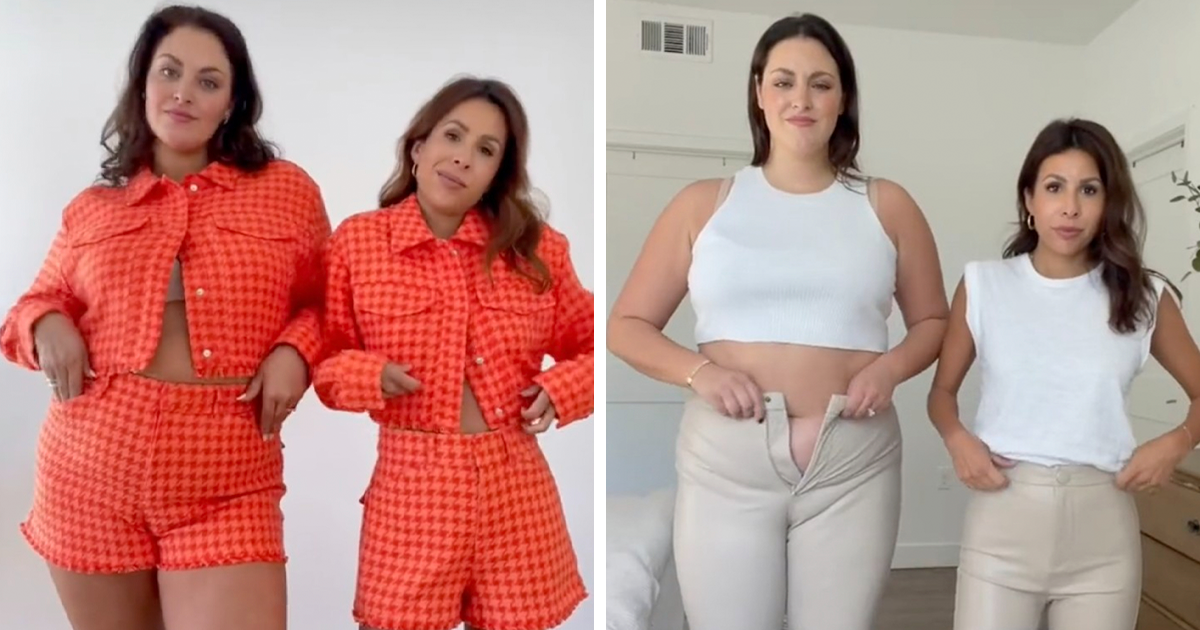
Fashion has always had a flair for drama, but few plot twists are as wild as women wearing the same outfit in XS and XL and somehow both looking like they understood the assignment. Across TikTok, Instagram, and other social platforms, creators have turned the fitting room into a mini social experiment: two women, two different sizes, one identical outfit, and a comment section suddenly rethinking everything it thought it knew about clothing labels.
The trend became especially visible through creators such as Kristina Zias, who wears XL/XXL and often compares outfits with friends who wear smaller sizes. Similar movements, including the popular #StyleNotSize concept from Denise Mercedes and Maria Castellanos, showed audiences that style is not locked behind a number on a tag. And honestly, the tag has been acting suspicious for years.
These viral videos are not just cute fashion content. They expose something shoppers have complained about for decades: women’s clothing sizes are inconsistent, emotionally loaded, and sometimes about as reliable as a weather forecast from a raccoon with Wi-Fi. One store’s XL may fit like another store’s medium. An XS may look relaxed in one brand and painted-on in another. The result is confusion, returns, self-doubt, and a lot of people whispering, “Is it me?” in a fitting room under fluorescent lights.
Why XL And XS Outfit Comparison Videos Went Viral
The appeal is simple: people love seeing real bodies in real clothes. Traditional fashion marketing often shows garments on one model, in one sample size, under lighting so perfect it might have its own agent. Viral XL and XS comparison videos break that spell. They show how the same dress, jeans, blazer, swimsuit, or matching set behaves on different proportions, heights, curves, shoulders, busts, waists, and hips.
That is powerful because shoppers do not buy clothes for mannequins. They buy clothes for school drop-offs, office meetings, brunch, errands, dates, vacations, family photos, and those mysterious Tuesdays when you want to look effortlessly stylish but also spiritually remain in pajamas.
When women compare XL and XS sizes of the same clothes, viewers get a more honest preview. A satin dress may drape beautifully on both bodies but hit at different lengths. A crop top may feel playful on one person and surprisingly modest on another. A pair of jeans may hug the waist on an XS body while revealing that the XL version needed better hip-to-waist grading. Suddenly, the conversation shifts from “Which body fits the outfit?” to “Did the brand design this outfit well for multiple bodies?”
The Real Message: Style Has No Single Size
One reason these videos resonate is that they challenge the old-fashioned idea that certain trends belong only to certain body types. For years, fashion advice columns loved handing out rules: avoid stripes, hide your arms, dress for your shape, wear this but never that. The internet has responded with a collective eye roll and a ring light.
In many viral clips, women wear the same bold outfit side by side: cutout dresses, wide-leg pants, bikinis, oversized blazers, bodycon sets, mini skirts, cargo pants, corset tops, or matching athleisure. The point is not that every item fits every person perfectly. The point is that confidence, styling, and good design matter more than outdated fashion “rules.”
These videos are refreshing because they are not asking one body to become more like another. They are showing that the same fashion idea can translate across bodies. That is a healthier, more useful message than pretending one silhouette is the universal standard. Clothing should adapt to people, not the other way around.
Women’s Clothing Sizes Are Inconsistent For A Reason
Anyone who has ever brought three sizes of the same pants into a fitting room already knows the truth: sizing is chaos wearing a barcode. The problem is not imaginary. Research on women’s apparel sizing has shown that brands use different size charts, different fit models, and different assumptions about body proportions.
Vanity sizing adds another layer. This happens when brands label larger measurements with smaller size numbers to make shoppers feel better about the purchase. In theory, it sounds like a harmless little confidence coupon. In practice, it creates a closet where someone can be a 6, 10, large, small, and “please send help” all in the same afternoon.
Economic research examining American apparel retailers found that women’s sizing differs across market categories. Moderately priced brands may inflate sizes, while luxury brands can run smaller. That helps explain why a shopper may wear a medium in one store, a small in another, and an XL in a designer piece that appears to have been cut for a decorative lamp.
The Fit Model Problem
Many brands build a garment around a fit model, then scale that pattern up or down. This process is called grading. The issue is that bodies do not expand like balloons in perfect mathematical increments. Shoulders, hips, busts, thighs, torsos, and arms all vary independently. A good XL is not simply an XS stretched wider. It needs thoughtful proportions.
That is why some comparison videos are so eye-opening. When the XS and XL versions are made well, both women look comfortable and stylish. When the grading is lazy, the XL version may pull in the chest, gape at the waist, sit strangely at the shoulders, or become shorter than expected. The audience notices immediately. Social media may be chaotic, but it has excellent detective skills when a hemline is suspicious.
Why Representation In Fashion Marketing Matters
These viral videos also highlight a major gap in online shopping: shoppers want to see clothes on bodies that look more like theirs. When a brand sells extended sizes but only shows the item on a smaller model, customers are left guessing. Will the fabric stretch? Will the buttons gap? Will the waistband roll? Will the dress become a tunic? Will the “mini” skirt become a legal document?
Representation is not just a nice bonus. It is practical information. Showing garments on multiple body types helps customers make smarter decisions and reduces frustration. It can also build trust. When a shopper sees the same item on XS, M, XL, 2X, petite, tall, and different body shapes, the brand is basically saying, “We know humans come in more than one template.” Revolutionary? It should not be. Useful? Absolutely.
Recent consumer sizing surveys have shown that many shoppers experience inconsistent sizing across brands and that poor fit can stop people from buying. That means this is not merely a social media complaint. It is a business problem. A dress that looks good on only one body type is not a strategy; it is a missed opportunity with sleeves.
The Body Positivity Angle: A Tag Is Not A Personality Test
The emotional side of sizing is real. Many women have stood in a dressing room and let a number on a tag ruin their mood. That number can feel personal, even though it is often the result of brand choices, pattern decisions, fabric behavior, manufacturing tolerances, and marketing psychology. In other words, the tag is not a moral judgment. It is a tiny rectangle with commitment issues.
Viral XL and XS videos help separate identity from sizing. When viewers see two women enjoying the same outfit in different sizes, the number becomes less important than the fit. Does it feel comfortable? Does it move well? Does it make the wearer want to do a little mirror pose? These are better questions than “What size am I supposed to be?”
This is especially important because size labels can affect self-esteem. Past viral conversations, including posts where women compared drastically different pant sizes that fit similarly, have reminded people that clothing sizes are not consistent enough to define anyone’s worth. The healthiest takeaway is simple: wear the size that fits your body today. The label can sit quietly and mind its own business.
What Brands Can Learn From The Viral XL Vs XS Trend
Brands should pay attention because these videos are basically free customer research wrapped in cute outfits. Every comment section is a focus group. Shoppers are saying what they want clearly: better size charts, honest measurements, diverse models, accurate product photos, and clothing designed for real proportions.
1. Show The Same Item On Multiple Sizes
This is the most obvious improvement. If a dress is sold from XS to 3X, show it on more than one model. Customers should not need to open twelve browser tabs, search TikTok, consult the moon, and read 84 reviews just to know whether a jumpsuit has enough room in the hips.
2. Use Garment Measurements, Not Just Body Measurements
Many size charts list body measurements, but shoppers also need garment measurements. A relaxed blazer, stretchy dress, rigid denim skirt, and ribbed knit top all fit differently. Listing waist, bust, hip, inseam, rise, shoulder width, length, and stretch level can reduce guesswork.
3. Grade Plus Sizes Thoughtfully
Extended sizing should not be an afterthought. A true XL, 1X, 2X, or 3X needs pattern development, fit testing, and fabric choices that work at that size. Simply enlarging a smaller sample can lead to awkward proportions. The viral videos make that visible, sometimes brutally visible. The internet has no mercy for a poorly placed seam.
4. Stop Treating Plus Sizes As Online-Only Extras
Another common frustration is that extended sizes may exist online but not in stores. That sends a message, whether brands intend it or not. Shoppers want the same access, the same fitting-room experience, and the same chance to make an impulse purchase after saying, “I’m just browsing.” Famous last words, by the way.
Why These Videos Are Good For Shoppers
For everyday shoppers, XL and XS comparison videos are useful because they make fashion less mysterious. They offer styling ideas, fit warnings, and reassurance. If the same pants look great on different bodies, a viewer may feel more confident trying them. If the larger size looks poorly constructed, viewers can save their money and their patience.
They also encourage people to shop by measurements and fit rather than emotional attachment to one size. This can make shopping more practical. A person might choose a larger size for comfort, a smaller size for a fitted look, or a different cut entirely. None of those choices say anything about beauty, discipline, value, or style. They say something about fabric, design, and personal preference.
The trend also makes it easier to discuss fashion without shame. Instead of hiding size differences, creators put them on screen and say, “Here we are. Same outfit. Different bodies. Still cute.” That kind of casual confidence can be more persuasive than any polished campaign.
Specific Examples Of The Trend In Action
Kristina Zias’s content became popular because she openly shares her experience as an XL/XXL shopper while trying on stylish pieces with friends of different sizes. The videos are fun, but they are also practical. Viewers can see whether a trend works beyond the sample-size fantasy that still dominates much of fashion advertising.
Denise Mercedes and Maria Castellanos helped popularize a similar idea with #StyleNotSize, often wearing matching outfits to show that fashion can look good across different body types. Their content pushed back against the assumption that certain clothes are reserved for smaller bodies. The outfits are not presented as a competition. They are presented as proof that style can be shared.
Other creators have joined the conversation by comparing jeans, swimsuits, dresses, activewear, workwear, and fast-fashion hauls. The best videos are not about deciding who “wore it better.” That question is tired. The better question is: did the brand make this item well enough for more than one body?
The Business Case For Better Sizing
Better sizing is not only a cultural issue. It is also a business advantage. Poor fit leads to abandoned carts, negative reviews, expensive returns, and lost trust. Online apparel returns are especially painful for retailers because customers often order multiple sizes, keep one, and send the rest back. This practice, sometimes called bracketing, is understandable when sizing is unpredictable. But it creates costs for brands and waste in the supply chain.
If companies want fewer returns, they should not simply blame shoppers. They should make sizing clearer. Better product data, diverse fit models, more accurate size charts, real customer photos, and improved pattern grading can help. The viral XL and XS videos show that shoppers are hungry for transparency. Give them the information and they will reward brands with trust, loyalty, and fewer “why does this fit like a napkin?” reviews.
What Shoppers Can Take Away From The Trend
The biggest lesson is that size labels are tools, not identities. They are supposed to help you find clothes, not assign your place in society. If you need an XL in one brand and a medium in another, congratulations: you have met women’s fashion sizing, the carnival game nobody wins consistently.
Measure your favorite garments at home and compare those numbers to product pages. Read reviews from people who mention height, body shape, fabric stretch, and whether the item runs small or large. Follow creators with body types similar to yours, but also follow people with different bodies to expand your style imagination. Most importantly, choose comfort and confidence over loyalty to a letter.
Personal Experiences And Everyday Lessons From XL And XS Outfit Comparisons
One of the most relatable experiences connected to this trend is the “same store, different reality” moment. A shopper walks into a store believing she knows her size. She grabs jeans, a skirt, and a dress in that size, then enters the fitting room with innocent optimism. Ten minutes later, one item is too tight, one is too loose, and one appears to have been designed for a person with no known human joints. This is when the shopper begins questioning the laws of physics, not her body.
XL and XS comparison videos feel comforting because they show that this confusion is widespread. The problem is not that shoppers are failing fashion. Fashion is often failing shoppers. When two women try the same outfit and both discuss how it fits, the experience becomes less lonely. People in the comments often share stories like, “I own three sizes from the same brand,” or “I thought I was the only one who had to size up two sizes in jeans.” That shared honesty turns frustration into community.
Another common experience is learning that fit preference matters. Some people like oversized shirts, relaxed trousers, and roomy jackets. Others prefer fitted tops, structured dresses, and close-cut denim. Two women may wear the same item differently not because one size is “better,” but because their comfort goals are different. The viral videos normalize that choice. A size is not a trophy. It is a setting, like volume on a speaker. Turn it up or down until it works for you.
These comparisons also teach shoppers to look beyond the front view. A garment can look great standing still, then betray everyone the moment someone sits, walks, bends, reaches, or performs the sacred fitting-room squat test. Videos reveal movement. They show whether pants dig in, whether a dress rides up, whether sleeves restrict motion, or whether fabric becomes sheer under stretch. This is information a still product photo rarely provides.
For many women, the trend also makes shopping more playful again. Instead of entering a store prepared for emotional combat, shoppers can treat sizing like a puzzle. The question becomes, “Which cut works for me?” rather than “What is wrong with me?” That shift matters. Clothes are supposed to serve daily life. They should help people feel present, comfortable, expressive, and ready for whatever the day brings, whether that is a meeting, a coffee run, or a dramatic hallway walk that nobody asked for but everyone deserved.
The best personal lesson from the XL and XS viral trend is this: comparison does not have to be harmful when it is framed with respect. These videos are not about ranking bodies. They are about comparing garment performance. When creators make that clear, the content becomes empowering. It gives viewers permission to enjoy fashion without shrinking themselves, hiding themselves, or apologizing for needing a different size.
And yes, there is still room for humor. Sometimes a dress will fit one person like elegant eveningwear and another like a confused scarf. Sometimes jeans will create a waist gap large enough to store snacks. Sometimes a “one size fits all” label deserves to be laughed out of the room. Humor helps people talk about a frustrating topic without turning it into a personal wound.
Ultimately, women comparing XL and XS sizes of the same clothes have gone viral because the videos are honest, useful, and quietly rebellious. They remind shoppers that bodies are diverse, style is flexible, and brands need to do better. Most of all, they prove that great fashion should not ask, “Are you the right size for this outfit?” It should ask, “Did we make this outfit well enough for you?”
Conclusion
The viral XL and XS outfit comparison trend is more than a social media moment. It is a stylish, funny, and surprisingly powerful critique of women’s clothing sizes. By showing the same clothes on different bodies, creators reveal the gaps in fashion design, the limits of size labels, and the importance of representation. They also offer a more generous way to think about style: not as a number to chase, but as a form of self-expression available to everybody.
For shoppers, the message is practical and freeing. Try the size that fits. Ignore the label drama. Look for brands that respect real proportions. For fashion companies, the message is even clearer: customers are watching, measuring, reviewing, posting, and comparing. Make clothes for real bodies, or prepare to be politely roasted by the internet in excellent lighting.